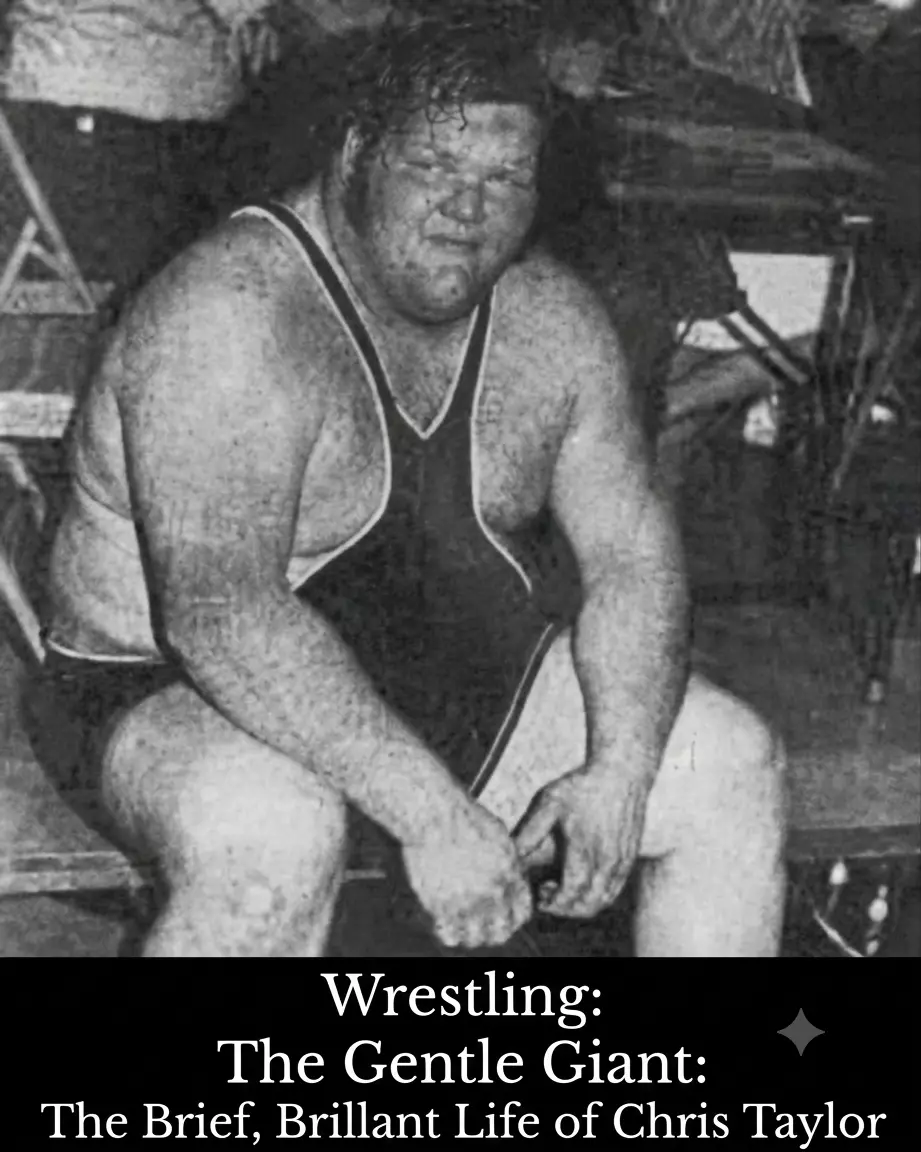
Wrestling: The Gentle Giant: The Brief, Brillant Life of Chris Taylor
The Gentle Giant: The Brief, Brillant Life of Chris Taylor
When sports historians talk about the most physically imposing athletes of the 20th century, names like Wilt Chamberlain or Shaquille O’Neal naturally dominate. Yet, standing right alongside them in sheer physical scale—and athletic dominance—was Christopher J. Taylor. Weighing over 400 pounds and standing 6 feet 5 inches tall, Taylor was a larger-than-life figure who captured the world’s attention at the 1972 Munich Olympics before transitioning into professional wrestling. Though his life was tragically short, his legacy remains permanently etched into the bedrock of American wrestling history.
Early Life and the Making of a Giant
Christopher J. Taylor was born on June 13, 1950, in Muskegon, Michigan. Growth spurts hit Taylor early and dramatically; by the time he enrolled at Dowagiac High School in southwestern Michigan, he was already tracking toward a truly historic frame.
Despite his massive size, Taylor was remarkably light on his feet and possessed a natural agility that surprised coaches. He found his calling on the high school wrestling mats, where his combination of colossal weight and functional athletic flexibility made him an elite heavyweight prospect right out of the gate.
Collegiate Dominance: Muskegon and Iowa State
Taylor’s collegiate career began at Muskegon Community College, where he quickly proved to be a man among boys. His performance caught the eye of legendary Iowa State University wrestling coach Harold Nichols, who recruited the junior college standout to join the powerhouse Cyclones.
At Iowa State, Taylor became a folkstyle wrestling icon. During his two years under Nichols, he went on a legendary run that culminated in back-to-back NCAA Division I Heavyweight Championships:
1972 Championship:
Taylor claimed his first national crown by defeating Greg Wojciechowski of Toledo in College Park, Maryland.
1973 Championship:
He successfully defended his crown the following year in Seattle by defeating Jim Hagen.
Taylor’s collegiate matches were massive spectacles. Opponents simply couldn’t handle his leverage, and his ability to suffocatingly wear down challengers became legendary in Ames, Iowa.
The 1972 Munich Olympics: Controversy and Courage
Following his first NCAA title, Taylor pulled off a rare and incredibly grueling feat for an American heavyweight: he qualified to compete in
both
freestyle and Greco-Roman wrestling at the 1972 Summer Olympics in Munich, Germany. Weighing in at 412 pounds (187 kg), Taylor made history as the heaviest Olympian ever recorded up to that point.
The Freestyle Controversy
In the freestyle tournament, Taylor’s march to gold came down to a highly anticipated clash with the iconic Soviet champion, Aleksandr Medved. The match became one of the most controversial in Olympic history.
Medved appeared visibly exhausted and spent much of the match stalling against the younger, heavier American. However, the referee unexpectedly hit Taylor with a passivity warning and awarded a crucial, decisive point to Medved, giving the Soviet a narrow 3-2 victory. The referee later admitted he felt bad for Medved due to Taylor’s overwhelming size advantage. The international wrestling federation subsequently dismissed the referee from the tournament and banned him from officiating international events—but the decision stood. Taylor gracefully rebounded from the heartbreak to capture the
Olympic Bronze Medal.
The Greco-Roman Highlight
A week later, in the Greco-Roman tournament, Taylor faced West Germany’s Wilfried Dietrich—a man he had already beaten in the freestyle event. In a moment that remains immortalized in wrestling lore, the much lighter Dietrich executed a spectacular, gravity-defying suplex, lifting the 412-pound Taylor off the mat to secure a pinfall. Though Taylor did not medal in Greco-Roman, the imagery of that match became legendary.
Recognizing his mainstream appeal and charisma, legendary promoter Verne Gagne aggressively recruited Taylor into the world of professional wrestling immediately after his collegiate career wrapped up in 1973.
[Trainers]: Verne Gagne & Billy Robinson [Promotion]: American Wrestling Association (AWA) [Debut]: 1973 vs. Rene Goulet
Taylor was formally trained by Gagne and the legendary technical shooter Billy Robinson. He debuted for the American Wrestling Association (AWA) in 1973 to massive fanfare. Because of his background, he didn’t rely on cheap gimmicks; he was presented as a high-level athlete who could legitimately out-grapple anyone.
During his run in the AWA, Taylor was being groomed as a top-tier babyface (hero) and future world champion. He shared the ring with massive stars of the era, including a young, up-and-coming future legend named Ric Flair. Clips of Taylor pushing rookies to their absolute limits are still prominently featured in AWA retrospective documentaries.
Unfortunately, the tremendous physical toll of carrying over 400 pounds began to wear on Taylor’s health. Chronic cardiovascular and respiratory issues severely limited his stamina and mobility. Realizing his body could no longer handle the grueling travel schedule and physical impact of the squared circle, Taylor was forced into an early retirement from professional wrestling in 1977.
Conclusion and Legacy
Just two years after stepping away from the ring, Chris Taylor passed away in his sleep at his home in Story City, Iowa, on June 30, 1979. He was only 29 years old.
Though his life was brief, Taylor left behind an outsized legacy that spanned the amateur, collegiate, Olympic, and professional ranks. He was a gentle giant who paired terrifying physical power with supreme athletic grace. In recognition of his enduring impact on the sport, he was posthumously inducted into:
The
Iowa State Wrestling Hall of Fame
(Class of 2012)
The
National Wrestling Hall of Fame
as a Distinguished Member (Class of 2012)
Chris Taylor remains a definitive proof-of-concept that true giants don’t just occupy space—with the right work ethic, they can reshape an entire sport.
Up To $1500 in Bonus Bets Paid Back if your First Bet Does Not Win
T&Cs apply
4.5/5
Gambling problem? Call 1-800-GAMBLER or 1-800-MY-RESET (Available in the US) 877-8-HOPENY or text HOPENY (467369) (NY) 1-800-327-5050 (MA), 1-800-BETS-OFF (IA), 1-800-981-0023 (PR). 21+ only. Please Gamble Responsibly. See BetMGM.com for Terms. First Bet Offer for new customers only (if applicable). Subject to eligibility requirements. Bonus bets are non-withdrawable. In partnership with Kansas Crossing Casino and Hotel. Promotional offers not available in Mississippi, Massachusetts, New York, Ontario, or Puerto Rico.
New DraftKings Customers: Spend $5+ Get $150 in Bonuses
T&Cs apply
4.5/5
GAMBLING PROBLEM? CALL 1-800-GAMBLER or 1-800-MY-RESET, (800) 327-5050 or visit gamblinghelplinema.org (MA). Please Gamble Responsibly. 888-789-7777/visit ccpg.org (CT), or visit www.mdgamblinghelp.org (MD), 1-800-981-0023 (PR). 21+ and present in most states. (18+ DC/NH/PR/WY). Void in CAN. Eligibility restrictions apply. On behalf of Boot Hill Casino (KS). Pass-thru of per wager tax may apply in IL. 1 per new DraftKings customer. $5+ first-time bet req. Max. $150 issued as non-withdrawable Bonus Bets. Stake removed from payout. Reward issued as $50 in Bonus Bets every 7 days via click-to-claim for 14 days. Bonus Bets and click-to-claims expire 7 days (168hrs) after issuance. Terms: sportsbook.draftkings.com/promos. Ends 10/11/26 at 11:59 PM ET. Sponsored by DK.
Must be 21+. GAMBLING PROBLEM? CALL 1-800-GAMBLER OR CALL 1-800-MY-RESET, www.mdgamblinghelp.org (MD), (800)-327-5050 or gamblinghelplinema.org (MA), Call (877)8-HOPENY or text HOPENY (467369) (NY), (888) 789-7777 or ccpg.org (CT), morethanagame.nc.gov (NC), 1800gambler.net (WV)
Bet $1 and get double the winnings up to $25 for your next 10 bets
T&Cs apply
4.4/5
21+ New users only. Must register using eligible promo code. First bet after registration must qualify. Max. Bonus Bet: $1,000. Bonus Bet expires 14 days after receipt. Void where prohibited. See Caesars.com/promos for full terms. Gambling Problem? 1-800-GAMBLER (1-800-426-2537)
21+ and present in OH. Gambling Problem? Call 1-800-GAMBLER.
This site is using
Cloudflare
and adheres to the
Google Safe Browsing Program. We adapted
Google's Privacy Guidelines
to keep your data safe at all times.
Close
Ready to Win Big? Join the Elite with Our Sports Betting Deals!
FanDuel Promo
New Users – Get $250 in Bonus Bets when you wager $5 for 5 days
Up To $1500 in Bonus Bets Paid Back if your First Bet Does Not Win
Best Slots
T&Cs and 21+ apply
Gambling problem? Call 1-800-GAMBLER or 1-800-MY-RESET (Available in the US) 877-8-HOPENY or text HOPENY (467369) (NY) 1-800-327-5050 (MA), 1-800-BETS-OFF (IA), 1-800-981-0023 (PR). 21+ only. Please Gamble Responsibly. See BetMGM.com for Terms. First Bet Offer for new customers only (if applicable). Subject to eligibility requirements. Bonus bets are non-withdrawable. In partnership with Kansas Crossing Casino and Hotel. Promotional offers not available in Mississippi, Massachusetts, New York, Ontario, or Puerto Rico.
Code:
Open BetMGM
Get Bonus
DraftKings Promo
New DraftKings Customers: Spend $5+ Get $150 in Bonuses
Newcomer
T&Cs and 21+ apply
GAMBLING PROBLEM? CALL 1-800-GAMBLER or 1-800-MY-RESET, (800) 327-5050 or visit gamblinghelplinema.org (MA). Please Gamble Responsibly. 888-789-7777/visit ccpg.org (CT), or visit www.mdgamblinghelp.org (MD), 1-800-981-0023 (PR). 21+ and present in most states. (18+ DC/NH/PR/WY). Void in CAN. Eligibility restrictions apply. On behalf of Boot Hill Casino (KS). Pass-thru of per wager tax may apply in IL. 1 per new DraftKings customer. $5+ first-time bet req. Max. $150 issued as non-withdrawable Bonus Bets. Stake removed from payout. Reward issued as $50 in Bonus Bets every 7 days via click-to-claim for 14 days. Bonus Bets and click-to-claims expire 7 days (168hrs) after issuance. Terms: sportsbook.draftkings.com/promos. Ends 10/11/26 at 11:59 PM ET. Sponsored by DK.
Code:
Open DraftKings
Get Bonus
Find out what the legends have to say about sports this week....