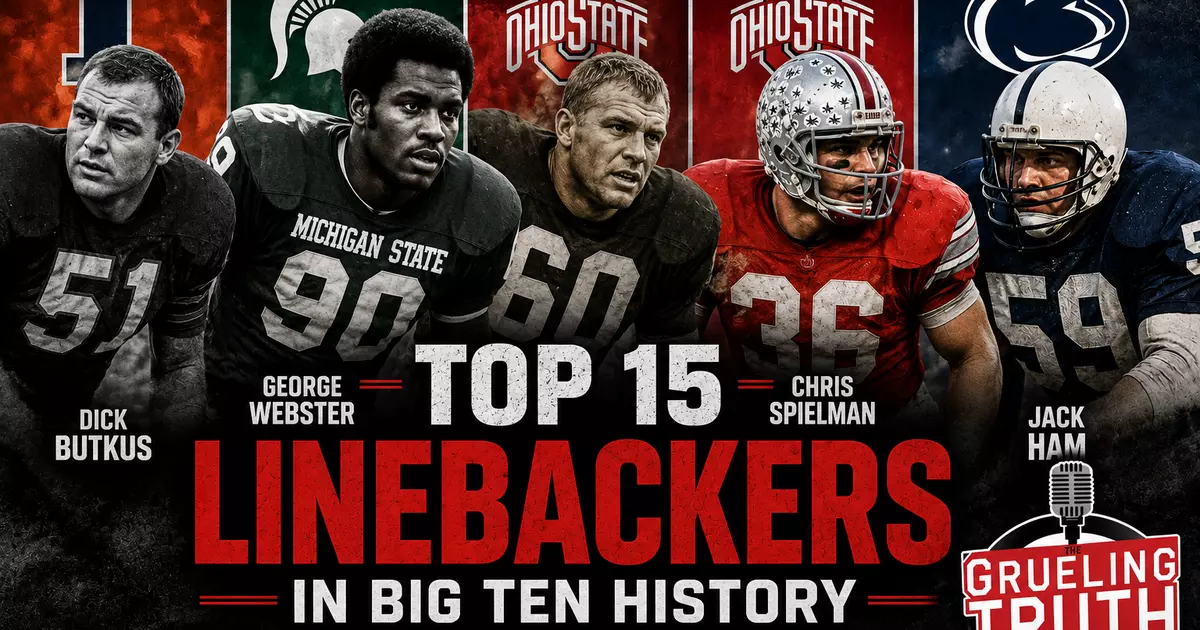
The Big Ten has long been known for producing dominant linebackers. From the bruising defenses of the 1960s and 1970s to the Modern era!
The Big Ten has long been known for producing dominant linebackers. From the bruising defenses of the 1960s and 1970s to the speed and athleticism of the modern era, no conference has consistently developed more elite linebackers. These players defined games with punishing hits, relentless tackling, leadership, and championship performances. This ranking is based primarily on their college careers, taking into account All-American honors, conference awards, impact on winning, individual dominance, and overall legacy.
T15. Larry Station-Iowa
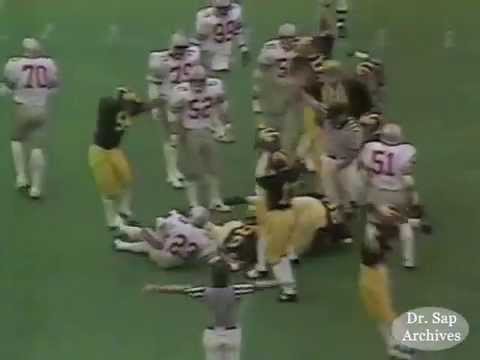
Larry Station was the centerpiece of Iowa’s outstanding defenses during the 1980s under Hayden Fry. A four-year starter, Station led the Hawkeyes in tackles every season of his career, a remarkable accomplishment in one of college football’s toughest conferences. He earned First-Team All-Big Ten honors three consecutive years and was a two-time consensus All-American. Station helped lead Iowa to the 1985 Big Ten championship while becoming one of the most productive defensive players in school history. His instincts, tackling ability, and leadership made him one of the nation’s most respected linebackers. Few players have ever enjoyed a more consistent collegiate career than Station, who remains one of the greatest defensive players Iowa has ever produced.
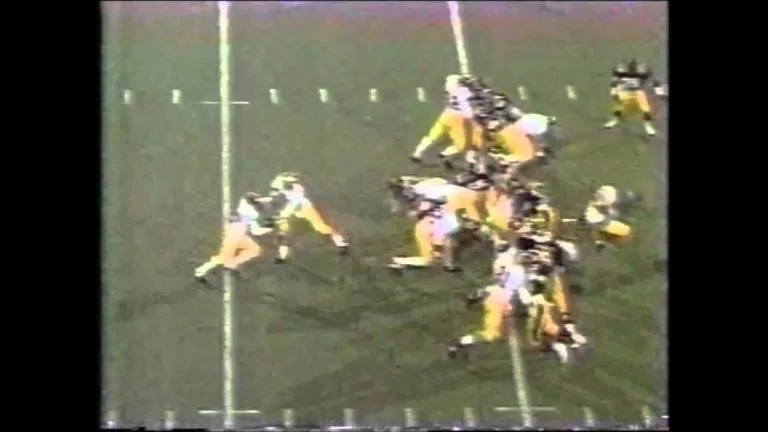
Larry Station tackles Jamie Morris, 1985 #1 Iowa vs. #2 Michigan
T15. Carl Banks – Michigan State
Before becoming a two-time Super Bowl champion with the New York Giants, Carl Banks established himself as one of Michigan State’s finest linebackers. Banks possessed exceptional athleticism for his size and could defend both the run and pass at a high level. His versatility made him invaluable in the Spartans’ defense, and his physical style intimidated opposing offenses. Banks developed into an elite NFL player, but his collegiate career was equally impressive. He helped Michigan State remain competitive during a difficult era while proving himself as one of the conference’s most complete linebackers. His combination of speed, strength, and football intelligence earns him a place among the Big Ten’s all-time greats.
Former Spartan Carl Banks Talks Michigan State Playing Days | CampusInsiders
14. Ron Simpkins–Michigan
Ron Simpkins was one of
Bo Schembechler’s
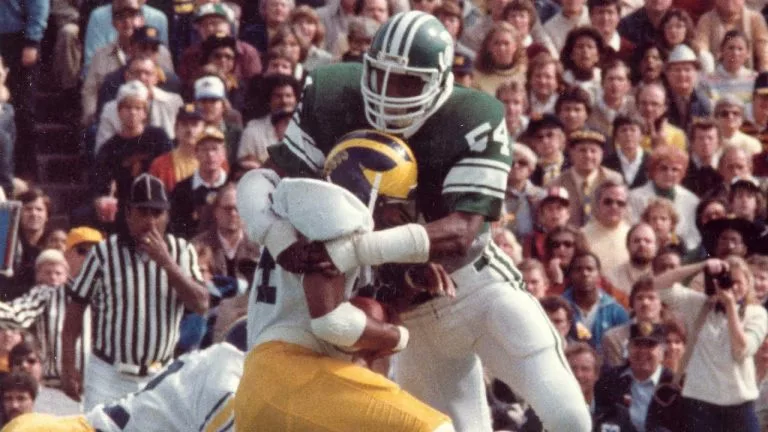
toughest defensive leaders during the late 1970s. A consensus All-American in 1979, Simpkins embodied Michigan football with his relentless motor, physical tackling, and leadership. He anchored one of the nation’s best defenses while helping the Wolverines remain a perennial Big Ten championship contender. Simpkins excelled at diagnosing plays before they developed and consistently delivered big hits that changed momentum. His impact extended beyond statistics, as teammates fed off his intensity and work ethic. Few linebackers represented Michigan’s defensive tradition better than Simpkins.
1977 Ohio State Michigan Ron Simpkins Fumble Recovery
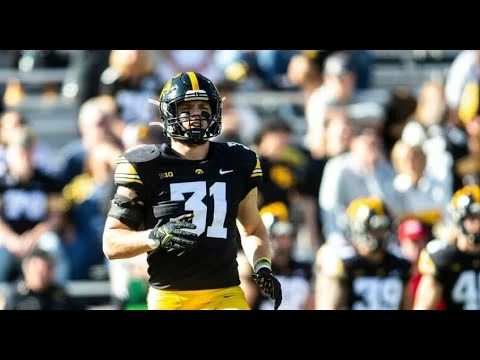
13. Jack Campbell–Iowa
Jack Campbell became the modern standard for Iowa linebackers. During his senior season in 2022, Campbell won the Butkus Award as the nation’s top linebacker while earning unanimous All-American honors. He finished his Hawkeye career with more than 300 tackles, demonstrating remarkable consistency and durability. Campbell excelled in pass coverage, run defense, and leadership, helping Iowa field one of the nation’s elite defenses. His football IQ allowed him to diagnose plays instantly, and his sure tackling rarely allowed opponents extra yardage. Campbell left Iowa as one of the greatest linebackers in school history and immediately became a first-round NFL Draft selection.
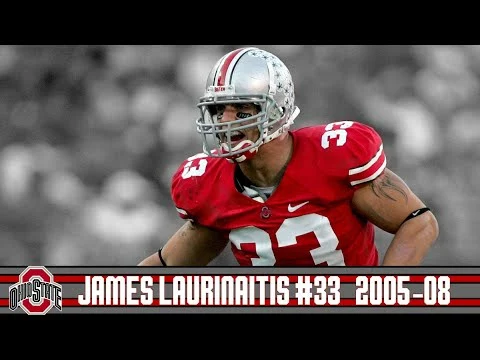
James Laurinaitis enjoyed one of the most decorated careers in Ohio State history. A three-time All-American, Laurinaitis won the Butkus Award, Nagurski Trophy, Lott Trophy, and multiple Big Ten Defensive Player of the Year honors while leading the Buckeyes to multiple conference championships and two national championship appearances. Nicknamed “The Animal,” Laurinaitis combined exceptional instincts with elite leadership and remarkable consistency. Few linebackers have ever collected as many individual awards while serving as the unquestioned leader of one of college football’s premier programs.
James Laurinaitis | Ohio State Highlights
11. Pat Fitzgerald – Northwestern
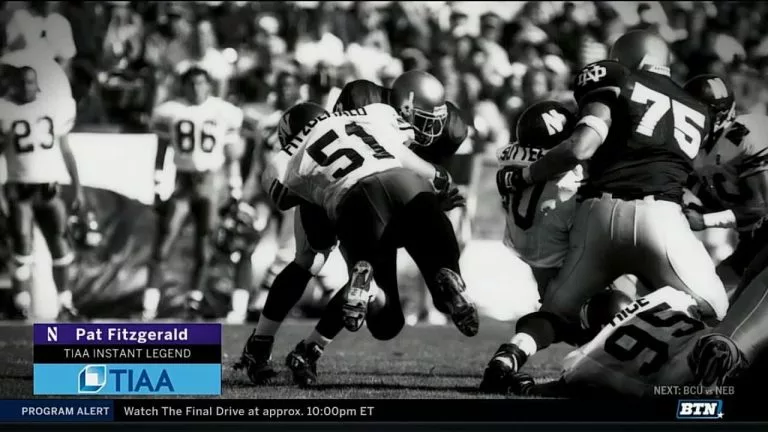
Before becoming Northwestern’s legendary head coach, Pat Fitzgerald was one of the greatest linebackers in college football history. He won the Bronko Nagurski Trophy twice, an unprecedented accomplishment, while helping lead Northwestern to a Big Ten championships after decades of futility. Fitzgerald possessed outstanding instincts and consistently found the football. His leadership helped transform one of the conference’s worst programs into a championship contender. No player better symbolizes Northwestern football than Fitzgerald.
Instant Legend: Pat Fitzgerald | Northwestern | Big Ten Football | BTN Tailgate
10. LaVar Arrington – Penn State
Although his Penn State career lasted only three seasons, LaVar Arrington became one of the most feared defenders in college football. His combination of speed, explosiveness, and power revolutionized the outside linebacker position. Arrington’s famous leap over the offensive line against Illinois remains one of the most iconic defensive plays in college football history. A unanimous All-American and Butkus Award winner, Arrington’s impact went far beyond statistics. He could rush the passer, stop the run, and cover receivers with equal effectiveness. Few linebackers have ever possessed his rare athletic ability.
#Throwback | LaVar Arrington | Penn State | Highlights
9. Tom Cousineau – Ohio State
Tom Cousineau entered Ohio State as one of the nation’s most celebrated recruits and exceeded every expectation. A two-time consensus All-American, Cousineau combined elite athletic ability with textbook tackling fundamentals. He became one of Woody Hayes’ greatest defensive players while leading the Buckeyes to multiple Big Ten championships. Cousineau’s sideline-to-sideline range allowed him to dominate both inside and outside runs, and his leadership made Ohio State’s defense one of the nation’s best throughout his career. His collegiate résumé remains among the finest in Buckeye history.
The Legend of Tom Cousineau
8. Chris Spielman – Ohio State
Chris Spielman embodied everything great about Big Ten football. A three-time All-American and Lombardi Award winner, Spielman played with unmatched intensity and relentless effort. He seemed to make every important tackle and consistently elevated Ohio State’s defense with his leadership. His combination of instincts, physicality, and football intelligence made him one of the most complete linebackers in college football history. Spielman remains one of the most beloved Buckeyes ever to wear the scarlet and gray.
Chris Spielman | Ohio State Highlights
7. Shane Conlan – Penn State
Shane Conlan anchored
Penn State’s
national championship defense in 1986 and earned consensus All-American honors during one of the greatest seasons by a linebacker. His instincts, tackling, and leadership helped Penn State upset Miami in the Fiesta Bowl to win the national title. Conlan excelled in every phase of defense and consistently made game-changing plays. His performance on the biggest stage cemented his legacy as one of the greatest linebackers ever to play for the Nittany Lions.
Linebacker U Penn State Shane Conlan blows up the Sooners
6. Andre Tippett – Iowa
Andre Tippett earned his place among the top 15 linebackers in Big Ten history by becoming one of the most dominant defensive players ever to wear an Iowa uniform. A two-time First-Team All-Big Ten selection, Tippett was the leader of Hayden Fry’s revitalized Hawkeye program and helped transform Iowa into a national contender in the early 1980s. Blessed with exceptional speed, strength, and relentless pursuit, Tippett excelled as both a run stopper and an elite pass rusher long before edge defenders became a featured position. His ability to consistently disrupt opposing offenses made him one of the most feared defenders in the conference. Tippett capped his collegiate career by earning consensus All-American honors in 1981, the same season Iowa captured its first Big Ten championship in over two decades and earned a trip to the Rose Bowl. He later enjoyed a Hall of Fame career with the New England Patriots, but his dominance at Iowa alone secures his legacy as one of the greatest linebackers in Big Ten history.
Lessons from Legends Ep. 11 Featuring Andre Tippett | Class of 2021 | University of Iowa
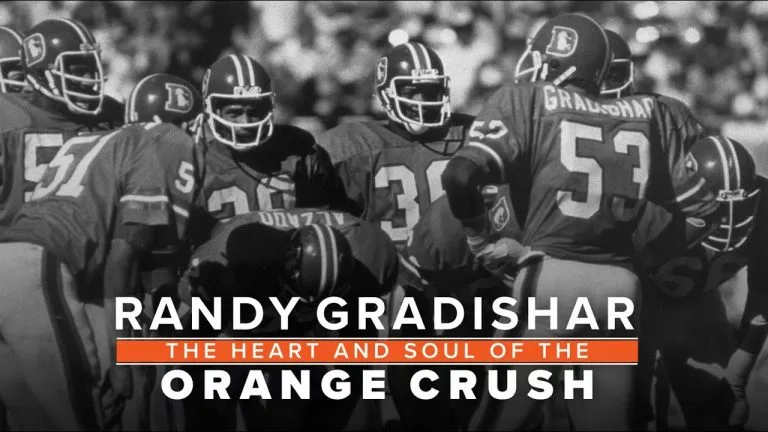
5. Randy Gradishar – Ohio State
Woody Hayes once called Randy Gradishar the greatest linebacker he ever coached, an extraordinary compliment considering Ohio State’s history. Gradishar was a two-time All-American who finished sixth in the Heisman Trophy voting in 1973, an almost unheard-of accomplishment for a linebacker. He led one of the greatest Buckeye defenses ever assembled while helping Ohio State win multiple Big Ten championships. His tackling ability, leadership, and intelligence made him nearly impossible to block.
Randy Gradishar: The Heart and Soul of the Orange Crush | Full Documentary
4. Jack Ham – Penn State
Although Penn State was independent during Jack Ham’s playing days, the Nittany Lions are now a proud member of the Big Ten, and Ham remains one of the greatest linebackers ever produced by any current conference school. A consensus All-American, Ham combined incredible instincts with flawless technique and exceptional athleticism. He later became one of the NFL’s greatest linebackers with the Pittsburgh Steelers’ Steel Curtain defense. His collegiate dominance alone earns him a place in the top five.
Linebacker U Penn State Tradition Jack Ham as a Steeler
3. Ray Nitschke – Illinois
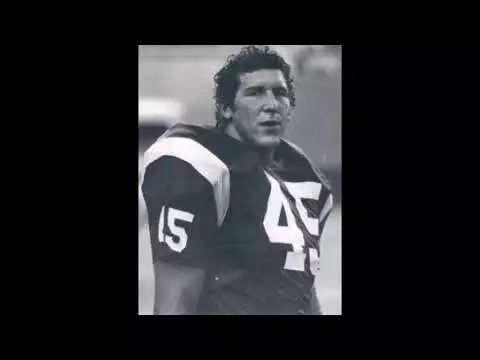
Before becoming a Green Bay Packers legend, Ray Nitschke starred at Illinois, where he established himself as one of the toughest defenders of his era. His aggressive, intimidating style helped define the linebacker position. Nitschke excelled at stopping the run and brought unmatched physicality to every game. His influence on defensive football extended far beyond his playing days, and his collegiate achievements remain among Illinois’ greatest.
Ray Nitschke run
2. George Webster – Michigan State
George Webster wasn’t just one of the greatest linebackers in Big Ten history—he changed the way the position was played. Under legendary coach Duffy Daugherty, Webster became the prototype for the modern “roverback,” a hybrid linebacker and defensive back capable of covering receivers, stopping the run, and rushing the passer. His rare combination of size, speed, and instincts made him nearly impossible for offenses to account for. Webster earned consensus All-American honors in both 1965 and 1966 while leading Michigan State to consecutive Big Ten championships and national championship-caliber seasons. Daugherty once famously said, “George doesn’t tackle people—he explodes them,” a fitting description of Webster’s intimidating style of play. His No. 90 became just the second jersey retired in Michigan State football history, and he was inducted into the College Football Hall of Fame in 1987. Webster’s impact extended far beyond statistics; he revolutionized defensive football and remains one of the most influential linebackers the college game has ever seen
George Webster MSU Hall of Fame induction speech 1992 football
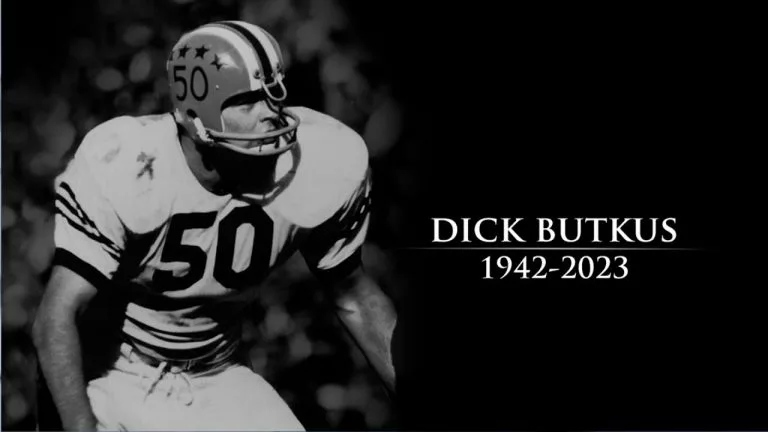
1. Dick Butkus – Illinois
No linebacker in
Big Ten history
changed the game more than Dick Butkus. He was the most dominant defensive player of his generation and remains the face of linebacker play more than 60 years later. Butkus combined ferocious tackling, elite instincts, remarkable leadership, and unmatched intimidation into one complete package. His Illinois teams won the 1963 Big Ten championship and Rose Bowl, while he captured virtually every major honor available. His legacy has endured through the Butkus Award and his place among college football’s greatest players. Simply put, there has never been a better linebacker in Big Ten history.
Remembering Illinois & NFL Legend Dick Butkus | The B1G Show
Up To $1500 in Bonus Bets Paid Back if your First Bet Does Not Win
T&Cs apply
4.5/5
Gambling problem? Call 1-800-GAMBLER or 1-800-MY-RESET (Available in the US) 877-8-HOPENY or text HOPENY (467369) (NY) 1-800-327-5050 (MA), 1-800-BETS-OFF (IA), 1-800-981-0023 (PR). 21+ only. Please Gamble Responsibly. See BetMGM.com for Terms. First Bet Offer for new customers only (if applicable). Subject to eligibility requirements. Bonus bets are non-withdrawable. In partnership with Kansas Crossing Casino and Hotel. Promotional offers not available in Mississippi, Massachusetts, New York, Ontario, or Puerto Rico.
New DraftKings Customers: Spend $5+ Get $150 in Bonuses
T&Cs apply
4.5/5
GAMBLING PROBLEM? CALL 1-800-GAMBLER or 1-800-MY-RESET, (800) 327-5050 or visit gamblinghelplinema.org (MA). Please Gamble Responsibly. 888-789-7777/visit ccpg.org (CT), or visit www.mdgamblinghelp.org (MD), 1-800-981-0023 (PR). 21+ and present in most states. (18+ DC/NH/PR/WY). Void in CAN. Eligibility restrictions apply. On behalf of Boot Hill Casino (KS). Pass-thru of per wager tax may apply in IL. 1 per new DraftKings customer. $5+ first-time bet req. Max. $150 issued as non-withdrawable Bonus Bets. Stake removed from payout. Reward issued as $50 in Bonus Bets every 7 days via click-to-claim for 14 days. Bonus Bets and click-to-claims expire 7 days (168hrs) after issuance. Terms: sportsbook.draftkings.com/promos. Ends 10/11/26 at 11:59 PM ET. Sponsored by DK.
Must be 21+. GAMBLING PROBLEM? CALL 1-800-GAMBLER OR CALL 1-800-MY-RESET, www.mdgamblinghelp.org (MD), (800)-327-5050 or gamblinghelplinema.org (MA), Call (877)8-HOPENY or text HOPENY (467369) (NY), (888) 789-7777 or ccpg.org (CT), morethanagame.nc.gov (NC), 1800gambler.net (WV)
Bet $1 and get double the winnings up to $25 for your next 10 bets
T&Cs apply
4.4/5
21+ New users only. Must register using eligible promo code. First bet after registration must qualify. Max. Bonus Bet: $1,000. Bonus Bet expires 14 days after receipt. Void where prohibited. See Caesars.com/promos for full terms. Gambling Problem? 1-800-GAMBLER (1-800-426-2537)
21+ and present in OH. Gambling Problem? Call 1-800-GAMBLER.
This site is using
Cloudflare
and adheres to the
Google Safe Browsing Program. We adapted
Google's Privacy Guidelines
to keep your data safe at all times.
Close
Ready to Win Big? Join the Elite with Our Sports Betting Deals!
FanDuel Promo
New Users – Get $250 in Bonus Bets when you wager $5 for 5 days
Up To $1500 in Bonus Bets Paid Back if your First Bet Does Not Win
Best Slots
T&Cs and 21+ apply
Gambling problem? Call 1-800-GAMBLER or 1-800-MY-RESET (Available in the US) 877-8-HOPENY or text HOPENY (467369) (NY) 1-800-327-5050 (MA), 1-800-BETS-OFF (IA), 1-800-981-0023 (PR). 21+ only. Please Gamble Responsibly. See BetMGM.com for Terms. First Bet Offer for new customers only (if applicable). Subject to eligibility requirements. Bonus bets are non-withdrawable. In partnership with Kansas Crossing Casino and Hotel. Promotional offers not available in Mississippi, Massachusetts, New York, Ontario, or Puerto Rico.
Code:
Open BetMGM
Get Bonus
DraftKings Promo
New DraftKings Customers: Spend $5+ Get $150 in Bonuses
Newcomer
T&Cs and 21+ apply
GAMBLING PROBLEM? CALL 1-800-GAMBLER or 1-800-MY-RESET, (800) 327-5050 or visit gamblinghelplinema.org (MA). Please Gamble Responsibly. 888-789-7777/visit ccpg.org (CT), or visit www.mdgamblinghelp.org (MD), 1-800-981-0023 (PR). 21+ and present in most states. (18+ DC/NH/PR/WY). Void in CAN. Eligibility restrictions apply. On behalf of Boot Hill Casino (KS). Pass-thru of per wager tax may apply in IL. 1 per new DraftKings customer. $5+ first-time bet req. Max. $150 issued as non-withdrawable Bonus Bets. Stake removed from payout. Reward issued as $50 in Bonus Bets every 7 days via click-to-claim for 14 days. Bonus Bets and click-to-claims expire 7 days (168hrs) after issuance. Terms: sportsbook.draftkings.com/promos. Ends 10/11/26 at 11:59 PM ET. Sponsored by DK.
Code:
Open DraftKings
Get Bonus
Find out what the legends have to say about sports this week....