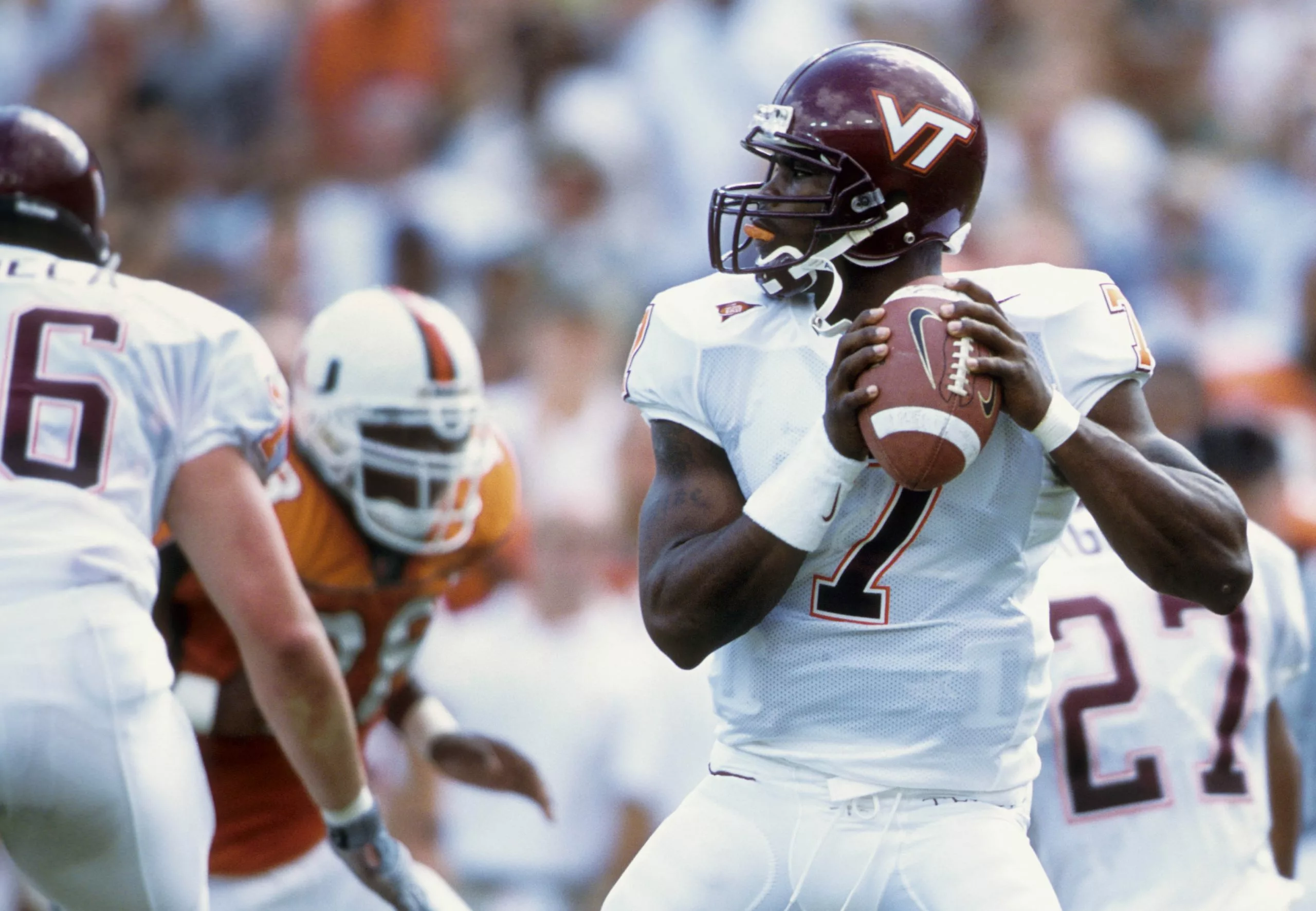
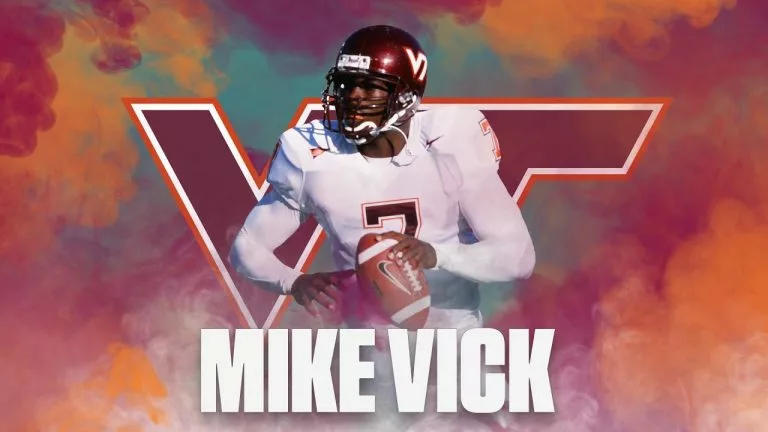
Nov 4, 2000; Miami, FL, USA: FILE PHOTO; Virginia Tech Hokies quarterback Michael Vick (7) in action against the Miami Hurricanes at the Orange Bowl. Mandatory Credit: USA TODAY Sports
Virginia Tech football built its identity differently than most major programs.
The Hokies weren’t created through five-star hype or blueblood prestige. They were built through defense, special teams, toughness, and players who developed into absolute monsters under Frank Beamer and Bud Foster. Lane Stadium became one of college football’s most intimidating environments because Virginia Tech teams played with relentless aggression and physicality.
This program produced legendary pass rushers, elite defensive backs, explosive quarterbacks, and some of the fiercest defenses college football has ever seen.
This list isn’t just about statistics.
It’s about impact, legacy, and the players who made Virginia Tech nationally relevant.
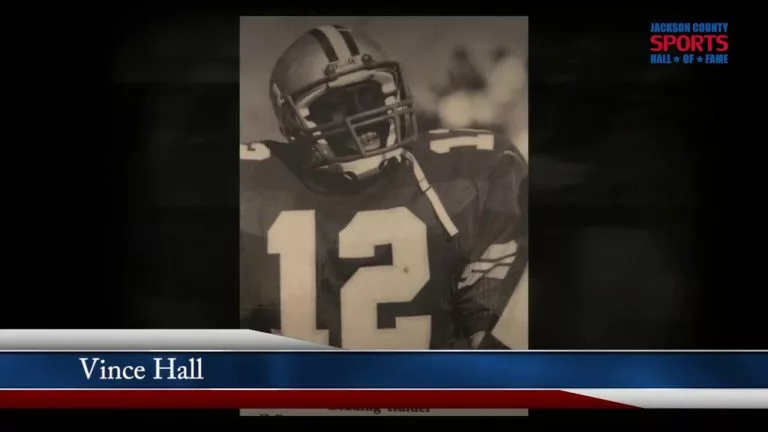
10) Vince Hall – LB
Vince Hall perfectly embodied what Bud Foster wanted from a linebacker.
Toughness. Intelligence. Relentless effort.
Hall wasn’t the biggest linebacker physically, but once the ball was snapped, size stopped mattering. He diagnosed plays instantly, attacked downhill, and became the emotional centerpiece of some of the greatest defenses in
Virginia Tech history.
From 2005 through 2007, the Hokies fielded defenses that terrorized offenses weekly, and Hall was at the center of everything. He piled up tackles at an absurd rate while consistently making the right read in Foster’s aggressive defensive system.
What made Hall special was discipline.
Virginia Tech’s defenses demanded precision because one mistake could destroy the entire scheme. Hall rarely made mistakes. Coaches trusted him completely because he understood angles, leverage, and assignments at an elite level.
His NFL career never fully materialized because of size concerns, but college football isn’t judged by combine measurements.
At Virginia Tech, Vince Hall played championship-level football.
And Hokie fans still remember exactly how dominant he was.
Vince Hall
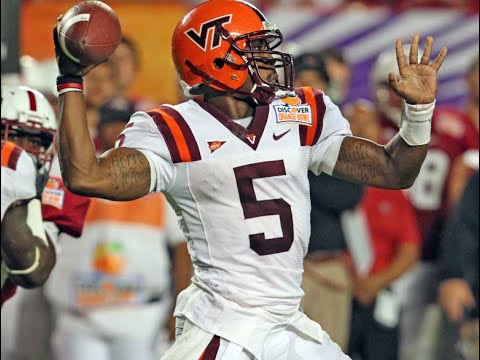
9) Tyrod Taylor – QB
Tyrod Taylor brought electricity to Virginia Tech football.
Every time he touched the football, Lane Stadium felt like it could explode.
Taylor arrived in Blacksburg carrying massive recruiting expectations, and eventually he became one of the most dynamic quarterbacks in school history. His combination of speed, arm strength, and improvisation gave Virginia Tech an offensive weapon defenses simply struggled to contain.
What separated Taylor from many dual-threat quarterbacks was growth.
Early in his career, he relied heavily on athleticism, but by his junior and senior seasons, he had evolved into a complete quarterback capable of dissecting defenses through the air as well. His 2010 ACC Player of the Year campaign showcased just how dangerous he had become.
And most importantly?
Virginia Tech won big with him.
Three BCS bowl appearances during his four seasons proved his ability to lead elite teams consistently.
Taylor wasn’t just exciting.
He gave Virginia Tech an offensive ceiling the program rarely reached before his arrival.
And when games got chaotic, he was usually at his best.
Tyrod Taylor Virginia Tech Highlights
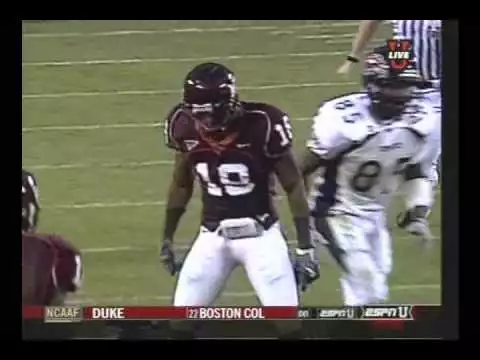
8) Brandon Flowers – CB
Virginia Tech became known nationally for producing elite defensive backs, and Brandon Flowers helped establish that reputation.
Flowers wasn’t the tallest cornerback, but he compensated with physicality, instincts, and toughness that few defensive backs could match. Wide receivers hated lining up against him because he challenged every route aggressively and tackled like a linebacker once the ball was caught.
That’s what separated him.
Flowers didn’t just cover.
He punished.
Under Bud Foster’s defense, Flowers developed into one of the best all-around corners in college football, earning All-American honors before eventually becoming a Pro Bowl player in the NFL.
What made him especially valuable was consistency. Virginia Tech’s aggressive defensive schemes demanded corners capable of surviving on islands in man coverage, and Flowers handled that responsibility constantly against elite competition.
He played with swagger, confidence, and edge—everything Hokie football represented during that era.
And while Virginia Tech produced many outstanding defensive backs, few were more complete than Brandon Flowers.
Brandon Flowers BIG HIT baby!!!
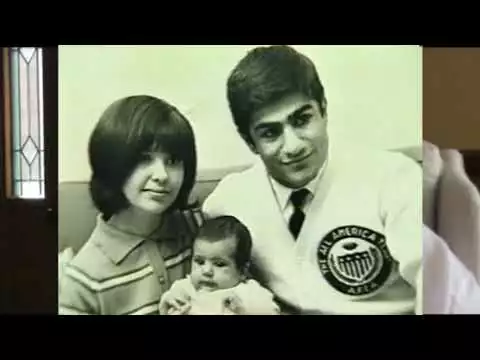
7) Frank Loria – DB
Frank Loria represents one of the most emotional and respected legacies in Virginia Tech football history.
A consensus All-American in 1967, Loria helped establish Virginia Tech as a legitimate football program long before the Hokies rose to national prominence under Frank Beamer. Playing defensive back during an era when offenses were becoming more aggressive through the air, Loria became one of the nation’s elite defenders because of intelligence, instincts, and leadership.
He wasn’t flashy.
He was dependable.
And teammates trusted him completely.
Loria later joined the coaching staff at Marshall University after his playing career ended, tragically becoming one of the 75 people killed in the 1970 Southern Airways Flight 932 crash.
That tragedy forever linked Loria to one of the saddest moments in sports history, but his football legacy at Virginia Tech deserves equal remembrance.
His No. 10 jersey remains permanently retired because Loria represented excellence, leadership, and class both on and off the field.
For Hokie fans, Frank Loria will always symbolize more than football.
Frank Loria Memory
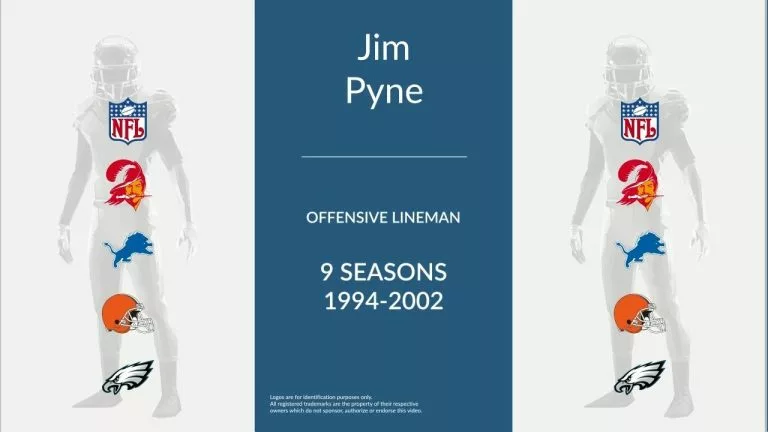
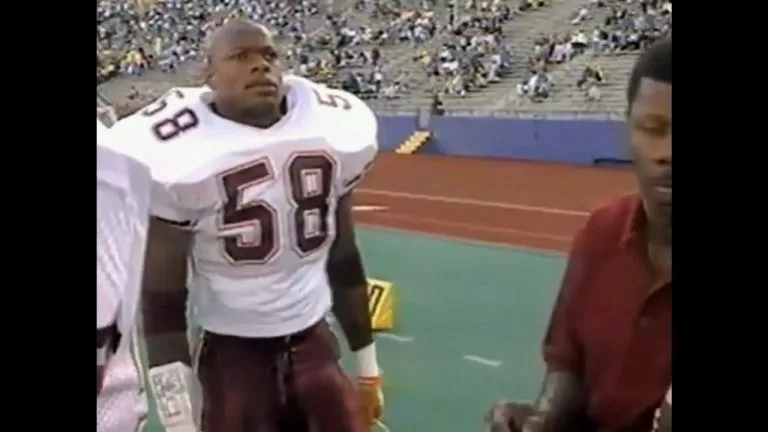
6) Jim Pyne – OL
Great offensive linemen rarely receive the attention they deserve.
Jim Pyne absolutely deserves it.
Pyne became Virginia Tech’s first unanimous All-American in 1993 because he dominated the line of scrimmage with intelligence, toughness, and technical precision. Offensive line play isn’t glamorous, but championship football cannot exist without it, and Pyne anchored Virginia Tech’s offense during a major turning point in the program’s growth.
What made Pyne exceptional was versatility and consistency. He combined power with elite footwork and understood leverage at a level most linemen never reach. Coaches trusted him completely because he never broke assignments and consistently controlled defenders physically.
His impact became so significant that Virginia Tech eventually named the offensive line meeting room after him—a fitting honor for someone who established the standard for line play in Blacksburg.
Pyne also carved out a lengthy NFL career with multiple franchises, proving his talent extended beyond college football.
But in Blacksburg, his legacy remains larger than statistics.
Jim Pyne helped build the toughness that defined Hokie football.
Jim Pyne: Football Offensive Lineman
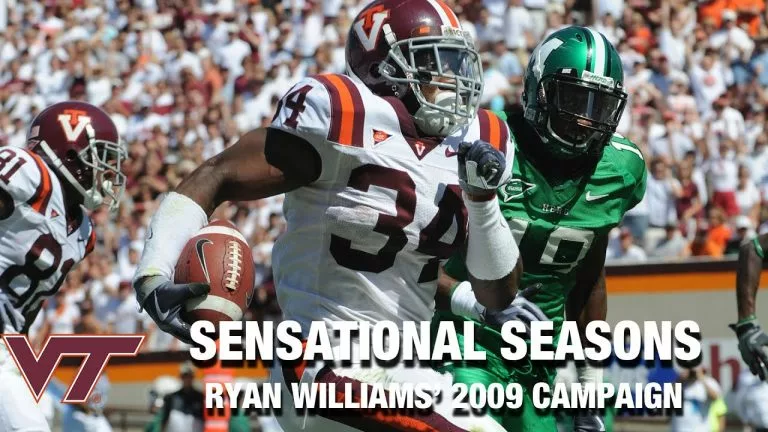
5) Ryan Williams – RB
For one healthy season, Ryan Williams looked unstoppable.
When Darren Evans suffered a preseason ACL injury in 2009,
Virginia Tech
suddenly needed a new offensive centerpiece. Williams responded by delivering one of the greatest freshman seasons in ACC history.
And he did it immediately.
Williams rushed for over 1,600 yards and scored 22 touchdowns while breaking multiple Virginia Tech and ACC records. His combination of balance, acceleration, and vision made him one of the most dangerous running backs in the country.
What separated Williams was explosiveness.
He didn’t need perfect blocking. One cut and he was suddenly gone.
Defenses quickly realized they couldn’t arm tackle him, and once he reached the second level, he became almost impossible to catch.
Unfortunately, injuries later prevented Williams from fully reaching his NFL potential, but Hokie fans will always remember what he looked like at his peak.
Because at his best?
Ryan Williams was terrifying.
And for one unforgettable season, he carried Virginia Tech’s offense almost entirely by himself.
Virginia Tech RB Ryan Williams’ Freshman Year | Sensational Seasons
4) Cornell Brown – DE
Virginia Tech built its national reputation on elite defensive line play, and Cornell Brown was one of the first truly dominant pass rushers to establish that identity nationally.
Despite being considered undersized by traditional standards, Brown overwhelmed offensive linemen through speed, leverage, and relentless effort. He played defensive end with aggression that perfectly fit the culture Frank Beamer and Bud Foster were building in Blacksburg.
Brown became a two-time All-American because opponents simply could not block him consistently one-on-one. His first step off the edge constantly disrupted quarterbacks and destroyed offensive timing.
But beyond statistics, Brown brought attitude.
He played angry.
And that mentality spread across Virginia Tech’s defense during the mid-1990s.
What makes Brown even more respected within the program is that he never truly left. He later returned to Virginia Tech’s coaching staff, helping develop future generations of defensive players while continuing the tradition he helped establish.
Brown didn’t just play for Virginia Tech.
He became part of the program’s foundation permanently.
Cornell Brown | Virginia Tech Hokies
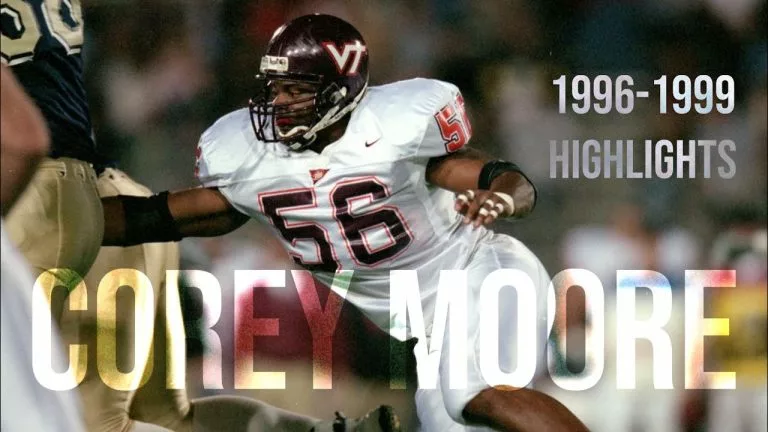
3) Corey Moore – DE
Corey Moore may have played the greatest defensive season in Virginia Tech history.
During the Hokies’ magical 1999 run to the national championship game, Michael Vick deservedly became the face of the program nationally—but Moore was just as important to that team’s success defensively.
And offensive coordinators knew it.
Moore attacked offenses relentlessly, winning both the Bronko Nagurski Award and Lombardi Award after terrorizing opposing quarterbacks throughout the season. His speed off the edge combined with violent hands and relentless motor made him one of the most disruptive defenders in college football.
What made Moore special was intensity.
He never seemed to slow down.
Every snap looked personal to him, and that energy became contagious throughout Virginia Tech’s defense. He played with emotion, swagger, and aggression that perfectly reflected Hokie football at its peak.
Moore didn’t just chase quarterbacks.
He hunted them.
And during the 1999 season, very few defenders in America were more dominant.
Virginia Tech Corey Moore highlights (1996-1999 )#virginiatechfootball #virginiatechhokies
2) Bruce Smith – DE
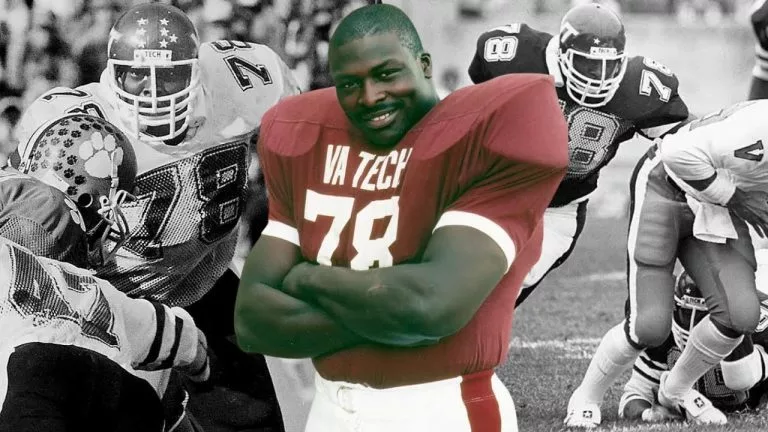
Bruce Smith is the greatest defensive player in Virginia Tech history.
And honestly, there isn’t much debate.
Before becoming the NFL’s all-time sack leader with 200 career sacks, Smith completely dominated college football in Blacksburg. He holds Virginia Tech’s sack records because offensive linemen simply had no answers for his combination of size, speed, and power.
Smith wasn’t just productive.
He was physically overwhelming.
After his senior season in 1984, Smith won the Outland Trophy and earned consensus All-American honors while cementing himself as one of the nation’s elite defensive linemen.
What made Smith unique was how advanced his pass-rushing ability already looked. He understood leverage, hand placement, and counter moves at a level far beyond most college defenders.
And once he reached the NFL?
He became one of the greatest defensive players football has ever seen.
But Virginia Tech fans saw that greatness first.
Bruce Smith didn’t just elevate Hokie football defensively.
He helped put the program on the national map entirely.
Bruce Smith: College Highlight Reel from Virginia Tech
1) Michael Vick – QB
Michael Vick changed Virginia Tech football forever.
There had never been a player quite like him before.
And honestly?
There still hasn’t been.
When Vick stepped onto the field in 1999, college football suddenly looked different. His combination of speed, arm strength, improvisation, and raw athletic ability felt almost unfair. Defenses didn’t just struggle to stop him—they struggled to comprehend what they were seeing.
As a redshirt freshman, Vick carried Virginia Tech to its only national championship game appearance while becoming a Heisman Trophy finalist and winning the first-ever Archie Griffin Award as college football’s most valuable player.
But statistics alone can’t explain Vick’s impact.
He transformed Virginia Tech nationally.
Suddenly, the Hokies weren’t just a tough defensive program—they became one of the most exciting teams in America. Lane Stadium turned into must-watch television because every Vick snap carried the possibility of something impossible happening.
He didn’t just make plays.
He created moments.
And few players in
college football history
have ever changed a program’s national identity more dramatically than Michael Vick.
Michael Vick’s ridiculous Virginia Tech highlights | College Football Mixtape
Up To $1500 in Bonus Bets Paid Back if your First Bet Does Not Win
T&Cs apply
4.5/5
Gambling problem? Call 1-800-GAMBLER or 1-800-MY-RESET (Available in the US) 877-8-HOPENY or text HOPENY (467369) (NY) 1-800-327-5050 (MA), 1-800-BETS-OFF (IA), 1-800-981-0023 (PR). 21+ only. Please Gamble Responsibly. See BetMGM.com for Terms. First Bet Offer for new customers only (if applicable). Subject to eligibility requirements. Bonus bets are non-withdrawable. In partnership with Kansas Crossing Casino and Hotel. Promotional offers not available in Mississippi, Massachusetts, New York, Ontario, or Puerto Rico.
New DraftKings Customers: Spend $5+ Get $150 in Bonuses
T&Cs apply
4.5/5
GAMBLING PROBLEM? CALL 1-800-GAMBLER or 1-800-MY-RESET, (800) 327-5050 or visit gamblinghelplinema.org (MA). Please Gamble Responsibly. 888-789-7777/visit ccpg.org (CT), or visit www.mdgamblinghelp.org (MD), 1-800-981-0023 (PR). 21+ and present in most states. (18+ DC/NH/PR/WY). Void in CAN. Eligibility restrictions apply. On behalf of Boot Hill Casino (KS). Pass-thru of per wager tax may apply in IL. 1 per new DraftKings customer. $5+ first-time bet req. Max. $150 issued as non-withdrawable Bonus Bets. Stake removed from payout. Reward issued as $50 in Bonus Bets every 7 days via click-to-claim for 14 days. Bonus Bets and click-to-claims expire 7 days (168hrs) after issuance. Terms: sportsbook.draftkings.com/promos. Ends 10/11/26 at 11:59 PM ET. Sponsored by DK.
Must be 21+. GAMBLING PROBLEM? CALL 1-800-GAMBLER OR CALL 1-800-MY-RESET, www.mdgamblinghelp.org (MD), (800)-327-5050 or gamblinghelplinema.org (MA), Call (877)8-HOPENY or text HOPENY (467369) (NY), (888) 789-7777 or ccpg.org (CT), morethanagame.nc.gov (NC), 1800gambler.net (WV)
Bet $1 and get double the winnings up to $25 for your next 10 bets
T&Cs apply
4.4/5
21+ New users only. Must register using eligible promo code. First bet after registration must qualify. Max. Bonus Bet: $1,000. Bonus Bet expires 14 days after receipt. Void where prohibited. See Caesars.com/promos for full terms. Gambling Problem? 1-800-GAMBLER (1-800-426-2537)
21+ and present in OH. Gambling Problem? Call 1-800-GAMBLER.
This site is using
Cloudflare
and adheres to the
Google Safe Browsing Program. We adapted
Google's Privacy Guidelines
to keep your data safe at all times.
Close
Ready to Win Big? Join the Elite with Our Sports Betting Deals!
FanDuel Promo
New Users – Get $250 in Bonus Bets when you wager $5 for 5 days
Up To $1500 in Bonus Bets Paid Back if your First Bet Does Not Win
Best Slots
T&Cs and 21+ apply
Gambling problem? Call 1-800-GAMBLER or 1-800-MY-RESET (Available in the US) 877-8-HOPENY or text HOPENY (467369) (NY) 1-800-327-5050 (MA), 1-800-BETS-OFF (IA), 1-800-981-0023 (PR). 21+ only. Please Gamble Responsibly. See BetMGM.com for Terms. First Bet Offer for new customers only (if applicable). Subject to eligibility requirements. Bonus bets are non-withdrawable. In partnership with Kansas Crossing Casino and Hotel. Promotional offers not available in Mississippi, Massachusetts, New York, Ontario, or Puerto Rico.
Code:
Open BetMGM
Get Bonus
DraftKings Promo
New DraftKings Customers: Spend $5+ Get $150 in Bonuses
Newcomer
T&Cs and 21+ apply
GAMBLING PROBLEM? CALL 1-800-GAMBLER or 1-800-MY-RESET, (800) 327-5050 or visit gamblinghelplinema.org (MA). Please Gamble Responsibly. 888-789-7777/visit ccpg.org (CT), or visit www.mdgamblinghelp.org (MD), 1-800-981-0023 (PR). 21+ and present in most states. (18+ DC/NH/PR/WY). Void in CAN. Eligibility restrictions apply. On behalf of Boot Hill Casino (KS). Pass-thru of per wager tax may apply in IL. 1 per new DraftKings customer. $5+ first-time bet req. Max. $150 issued as non-withdrawable Bonus Bets. Stake removed from payout. Reward issued as $50 in Bonus Bets every 7 days via click-to-claim for 14 days. Bonus Bets and click-to-claims expire 7 days (168hrs) after issuance. Terms: sportsbook.draftkings.com/promos. Ends 10/11/26 at 11:59 PM ET. Sponsored by DK.
Code:
Open DraftKings
Get Bonus
Find out what the legends have to say about sports this week....