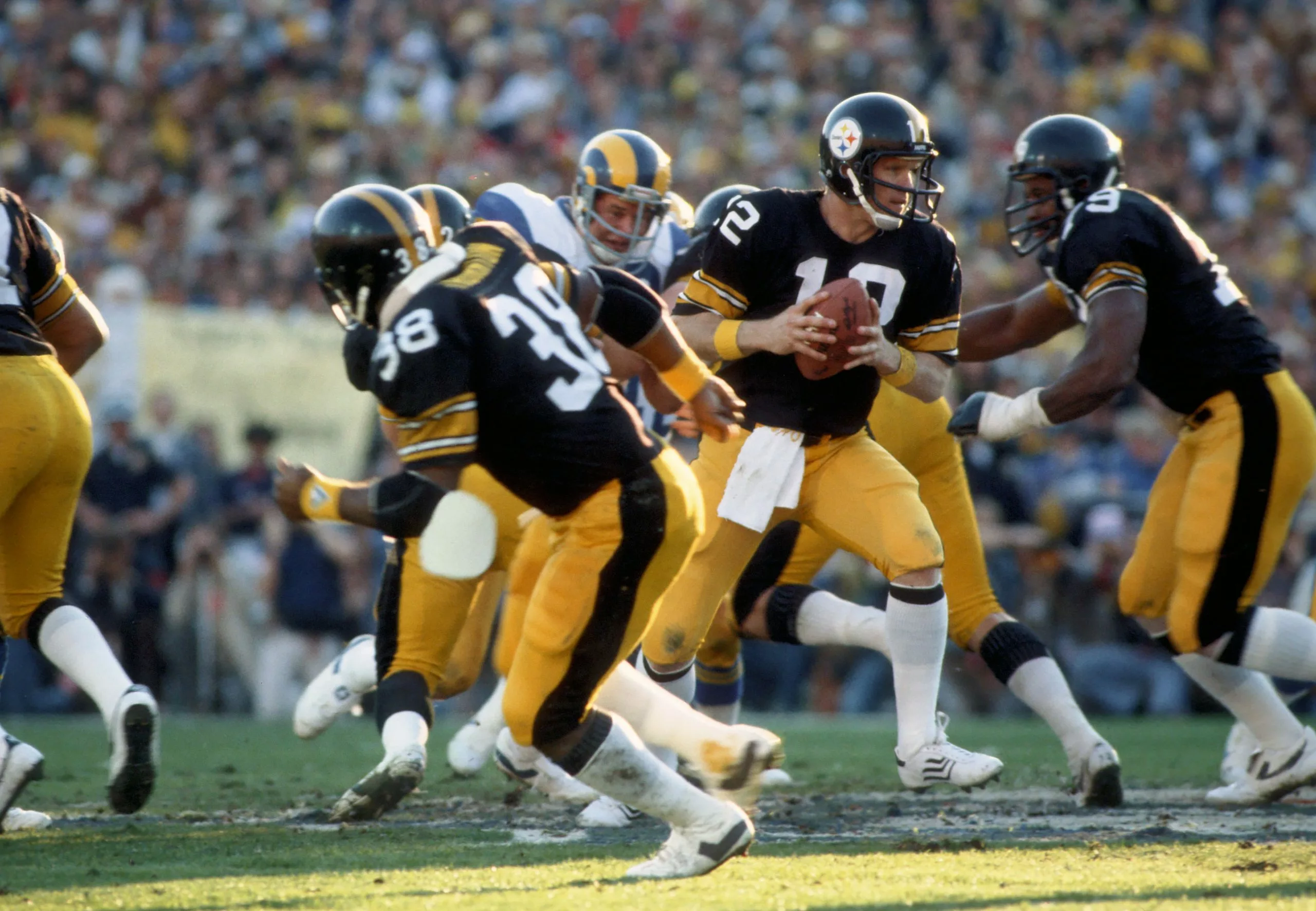
Jan 20, 1980; Pasadena, CA, USA; Pittsburgh Steelers quarterback Terry Bradshaw (12) in action during Super Bowl XIV against the Los Angeles Rams at the Rose Bowl. Pittsburgh went on and defeated the Rams 31-19 and earn their fourth Super Bowl Championship and their second back to back Super Bowl victory. Mandatory Credit: Tony Tomsic-USA TODAY NETWORK
The Pittsburgh Steelers are one of the most decorated franchises in NFL history, built on toughness, defense, and championship pedigree. From the Steel Curtain dynasty of the 1970s to the modern era of sustained excellence, the Steelers have produced some of the greatest players the game has ever seen.
This list ranks the
Top 10 Steelers of All Time, balancing dominance, longevity, championships, and overall impact on the franchise and the sport.
10) L. C. Greenwood (DL)
L.C. Greenwood was one of the most underrated stars of the legendary Steel Curtain defense. Playing his entire 13-year career in Pittsburgh, Greenwood combined length, athleticism, and relentless energy to become one of the most disruptive defensive linemen of his era.
A six-time Pro Bowler and two-time First-Team All-Pro, Greenwood recorded 73.5 unofficial sacks, the most by a defensive lineman in Steelers history. His signature gold shoes became iconic, symbolizing both flair and dominance on a defense loaded with Hall of Famers.
What made Greenwood special was his ability to complement stars like
Mean Joe Greene
while still producing at an elite level. He thrived in big moments, playing a key role in all four Super Bowl victories during the 1970s dynasty.
Despite often being overshadowed by bigger names, Greenwood’s consistency and impact cannot be overstated. He was a cornerstone of one of the greatest defenses ever assembled and remains one of the most important players in franchise history.
L.C. Greenwood’s Hardest Hits
9) Dermontti Dawson (OL)
Dermontti Dawson had the unenviable task of replacing Hall of Famer Mike Webster—and somehow exceeded expectations. Over a 13-year career, Dawson became one of the most dominant centers in NFL history, revolutionizing the position with his athleticism and intelligence.
Dawson played in 170 consecutive games and was selected to seven Pro Bowls while earning six First-Team All-Pro honors. His ability to pull, block in space, and anchor the offensive line made him the centerpiece of Pittsburgh’s offensive success in the late 1980s and 1990s.
He was named to the NFL’s All-Decade Team of the 1990s, a testament to his sustained excellence during a physically demanding era of football. Dawson’s technique and mobility helped redefine what was expected from a center, influencing future generations of offensive linemen.
In a franchise known for legendary centers, Dawson stands at or near the top. His consistency, durability, and dominance make him one of the greatest offensive linemen ever to wear the black and gold.
Dermontti Dawson | Pro Football Hall of Fame
8) Mike Webster (OL)
Mike Webster is the standard by which all centers are judged. As the anchor of the Steelers’ offensive line during the 1970s dynasty, Webster combined toughness, intelligence, and leadership to become one of the most respected players in NFL history.
Over 15 seasons in Pittsburgh, Webster played 220 games and was instrumental in all four Super Bowl championships. He was selected to nine Pro Bowls and earned five First-Team All-Pro honors, solidifying his place among the all-time greats.
Webster’s ability to call protections, dominate in the trenches, and play through pain became legendary. His work ethic and toughness embodied the Steelers’ identity, making him the emotional and physical leader of the offense.
Inducted into the Pro Football Hall of Fame in 1997, Webster’s legacy extends beyond statistics. He helped define what it meant to be a Steelers player—gritty, dependable, and relentless.
Steelers Hall of Famers: Mike Webster
7) Franco Harris (RB)
Franco Harris was the heartbeat of the Steelers’ offense during their 1970s dynasty. A powerful yet smooth runner, Harris combined durability with big-play ability, becoming the franchise’s all-time leading rusher.
He burst onto the scene as Rookie of the Year in 1972, rushing for 1,055 yards and immediately establishing himself as a cornerstone of the offense. That same season, he was part of the most iconic play in NFL history—the Immaculate Reception—which symbolized the birth of the Steelers dynasty.
Over his career in Pittsburgh, Harris rushed for 11,950 yards and 91 touchdowns, earning nine Pro Bowl selections and winning Super Bowl IX MVP honors. He was the ultimate big-game performer, consistently delivering in playoff situations.
Harris wasn’t just a great running back—he was a symbol of consistency and excellence. His ability to control games and wear down defenses made him indispensable to Pittsburgh’s championship success.
Franco Harris Hilites
6) Mel Blount (DB)
Mel Blount was so dominant that the NFL literally changed the rules because of him. His physical style of play at cornerback led to the implementation of the “Mel Blount Rule,” which limited contact with receivers beyond five yards.
Standing 6’3” with rare speed, Blount redefined what a cornerback could be. Over a 14-year career, he recorded 57 interceptions and was a five-time Pro Bowler and two-time First-Team All-Pro.
In 1975, Blount was named NFL Defensive Player of the Year, a rare honor for a cornerback. He played a crucial role in all four Steelers Super Bowl victories, often shutting down the opponent’s top receiver.
Blount’s combination of size, strength, and skill made him nearly impossible to beat in his prime. He didn’t just dominate—he changed the way the position is played.
Mel Blount HOF Induction Speech via. Steelers.com
5) Ben Roethlisberger (QB)
Few quarterbacks in NFL history defined a franchise the way Ben Roethlisberger did for Pittsburgh. Drafted in 2004, Roethlisberger immediately changed the trajectory of the Steelers, leading the team to a 15–1 record as a rookie and quickly establishing himself as one of the toughest and most clutch quarterbacks in the league.
Over an 18-year career, Roethlisberger threw for over 64,000 yards and 418 touchdowns, both franchise records. He led the Steelers to three Super Bowl appearances and two victories, including becoming the youngest quarterback to ever win a Super Bowl in Super Bowl XL. His ability to extend plays, shrug off defenders, and deliver downfield strikes became his trademark.
Roethlisberger was never the flashiest quarterback, but he was one of the most resilient. Whether playing through injuries or leading late-game drives, “Big Ben” embodied Pittsburgh’s blue-collar identity. His connection with receivers like Hines Ward and Antonio Brown helped define an era of offensive success that complemented the franchise’s defensive legacy.
Simply put, Roethlisberger is the greatest quarterback in Steelers history and one of the defining players of the 21st century NFL.
4) Terry Bradshaw (QB)
Terry Bradshaw’s career is one of the greatest redemption stories in NFL history. After a rocky start, Bradshaw developed into one of the most clutch quarterbacks the game has ever seen, leading the Steelers to four Super Bowl titles.
His 1978 MVP season highlighted his peak, as he threw for 2,915 yards and 28 touchdowns. More importantly, Bradshaw delivered in the biggest moments, earning two Super Bowl MVP awards.
Known for his toughness and ability to perform in adverse conditions, Bradshaw thrived in cold weather and high-pressure situations. His deep passing ability and fearless mentality made him a perfect fit for the Steelers’ aggressive style.
Bradshaw wasn’t just a quarterback—he was a winner. His leadership and clutch performances cemented his legacy as one of the greatest quarterbacks in NFL history.
Great Terry Bradshaw Film
3) Jack Ham (LB)
Jack Ham was the ultimate complete linebacker. Equally dominant against the run and in pass coverage, Ham possessed rare instincts and intelligence that made him one of the most versatile defenders ever.
During his 12-year career, Ham recorded 32 interceptions—an incredible number for a linebacker—and was selected to eight Pro Bowls while earning six First-Team All-Pro honors.
His ability to read offenses and make plays all over the field made him a cornerstone of the Steel Curtain defense. Ham’s discipline and consistency allowed the Steelers to execute complex defensive schemes at an elite level.
Inducted into the Pro Football Hall of Fame in 1988, Ham remains one of the most technically sound linebackers in NFL history. He was the definition of efficiency and excellence.
Linebacker U tradition–Jack Ham as a Steeler smashing OJ #2
2) Jack Lambert (LB)
Jack Lambert is the embodiment of Pittsburgh Steelers football. Undersized for a middle linebacker but possessing unmatched instincts and ferocity, Lambert became the heart and soul of the
Steel Curtain defense.
From the moment he stepped on the field, Lambert made an impact, winning Defensive Rookie of the Year and anchoring a defense that would dominate the NFL for years.
Over his 11-year career, Lambert was selected to nine Pro Bowls and earned six First-Team All-Pro honors. He was named Defensive Player of the Year and played a critical role in four Super Bowl victories.
What set Lambert apart wasn’t just his production—it was his presence. His intensity, leadership, and relentless style made him one of the most feared defenders in NFL history.
Lambert didn’t just play the game—he defined it for an entire generation of Steelers football.
Jack Lambert-Mini Biography
1) Joe Greene (DL)
“Mean” Joe Greene was the foundation upon which the Steelers dynasty was built. As the centerpiece of the Steel Curtain, Greene transformed the franchise from a perennial loser into a dominant powerhouse.
A 10-time Pro Bowler and two-time Defensive Player of the Year, Greene combined strength, quickness, and leadership to become one of the most feared defensive players in history.
He wasn’t just dominant statistically—he set the tone for an entire team. Greene’s intensity and leadership helped establish the culture that defined the Steelers for decades.
His impact extended beyond the field, as he became the face of the franchise during its rise to prominence. Greene is widely regarded as one of the greatest defensive linemen in NFL history.
Up To $1500 in Bonus Bets Paid Back if your First Bet Does Not Win
T&Cs apply
4.5/5
Gambling problem? Call 1-800-GAMBLER or 1-800-MY-RESET (Available in the US) 877-8-HOPENY or text HOPENY (467369) (NY) 1-800-327-5050 (MA), 1-800-BETS-OFF (IA), 1-800-981-0023 (PR). 21+ only. Please Gamble Responsibly. See BetMGM.com for Terms. First Bet Offer for new customers only (if applicable). Subject to eligibility requirements. Bonus bets are non-withdrawable. In partnership with Kansas Crossing Casino and Hotel. Promotional offers not available in Mississippi, Massachusetts, New York, Ontario, or Puerto Rico.
New DraftKings Customers: Spend $5+ Get $150 in Bonuses
T&Cs apply
4.5/5
GAMBLING PROBLEM? CALL 1-800-GAMBLER or 1-800-MY-RESET, (800) 327-5050 or visit gamblinghelplinema.org (MA). Please Gamble Responsibly. 888-789-7777/visit ccpg.org (CT), or visit www.mdgamblinghelp.org (MD), 1-800-981-0023 (PR). 21+ and present in most states. (18+ DC/NH/PR/WY). Void in CAN. Eligibility restrictions apply. On behalf of Boot Hill Casino (KS). Pass-thru of per wager tax may apply in IL. 1 per new DraftKings customer. $5+ first-time bet req. Max. $150 issued as non-withdrawable Bonus Bets. Stake removed from payout. Reward issued as $50 in Bonus Bets every 7 days via click-to-claim for 14 days. Bonus Bets and click-to-claims expire 7 days (168hrs) after issuance. Terms: sportsbook.draftkings.com/promos. Ends 10/11/26 at 11:59 PM ET. Sponsored by DK.
Must be 21+. GAMBLING PROBLEM? CALL 1-800-GAMBLER OR CALL 1-800-MY-RESET, www.mdgamblinghelp.org (MD), (800)-327-5050 or gamblinghelplinema.org (MA), Call (877)8-HOPENY or text HOPENY (467369) (NY), (888) 789-7777 or ccpg.org (CT), morethanagame.nc.gov (NC), 1800gambler.net (WV)
Bet $1 and get double the winnings up to $25 for your next 10 bets
T&Cs apply
4.4/5
21+ New users only. Must register using eligible promo code. First bet after registration must qualify. Max. Bonus Bet: $1,000. Bonus Bet expires 14 days after receipt. Void where prohibited. See Caesars.com/promos for full terms. Gambling Problem? 1-800-GAMBLER (1-800-426-2537)
21+ and present in OH. Gambling Problem? Call 1-800-GAMBLER.
This site is using
Cloudflare
and adheres to the
Google Safe Browsing Program. We adapted
Google's Privacy Guidelines
to keep your data safe at all times.
Close
Ready to Win Big? Join the Elite with Our Sports Betting Deals!
FanDuel Promo
New Users – Get $250 in Bonus Bets when you wager $5 for 5 days
Up To $1500 in Bonus Bets Paid Back if your First Bet Does Not Win
Best Slots
T&Cs and 21+ apply
Gambling problem? Call 1-800-GAMBLER or 1-800-MY-RESET (Available in the US) 877-8-HOPENY or text HOPENY (467369) (NY) 1-800-327-5050 (MA), 1-800-BETS-OFF (IA), 1-800-981-0023 (PR). 21+ only. Please Gamble Responsibly. See BetMGM.com for Terms. First Bet Offer for new customers only (if applicable). Subject to eligibility requirements. Bonus bets are non-withdrawable. In partnership with Kansas Crossing Casino and Hotel. Promotional offers not available in Mississippi, Massachusetts, New York, Ontario, or Puerto Rico.
Code:
Open BetMGM
Get Bonus
DraftKings Promo
New DraftKings Customers: Spend $5+ Get $150 in Bonuses
Newcomer
T&Cs and 21+ apply
GAMBLING PROBLEM? CALL 1-800-GAMBLER or 1-800-MY-RESET, (800) 327-5050 or visit gamblinghelplinema.org (MA). Please Gamble Responsibly. 888-789-7777/visit ccpg.org (CT), or visit www.mdgamblinghelp.org (MD), 1-800-981-0023 (PR). 21+ and present in most states. (18+ DC/NH/PR/WY). Void in CAN. Eligibility restrictions apply. On behalf of Boot Hill Casino (KS). Pass-thru of per wager tax may apply in IL. 1 per new DraftKings customer. $5+ first-time bet req. Max. $150 issued as non-withdrawable Bonus Bets. Stake removed from payout. Reward issued as $50 in Bonus Bets every 7 days via click-to-claim for 14 days. Bonus Bets and click-to-claims expire 7 days (168hrs) after issuance. Terms: sportsbook.draftkings.com/promos. Ends 10/11/26 at 11:59 PM ET. Sponsored by DK.
Code:
Open DraftKings
Get Bonus
Find out what the legends have to say about sports this week....