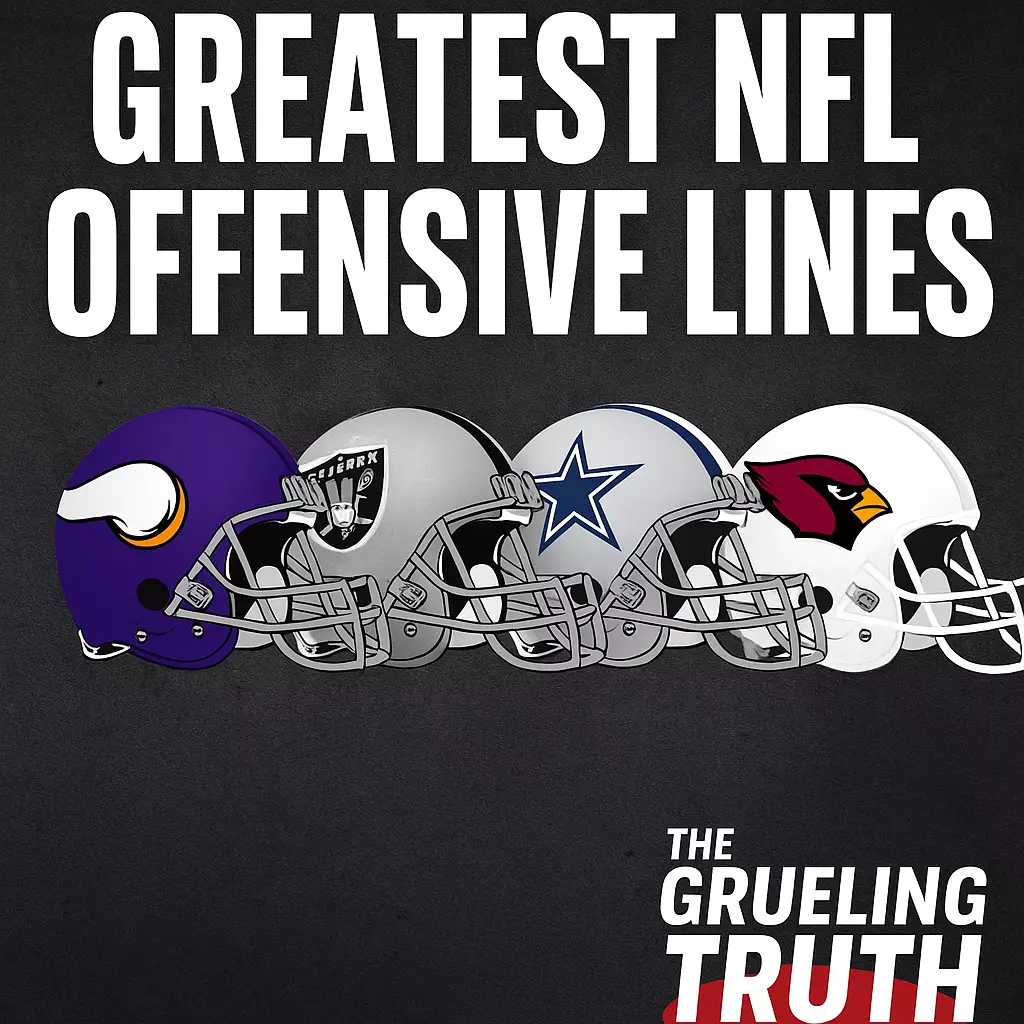
Dominant offensive lines used to define championship football. Today, with spread offenses and quick-release passing games, the art of line play has been lost. Many modern linemen enter the NFL never having learned to properly
kick step
— a fundamental once drilled daily by great coaches.
The best lines of all time came from an era when toughness, technique, and chemistry were everything. These units controlled the trenches, created legends, and proved that football is truly won up front. Let’s look back at the ten
greatest offensive lines
ever assembled.
10) Minnesota Vikings – Super Bowl IV
Starting Lineup
LT: Grady Alderman LG: Jim Vellone C: Mick Tingelhoff RG: Milt Sunde RT: Ron Yary
The 1969 Vikings went
12–2
and led the NFL with 379 points scored. Quarterback Joe Kapp threw for 19 touchdowns, while the running trio of Dave Osborn, Bill Brown, and Oscar Reed combined for over 1,400 yards.
Anchored by
Hall of Famers Mick Tingelhoff
and
Ron Yary, the “Purple People Movers” dominated the line of scrimmage. Tingelhoff and Grady Alderman made the Pro Bowl, cementing this group as one of the most technically sound lines of its time.
In Loving Memory of Mick Tingelhoff
9) Cincinnati Bengals – Super Bowl XXIII
Starting Lineup
LT: Anthony Muñoz LG: Bruce Reimers C: Bruce Kozerski RG: Max Montoya RT: Brian Blados
Led by
Anthony Muñoz, widely regarded as the greatest offensive lineman in NFL history, this Bengals unit powered an explosive 1988 offense.
Boomer Esiason
threw for 3,525 yards and 28 TDs, while
James Brooks
added 1,239 rushing yards.
Even after losing Joe Walter late in the season, the group held strong. Blados filled in admirably, Montoya and Reimers were rock solid inside, and Kozerski provided stability at center. Their protection nearly delivered Cincinnati its first Super Bowl win.
Anthony Munoz Ultimate NFL Career Highlights
8) Oakland Raiders – Super Bowl II
Starting Lineup
LT: Bob Svihus LG: Gene Upshaw C: Jim Otto RG: Wayne Hawkins RT: Harry Schuh
The 1967 Raiders were an AFL powerhouse. With
Daryle Lamonica
— “The Mad Bomber” — throwing for over 3,200 yards and 30 TDs, the offensive line kept him upright and deadly.
Anchored by
Hall of Famers Gene Upshaw and Jim Otto, this group dominated opposing fronts. Hawkins and Schuh were multi-time All-Stars, and the line paved the way for a balanced attack featuring Hewritt Dixon and Clem Daniels.
BOB “BOOMER” BROWN | Raiders History
7) Denver Broncos – Super Bowl XXXII
Starting Lineup
LT: Gary Zimmerman LG: Mark Schlereth C: Tom Nalen RG: Brian Habib RT: Tony Jones
The 1997 Broncos finally broke through thanks to their offensive line.
John Elway
had one of his best seasons, and
Terrell Davis
ran for 1,750 yards behind this dominant unit.
Future Hall of Famer
Gary Zimmerman
anchored the left side, while
Tom Nalen, one of the most underrated centers in league history, commanded the middle. The line’s combination of finesse and power brought Denver its long-awaited Super Bowl title.
1998 Denver Broncos outside zone clips
6) Green Bay Packers – Super Bowl I
Starting Lineup
LT: Bob Skoronski LG: Fuzzy Thurston C: Bill Curry RG: Jerry Kramer RT: Forrest Gregg
When you talk about the foundation of the
Lombardi Packers, you start with their offensive line.
Forrest Gregg, a Hall of Famer, led a unit that also featured the legendary
Jerry Kramer
pulling on the famous “Packer Sweep.”
Bill Curry held his ground in the middle, and Skoronski provided veteran leadership on the left side. It was the perfect balance of strength and precision — the kind of line that defined an era.
(1965-1967) Green Bay Packers Team Season Highlights “3 In A Row”
5) Washington Redskins – Super Bowl XVII
Starting Lineup
LT: Joe Jacoby LG: Russ Grimm C: Jeff Bostic RG: Fred Dean RT: George Starke
They called them
“The Hogs”, and this was their best version. The left side of
Jacoby and Grimm
mauled defenders, while
Jeff Bostic
anchored the middle.
In Super Bowl XVII, Washington’s line dominated the second half, paving the way for
John Riggins’ legendary performance and the franchise’s first title. Few offensive lines have ever controlled a game as completely as the 1982 Redskins.
“The Hogs” Ultimate NFL Career Highlights || 1980s Redskins Offensive Line
4) Oakland Raiders – Super Bowl XI
Starting Lineup
LT: Art Shell LG: Gene Upshaw C: Dave Dalby RG: George Buehler RT: John Vella
This was
power football at its peak. Hall of Famers
Art Shell
and
Gene Upshaw
anchored the left side, combining for 14 Pro Bowl appearances.
They protected
Ken Stabler, who threw for 27 touchdowns, and opened lanes for
Mark van Eeghen’s
1,012-yard season. The Raiders’ 32-14 Super Bowl XI win was a clinic in line dominance and execution.
1976 to 1983 Raiders Dynasty Highlights
3) Miami Dolphins – Super Bowl VIII
Starting Lineup
LT: Wayne Moore LG: Bob Kuechenberg C: Jim Langer RG: Larry Little RT: Norm Evans
Miami’s line didn’t just protect — they
dominated. In 1972,
Larry Csonka
and
Mercury Morris
combined for 2,117 rushing yards, and the following year they nearly matched that total.
Larry Little
and
Jim Langer, both Hall of Famers, led a cohesive, punishing group that powered the Dolphins to back-to-back Super Bowl wins and the NFL’s only perfect season.
The Sensational Sixth Season of the Miami Dolphins
2) Dallas Cowboys – Super Bowl XXVII
Starting Lineup
LT: Mark Tuinei LG: Nate Newton C: Mark Stepnoski / John Gesek RG: John Gesek / Kevin Gogan RT: Erik Williams
The
Great Wall of Dallas
was the gold standard for modern offensive lines. In 1992,
Troy Aikman
passed for 3,445 yards and
Emmitt Smith
rushed for 1,713 yards — both protected by this massive, agile front.
They were big, fast, and mean — a perfect blend of power and precision. The Cowboys’ back-to-back blowout wins over Buffalo showcased their dominance, especially in Super Bowl XXVIII when six straight runs to start the second half flipped the game.
Erik Williams highlights
1) 1975 St. Louis Cardinals
Starting Lineup
LT: Roger Finnie LG: Bob Young C: Tom Banke RG: Conrad Dobler RT: Dan Dierdorf
They never made a Super Bowl, but this
“Big Red Line”
was the most efficient in NFL history. In 1975, they allowed just
eight sacks all season, protecting the immobile Jim Hart while fueling Don Coryell’s aerial attack.
The line also paved the way for
Terry Metcalf
and
Jim Otis, who helped the Cardinals average 168 rushing yards per game. With Hall of Famer
Dan Dierdorf
and mauler
Conrad Dobler, this group remains the ultimate model of balance and precision.
1975 St. Louis Cardinals
Honorable Mention: Pittsburgh Steelers – Super Bowl XIV
Starting Lineup
LT: Jon Kolb LG: Sam Davis C: Mike Webster RG: Gerry Mullins RT: Larry Brown
The Steelers’ line was anchored by
Mike Webster, arguably the greatest center in NFL history. The addition of
Larry Brown
at right tackle in 1979 made this group even stronger. They cleared the way for Franco Harris and gave Terry Bradshaw time to connect with Swann and Stallworth — sealing
Pittsburgh’s dynasty years.
Conclusion
Great offensive lines aren’t just about size or strength; they’re about unity, intelligence, and trust. These groups dictated the flow of games, defined eras, and elevated the stars behind them.
In today’s NFL, the spotlight may shine on quarterbacks and receivers, but history reminds us that every championship begins in the trenches. The legends listed above are proof that true greatness always starts
up front.
Up To $1500 in Bonus Bets Paid Back if your First Bet Does Not Win
T&Cs apply
4.5/5
Gambling problem? Call 1-800-GAMBLER or 1-800-MY-RESET (Available in the US) 877-8-HOPENY or text HOPENY (467369) (NY) 1-800-327-5050 (MA), 1-800-BETS-OFF (IA), 1-800-981-0023 (PR). 21+ only. Please Gamble Responsibly. See BetMGM.com for Terms. First Bet Offer for new customers only (if applicable). Subject to eligibility requirements. Bonus bets are non-withdrawable. In partnership with Kansas Crossing Casino and Hotel. Promotional offers not available in Mississippi, Massachusetts, New York, Ontario, or Puerto Rico.
New DraftKings Customers: Spend $5+ Get $150 in Bonuses
T&Cs apply
4.5/5
GAMBLING PROBLEM? CALL 1-800-GAMBLER or 1-800-MY-RESET, (800) 327-5050 or visit gamblinghelplinema.org (MA). Please Gamble Responsibly. 888-789-7777/visit ccpg.org (CT), or visit www.mdgamblinghelp.org (MD), 1-800-981-0023 (PR). 21+ and present in most states. (18+ DC/NH/PR/WY). Void in CAN. Eligibility restrictions apply. On behalf of Boot Hill Casino (KS). Pass-thru of per wager tax may apply in IL. 1 per new DraftKings customer. $5+ first-time bet req. Max. $150 issued as non-withdrawable Bonus Bets. Stake removed from payout. Reward issued as $50 in Bonus Bets every 7 days via click-to-claim for 14 days. Bonus Bets and click-to-claims expire 7 days (168hrs) after issuance. Terms: sportsbook.draftkings.com/promos. Ends 10/11/26 at 11:59 PM ET. Sponsored by DK.
Must be 21+. GAMBLING PROBLEM? CALL 1-800-GAMBLER OR CALL 1-800-MY-RESET, www.mdgamblinghelp.org (MD), (800)-327-5050 or gamblinghelplinema.org (MA), Call (877)8-HOPENY or text HOPENY (467369) (NY), (888) 789-7777 or ccpg.org (CT), morethanagame.nc.gov (NC), 1800gambler.net (WV)
Bet $1 and get double the winnings up to $25 for your next 10 bets
T&Cs apply
4.4/5
21+ New users only. Must register using eligible promo code. First bet after registration must qualify. Max. Bonus Bet: $1,000. Bonus Bet expires 14 days after receipt. Void where prohibited. See Caesars.com/promos for full terms. Gambling Problem? 1-800-GAMBLER (1-800-426-2537)
21+ and present in OH. Gambling Problem? Call 1-800-GAMBLER.
This site is using
Cloudflare
and adheres to the
Google Safe Browsing Program. We adapted
Google's Privacy Guidelines
to keep your data safe at all times.
Close
Ready to Win Big? Join the Elite with Our Sports Betting Deals!
FanDuel Promo
New Users – Get $250 in Bonus Bets when you wager $5 for 5 days
Up To $1500 in Bonus Bets Paid Back if your First Bet Does Not Win
Best Slots
T&Cs and 21+ apply
Gambling problem? Call 1-800-GAMBLER or 1-800-MY-RESET (Available in the US) 877-8-HOPENY or text HOPENY (467369) (NY) 1-800-327-5050 (MA), 1-800-BETS-OFF (IA), 1-800-981-0023 (PR). 21+ only. Please Gamble Responsibly. See BetMGM.com for Terms. First Bet Offer for new customers only (if applicable). Subject to eligibility requirements. Bonus bets are non-withdrawable. In partnership with Kansas Crossing Casino and Hotel. Promotional offers not available in Mississippi, Massachusetts, New York, Ontario, or Puerto Rico.
Code:
Open BetMGM
Get Bonus
DraftKings Promo
New DraftKings Customers: Spend $5+ Get $150 in Bonuses
Newcomer
T&Cs and 21+ apply
GAMBLING PROBLEM? CALL 1-800-GAMBLER or 1-800-MY-RESET, (800) 327-5050 or visit gamblinghelplinema.org (MA). Please Gamble Responsibly. 888-789-7777/visit ccpg.org (CT), or visit www.mdgamblinghelp.org (MD), 1-800-981-0023 (PR). 21+ and present in most states. (18+ DC/NH/PR/WY). Void in CAN. Eligibility restrictions apply. On behalf of Boot Hill Casino (KS). Pass-thru of per wager tax may apply in IL. 1 per new DraftKings customer. $5+ first-time bet req. Max. $150 issued as non-withdrawable Bonus Bets. Stake removed from payout. Reward issued as $50 in Bonus Bets every 7 days via click-to-claim for 14 days. Bonus Bets and click-to-claims expire 7 days (168hrs) after issuance. Terms: sportsbook.draftkings.com/promos. Ends 10/11/26 at 11:59 PM ET. Sponsored by DK.
Code:
Open DraftKings
Get Bonus
Find out what the legends have to say about sports this week....