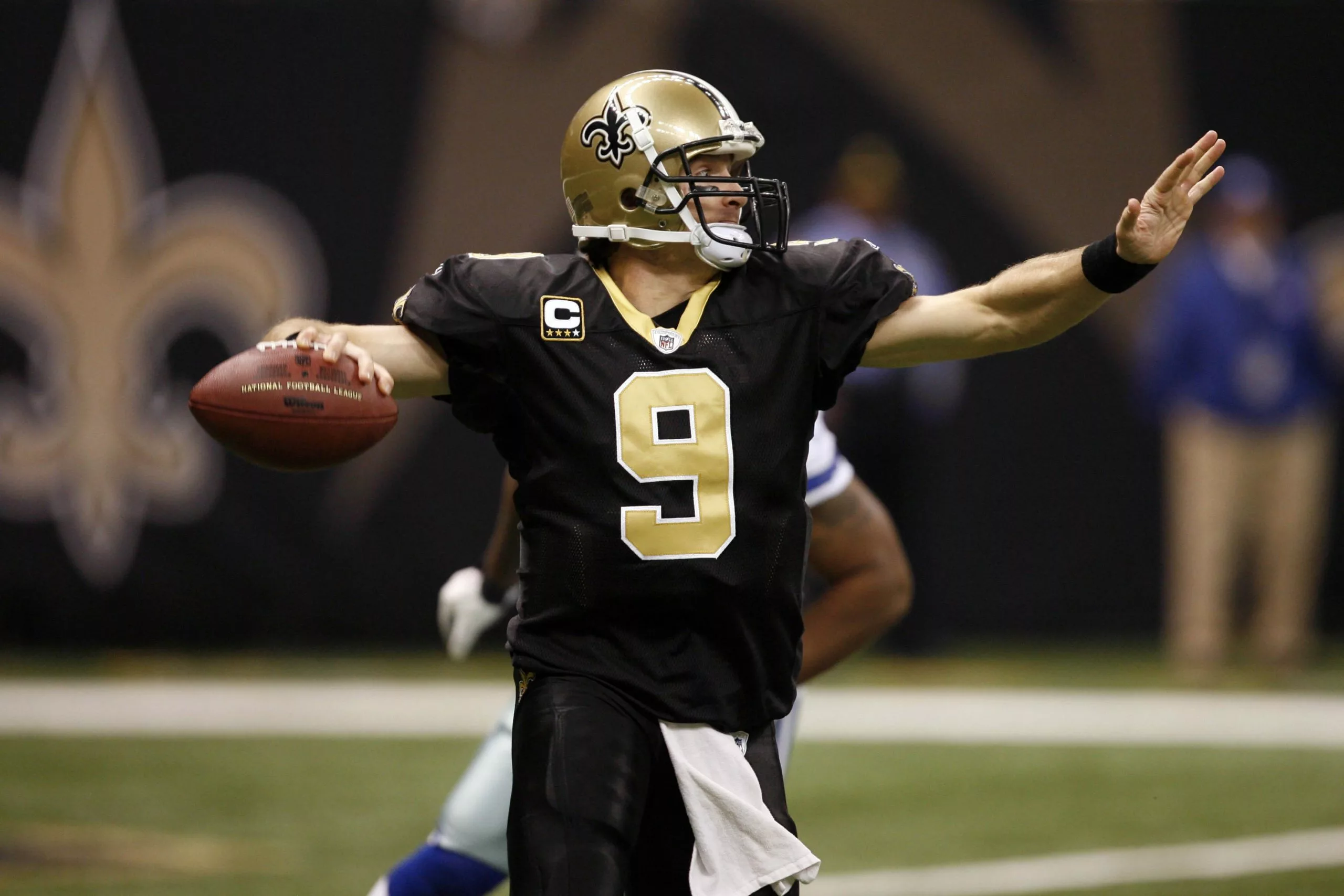
Dec. 19, 2009; New Orleans, LA, USA; New Orleans Saints quarterback Drew Brees (9) throws a pass against the Dallas Cowboys at the Louisiana Superdome. Mandatory Credit: Matt Stamey-USA TODAY Sports
The history of the New Orleans Saints is unlike any franchise in the NFL. For decades the Saints were lovable losers, a team defined more by paper bags and heartbreak than championships. Then everything changed.
What makes ranking the greatest Saints ever so difficult is balancing different eras. Do you value the legends who gave the franchise credibility during the bad years? Or the superstars who helped bring
New Orleans
its first Super Bowl championship?
This list weighs greatness, impact on the franchise, longevity, dominance at their position, leadership, and legacy in New Orleans.
10. Pat Swilling — Linebacker
Pat Swilling was one of the fiercest pass rushers of the late 1980s and early 1990s. As a key member of the legendary “Dome Patrol” linebacking corps, Swilling helped transform the Saints from a joke into a legitimate contender.
Swilling won the NFL Defensive Player of the Year award in 1991 after recording 17 sacks. His explosiveness off the edge made him one of the most feared defenders in football during his prime.
The Saints defense became the identity of the franchise during this era, and Swilling was a massive reason why.
Every Pat Swilling Interception | Pat Swilling Highlights
9. Cameron Jordan — Defensive End
Cameron Jordan is one of the greatest defensive linemen of the modern NFL era and arguably the best defensive player the Saints have had since the Dome Patrol days.
Jordan has spent his entire career terrorizing quarterbacks while becoming one of the most respected leaders in franchise history. He is the Saints’ all-time sack leader with 132 career sacks.
Beyond the numbers, Jordan embodied consistency. Year after year he showed up, played hurt, produced, and represented the city with professionalism.
Few Saints players have ever combined longevity and elite production the way Jordan has.
Morten Andersen was one of the greatest kickers in NFL history and one of the first true superstars the Saints ever had. He scored 1,318 points for New Orleans and became a symbol of reliability during some difficult eras of Saints football.
Andersen’s booming leg helped carry the Saints to their first playoff appearance in franchise history in 1987.
He eventually became a Pro Football Hall of Famer and remains one of the most respected specialists the game has ever seen.
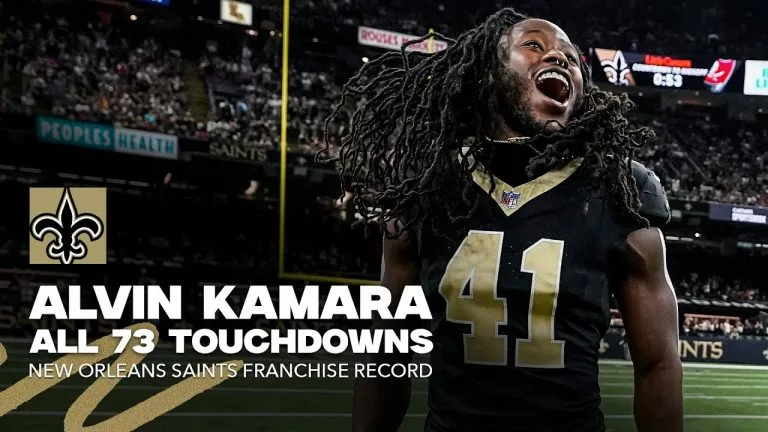
Alvin Kamara completely changed the running back position in New Orleans.
Kamara was not just a great runner — he became one of the most dangerous offensive weapons in football. His ability to destroy defenses as both a runner and receiver made him almost impossible to scheme against.
He became the Saints’ all-time leader in rushing touchdowns and total touchdowns while redefining offensive versatility.
Kamara’s six-touchdown Christmas performance against the Vikings in 2020 remains one of the greatest individual games in NFL history.
Watch All 73 Alvin Kamara TDs for Saints Record | Highlights
6. Marques Colston — Wide Receiver
Marques Colston may be the most underrated receiver of his generation.
A seventh-round draft pick out of Hofstra, Colston became
Drew Brees’
most trusted weapon during the greatest offensive era in Saints history. He retired as the franchise leader in receptions, receiving yards, and touchdown catches.
What made Colston special was consistency. He was never flashy, never loud, and never obsessed with attention. He simply produced year after year.
Without Colston, the Saints offense never becomes the machine it was under Sean Payton.
Marques Colston Career Highlights “All Gold”
5. Sam Mills — Linebacker
At just 5-foot-9, Sam Mills was told repeatedly he was too small to play linebacker in the NFL.
All he did was become one of the greatest defensive players in Saints history.
Mills was the emotional leader of the Dome Patrol defense and one of the toughest players to ever wear a Saints uniform. He led the team in tackles five times and became the heart and soul of the franchise during its rise in the late 1980s and early 1990s.
Even today, Mills represents everything New Orleans loves in an athlete: toughness, resilience, humility, and heart.
Sam Mills Highlights: New Orleans Saints Ring of Honor Inductee 2021
4. Rickey Jackson — Linebacker
Rickey Jackson was the first true defensive superstar in Saints history.
As the cornerstone of the Dome Patrol, Jackson played with relentless intensity and physicality. He recorded 115 sacks with New Orleans and became the franchise’s all-time leader in sacks, solo tackles, forced fumbles, and fumble recoveries.
Jackson helped drag the Saints into respectability after years of irrelevance. Before Drew Brees arrived, Jackson was widely viewed as the greatest player in franchise history.
There is still a strong argument for him today.
Unbelievable Highlights from Rickey Jackson NFL Hall of Fame Career!
3. Archie Manning — Quarterback
Archie Manning may have never won a championship in New Orleans, but no player meant more to the franchise during its darkest years.
Manning spent most of the 1970s carrying terrible Saints teams while taking unbelievable punishment behind awful offensive lines. Yet despite the losing, he became beloved throughout Louisiana because of his toughness, leadership, and refusal to quit.
He gave the Saints legitimacy before they had any.
Without Archie Manning, the Saints might not have survived long enough to become what they are today.
Archie Manning Highlights
2. Willie Roaf — Offensive Tackle
Willie Roaf was simply dominant.
The Hall of Fame left tackle protected Saints quarterbacks for nearly a decade while establishing himself as one of the greatest offensive linemen in NFL history. Roaf made seven Pro Bowls as a Saint and earned spots on both the NFL 1990s and 2000s All-Decade Teams.
What separated Roaf was his athleticism. At over 300 pounds, he moved like a tight end while overpowering defenders in the run game.
Many believe he remains the greatest pure offensive lineman the Saints have ever produced.
When Brees arrived in 2006 alongside Sean Payton, the Saints were still viewed as one of the NFL’s cursed franchises. Everything changed almost immediately. Brees helped lead the emotional post-Katrina rebirth of New Orleans and ultimately delivered the city its first Super Bowl championship in Super Bowl XLIV, earning Super Bowl MVP honors.
He shattered franchise passing records and retired holding numerous NFL records, including career passing yards and completions at the time of his retirement.
But Brees’ greatness went beyond statistics.
No athlete has ever meant more to the city of New Orleans than Drew Brees.
A Champion’s Journey: The Drew Brees Story | New Orleans Saints Football
Up To $1500 in Bonus Bets Paid Back if your First Bet Does Not Win
T&Cs apply
4.5/5
Gambling problem? Call 1-800-GAMBLER or 1-800-MY-RESET (Available in the US) 877-8-HOPENY or text HOPENY (467369) (NY) 1-800-327-5050 (MA), 1-800-BETS-OFF (IA), 1-800-981-0023 (PR). 21+ only. Please Gamble Responsibly. See BetMGM.com for Terms. First Bet Offer for new customers only (if applicable). Subject to eligibility requirements. Bonus bets are non-withdrawable. In partnership with Kansas Crossing Casino and Hotel. Promotional offers not available in Mississippi, Massachusetts, New York, Ontario, or Puerto Rico.
New DraftKings Customers: Spend $5+ Get $150 in Bonuses
T&Cs apply
4.5/5
GAMBLING PROBLEM? CALL 1-800-GAMBLER or 1-800-MY-RESET, (800) 327-5050 or visit gamblinghelplinema.org (MA). Please Gamble Responsibly. 888-789-7777/visit ccpg.org (CT), or visit www.mdgamblinghelp.org (MD), 1-800-981-0023 (PR). 21+ and present in most states. (18+ DC/NH/PR/WY). Void in CAN. Eligibility restrictions apply. On behalf of Boot Hill Casino (KS). Pass-thru of per wager tax may apply in IL. 1 per new DraftKings customer. $5+ first-time bet req. Max. $150 issued as non-withdrawable Bonus Bets. Stake removed from payout. Reward issued as $50 in Bonus Bets every 7 days via click-to-claim for 14 days. Bonus Bets and click-to-claims expire 7 days (168hrs) after issuance. Terms: sportsbook.draftkings.com/promos. Ends 10/11/26 at 11:59 PM ET. Sponsored by DK.
Must be 21+. GAMBLING PROBLEM? CALL 1-800-GAMBLER OR CALL 1-800-MY-RESET, www.mdgamblinghelp.org (MD), (800)-327-5050 or gamblinghelplinema.org (MA), Call (877)8-HOPENY or text HOPENY (467369) (NY), (888) 789-7777 or ccpg.org (CT), morethanagame.nc.gov (NC), 1800gambler.net (WV)
Bet $1 and get double the winnings up to $25 for your next 10 bets
T&Cs apply
4.4/5
21+ New users only. Must register using eligible promo code. First bet after registration must qualify. Max. Bonus Bet: $1,000. Bonus Bet expires 14 days after receipt. Void where prohibited. See Caesars.com/promos for full terms. Gambling Problem? 1-800-GAMBLER (1-800-426-2537)
21+ and present in OH. Gambling Problem? Call 1-800-GAMBLER.
This site is using
Cloudflare
and adheres to the
Google Safe Browsing Program. We adapted
Google's Privacy Guidelines
to keep your data safe at all times.
Close
Ready to Win Big? Join the Elite with Our Sports Betting Deals!
FanDuel Promo
New Users – Get $250 in Bonus Bets when you wager $5 for 5 days
Up To $1500 in Bonus Bets Paid Back if your First Bet Does Not Win
Best Slots
T&Cs and 21+ apply
Gambling problem? Call 1-800-GAMBLER or 1-800-MY-RESET (Available in the US) 877-8-HOPENY or text HOPENY (467369) (NY) 1-800-327-5050 (MA), 1-800-BETS-OFF (IA), 1-800-981-0023 (PR). 21+ only. Please Gamble Responsibly. See BetMGM.com for Terms. First Bet Offer for new customers only (if applicable). Subject to eligibility requirements. Bonus bets are non-withdrawable. In partnership with Kansas Crossing Casino and Hotel. Promotional offers not available in Mississippi, Massachusetts, New York, Ontario, or Puerto Rico.
Code:
Open BetMGM
Get Bonus
DraftKings Promo
New DraftKings Customers: Spend $5+ Get $150 in Bonuses
Newcomer
T&Cs and 21+ apply
GAMBLING PROBLEM? CALL 1-800-GAMBLER or 1-800-MY-RESET, (800) 327-5050 or visit gamblinghelplinema.org (MA). Please Gamble Responsibly. 888-789-7777/visit ccpg.org (CT), or visit www.mdgamblinghelp.org (MD), 1-800-981-0023 (PR). 21+ and present in most states. (18+ DC/NH/PR/WY). Void in CAN. Eligibility restrictions apply. On behalf of Boot Hill Casino (KS). Pass-thru of per wager tax may apply in IL. 1 per new DraftKings customer. $5+ first-time bet req. Max. $150 issued as non-withdrawable Bonus Bets. Stake removed from payout. Reward issued as $50 in Bonus Bets every 7 days via click-to-claim for 14 days. Bonus Bets and click-to-claims expire 7 days (168hrs) after issuance. Terms: sportsbook.draftkings.com/promos. Ends 10/11/26 at 11:59 PM ET. Sponsored by DK.
Code:
Open DraftKings
Get Bonus
Find out what the legends have to say about sports this week....