The Indiana Hoosiers have had so many legendary teams and players that a lot of times some Legendary players get forgotten.
Indiana basketball wasn’t built on stars alone—it was built on players who
executed, sacrificed, and won without recognition. These are the guys who made the machine work but never got the credit they deserved.
10. Steve Eyl (1984–1988)
Steve Eyl is one of those players whose value only shows up if you truly understand how Indiana basketball
was played under Bob Knight. As a member of the 1987 national championship team, Eyl’s role was not to score or dominate statistically, but to execute, defend, and maintain structure within the offense.
Eyl was a fundamentally sound player who could handle the ball, defend opposing perimeter players, and make the right decision under pressure. Knight trusted him because he rarely made mistakes—a trait that carried significant weight in that system. While he didn’t put up big numbers, his presence allowed stars like Steve Alford and Dean Garrett to operate more freely.
In many ways, Eyl represents the type of player that defined Indiana’s success during its championship years—unselfish, disciplined, and completely committed to the system. His contributions may not show up in box scores, but they were critical to winning at the highest level.
1987 NCAA Championship Team Reunion
9. Jordan Hulls (2009–2013)
Jordan Hulls represents everything that often gets overlooked in modern basketball—efficiency, discipline, and reliability. While he lacked elite athleticism, Hulls made up for it with intelligence and precision. He finished his career as one of the best free throw shooters in Indiana history, hovering around 90%, which made him invaluable in late-game situations. More importantly, he was a stabilizing presence during one of the most important rebuilding periods in program history under Tom Crean.
Hulls played a major role on the 2012 Sweet Sixteen team and the 2013 Big Ten championship squad, helping Indiana return to national prominence. He understood spacing, rarely forced bad shots, and consistently made the right decision with the basketball. In an era where flashy guards get attention, Hulls quietly did everything necessary to win. He may never be remembered as a star, but Indiana’s resurgence does not happen without his steady hand and execution.
[12.10.11] Jordan Hulls – 11 Points Vs Kentucky (Complete Highlights)
8. Joe Hillman (1985–1989)
Joe Hillman played a crucial role on Indiana’s 1987 national championship team, yet he is rarely mentioned when discussing that roster. Overshadowed by players like Steve Alford and Keith Smart, Hillman’s contributions were rooted in toughness, defense, and rebounding from the guard position.
Hillman brought physicality and energy every time he stepped on the floor. He was capable of guarding multiple positions and consistently made the hustle plays that don’t show up in highlight reels. His ability to rebound from the perimeter and defend aggressively gave Indiana a level of versatility that proved critical during the tournament run.
While he may not have been a primary scoring option, Hillman’s impact on the game was undeniable. He played winning basketball—plain and simple. Players like him rarely get recognition, but without his presence, Indiana’s 1987 championship run becomes much more difficult.
In 1989 Hillman became a key player for the Hoosiers, averaging 12.6 points per game and serving as captain of the eventual Big Ten champions. Despite his somewhat modest statistics, Hillman’s importance to the team was recognized by opposing coaches, some of whom championed his candidacy for Big Ten Player of the Year (eventually shared by teammate Jay Edwards and Glen Rice of Michigan). He was named second-team all-conference and an honorable mention All-American by the Associated Press. Hillman proved in 1989 that he was more than just a role player.
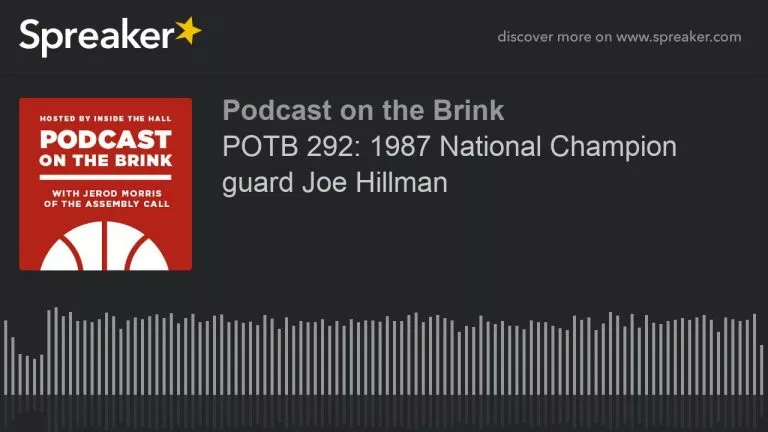
POTB 292: 1987 National Champion guard Joe Hillman
7. Tom Abernethy (1973–1976)
Tom Abernethy was the type of player every great team needs but few fans truly appreciate. As a key contributor to the undefeated 1976 national championship team, Abernethy embraced the role of doing the dirty work—defending, rebounding, and providing toughness inside. While teammates like Scott May and Kent Benson received most of the recognition, Abernethy’s contributions were essential to the team’s success.
He wasn’t a primary scoring option, but that was never his job. Instead, he focused on physical play, positioning, and execution, allowing Indiana’s stars to thrive. His willingness to sacrifice individual numbers for team success is exactly what defined Bob Knight’s system. Without players like Abernethy, that 32–0 season doesn’t happen. His legacy may not come with accolades or headlines, but his impact on one of the greatest teams in college basketball history is undeniable.
Greg Graham was one of the most reliable and consistent players on Indiana’s 1992 Final Four team, yet his name is rarely mentioned among the program’s top guards. By his senior season, Graham averaged over 16 points per game, showing he could be a legitimate scoring option while still fitting within Bob Knight’s structured system.
What made Graham valuable wasn’t just his scoring—it was his dependability. He played within himself, defended his position, and made timely plays without forcing the action. On a team loaded with talent, Graham provided balance and stability, allowing Indiana to function at a high level. He wasn’t flashy or attention-grabbing, but he consistently produced when it mattered.
Players like Graham often get lost in history because they don’t dominate headlines, but his role in one of Indiana’s most successful modern-era teams makes him one of the most underrated players the program has produced.
Top 10 Indiana Hoosier Basketball Players of All Time
5. Steve Green (1972–1975)
Steve Green provided critical scoring balance for the Hoosiers, yet his contributions are often overlooked in favor of higher-profile teammates. Green averaged double figures during his career and was a consistent offensive threat who could stretch defenses with his shooting.
On a team loaded with talent, Green’s ability to score without dominating the ball made him invaluable. He complemented players like Scott May and Quinn Buckner by providing spacing and offensive versatility. His willingness to play within the system while still producing consistently helped make Indiana nearly impossible to defend.
Green wasn’t just along for the ride—he was a key component of one of the greatest teams in
college basketball history. His scoring and efficiency deserve far more recognition than they typically receive.
1975 Hoosiers Senior Class 40th Reunion
4. Jim Thomas (1979–1983)
Jim Thomas was the type of player every championship team needs but few fans remember. As a member of the 1981 national championship team, Thomas provided toughness, rebounding, and interior defense—allowing Indiana’s perimeter stars to thrive.
He wasn’t asked to score, and he didn’t need to. His role was to handle the physical aspects of the game—setting screens, battling for rebounds, and protecting the paint. Those responsibilities rarely generate headlines, but they are essential to winning at a high level.
Thomas embraced that role completely. His willingness to do the work others avoided made him one of the most valuable players on that roster. Without him, Indiana loses a key element of its championship formula.
His shining moment was the Final Four in 1981 where his defense and rebounding landed him on the all-tournament team.
Jim Thomas (21pts/4asts) vs. Bulls (1985)
3. Tom Coverdale (1999–2003)
Coverdale helped led Indiana to the 2002 National Championship game, and yet his name is rarely mentioned among the program’s top guards. His performance in the Sweet 16 comeback against Duke remains one of the greatest in school history, as he controlled the tempo and delivered in the biggest moments.
Coverdale wasn’t the most athletic or physically gifted player, but he understood how to win. He managed games, made smart decisions, and consistently delivered under pressure. His leadership during that tournament run is one of the main reasons Indiana made it as far as it did.
In a program that values winning above all else, Coverdale’s legacy deserves far more recognition than it receives.
IU Oklahoma Final Four 2002 Moye Coverdale
2. A.J. Guyton (1996–2000)
A.J. Guyton is one of the most underappreciated scorers in Indiana history. Finishing his career with over 2,100 points, Guyton carried the offensive load during a transitional period in the late Bob Knight era. Despite his production, he is often overlooked when discussing the program’s all-time great guards.
Guyton had the ability to create his own shot, hit contested jumpers, and deliver in clutch situations. He was a two-time First Team All-Big Ten selection and one of the few players during that era capable of taking over a game offensively. Unfortunately, the lack of deep tournament success during his tenure has caused his individual accomplishments to be undervalued.
If Guyton had played on a championship-caliber team, his reputation would be entirely different. Instead, he remains one of the most overlooked elite scorers the program has ever had.
A.J.Guyton
1. Bobby Wilkerson (1973–1976)
Bobby Wilkerson was one of the most important defensive players on the undefeated
1976 national championship team, yet his contributions are often overshadowed by Indiana’s more prominent stars. Wilkerson was an elite defender who could guard multiple positions and disrupt opposing offenses with his anticipation and quickness.
His ability to create turnovers and apply pressure helped define Indiana’s defensive identity during that era. Wilkerson didn’t need to score to impact the game—his value came from shutting down opposing players and creating opportunities for his teammates.
In many ways, he was the defensive backbone of that team. Without Wilkerson, Indiana’s dominance on that end of the floor would not have been the same. He may not receive the same recognition as his teammates, but his role in one of the greatest teams ever is undeniable.
BOBBY WILKERSON 1976 NCAA MEN’S COLLEGIATE BASKETBALL HALL OF FAME LEGEND
Up To $1500 in Bonus Bets Paid Back if your First Bet Does Not Win
T&Cs apply
4.5/5
Gambling problem? Call 1-800-GAMBLER or 1-800-MY-RESET (Available in the US) 877-8-HOPENY or text HOPENY (467369) (NY) 1-800-327-5050 (MA), 1-800-BETS-OFF (IA), 1-800-981-0023 (PR). 21+ only. Please Gamble Responsibly. See BetMGM.com for Terms. First Bet Offer for new customers only (if applicable). Subject to eligibility requirements. Bonus bets are non-withdrawable. In partnership with Kansas Crossing Casino and Hotel. Promotional offers not available in Mississippi, Massachusetts, New York, Ontario, or Puerto Rico.
New DraftKings Customers: Spend $5+ Get $150 in Bonuses
T&Cs apply
4.5/5
GAMBLING PROBLEM? CALL 1-800-GAMBLER or 1-800-MY-RESET, (800) 327-5050 or visit gamblinghelplinema.org (MA). Please Gamble Responsibly. 888-789-7777/visit ccpg.org (CT), or visit www.mdgamblinghelp.org (MD), 1-800-981-0023 (PR). 21+ and present in most states. (18+ DC/NH/PR/WY). Void in CAN. Eligibility restrictions apply. On behalf of Boot Hill Casino (KS). Pass-thru of per wager tax may apply in IL. 1 per new DraftKings customer. $5+ first-time bet req. Max. $150 issued as non-withdrawable Bonus Bets. Stake removed from payout. Reward issued as $50 in Bonus Bets every 7 days via click-to-claim for 14 days. Bonus Bets and click-to-claims expire 7 days (168hrs) after issuance. Terms: sportsbook.draftkings.com/promos. Ends 10/11/26 at 11:59 PM ET. Sponsored by DK.
Must be 21+. GAMBLING PROBLEM? CALL 1-800-GAMBLER OR CALL 1-800-MY-RESET, www.mdgamblinghelp.org (MD), (800)-327-5050 or gamblinghelplinema.org (MA), Call (877)8-HOPENY or text HOPENY (467369) (NY), (888) 789-7777 or ccpg.org (CT), morethanagame.nc.gov (NC), 1800gambler.net (WV)
Bet $1 and get double the winnings up to $25 for your next 10 bets
T&Cs apply
4.4/5
21+ New users only. Must register using eligible promo code. First bet after registration must qualify. Max. Bonus Bet: $1,000. Bonus Bet expires 14 days after receipt. Void where prohibited. See Caesars.com/promos for full terms. Gambling Problem? 1-800-GAMBLER (1-800-426-2537)
21+ and present in OH. Gambling Problem? Call 1-800-GAMBLER.
This site is using
Cloudflare
and adheres to the
Google Safe Browsing Program. We adapted
Google's Privacy Guidelines
to keep your data safe at all times.
Close
Ready to Win Big? Join the Elite with Our Sports Betting Deals!
FanDuel Promo
New Users – Get $250 in Bonus Bets when you wager $5 for 5 days
Up To $1500 in Bonus Bets Paid Back if your First Bet Does Not Win
Best Slots
T&Cs and 21+ apply
Gambling problem? Call 1-800-GAMBLER or 1-800-MY-RESET (Available in the US) 877-8-HOPENY or text HOPENY (467369) (NY) 1-800-327-5050 (MA), 1-800-BETS-OFF (IA), 1-800-981-0023 (PR). 21+ only. Please Gamble Responsibly. See BetMGM.com for Terms. First Bet Offer for new customers only (if applicable). Subject to eligibility requirements. Bonus bets are non-withdrawable. In partnership with Kansas Crossing Casino and Hotel. Promotional offers not available in Mississippi, Massachusetts, New York, Ontario, or Puerto Rico.
Code:
Open BetMGM
Get Bonus
DraftKings Promo
New DraftKings Customers: Spend $5+ Get $150 in Bonuses
Newcomer
T&Cs and 21+ apply
GAMBLING PROBLEM? CALL 1-800-GAMBLER or 1-800-MY-RESET, (800) 327-5050 or visit gamblinghelplinema.org (MA). Please Gamble Responsibly. 888-789-7777/visit ccpg.org (CT), or visit www.mdgamblinghelp.org (MD), 1-800-981-0023 (PR). 21+ and present in most states. (18+ DC/NH/PR/WY). Void in CAN. Eligibility restrictions apply. On behalf of Boot Hill Casino (KS). Pass-thru of per wager tax may apply in IL. 1 per new DraftKings customer. $5+ first-time bet req. Max. $150 issued as non-withdrawable Bonus Bets. Stake removed from payout. Reward issued as $50 in Bonus Bets every 7 days via click-to-claim for 14 days. Bonus Bets and click-to-claims expire 7 days (168hrs) after issuance. Terms: sportsbook.draftkings.com/promos. Ends 10/11/26 at 11:59 PM ET. Sponsored by DK.
Code:
Open DraftKings
Get Bonus
Find out what the legends have to say about sports this week....





































![Video: [12.10.11] Jordan Hulls - 11 Points Vs Kentucky (Complete Highlights)](/wp-content/uploads/2026/05/video-12-10-11-jordan-hulls-11-points-vs-kentucky-complete-highlights--768x432.jpg.webp)