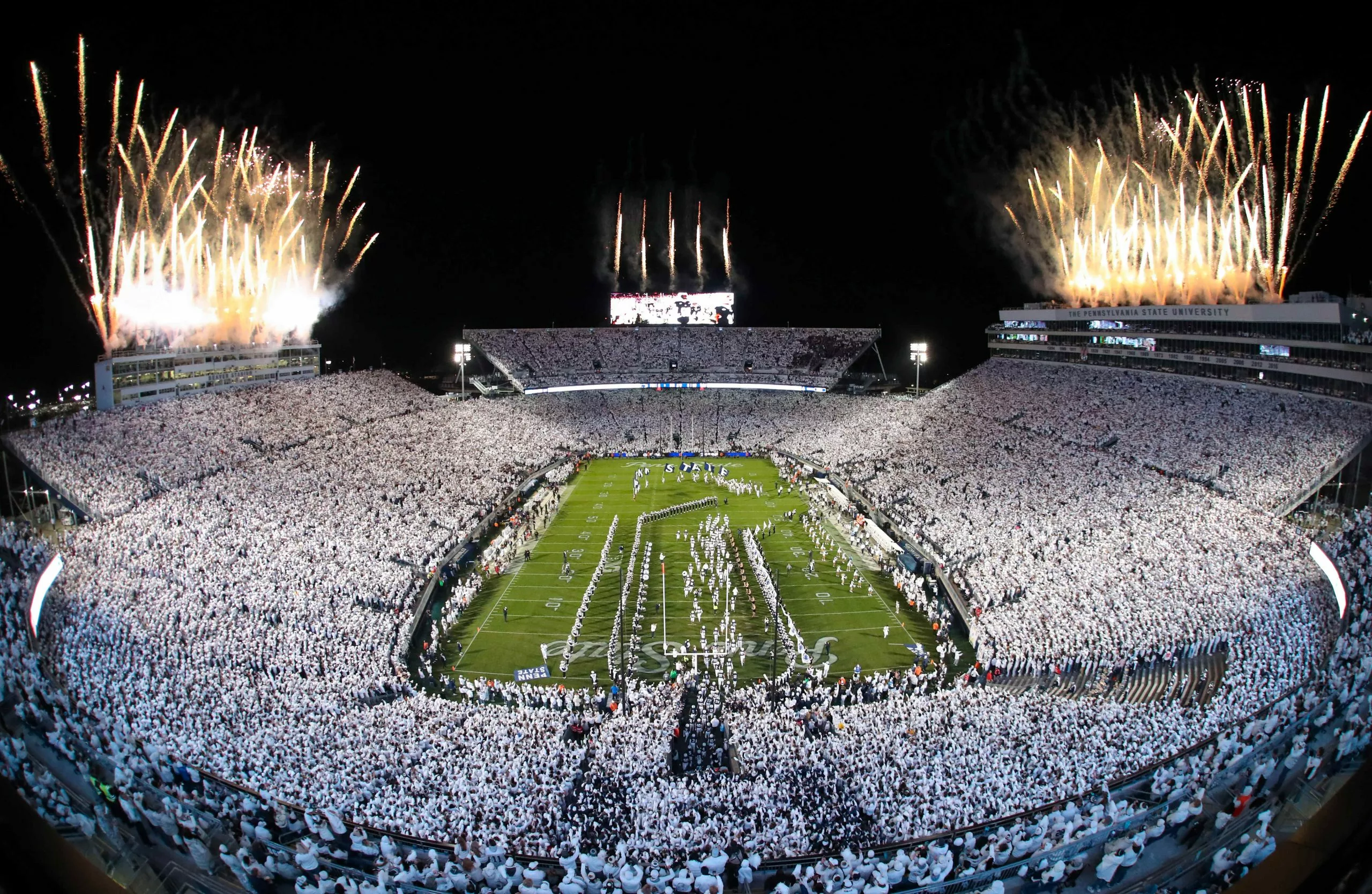
Nov 9, 2024; University Park, Pennsylvania, USA; Fireworks burst overhead as the Penn State Nittany Lions take the field prior to a White Out game against the Washington Huskies at Beaver Stadium. Mandatory Credit: Matthew O'Haren-Imagn Images
Great college football stadiums do more than hold fans.
They create fear.
The most intimidating stadiums in college football history become weapons. Communication disappears. Momentum snowballs instantly. Opponents walk into hostile environments knowing one mistake could bury them beneath noise, pressure, tradition, and chaos.
Some stadiums intimidate through sheer volume.
Others through history.
And a few become terrifying because the fan base itself treats Saturdays like holy war.
These are the ten most intimidating college football stadiums ever.
10. Neyland Stadium – Tennessee
When
Neyland Stadium
is fully alive, it feels like a massive orange earthquake.
More than 100,000 screaming Tennessee fans packed beside the Tennessee River create one of college football’s most emotional environments. The singing of “Rocky Top” becomes psychological torture for opposing teams once momentum shifts toward the Volunteers.
Night games especially become overwhelming.
The stadium’s steep design traps sound beautifully, and when Tennessee football is nationally relevant, the atmosphere becomes absolutely vicious.
The SEC has always respected Neyland for one simple reason:
Things spiral out of control quickly there.
9. Doak Campbell Stadium – Florida State
At its peak, Doak Campbell Stadium felt unbeatable.
The combination of speed, swagger, crowd noise, and pregame tradition created one of the most intimidating environments of the 1990s dynasty era under Bobby Bowden.
When the spear plants at midfield and the crowd explodes during the Seminole chant, opposing teams instantly understand they entered hostile territory.
Florida State’s dominance during its peak years amplified the fear factor because opponents knew falling behind often meant the game was over immediately.
8. Sanford Stadium – Georgia
“Between the Hedges” sounds peaceful.
It is not.
Sanford Stadium became one of college football’s most intimidating environments because Georgia fans combine SEC passion with modern championship expectations.
The crowd noise swallows communication during major moments, especially defensively. Since Kirby Smart transformed Georgia into a national superpower, the atmosphere reached another level entirely.
Opponents now enter Athens expecting violence, pressure, and relentless physical football.
And Sanford Stadium feeds directly into that identity.
7. The Horseshoe – Ohio State
Few stadiums carry more psychological pressure than Ohio Stadium.
“The Horseshoe” intimidates because of scale, history, and expectation. More than 100,000 fans create one of the loudest and most tradition-heavy environments in sports. When Ohio State enters a major game undefeated, the pressure inside the building becomes suffocating.
Michigan players have openly discussed the emotional intensity of entering the stadium.
Penn State has struggled with communication there repeatedly.
The Shoe feels enormous because Ohio State football itself feels enormous.
6. Autzen Stadium – Oregon
Autzen should not be this loud.
That is what makes it terrifying.
Despite being significantly smaller than many major college stadiums, Autzen Stadium traps sound so violently that opponents often compare it to NFL playoff environments.
Oregon’s speed-based football identity made the atmosphere even more dangerous during the Ducks’ rise nationally. Once the crowd senses momentum, the stadium becomes relentless.
Communication vanishes quickly.
Tempo overwhelms opponents.
And Autzen starts feeling much bigger than it actually is.
5. Bryant-Denny Stadium – Alabama
Fear changes when championships become expected.
Bryant-Denny Stadium
became terrifying because opponents spent over a decade entering the stadium knowing they would likely face the most disciplined machine in college football history.
During the Nick Saban era, Alabama crowds developed a cold confidence rarely seen elsewhere. The atmosphere was not chaotic.
It was clinical.
Opponents often looked mentally defeated after one early Alabama touchdown because the program itself became psychologically overwhelming nationally.
Bryant-Denny represented inevitability.
That is true intimidation.
4. The Swamp – Florida
There is a reason opponents hate playing at Ben Hill Griffin Stadium.
“The Swamp” combines brutal humidity, crowd proximity, SEC hostility, and pure chaos into one of college football’s nastiest environments. Florida fans sit directly on top of the action, creating enormous pressure on opposing offenses.
Steve Spurrier once famously said opponents “only get a half a Gatorade” leaving the stadium.
That attitude perfectly captured the building’s personality.
The Swamp feels exhausting emotionally and physically.
Especially at night.
Of course, now it’s not so scary, but I did say ever!
3. Tiger Stadium – LSU
Night games at Tiger Stadium may be the loudest environments in college football history.
“Death Valley” becomes absolute madness after dark.
The humidity suffocates opponents physically while the crowd suffocates them mentally. LSU fans weaponize noise better than almost any fan base in America, especially once momentum swings toward the Tigers.
Entire offensive drives collapse because communication becomes impossible.
Visiting teams routinely burn timeouts simply trying to survive emotionally.
Death Valley is not hype.
It is real.
2. Michigan Stadium – Michigan
“The Big House” intimidates differently than other stadiums.
It overwhelms through scale.
More than 110,000 fans packed into Michigan Stadium creates one of the most visually imposing environments in sports. Opponents often describe the stadium as feeling endless once they walk onto the field.
The atmosphere becomes especially brutal during rivalry games against Ohio State or major national matchups.
Every mistake feels magnified because the entire stadium reacts together.
Over 100,000 fans dressed completely in white transform Beaver Stadium into the most intimidating atmosphere in American sports. The visuals alone create pressure before the game even begins.
Then the noise starts.
Communication disappears instantly. Opposing quarterbacks panic. Offensive linemen jump early. Momentum swings become avalanches because the crowd never stops attacking mentally.
Even elite programs openly admit White Out games affect preparation all week beforehand.
The combination of scale, noise, visuals, emotion, and national intensity makes Beaver Stadium the most intimidating college football stadium ever.
Final Thoughts
Great college football stadiums become part of the game itself.
They create fear, pressure, confusion, and momentum that can completely alter outcomes. Opposing teams do not just battle talent inside these buildings.
Up To $1500 in Bonus Bets Paid Back if your First Bet Does Not Win
T&Cs apply
4.5/5
Gambling problem? Call 1-800-GAMBLER or 1-800-MY-RESET (Available in the US) 877-8-HOPENY or text HOPENY (467369) (NY) 1-800-327-5050 (MA), 1-800-BETS-OFF (IA), 1-800-981-0023 (PR). 21+ only. Please Gamble Responsibly. See BetMGM.com for Terms. First Bet Offer for new customers only (if applicable). Subject to eligibility requirements. Bonus bets are non-withdrawable. In partnership with Kansas Crossing Casino and Hotel. Promotional offers not available in Mississippi, Massachusetts, New York, Ontario, or Puerto Rico.
New DraftKings Customers: Spend $5+ Get $150 in Bonuses
T&Cs apply
4.5/5
GAMBLING PROBLEM? CALL 1-800-GAMBLER or 1-800-MY-RESET, (800) 327-5050 or visit gamblinghelplinema.org (MA). Please Gamble Responsibly. 888-789-7777/visit ccpg.org (CT), or visit www.mdgamblinghelp.org (MD), 1-800-981-0023 (PR). 21+ and present in most states. (18+ DC/NH/PR/WY). Void in CAN. Eligibility restrictions apply. On behalf of Boot Hill Casino (KS). Pass-thru of per wager tax may apply in IL. 1 per new DraftKings customer. $5+ first-time bet req. Max. $150 issued as non-withdrawable Bonus Bets. Stake removed from payout. Reward issued as $50 in Bonus Bets every 7 days via click-to-claim for 14 days. Bonus Bets and click-to-claims expire 7 days (168hrs) after issuance. Terms: sportsbook.draftkings.com/promos. Ends 10/11/26 at 11:59 PM ET. Sponsored by DK.
Must be 21+. GAMBLING PROBLEM? CALL 1-800-GAMBLER OR CALL 1-800-MY-RESET, www.mdgamblinghelp.org (MD), (800)-327-5050 or gamblinghelplinema.org (MA), Call (877)8-HOPENY or text HOPENY (467369) (NY), (888) 789-7777 or ccpg.org (CT), morethanagame.nc.gov (NC), 1800gambler.net (WV)
Bet $1 and get double the winnings up to $25 for your next 10 bets
T&Cs apply
4.4/5
21+ New users only. Must register using eligible promo code. First bet after registration must qualify. Max. Bonus Bet: $1,000. Bonus Bet expires 14 days after receipt. Void where prohibited. See Caesars.com/promos for full terms. Gambling Problem? 1-800-GAMBLER (1-800-426-2537)
21+ and present in OH. Gambling Problem? Call 1-800-GAMBLER.
This site is using
Cloudflare
and adheres to the
Google Safe Browsing Program. We adapted
Google's Privacy Guidelines
to keep your data safe at all times.
Close
Ready to Win Big? Join the Elite with Our Sports Betting Deals!
FanDuel Promo
New Users – Get $250 in Bonus Bets when you wager $5 for 5 days
Up To $1500 in Bonus Bets Paid Back if your First Bet Does Not Win
Best Slots
T&Cs and 21+ apply
Gambling problem? Call 1-800-GAMBLER or 1-800-MY-RESET (Available in the US) 877-8-HOPENY or text HOPENY (467369) (NY) 1-800-327-5050 (MA), 1-800-BETS-OFF (IA), 1-800-981-0023 (PR). 21+ only. Please Gamble Responsibly. See BetMGM.com for Terms. First Bet Offer for new customers only (if applicable). Subject to eligibility requirements. Bonus bets are non-withdrawable. In partnership with Kansas Crossing Casino and Hotel. Promotional offers not available in Mississippi, Massachusetts, New York, Ontario, or Puerto Rico.
Code:
Open BetMGM
Get Bonus
DraftKings Promo
New DraftKings Customers: Spend $5+ Get $150 in Bonuses
Newcomer
T&Cs and 21+ apply
GAMBLING PROBLEM? CALL 1-800-GAMBLER or 1-800-MY-RESET, (800) 327-5050 or visit gamblinghelplinema.org (MA). Please Gamble Responsibly. 888-789-7777/visit ccpg.org (CT), or visit www.mdgamblinghelp.org (MD), 1-800-981-0023 (PR). 21+ and present in most states. (18+ DC/NH/PR/WY). Void in CAN. Eligibility restrictions apply. On behalf of Boot Hill Casino (KS). Pass-thru of per wager tax may apply in IL. 1 per new DraftKings customer. $5+ first-time bet req. Max. $150 issued as non-withdrawable Bonus Bets. Stake removed from payout. Reward issued as $50 in Bonus Bets every 7 days via click-to-claim for 14 days. Bonus Bets and click-to-claims expire 7 days (168hrs) after issuance. Terms: sportsbook.draftkings.com/promos. Ends 10/11/26 at 11:59 PM ET. Sponsored by DK.
Code:
Open DraftKings
Get Bonus
Find out what the legends have to say about sports this week....