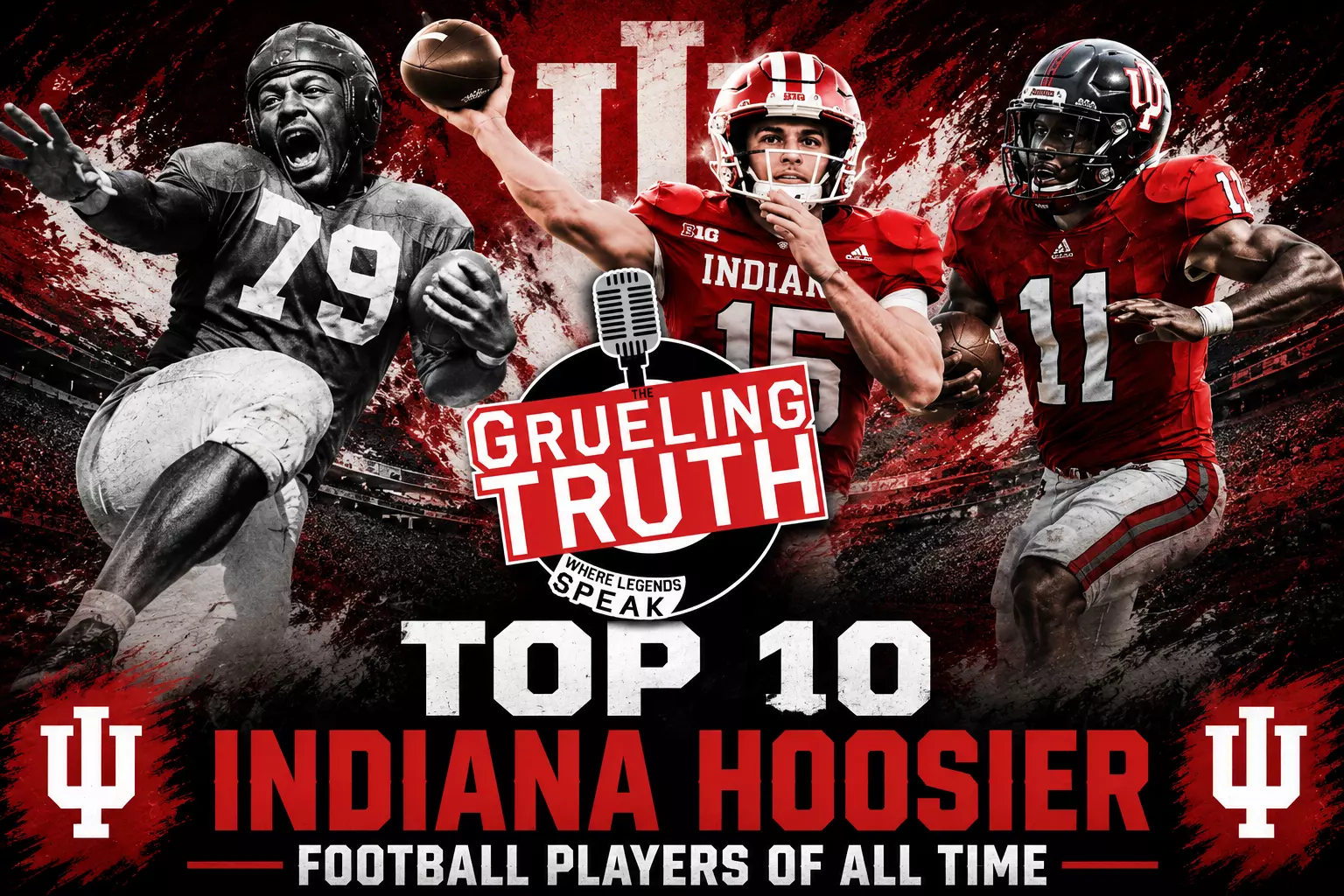
It would seem that the Indiana Hoosiers started playing football in 2024, that's not true it seems Indiana Football has many legends.
For decades, Indiana Hoosiers football lived in the shadows of the Big Ten powers. The Hoosiers were often overlooked nationally, rarely mentioned among the elite programs in college football, and forced to fight for respect every single season.
But greatness has always existed in Bloomington.
From Hall of Fame pioneers to statistical monsters to modern championship legends,
Indiana football
has produced players who changed the sport, changed the university, and ultimately changed the expectations surrounding the program forever.
Then came the Curt Cignetti era and the 2025 National Championship season, the year Indiana football finally climbed the mountain nobody believed it could reach.
This list balances everything:
Individual greatness
Historical impact
Program-changing influence
Championships
NFL success
Statistical dominance
Legacy
And with that in mind, here are the 10 greatest Indiana Hoosier football players of all time.
T-10. Dan Feeney — Offensive Line (2012–16)
Offensive linemen rarely receive enough recognition, but Dan Feeney forced people to notice.
Feeney became one of the most decorated linemen in program history:
Two-time First-Team All-American
Multi-year All-Big Ten performer
Team leader and tone-setter
He anchored some of Indiana’s best modern offenses and consistently battled elite defensive fronts across the Big Ten.
More importantly, Feeney represented toughness. He played through injuries, fought through adversity, and became the foundation of Indiana’s offensive identity during his era.
Until the championship run of 2025, Feeney was widely viewed as the greatest offensive lineman Indiana had ever produced.
#BTNAllDecade Team Selection: Indiana G Dan Feeney | Big Ten Football
T-10. James Hardy — Wide Receiver (2005–07)
James Hardy remains the greatest wide receiver in Indiana football history.
At 6-foot-7, Hardy was almost impossible to defend near the goal line. He combined elite size with remarkable athleticism and became the centerpiece of Indiana’s offense during one of the most emotional periods in school history.
Hardy still owns school records for:
Career receptions
Receiving yards
Receiving touchdowns
But his legacy goes beyond numbers.
Following the tragic death of head coach Terry Hoeppner in 2007, Hardy helped rally the Hoosiers emotionally and spiritually. Indiana fought its way to the Insight Bowl and earned one of the most meaningful victories in program history.
Hardy wasn’t just productive. He became symbolic of Indiana football’s resilience.
James Hardy 20-yard TD vs Iowa
9. John Isenbarger — Tailback/Punter (1967–69)
Before the modern stars, before the explosive offenses, and before Indiana football dreamed of national championships, there was John Isenbarger — one of the most complete and versatile players in school history.
Isenbarger became the centerpiece of Indiana’s legendary 1967 Big Ten Championship team, helping lead the Hoosiers to one of the greatest seasons the program had experienced prior to the Curt Cignetti era. That 1967 squad earned a trip to the Rose Bowl and remains one of the defining teams in Indiana football history.
What made Isenbarger special was his ability to impact every phase of the game.
He starred as both:
Tailback
Punter
while leading Indiana in both rushing and punting for three consecutive seasons.
By the time his career ended, Isenbarger had rewritten Indiana’s rushing record book. His 1,217 rushing yards in 1969 set a new school single-season record at the time, and he also established new career rushing marks for the Hoosiers.
His accolades were equally impressive:
Two-time All-American
First-Team All-Big Ten selection
Indiana Most Valuable Player in 1969
Played in the East-West Shrine Game
Hula Bowl participant
College All-Star Game selection
Most importantly, Isenbarger represented toughness and versatility during an era when football demanded players do everything. He wasn’t just a great runner — he was the engine that powered one of the most important teams in Indiana football history.
Long before Indiana football became nationally relevant again, John Isenbarger helped prove the Hoosiers could compete with anybody in the Big Ten.
Indiana upsets Purdue classic college football 1967
8. Trent Green — Quarterback (1989–92)
Before Indiana became associated with explosive quarterback play, there was Trent Green.
Green threw for over 5,400 career yards during an era when Big Ten football was still heavily built around power running games. He brought sophistication and consistency to Indiana’s passing attack and helped stabilize the program during the
Bill Mallory era.
Green’s intelligence and precision made him one of the most efficient quarterbacks in school history.
His later NFL success elevated his legacy even further. Green became a two-time Pro Bowler with the Kansas City Chiefs and one of the most respected quarterbacks of his generation.
B1G Stories with Tom Dienhart: Trent Green On Bill Mallory
7. Harry Gonso — Quarterback (1967–69)
Few quarterbacks in the history of Indiana Hoosiers football meant more to winning than Harry Gonso.
Gonso was the leader and field general of Indiana’s legendary
1967 Big Ten Championship
team, one of the most important squads in school history prior to the national championship breakthrough of 2025. Under head coach John Pont, Gonso helped guide the Hoosiers to a Rose Bowl appearance and a season that permanently changed how Indiana football was viewed nationally.
What made Gonso unique was his toughness, intelligence, and ability to make plays in the biggest moments. He wasn’t flashy in the modern sense, but he embodied winning football. During an era dominated by power football and defensive battles, Gonso consistently delivered when Indiana needed him most.
He earned:
First-Team All-Big Ten honors
Team MVP recognition
National respect as one of the conference’s best quarterbacks
More importantly, he became the face of one of the greatest eras in Indiana football history.
The 1967 team was built on discipline, toughness, and belief, and Harry Gonso was at the center of all of it. His leadership helped elevate Indiana from conference afterthought to Big Ten champion, something few quarterbacks in school history can claim.
Before Fernando Mendoza brought a national championship to Bloomington, Harry Gonso quarterbacked the team that set the standard for Indiana football greatness for nearly six decades.
Harry Gonso, Former IU Trustee and Daniels Chief of Staff
6. Tevin Coleman — Running Back (2012–14)
At his peak, Tevin Coleman may have been the most explosive offensive player Indiana ever produced.
His 2014 season was absolutely historic:
2,036 rushing yards
Unanimous First-Team All-American
Doak Walker Award finalist
Every defense knew Coleman was getting the football, and nobody could stop him anyway.
Coleman combined elite acceleration, breakaway speed, vision, and toughness. He could turn a routine inside zone play into an 80-yard touchdown in seconds.
Had Indiana fielded a stronger defense during his era, Coleman likely becomes a serious Heisman contender nationally.
Tevin Coleman Highlight Reel
5. Antwaan Randle El — Quarterback (1998–2001)
Long before dual-threat quarterbacks became common, Antwaan Randle El was redefining what the position could be.
Randle El became the first player in NCAA Division I history to:
Pass for 40 touchdowns
Rush for 40 touchdowns
He was electric every time he touched the football. Defensive coordinators had nightmares trying to contain him because he could destroy teams with his arm, his legs, or pure improvisation.
More importantly, he made Indiana football nationally relevant.
Even fans of rival schools tuned in just to watch him play.
Randle El remains one of the most entertaining players in college football history.
AntwaanRandleElLevronWilliamshighlights.mp4
4. Anthony Thompson — Running Back (1986–89)
For decades, Anthony Thompson represented the gold standard of Indiana football greatness.
His 1989 season remains one of the greatest individual seasons in
Big Ten history:
Heisman Trophy runner-up
Maxwell Award winner
Walter Camp Award winner
NCAA leader in rushing touchdowns and scoring
Thompson’s career touchdown total of 65 stood as the Division I record for years.
What separated Thompson from many great college backs was consistency. He delivered elite production year after year while carrying the pressure of being the face of Indiana football nationally.
For an entire generation of Hoosier fans, Anthony Thompson was Indiana football.
Most Iconic Person: Anthony Thompson | B1G Football
3. George Taliaferro — Halfback (1945, 1947–48)
George Taliaferro is one of the most important figures in college football history.
A three-time All-American, Taliaferro starred on Indiana’s legendary 1945 Big Ten championship team and became the first Black player ever drafted into the NFL.
But reducing his story to historical significance alone would undersell how dominant he actually was on the field.
Taliaferro could do everything:
Run
Pass
Return kicks
Defend
Lead
He was one of the most versatile players of his era and played the game with elegance, toughness, and intelligence during a period of enormous racial adversity.
His greatness transcended football.
Taliaferro helped change the sport itself.
George Taliaferro 🏈🔥 Indiana University
2. Pete Pihos — End/Fullback (1942–43, 1945–46)
No discussion about the greatest players in the history of Indiana Hoosiers football is complete without Pete Pihos.
Long before modern offenses, television contracts, and playoff systems transformed college football, Pihos established himself as one of the most dominant and versatile players the sport had ever seen. Playing both end and fullback during the 1940s, he became the foundation of Indiana’s legendary 1945 Big Ten Championship team, a squad that stood as the gold standard of Hoosier football for generations.
Pihos was the definition of an old-school football warrior:
Four-time All-American
Two-way star
Elite blocker
Dominant receiver
Physical runner
Relentless competitor
Very few players in college football history could impact the game in as many ways as Pihos did.
His greatness extended far beyond Bloomington. After his Indiana career, Pihos became an NFL star with the Philadelphia Eagles, winning multiple NFL championships before earning induction into both:
The College Football Hall of Fame
The Pro Football Hall of Fame
That combination of collegiate and professional greatness places him in extraordinarily rare company.
For decades, Pete Pihos was viewed as the greatest player Indiana football had ever produced, and there is still a powerful argument for that today. His toughness, versatility, and championship pedigree helped establish the foundation upon which every future Hoosier legend would build.
PHILADELPHIA EAGLES PETE PIHOS [Full Highlights] 🦅🏆🏅
1. Fernando Mendoza — Quarterback (2025)
No player changed the history of Indiana Hoosiers football more than Fernando Mendoza.
Not Pete Pihos. Not Anthony Thompson. Not Antwaan Randle El.
Fernando Mendoza accomplished what generations of Indiana players had dreamed about but never achieved:
National Championship
Rose Bowl victory
Perfect season
Historic statistical production
National respect
Mendoza threw 41 touchdown passes during the greatest season in school history and became the face of the most important era Indiana football has ever experienced.
That matters.
Programs like Texas, Alabama, Ohio State, and USC have won championships before. Indiana had not.
What Mendoza did was fundamentally different because he transformed the identity of an entire football program. He permanently changed what Indiana football could aspire to become.
Pete Pihos may have been the greatest traditional football player Indiana ever produced.
Up To $1500 in Bonus Bets Paid Back if your First Bet Does Not Win
T&Cs apply
4.5/5
Gambling problem? Call 1-800-GAMBLER or 1-800-MY-RESET (Available in the US) 877-8-HOPENY or text HOPENY (467369) (NY) 1-800-327-5050 (MA), 1-800-BETS-OFF (IA), 1-800-981-0023 (PR). 21+ only. Please Gamble Responsibly. See BetMGM.com for Terms. First Bet Offer for new customers only (if applicable). Subject to eligibility requirements. Bonus bets are non-withdrawable. In partnership with Kansas Crossing Casino and Hotel. Promotional offers not available in Mississippi, Massachusetts, New York, Ontario, or Puerto Rico.
New DraftKings Customers: Spend $5+ Get $150 in Bonuses
T&Cs apply
4.5/5
GAMBLING PROBLEM? CALL 1-800-GAMBLER or 1-800-MY-RESET, (800) 327-5050 or visit gamblinghelplinema.org (MA). Please Gamble Responsibly. 888-789-7777/visit ccpg.org (CT), or visit www.mdgamblinghelp.org (MD), 1-800-981-0023 (PR). 21+ and present in most states. (18+ DC/NH/PR/WY). Void in CAN. Eligibility restrictions apply. On behalf of Boot Hill Casino (KS). Pass-thru of per wager tax may apply in IL. 1 per new DraftKings customer. $5+ first-time bet req. Max. $150 issued as non-withdrawable Bonus Bets. Stake removed from payout. Reward issued as $50 in Bonus Bets every 7 days via click-to-claim for 14 days. Bonus Bets and click-to-claims expire 7 days (168hrs) after issuance. Terms: sportsbook.draftkings.com/promos. Ends 10/11/26 at 11:59 PM ET. Sponsored by DK.
Must be 21+. GAMBLING PROBLEM? CALL 1-800-GAMBLER OR CALL 1-800-MY-RESET, www.mdgamblinghelp.org (MD), (800)-327-5050 or gamblinghelplinema.org (MA), Call (877)8-HOPENY or text HOPENY (467369) (NY), (888) 789-7777 or ccpg.org (CT), morethanagame.nc.gov (NC), 1800gambler.net (WV)
Bet $1 and get double the winnings up to $25 for your next 10 bets
T&Cs apply
4.4/5
21+ New users only. Must register using eligible promo code. First bet after registration must qualify. Max. Bonus Bet: $1,000. Bonus Bet expires 14 days after receipt. Void where prohibited. See Caesars.com/promos for full terms. Gambling Problem? 1-800-GAMBLER (1-800-426-2537)
21+ and present in OH. Gambling Problem? Call 1-800-GAMBLER.
This site is using
Cloudflare
and adheres to the
Google Safe Browsing Program. We adapted
Google's Privacy Guidelines
to keep your data safe at all times.
Close
Ready to Win Big? Join the Elite with Our Sports Betting Deals!
FanDuel Promo
New Users – Get $250 in Bonus Bets when you wager $5 for 5 days
Up To $1500 in Bonus Bets Paid Back if your First Bet Does Not Win
Best Slots
T&Cs and 21+ apply
Gambling problem? Call 1-800-GAMBLER or 1-800-MY-RESET (Available in the US) 877-8-HOPENY or text HOPENY (467369) (NY) 1-800-327-5050 (MA), 1-800-BETS-OFF (IA), 1-800-981-0023 (PR). 21+ only. Please Gamble Responsibly. See BetMGM.com for Terms. First Bet Offer for new customers only (if applicable). Subject to eligibility requirements. Bonus bets are non-withdrawable. In partnership with Kansas Crossing Casino and Hotel. Promotional offers not available in Mississippi, Massachusetts, New York, Ontario, or Puerto Rico.
Code:
Open BetMGM
Get Bonus
DraftKings Promo
New DraftKings Customers: Spend $5+ Get $150 in Bonuses
Newcomer
T&Cs and 21+ apply
GAMBLING PROBLEM? CALL 1-800-GAMBLER or 1-800-MY-RESET, (800) 327-5050 or visit gamblinghelplinema.org (MA). Please Gamble Responsibly. 888-789-7777/visit ccpg.org (CT), or visit www.mdgamblinghelp.org (MD), 1-800-981-0023 (PR). 21+ and present in most states. (18+ DC/NH/PR/WY). Void in CAN. Eligibility restrictions apply. On behalf of Boot Hill Casino (KS). Pass-thru of per wager tax may apply in IL. 1 per new DraftKings customer. $5+ first-time bet req. Max. $150 issued as non-withdrawable Bonus Bets. Stake removed from payout. Reward issued as $50 in Bonus Bets every 7 days via click-to-claim for 14 days. Bonus Bets and click-to-claims expire 7 days (168hrs) after issuance. Terms: sportsbook.draftkings.com/promos. Ends 10/11/26 at 11:59 PM ET. Sponsored by DK.
Code:
Open DraftKings
Get Bonus
Find out what the legends have to say about sports this week....



































![Video: PHILADELPHIA EAGLES PETE PIHOS [Full Highlights] 🦅🏆🏅](/wp-content/uploads/2023/02/video-philadelphia-eagles-pete-pihos-full-highlights-.jpg.webp)