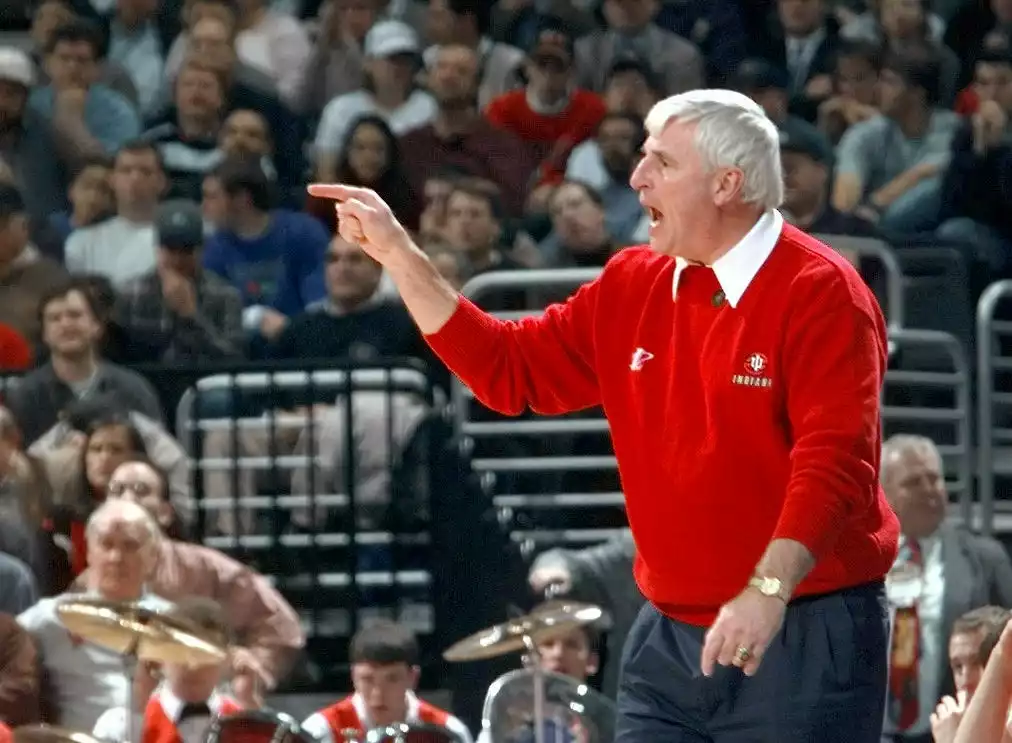
Bob Knight retired as men's college basketball's all-time winningest coach.
You don’t define Bob Knight with soundbites.
You define him with games—moments where preparation crushed talent, discipline beat chaos, and
Indiana Hoosiers men’s basketball
imposed its will on the biggest stages in the sport.
This is the real list. No filler. No bad history. Just the games that built the legend.
10. Indiana 53, Purdue 52 — March 21, 1979 (NIT Championship, Madison Square Garden)
Knight didn’t accept down years—and this game proves it.
After missing the NCAA Tournament, Indiana faced rival Purdue Boilermakers men’s basketball in the NIT title game. Purdue was one of the best teams in the country, led by All-American Joe Barry Carroll. The Big Ten that year had a three-way tie for first and Purdue was one of those three. Back then the tournament field was smaller so only two Big Ten Teams were allowed in the tourney and that is why Purdue was left out.
Indiana made it ugly—and that was the plan.
The Hoosiers slowed the game, defended relentlessly, and turned it into a possession-by-possession fight. Every mistake mattered.
Then came the moment—Butch Carter’s game-winning shot.
This wasn’t just about winning the NIT. It was about proving that even in a “down” season, Knight’s teams could still beat elite competition on a national stage.
Indiana vs Purdue – 3/21/1979 – NIT Championship Game
If the 1976 run defined Bob Knight’s rise, this game defined his ability to evolve.
Facing the UCLA Bruins in the Elite Eight, Indiana didn’t grind out a typical Knight-style win—they exploded. The 106–79 victory wasn’t just decisive, it was shocking in how it happened. Knight’s teams were known for control, defense, and discipline—not hanging triple digits in an Elite Eight game.
But this 1992 group was different.
Led by Calbert Cheaney and a balanced offensive attack, Indiana turned the game into a clinic in efficiency. They pushed when opportunities were there, executed in the half court, and completely overwhelmed UCLA with pace and precision. Every possession felt intentional—and devastating.
This game matters because it shattered the stereotype of what a Knight team could be. Indiana didn’t just win—they dominated a blue-blood program on a national stage.
It sent the Hoosiers to the Final Four and proved that even late in his career, Knight could adapt, expand offensively, and still impose his will at the highest level.
This was the moment the balance of power shifted in college basketball. UCLA Bruins men’s basketball had defined dominance for over a decade, and even post-John Wooden, they still represented the standard.
Indiana didn’t just beat UCLA—they dismantled them.
The Hoosiers dictated pace, defended at an elite level, and never allowed UCLA to establish rhythm. Scott May and Kent Benson led the offense, but the real story was execution. Every possession mattered, and Indiana controlled them.
This wasn’t a fluke. It was a statement. Knight didn’t want to compete with UCLA—he wanted to replace them. This game proved he could.
1976 Final Four: Indiana vs UCLA – Clash of College Giants !
This is where Knight’s Indiana truly arrived. Before this game, the Hoosiers were a strong Big Ten program trying to break into the national elite. Kentucky Wildcats men’s basketball was already there. Beating them on a neutral floor in Nashville carried real weight in that era, especially in the NCAA Tournament.
Indiana didn’t pull a miracle—they controlled the game. The Hoosiers jumped out early, dictated tempo, and forced Kentucky into a half-court battle that neutralized their athleticism. Knight’s emphasis on spacing, patience, and decision-making was already taking shape.
The significance is bigger than the score. This win sent Indiana to the Final Four and proved Knight could build a team that would win in March against a blue blood. It wasn’t flashy, but it was disciplined—and that would define everything that followed.
Winning at Ann Arbor in 1993 meant walking into one of the most hostile environments in college basketball and facing one of the most talented teams in the country. The Michigan Wolverines men’s basketball, powered by the Fab Five, could overwhelm opponents with athleticism, pace, and swagger. Most teams tried to match that style—and lost because of it.
Bob Knight never played that game.
Indiana dictated terms from the opening tip. The Hoosiers slowed the tempo, forced Michigan into a half-court battle, and turned the game into a possession-by-possession grind. That’s exactly where Knight’s teams lived.
Calbert Cheaney delivered like a star, providing consistent scoring and composure when Michigan made its inevitable runs. But the difference wasn’t just Cheaney—it was execution. Indiana didn’t panic, didn’t rush, and didn’t give the game away.
In a one-point finish, that discipline mattered.
The 76–75 win wasn’t flashy. It was controlled. And that’s what made it one of the most defining road performances of Knight’s later years—beating elite talent by refusing to play their game. Knight owned the Fab Five winning three of the four games played between the teams.
Indiana Hoosiers vs Michigan Wolverines (January 12, 1993) “The Hoosiers Take Care Of The Fab Five”
Perfect seasons don’t survive games like this unless the team is built differently.
Marquette Golden Eagles men’s basketball was tough, physical, and more than capable of ending Indiana’s undefeated run. The pressure was enormous—everything was on the line.
Knight’s team didn’t flinch.
Indiana controlled tempo, defended with discipline, and executed just enough offensively to separate late. This wasn’t a blowout—it was a grind. Exactly the kind of game where lesser teams break.
Indiana didn’t.
This game is often overlooked because of what came after, but it was essential. Without this win, there is no perfect season. It showed Knight’s teams could win not just with dominance, but with composure under pressure.
Seeding was much different in 1976 and this game was played between what most people considered the best two teams in the country. Marquette would win it all the next year.
March 20, 1976 – Indiana vs Marquette: NCAA Tournament Clash !
4. Indiana 63, North Carolina 50 — March 30, 1981 (National Championship, Philadelphia)
This game cemented Knight as more than a one-title coach.
These teams played earlier in the season and the Tar Heels won going away, this time would be much differenr.
Facing North Carolina Tar Heels men’s basketball and Dean Smith, Indiana delivered a controlled, disciplined performance. The Hoosiers dictated tempo, defended at a high level, and executed efficiently.
Isiah Thomas led the way, controlling the pace and making critical plays. North Carolina never found rhythm because Indiana never allowed it.
This wasn’t dramatic—it was methodical.
Knight now had two titles with different types of teams, proving his system wasn’t dependent on one roster style. That adaptability defined his greatness.
Indiana vs. UNC: 1981 NCAA men’s basketball national championship | FULL REPLAY
3. Indiana 72, North Carolina 68 — March 23, 1984 (NCAA Sweet 16, Atlanta)
This is one of the greatest coaching performances of Knight’s career.
North Carolina Tar Heels men’s basketball came in loaded—Michael Jordan, Sam Perkins, Brad Daugherty. Indiana didn’t match that talent.
So Knight changed the game.
Indiana slowed tempo, forced a half-court battle, and relied on execution. Michael Jordan got in foul trouble early, frustrating Jordan and limiting his impact before he fouled out.
Indiana didn’t out-talent North Carolina.
They out-coached them.
Indiana vs. UNC (1984 Sweet 16): Michael Jordan’s final college game
2. Indiana 74, Syracuse 73 — March 30, 1987 (National Championship, New Orleans)
The shot is iconic—but the preparation is the story.
Facing Syracuse Orange men’s basketball, Indiana executed under pressure all night. Steve Alford kept the Hoosiers in position early with his scoring and leadership.
Then came the final possession.
Knight trusted his system, ran the play, and Keith Smart delivered.
This wasn’t improvisation—it was design.
Knight’s third title came through execution, not chaos. That’s what made his teams different.
Up To $1500 in Bonus Bets Paid Back if your First Bet Does Not Win
T&Cs apply
4.5/5
Gambling problem? Call 1-800-GAMBLER or 1-800-MY-RESET (Available in the US) 877-8-HOPENY or text HOPENY (467369) (NY) 1-800-327-5050 (MA), 1-800-BETS-OFF (IA), 1-800-981-0023 (PR). 21+ only. Please Gamble Responsibly. See BetMGM.com for Terms. First Bet Offer for new customers only (if applicable). Subject to eligibility requirements. Bonus bets are non-withdrawable. In partnership with Kansas Crossing Casino and Hotel. Promotional offers not available in Mississippi, Massachusetts, New York, Ontario, or Puerto Rico.
New DraftKings Customers: Spend $5+ Get $150 in Bonuses
T&Cs apply
4.5/5
GAMBLING PROBLEM? CALL 1-800-GAMBLER or 1-800-MY-RESET, (800) 327-5050 or visit gamblinghelplinema.org (MA). Please Gamble Responsibly. 888-789-7777/visit ccpg.org (CT), or visit www.mdgamblinghelp.org (MD), 1-800-981-0023 (PR). 21+ and present in most states. (18+ DC/NH/PR/WY). Void in CAN. Eligibility restrictions apply. On behalf of Boot Hill Casino (KS). Pass-thru of per wager tax may apply in IL. 1 per new DraftKings customer. $5+ first-time bet req. Max. $150 issued as non-withdrawable Bonus Bets. Stake removed from payout. Reward issued as $50 in Bonus Bets every 7 days via click-to-claim for 14 days. Bonus Bets and click-to-claims expire 7 days (168hrs) after issuance. Terms: sportsbook.draftkings.com/promos. Ends 10/11/26 at 11:59 PM ET. Sponsored by DK.
Must be 21+. GAMBLING PROBLEM? CALL 1-800-GAMBLER OR CALL 1-800-MY-RESET, www.mdgamblinghelp.org (MD), (800)-327-5050 or gamblinghelplinema.org (MA), Call (877)8-HOPENY or text HOPENY (467369) (NY), (888) 789-7777 or ccpg.org (CT), morethanagame.nc.gov (NC), 1800gambler.net (WV)
Bet $1 and get double the winnings up to $25 for your next 10 bets
T&Cs apply
4.4/5
21+ New users only. Must register using eligible promo code. First bet after registration must qualify. Max. Bonus Bet: $1,000. Bonus Bet expires 14 days after receipt. Void where prohibited. See Caesars.com/promos for full terms. Gambling Problem? 1-800-GAMBLER (1-800-426-2537)
21+ and present in OH. Gambling Problem? Call 1-800-GAMBLER.
This site is using
Cloudflare
and adheres to the
Google Safe Browsing Program. We adapted
Google's Privacy Guidelines
to keep your data safe at all times.
Close
Ready to Win Big? Join the Elite with Our Sports Betting Deals!
FanDuel Promo
New Users – Get $250 in Bonus Bets when you wager $5 for 5 days
Up To $1500 in Bonus Bets Paid Back if your First Bet Does Not Win
Best Slots
T&Cs and 21+ apply
Gambling problem? Call 1-800-GAMBLER or 1-800-MY-RESET (Available in the US) 877-8-HOPENY or text HOPENY (467369) (NY) 1-800-327-5050 (MA), 1-800-BETS-OFF (IA), 1-800-981-0023 (PR). 21+ only. Please Gamble Responsibly. See BetMGM.com for Terms. First Bet Offer for new customers only (if applicable). Subject to eligibility requirements. Bonus bets are non-withdrawable. In partnership with Kansas Crossing Casino and Hotel. Promotional offers not available in Mississippi, Massachusetts, New York, Ontario, or Puerto Rico.
Code:
Open BetMGM
Get Bonus
DraftKings Promo
New DraftKings Customers: Spend $5+ Get $150 in Bonuses
Newcomer
T&Cs and 21+ apply
GAMBLING PROBLEM? CALL 1-800-GAMBLER or 1-800-MY-RESET, (800) 327-5050 or visit gamblinghelplinema.org (MA). Please Gamble Responsibly. 888-789-7777/visit ccpg.org (CT), or visit www.mdgamblinghelp.org (MD), 1-800-981-0023 (PR). 21+ and present in most states. (18+ DC/NH/PR/WY). Void in CAN. Eligibility restrictions apply. On behalf of Boot Hill Casino (KS). Pass-thru of per wager tax may apply in IL. 1 per new DraftKings customer. $5+ first-time bet req. Max. $150 issued as non-withdrawable Bonus Bets. Stake removed from payout. Reward issued as $50 in Bonus Bets every 7 days via click-to-claim for 14 days. Bonus Bets and click-to-claims expire 7 days (168hrs) after issuance. Terms: sportsbook.draftkings.com/promos. Ends 10/11/26 at 11:59 PM ET. Sponsored by DK.
Code:
Open DraftKings
Get Bonus
Find out what the legends have to say about sports this week....