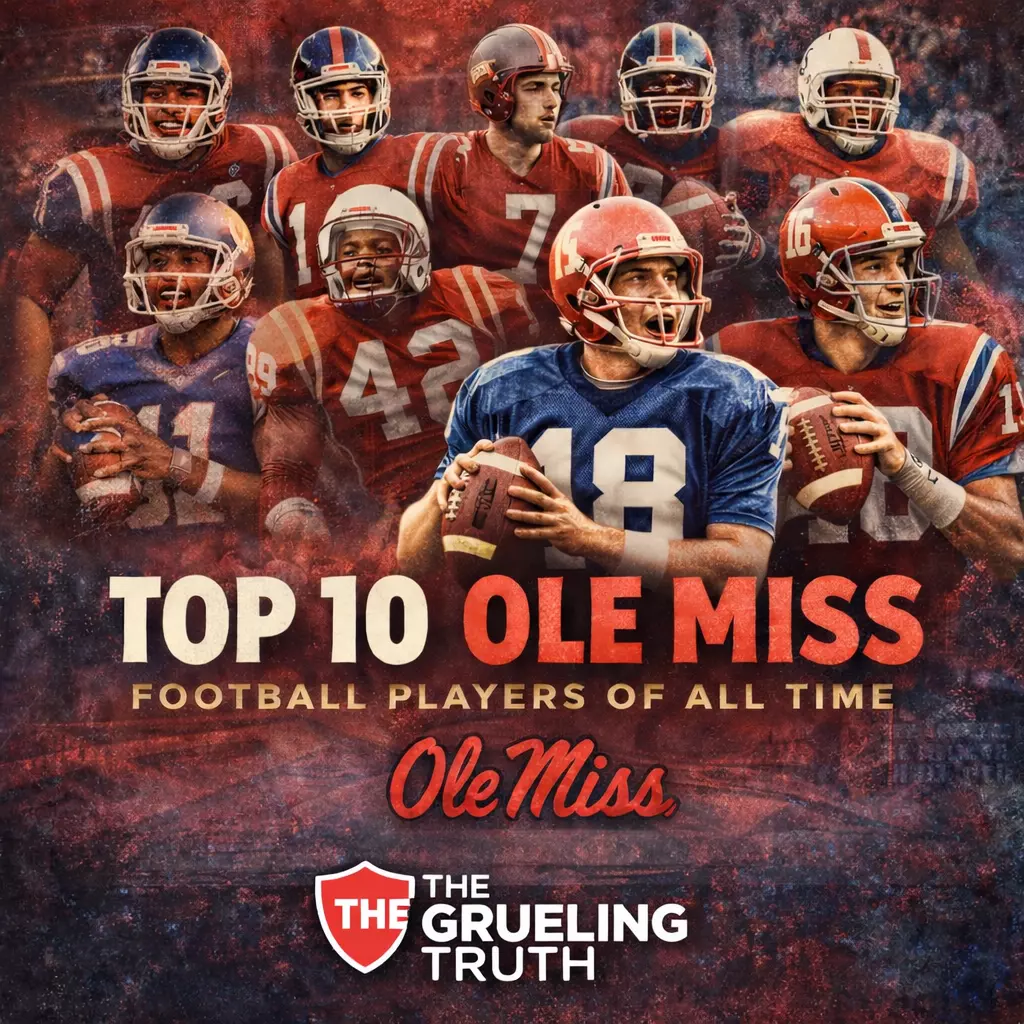
Ole Miss football history is not defined by sustained national dominance, but by
individual greatness—players who carried the program, elevated it, and in some cases preserved it during difficult eras. From national icons to trench warriors, these ten men represent the very best ever to wear the Rebel uniform.
10. Chucky Mullins (DB, 1987–1988)
Chucky Mullins’ legacy is immortal at Ole Miss, and while his career was tragically short, his impact was profound and enduring. Playing defensive back in 1987 and 1988, Mullins embodied everything Ole Miss football aspired to be—fearless, physical, and selfless.
Mullins was known for his aggressive style and relentless pursuit, playing with an edge that set the tone for the Rebels’ defense. He was a respected teammate and a tone-setter on the field, the kind of player whose presence elevated everyone around him. His career was cut short by a catastrophic spinal cord injury suffered in 1989, but his football impact was already firmly established.
What separates Mullins from symbolic tributes is that he
earned his reputation on the field. He was a legitimate SEC-caliber defensive back whose toughness reflected the spirit of Ole Miss football during a challenging era.
The creation of the
Chucky Mullins Courage Award, awarded annually to a college football defensive player, ensures his legacy extends far beyond Oxford. At Ole Miss, his jersey number and name remain sacred, representing not just courage, but excellence and commitment.
Episode 287 Courage: The Chucky Mullins Story
9. Charlie Conerly (QB, 1942–1947)
Charlie “Choo-Choo” Conerly was Ole Miss football’s first true national star. Playing quarterback from 1942 to 1945, Conerly helped bring the Rebels into the national conversation during a time when Southern football was still fighting for legitimacy on a national stage.
Conerly was a gifted passer in an era dominated by the run, finishing sixth in Heisman Trophy voting in 1945—an extraordinary accomplishment for an Ole Miss player at the time. His leadership and command of the offense helped elevate the program’s profile and laid the groundwork for future success.
After Ole Miss, Conerly went on to become a legend with the New York Giants, further validating the quality of football being played in Oxford. His NFL success retroactively enhanced Ole Miss’ reputation as a place capable of producing elite talent.
Conerly’s importance lies not just in production, but in
precedent. He showed that Ole Miss players could excel nationally and professionally, opening doors for generations to follow.
Charlie Conerly ESPN Special
8. Jake Gibbs (WR, 1958–1960)
Jake Gibbs was one of the most dynamic athletes ever to wear an Ole Miss uniform. Playing wide receiver from 1958 to 1960 under Johnny Vaught, Gibbs was a key contributor to one of the most successful eras in program history, including the
1960 national championship.
In an era when passing was limited, Gibbs’ speed and playmaking ability stood out. He stretched defenses vertically and made critical catches in big moments, helping Ole Miss compete at the highest level nationally.
What makes Gibbs unique is his versatility. He was such an exceptional athlete that he chose professional baseball over football, later playing in the World Series with the Minnesota Twins. That choice doesn’t diminish his football legacy—it enhances it. Few players were talented enough to excel at the highest levels of two professional sports.
Gibbs represents the golden age of Ole Miss football, when the Rebels were a national power built on discipline, execution, and elite athleticism.
All-American Spotlight: Jake Gibbs
7. Dexter McCluster (RB/WR, 2006–2009)
Dexter McCluster was the most electrifying offensive weapon in Ole Miss history. From 2006 to 2009, McCluster redefined versatility, thriving as a running back, receiver, return man, and occasional quarterback.
McCluster amassed over
4,000 all-purpose yards, torching defenses with elite speed, vision, and balance. His 282-yard rushing performance against Tennessee in 2009 remains one of the greatest individual games in program history.
More than numbers, McCluster changed how Ole Miss attacked defenses. His presence forced mismatches and opened the playbook, playing a central role in the Rebels’ resurgence during the late 2000s.
McCluster was ahead of his time—a prototype for today’s hybrid offensive stars—and one of the most dangerous players the SEC has ever seen in space.
Classic Performances: Dexter McCluster’s huge game against Tennessee (2009)
6. Deuce McAllister (RB, 1997–2000)
Deuce McAllister was the embodiment of toughness and consistency. Playing running back from 1997 to 2000, McAllister rushed for over
3,600 yards
and became the foundation of Ole Miss’ offense during a transitional period.
McAllister wasn’t flashy, but he was relentless. He punished defenders, excelled in short-yardage situations, and set the tone physically every Saturday. His leadership stabilized the program and helped return Ole Miss to bowl relevance.
His long NFL career and Super Bowl championship with the Saints further validated his greatness. At Ole Miss, McAllister represents dependability and professionalism—traits every program needs to survive.
Classic Tailback – Deuce McAllister Ole Miss Highlights
5. A.J. Brown (WR, 2016–2018)
A.J. Brown is the most complete wide receiver in Ole Miss football history and one of the most productive pass catchers the SEC has ever seen. Playing from
2016 to 2018, Brown combined elite physicality, precise route running, and rare consistency to become the focal point of the Rebels’ offense during one of the most turbulent periods in program history.
Brown finished his Ole Miss career with
2,984 receiving yards, which still ranks among the school’s all-time leaders, while hauling in
189 receptions and 19 touchdowns. What makes those numbers even more impressive is the context. Brown produced at an elite level despite constant quarterback turnover, NCAA sanctions, coaching changes, and defensive struggles that often forced Ole Miss into shootouts.
Unlike many college receivers who rely purely on speed, Brown dominated through
strength, body control, and
football intelligence. He excelled in contested catches, routinely bullied defensive backs after the catch, and ran routes with NFL-level polish. His ability to work the middle of the field made him nearly uncoverable, especially on third down.
Brown recorded three straight 1,000-yard seasons, a feat rarely accomplished in the SEC, and consistently performed against top competition. He wasn’t just productive — he was dependable, showing up every week regardless of circumstance.
A.J. Brown’s immediate NFL success only confirms what Ole Miss fans already knew: he wasn’t just great for the Rebels — he was
one of the best players ever to wear the uniform.
Ole Miss WR AJ Brown Career Highlights ᴴᴰ
4. Patrick Willis (LB, 2003–2006)
Patrick Willis is the greatest defensive player in Ole Miss history. From 2003 to 2006, Willis terrorized offenses, recording over
350 career tackles
and earning
SEC Defensive Player of the Year,
Butkus Award, and
All-America
honors.
Willis was instinctive, explosive, and disciplined. He diagnosed plays instantly and delivered punishing tackles while maintaining perfect technique. His senior season was one of the most dominant defensive campaigns the SEC has ever seen.
Willis carried Ole Miss defenses during an era of offensive inconsistency, keeping the Rebels competitive through sheer excellence. His NFL Hall of Fame career only reinforces what Ole Miss fans already knew—he was special.
Patrick Willis Ole Miss “Best Of Career” College Football Highlights | Patrick Willis Highlights
3. Ben Williams (DT, 1972–1974)
Ben Williams was Ole Miss’ first
consensus All-American
and the most dominant defensive lineman in program history. Playing from 1972 to 1974, Williams controlled games from the interior, amassing over
300 tackles
as a defensive tackle.
Williams thrived during a difficult period for Ole Miss football, restoring credibility through sheer dominance. Offenses double-teamed him constantly—and still failed.
His impact went beyond statistics. He reestablished Ole Miss as a physical force in the SEC and became a standard-bearer for defensive excellence.
All-American Spotlight: Ben Williams
2. Eli Manning (QB, 2000–2003)
Eli Manning brought Ole Miss back to national prominence. From 2000 to 2003, he rewrote the school’s passing records and won the
2003 Maxwell Award.
Eli’s calm leadership, accuracy, and intelligence transformed the program culturally. Ole Miss wasn’t just competitive—it was relevant.
His NFL success elevated the program’s visibility, but his Ole Miss legacy stands on its own as one of the most important eras in school history.
Eli Manning Ole Miss Highlights ||| “1st Overall Pick In 2004 Draft”
1. Archie Manning (QB, 1968–1970)
Archie Manning is the standard.
Playing from 1968 to 1970, Archie carried Ole Miss teams with limited support to national relevance. He threw for over
4,700 yards, rushed for over
800, and accounted for nearly every point the Rebels scored.
Archie finished third in
Heisman voting
in 1969 despite Ole Miss not being a powerhouse. He wasn’t just great—he was heroic.
No player has ever meant more to Ole Miss football. Archie Manning remains the greatest Rebel of all time.
Up To $1500 in Bonus Bets Paid Back if your First Bet Does Not Win
T&Cs apply
4.5/5
Gambling problem? Call 1-800-GAMBLER or 1-800-MY-RESET (Available in the US) 877-8-HOPENY or text HOPENY (467369) (NY) 1-800-327-5050 (MA), 1-800-BETS-OFF (IA), 1-800-981-0023 (PR). 21+ only. Please Gamble Responsibly. See BetMGM.com for Terms. First Bet Offer for new customers only (if applicable). Subject to eligibility requirements. Bonus bets are non-withdrawable. In partnership with Kansas Crossing Casino and Hotel. Promotional offers not available in Mississippi, Massachusetts, New York, Ontario, or Puerto Rico.
New DraftKings Customers: Spend $5+ Get $150 in Bonuses
T&Cs apply
4.5/5
GAMBLING PROBLEM? CALL 1-800-GAMBLER or 1-800-MY-RESET, (800) 327-5050 or visit gamblinghelplinema.org (MA). Please Gamble Responsibly. 888-789-7777/visit ccpg.org (CT), or visit www.mdgamblinghelp.org (MD), 1-800-981-0023 (PR). 21+ and present in most states. (18+ DC/NH/PR/WY). Void in CAN. Eligibility restrictions apply. On behalf of Boot Hill Casino (KS). Pass-thru of per wager tax may apply in IL. 1 per new DraftKings customer. $5+ first-time bet req. Max. $150 issued as non-withdrawable Bonus Bets. Stake removed from payout. Reward issued as $50 in Bonus Bets every 7 days via click-to-claim for 14 days. Bonus Bets and click-to-claims expire 7 days (168hrs) after issuance. Terms: sportsbook.draftkings.com/promos. Ends 10/11/26 at 11:59 PM ET. Sponsored by DK.
Must be 21+. GAMBLING PROBLEM? CALL 1-800-GAMBLER OR CALL 1-800-MY-RESET, www.mdgamblinghelp.org (MD), (800)-327-5050 or gamblinghelplinema.org (MA), Call (877)8-HOPENY or text HOPENY (467369) (NY), (888) 789-7777 or ccpg.org (CT), morethanagame.nc.gov (NC), 1800gambler.net (WV)
Bet $1 and get double the winnings up to $25 for your next 10 bets
T&Cs apply
4.4/5
21+ New users only. Must register using eligible promo code. First bet after registration must qualify. Max. Bonus Bet: $1,000. Bonus Bet expires 14 days after receipt. Void where prohibited. See Caesars.com/promos for full terms. Gambling Problem? 1-800-GAMBLER (1-800-426-2537)
21+ and present in OH. Gambling Problem? Call 1-800-GAMBLER.
This site is using
Cloudflare
and adheres to the
Google Safe Browsing Program. We adapted
Google's Privacy Guidelines
to keep your data safe at all times.
Close
Ready to Win Big? Join the Elite with Our Sports Betting Deals!
FanDuel Promo
New Users – Get $250 in Bonus Bets when you wager $5 for 5 days
Up To $1500 in Bonus Bets Paid Back if your First Bet Does Not Win
Best Slots
T&Cs and 21+ apply
Gambling problem? Call 1-800-GAMBLER or 1-800-MY-RESET (Available in the US) 877-8-HOPENY or text HOPENY (467369) (NY) 1-800-327-5050 (MA), 1-800-BETS-OFF (IA), 1-800-981-0023 (PR). 21+ only. Please Gamble Responsibly. See BetMGM.com for Terms. First Bet Offer for new customers only (if applicable). Subject to eligibility requirements. Bonus bets are non-withdrawable. In partnership with Kansas Crossing Casino and Hotel. Promotional offers not available in Mississippi, Massachusetts, New York, Ontario, or Puerto Rico.
Code:
Open BetMGM
Get Bonus
DraftKings Promo
New DraftKings Customers: Spend $5+ Get $150 in Bonuses
Newcomer
T&Cs and 21+ apply
GAMBLING PROBLEM? CALL 1-800-GAMBLER or 1-800-MY-RESET, (800) 327-5050 or visit gamblinghelplinema.org (MA). Please Gamble Responsibly. 888-789-7777/visit ccpg.org (CT), or visit www.mdgamblinghelp.org (MD), 1-800-981-0023 (PR). 21+ and present in most states. (18+ DC/NH/PR/WY). Void in CAN. Eligibility restrictions apply. On behalf of Boot Hill Casino (KS). Pass-thru of per wager tax may apply in IL. 1 per new DraftKings customer. $5+ first-time bet req. Max. $150 issued as non-withdrawable Bonus Bets. Stake removed from payout. Reward issued as $50 in Bonus Bets every 7 days via click-to-claim for 14 days. Bonus Bets and click-to-claims expire 7 days (168hrs) after issuance. Terms: sportsbook.draftkings.com/promos. Ends 10/11/26 at 11:59 PM ET. Sponsored by DK.
Code:
Open DraftKings
Get Bonus
Find out what the legends have to say about sports this week....