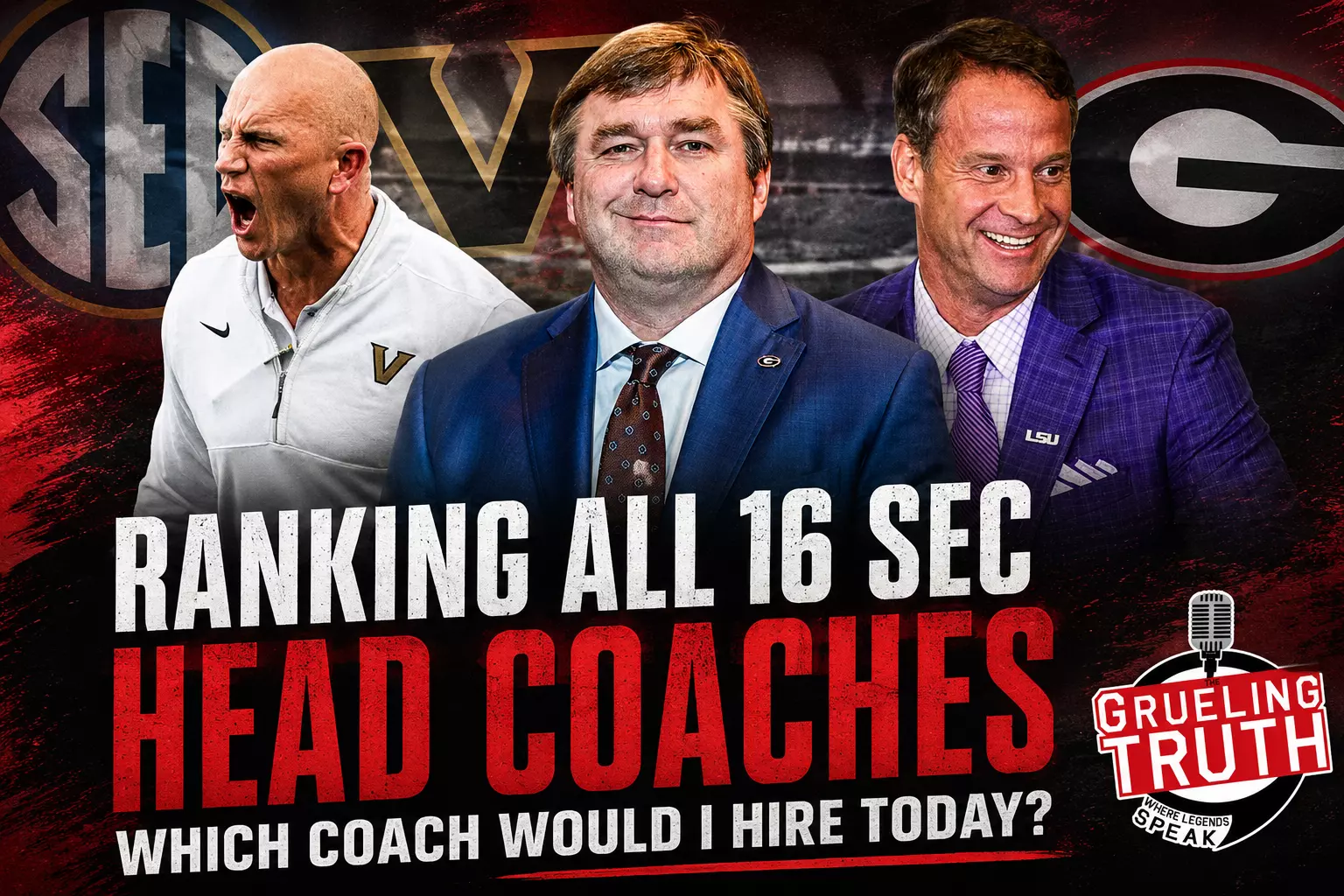
There is a difference between ranking coaches based on career accomplishments and ranking coaches based on who you would hire to lead your program today.
There is a difference between ranking coaches based on career accomplishments and ranking coaches based on who you would hire to lead your program today. This list isn’t simply about national championships or all-time wins. It’s about identifying the coaches who are doing the best jobs right now, considering their resources, recruiting challenges, player development, and ability to build sustainable winners.
Winning at Georgia is hard. Winning at Vanderbilt may be nearly impossible. That’s why context matters.
Here are my rankings of all 16 SEC head coaches entering the 2026 season.
16. Will Stein – Kentucky
Will Stein enters his first season as a head coach after establishing himself as one of college football’s brightest offensive minds. His work as Oregon’s offensive coordinator earned him the Kentucky job, but until he proves he can manage an entire
SEC program, he starts at the bottom of the rankings. That isn’t a knock on his ability. In fact, many believe Stein has tremendous upside. The challenge is that he has never been a head coach in the SEC. Kentucky fans are hopeful he can bring explosive offense and modern concepts to Lexington, but rankings must be based on proven head coaching performance, and Stein simply hasn’t had the opportunity to build that résumé yet.
15. Ryan Silverfield – Arkansas
Silverfield arrives at Arkansas after a successful run at Memphis, where he consistently produced winning teams and bowl appearances. The challenge awaiting him in Fayetteville is much greater than anything he faced in the AAC. Arkansas has resources, fan support, and facilities, but competing against Texas, Oklahoma, LSU, and Texas A&M every year is a different level of difficulty. Silverfield is a respected coach who understands offense and player development, but until he proves he can consistently win in the SEC, he remains near the bottom of the rankings.
14. Alex Golesh – Auburn
Golesh performed an impressive rebuilding job at South Florida before earning the Auburn position. His offensive creativity and ability to connect with players make him one of the conference’s most intriguing young coaches. Auburn believes Golesh can restore the Tigers to national prominence, but he inherits a difficult situation in a league loaded with elite coaching talent. Golesh has tremendous upside and could rise quickly, but entering 2026 he is still largely projecting future success rather than building upon proven SEC accomplishments.
13. Jeff Lebby – Mississippi State
Lebby remains one of college football’s most innovative offensive minds. Mississippi State hired him to create excitement and modernize the Bulldogs’ offense. While progress has been made, rebuilding a roster capable of competing weekly in the SEC takes time. Lebby’s offenses are always dangerous, and his reputation as a quarterback developer is well earned. The biggest question is whether he can build a complete football program capable of winning consistently in the nation’s toughest conference. His future remains bright, but more results are needed.
12. Jon Sumrall – Florida
Few coaching hires generated more excitement than Florida’s decision to bring in Jon Sumrall. After turning Troy into a powerhouse and succeeding at Tulane, Sumrall earned his shot at one of college football’s most prestigious jobs. Florida’s potential remains enormous, but expectations in Gainesville are unlike almost anywhere else. Sumrall’s track record suggests he can build winners, yet he still has to prove it at the SEC level. His ranking reflects promise rather than a lack of ability.
11. Shane Beamer – South Carolina
Beamer has steadily elevated South Carolina’s football program. The Gamecocks consistently play hard, compete against more talented opponents, and have developed a strong culture under his leadership. Beamer’s enthusiasm resonates with players and recruits alike. While South Carolina has not broken through into SEC championship contention, it has become a dangerous program capable of upsetting almost anyone. Another breakthrough season could push Beamer into the conference’s upper tier.
10. Eli Drinkwitz – Missouri
Drinkwitz has quietly built one of the SEC’s most consistent programs. Missouri is no longer viewed as an underdog. The Tigers recruit well, develop talent, and enter every season expecting to compete for major bowl games. Drinkwitz has exceeded expectations at virtually every turn and deserves far more national recognition than he receives. Missouri may never have the recruiting advantages of Georgia or Texas, but Drinkwitz has consistently found ways to win.
9. Josh Heupel – Tennessee
Heupel transformed Tennessee from a struggling program into a legitimate national contender. His offense is among the most explosive in college football, and the Volunteers once again expect to compete for championships. Recruiting has improved significantly, and Tennessee has regained its place among the SEC’s upper tier. Heupel deserves enormous credit for resurrecting one of college football’s sleeping giants and restoring confidence throughout the program.
8. Lane Kiffin – LSU
Kiffin’s move to LSU placed one of the sport’s most creative offensive minds at one of its premier programs. Few coaches understand modern offense better than Kiffin. He recruits well, develops quarterbacks, and consistently wins games. The only thing missing from his résumé is a national championship. At LSU, he now possesses the resources necessary to compete for one. It would not be surprising if Kiffin eventually climbs even higher on this list.
7. Pete Golding – Ole Miss
After building one of the SEC’s best defenses and earning the Ole Miss job, Golding faces the challenge of replacing Lane Kiffin. He is highly respected throughout the coaching profession and has demonstrated an ability to develop talent and build tough defenses. The question is whether he can maintain the level of success Ole Miss enjoyed in recent seasons. Golding has the football IQ and recruiting ability necessary to succeed, but this is still a relatively new chapter in his career.
6. Brent Venables – Oklahoma
Venables inherited one of
college football’s premier programs
and has guided Oklahoma through its transition into the SEC. Known as one of the game’s best defensive minds, he has emphasized toughness and physicality while maintaining elite recruiting standards. The Sooners remain a threat to compete for conference championships, and Venables deserves credit for navigating one of the sport’s most difficult transitions. Oklahoma’s ceiling remains extremely high.
5. Mike Elko – Texas A&M
Elko has quickly stabilized Texas A&M. The Aggies have always had talent, but previous staffs struggled to maximize it. Elko brings discipline, accountability, and one of the sharpest defensive minds in football. Texas A&M appears far more organized under his leadership, and many believe a breakthrough season is coming. If the Aggies can develop consistent quarterback play, Elko could soon find himself among the conference’s elite coaches.
4. Kalen DeBoer – Alabama
Replacing Nick Saban was the most difficult assignment in college football. DeBoer has handled it remarkably well. His success at Fresno State and Washington proved he could build winners, and he has maintained Alabama’s championship standards. DeBoer’s offensive expertise and calm leadership style have helped the Crimson Tide remain among the nation’s elite. Few coaches in the country are better equipped to lead a modern program.
3. Steve Sarkisian – Texas
Texas spent years underachieving before Sarkisian arrived. Today, the Longhorns are one of the most talented programs in America. Sarkisian has built a roster capable of competing for national championships while establishing a culture of accountability and excellence. His offensive brilliance is undeniable, and his ability to develop quarterbacks ranks among the nation’s best. Texas is once again a powerhouse because of his leadership.
2. Clark Lea – Vanderbilt
This ranking will be controversial, but it shouldn’t be.
No coach in America has done more with fewer advantages. Vanderbilt is arguably the toughest job in the SEC and one of the toughest jobs in all of college football. Recruiting challenges, academic standards, and limited football tradition make sustained success incredibly difficult.
Yet Lea transformed Vanderbilt into a winner and changed the perception of the entire program. Winning ten games at Vanderbilt is one of the greatest coaching accomplishments in recent SEC history. If coaching is about maximizing your situation, few coaches in America deserve more praise.
1. Kirby Smart – Georgia
Kirby Smart
remains the standard for college football coaching. Multiple national championships, elite recruiting classes, NFL talent throughout the roster, and consistent dominance have made Georgia the premier program in the country. Smart has built a machine that operates at the highest level every season. His teams are physical, disciplined, and relentless. Until someone consistently dethrones Georgia, Smart remains the coach every athletic director would hire first.
Final Thoughts
Many rankings focus solely on championships and recruiting rankings. This list takes a different approach. It values context and rewards coaches who maximize their resources.
That’s why Clark Lea sits at No. 2.
Winning at Vanderbilt is harder than winning at almost any other SEC school. What Lea has accomplished deserves recognition.
But until someone knocks Georgia off the mountain, Kirby Smart remains the king of SEC coaching.
Up To $1500 in Bonus Bets Paid Back if your First Bet Does Not Win
T&Cs apply
4.5/5
Gambling problem? Call 1-800-GAMBLER or 1-800-MY-RESET (Available in the US) 877-8-HOPENY or text HOPENY (467369) (NY) 1-800-327-5050 (MA), 1-800-BETS-OFF (IA), 1-800-981-0023 (PR). 21+ only. Please Gamble Responsibly. See BetMGM.com for Terms. First Bet Offer for new customers only (if applicable). Subject to eligibility requirements. Bonus bets are non-withdrawable. In partnership with Kansas Crossing Casino and Hotel. Promotional offers not available in Mississippi, Massachusetts, New York, Ontario, or Puerto Rico.
New DraftKings Customers: Spend $5+ Get $150 in Bonuses
T&Cs apply
4.5/5
GAMBLING PROBLEM? CALL 1-800-GAMBLER or 1-800-MY-RESET, (800) 327-5050 or visit gamblinghelplinema.org (MA). Please Gamble Responsibly. 888-789-7777/visit ccpg.org (CT), or visit www.mdgamblinghelp.org (MD), 1-800-981-0023 (PR). 21+ and present in most states. (18+ DC/NH/PR/WY). Void in CAN. Eligibility restrictions apply. On behalf of Boot Hill Casino (KS). Pass-thru of per wager tax may apply in IL. 1 per new DraftKings customer. $5+ first-time bet req. Max. $150 issued as non-withdrawable Bonus Bets. Stake removed from payout. Reward issued as $50 in Bonus Bets every 7 days via click-to-claim for 14 days. Bonus Bets and click-to-claims expire 7 days (168hrs) after issuance. Terms: sportsbook.draftkings.com/promos. Ends 10/11/26 at 11:59 PM ET. Sponsored by DK.
Must be 21+. GAMBLING PROBLEM? CALL 1-800-GAMBLER OR CALL 1-800-MY-RESET, www.mdgamblinghelp.org (MD), (800)-327-5050 or gamblinghelplinema.org (MA), Call (877)8-HOPENY or text HOPENY (467369) (NY), (888) 789-7777 or ccpg.org (CT), morethanagame.nc.gov (NC), 1800gambler.net (WV)
Bet $1 and get double the winnings up to $25 for your next 10 bets
T&Cs apply
4.4/5
21+ New users only. Must register using eligible promo code. First bet after registration must qualify. Max. Bonus Bet: $1,000. Bonus Bet expires 14 days after receipt. Void where prohibited. See Caesars.com/promos for full terms. Gambling Problem? 1-800-GAMBLER (1-800-426-2537)
21+ and present in OH. Gambling Problem? Call 1-800-GAMBLER.
This site is using
Cloudflare
and adheres to the
Google Safe Browsing Program. We adapted
Google's Privacy Guidelines
to keep your data safe at all times.
Close
Ready to Win Big? Join the Elite with Our Sports Betting Deals!
FanDuel Promo
New Users – Get $250 in Bonus Bets when you wager $5 for 5 days
Up To $1500 in Bonus Bets Paid Back if your First Bet Does Not Win
Best Slots
T&Cs and 21+ apply
Gambling problem? Call 1-800-GAMBLER or 1-800-MY-RESET (Available in the US) 877-8-HOPENY or text HOPENY (467369) (NY) 1-800-327-5050 (MA), 1-800-BETS-OFF (IA), 1-800-981-0023 (PR). 21+ only. Please Gamble Responsibly. See BetMGM.com for Terms. First Bet Offer for new customers only (if applicable). Subject to eligibility requirements. Bonus bets are non-withdrawable. In partnership with Kansas Crossing Casino and Hotel. Promotional offers not available in Mississippi, Massachusetts, New York, Ontario, or Puerto Rico.
Code:
Open BetMGM
Get Bonus
DraftKings Promo
New DraftKings Customers: Spend $5+ Get $150 in Bonuses
Newcomer
T&Cs and 21+ apply
GAMBLING PROBLEM? CALL 1-800-GAMBLER or 1-800-MY-RESET, (800) 327-5050 or visit gamblinghelplinema.org (MA). Please Gamble Responsibly. 888-789-7777/visit ccpg.org (CT), or visit www.mdgamblinghelp.org (MD), 1-800-981-0023 (PR). 21+ and present in most states. (18+ DC/NH/PR/WY). Void in CAN. Eligibility restrictions apply. On behalf of Boot Hill Casino (KS). Pass-thru of per wager tax may apply in IL. 1 per new DraftKings customer. $5+ first-time bet req. Max. $150 issued as non-withdrawable Bonus Bets. Stake removed from payout. Reward issued as $50 in Bonus Bets every 7 days via click-to-claim for 14 days. Bonus Bets and click-to-claims expire 7 days (168hrs) after issuance. Terms: sportsbook.draftkings.com/promos. Ends 10/11/26 at 11:59 PM ET. Sponsored by DK.
Code:
Open DraftKings
Get Bonus
Find out what the legends have to say about sports this week....