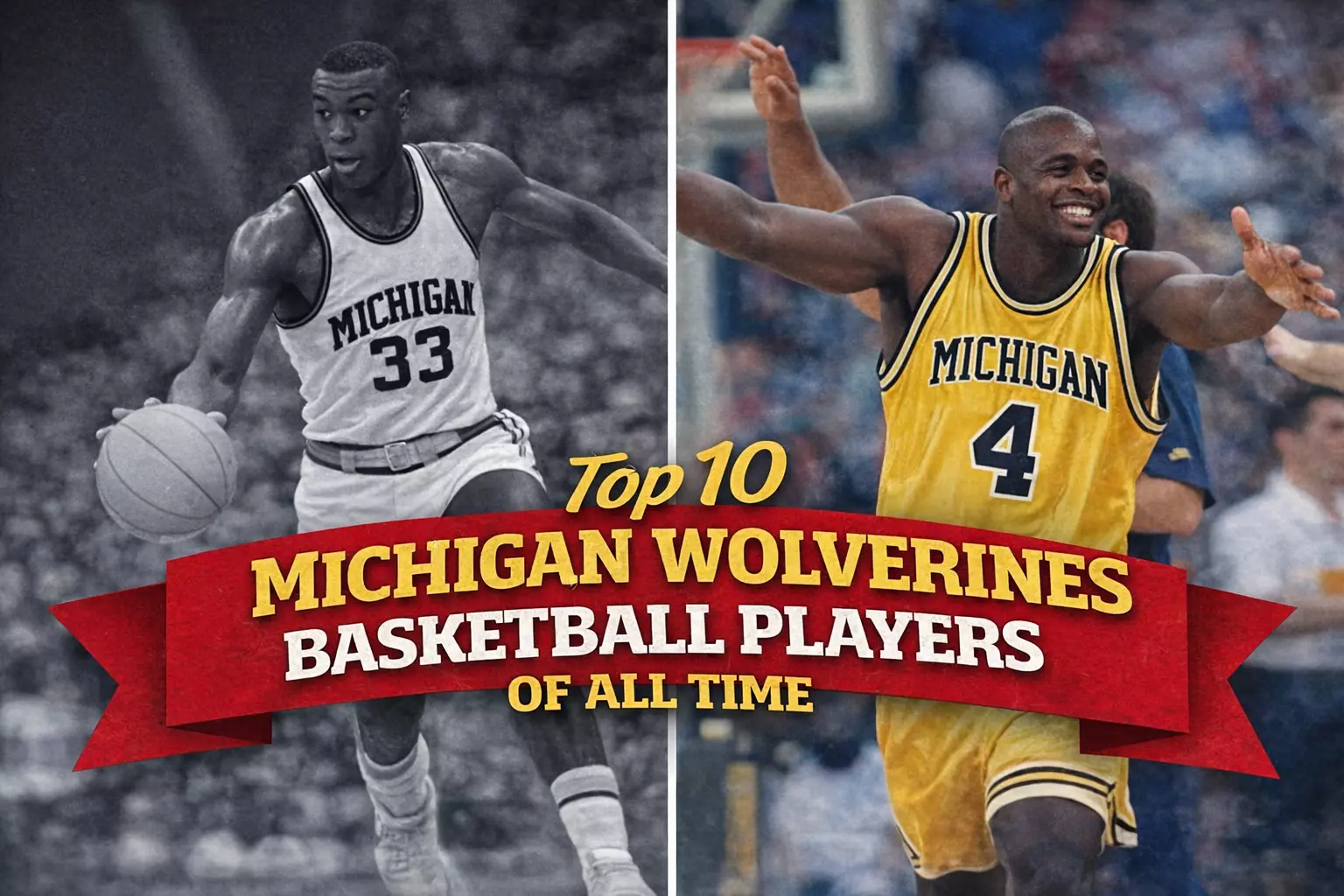
The Michigan Wolverines are known as a football school but the basketball program has been amazing through the years also!
The University of Michigan basketball program is one of the most iconic in college basketball history. From the dominance of the 1960s to the cultural revolution of the Fab Five and the resurgence under John Beilein, Michigan has consistently produced elite talent.
This list breaks down the
Top 10 players in Wolverines history, based on production, impact, legacy, and unforgettable moments.
10. Rumeal Robinson (1987–1990)
Rumeal Robinson etched his name into Michigan lore with one of the most clutch performances in NCAA Tournament history. As the starting point guard on the 1989 national championship team, Robinson played a pivotal role throughout the tournament, but it was his composure in the title game that defined his legacy.
With Michigan trailing Seton Hall in overtime of the 1989 championship game, Robinson stepped to the free-throw line with everything on the line. He calmly knocked down both shots to secure Michigan’s first national title, forever cementing his place in program history.
Over his career, Robinson scored more than 1,400 points and dished out over 400 assists, showcasing his ability as both a scorer and facilitator. He was a steady floor general who thrived in big moments and brought leadership to a talented roster.
Robinson’s legacy isn’t just about statistics—it’s about delivering when it mattered most. His championship-clinching free throws remain one of the most iconic moments in Michigan basketball history.
Big Ten Elite: 1989 Michigan Basketball 6
9. Trey Burke (2011–2013)
Trey Burke was the engine behind Michigan’s return to national prominence in the early 2010s. In just two seasons, Burke transformed the Wolverines into a championship contender and became one of the most electrifying guards in college basketball.
During the 2012–13 season, Burke averaged 18.6 points and 6.7 assists per game while leading Michigan to the NCAA championship game. His defining moment came in the Sweet 16 against Kansas, when he hit a deep, game-tying three-pointer that instantly became one of the greatest shots in tournament history.
Burke swept nearly every major national award, including the
Naismith and Wooden Awards, solidifying his status as the best player in college basketball that season.
What made Burke special was his combination of poise, skill, and leadership. He controlled the tempo, made big shots, and elevated everyone around him.
Despite a short college career, Burke’s impact was massive, making him one of the most important players in modern Michigan history.
Ultimate Trey Burke Highlight
8. Jalen Rose (1992–1994)
Jalen Rose was the heartbeat of the legendary Fab Five, a group that changed college basketball forever. While all five members were stars, Rose served as the leader, playmaker, and emotional center of the team.
A versatile 6’8” guard-forward, Rose averaged 17.5 points per game during his Michigan career and showcased elite passing ability. He had the size to post up, the vision to run the offense, and the swagger that defined the Fab Five era.
Rose helped lead Michigan to back-to-back NCAA championship games in 1992 and 1993, bringing a new level of style and cultural influence to the sport. The Fab Five didn’t just win—they changed how players dressed, talked, and carried themselves.
Beyond statistics, Rose’s impact was cultural. He helped redefine college basketball’s identity, and his leadership set the tone for one of the most influential teams in NCAA history.
Michigan’s Fab Five – A Look Back – Jalen Rose Highlights
7. Rudy Tomjanovich (1967–1970)
Before becoming an NBA championship-winning coach, Rudy Tomjanovich was one of the most dominant players in Michigan history. A powerful forward, Tomjanovich averaged an incredible
25.1 points and 14 rebounds per game
during his college career.
His combination of strength, skill, and scoring ability made him nearly unstoppable in the paint. He was a consistent double-double machine and one of the most physically imposing players of his era.
Tomjanovich earned All-American honors and established himself as one of the premier big men in college basketball during the late 1960s. His ability to control the game inside made him the focal point of Michigan’s offense.
Though Michigan didn’t win a national title during his tenure, Tomjanovich’s individual dominance and consistency place him among the program’s all-time greats.
Basketball Hall Of Famer Rudy Tomjanovich Talks Michigan, His Career
6. Campy Russell (1971–1974)
Campy Russell was one of the most dynamic scorers Michigan has ever had. Known for his smooth offensive game and versatility, Russell was capable of scoring from anywhere on the floor.
During his senior season, he averaged
23.7 points per game, earning First-Team All-Big Ten honors. His ability to create his own shot and consistently produce offense made him one of the most dangerous players in the conference.
Russell’s impact extended beyond scoring. He brought athleticism, energy, and leadership to Michigan during a transitional period for the program.
What set Russell apart was his ability to take over games. When Michigan needed a bucket, he was the player they turned to, and more often than not, he delivered.
His success carried over to the NBA, where he enjoyed a long and productive career, further solidifying his place as one of Michigan’s all-time greats.
Video: Watching from afar, former U-M great Campy Russell says, ‘Michigan is back’
5. Chris Webber (1992–1993)
Chris Webber was the centerpiece of the Fab Five and one of the most talented players in Michigan history. As a freshman, he immediately became a dominant force, combining size, skill, and basketball IQ in a way few players ever have.
Webber averaged 19.2 points and 10 rebounds per game during his sophomore season, leading Michigan to back-to-back NCAA championship game appearances.
Despite the infamous timeout in the 1993 title game, Webber’s impact on the program is undeniable. He revolutionized the power forward position with his ability to handle the ball, pass, and score.
Webber’s presence made Michigan one of the most feared teams in the country, and his style of play helped redefine what was possible for big men.
His legacy goes far beyond one moment—he was a generational talent who changed the game.
Chris Webber😤Michigan Highlights(1991-1993)
4. Phil Hubbard (1975–1979)
Phil Hubbard was one of the most talented big men in Michigan history and a key figure in the Wolverines’ success during the mid-1970s.
As a freshman, Hubbard helped lead Michigan to the
1976 NCAA championship game, showcasing his ability to compete at the highest level early in his career.
Despite suffering a serious knee injury that limited his athleticism, Hubbard still managed to average
16.5 points and 11.1 rebounds per game
over his career.
What makes Hubbard’s story remarkable is his resilience. Even after losing some of his explosiveness, he remained a dominant force in the paint through skill, positioning, and toughness.
His ability to overcome adversity while still producing at a high level solidifies his place among Michigan’s all-time greats.
1977 NCAA Tournament – Charlotte vs Michigan
3. Rickey Green (1975–1977)
Rickey Green is widely regarded as the greatest point guard in Michigan basketball history. A lightning-fast playmaker, Green controlled the tempo of the game and made everyone around him better.
Green led Michigan to the
1976 NCAA championship game
and earned First-Team All-American honors during his career.
His ability to push the pace, break down defenses, and create scoring opportunities made him one of the most exciting players to watch. He wasn’t just a passer—he could score efficiently when needed.
Green’s leadership and decision-making were critical to Michigan’s success during his tenure. He understood how to control a game and consistently put his team in position to win.
His impact on the point guard position at Michigan remains unmatched.
Greatest Seasons: 1976 Basketball – Michigan
2. Glen Rice (1985–1989)
Glen Rice is the greatest scorer in Michigan basketball history and one of the most dominant offensive players the NCAA Tournament has ever seen.
Rice finished his career with
2,442 points, but his defining moment came during the
1989 NCAA Tournament, where he scored a record
184 points, leading Michigan to its first national championship.
His shooting ability was unmatched. Rice could score from anywhere on the floor, and once he got hot, he was nearly impossible to stop.
Throughout the tournament, he delivered one clutch performance after another, carrying Michigan to the title.
Rice’s combination of scoring, efficiency, and clutch play makes him one of the greatest players not just in Michigan history—but in college basketball history.
Cazzie Russell is the greatest player in Michigan basketball history and the program’s first true superstar.
A three-time All-American, Russell led Michigan to
three Big Ten titles
and the
1965 NCAA championship game. He was named the
National Player of the Year in 1966, solidifying his place among the all-time greats.
Russell finished his career as one of Michigan’s all-time leading scorers and was the face of the program during its rise to national prominence.
What made Russell special was his complete game. He could score, rebound, and lead, all while consistently delivering in big moments.
His impact on Michigan basketball is immeasurable. He helped build the foundation for everything that followed.
Simply put—Cazzie Russell didn’t just play at Michigan…
he defined it.
Cager for the Ages
Final Thoughts
Michigan basketball has produced legends across generations, from pioneers like Cazzie Russell to modern stars like Trey Burke.
Each of these players helped shape the Wolverines’ legacy—but at the top…
Cazzie Russell still stands alone.
Up To $1500 in Bonus Bets Paid Back if your First Bet Does Not Win
T&Cs apply
4.5/5
Gambling problem? Call 1-800-GAMBLER or 1-800-MY-RESET (Available in the US) 877-8-HOPENY or text HOPENY (467369) (NY) 1-800-327-5050 (MA), 1-800-BETS-OFF (IA), 1-800-981-0023 (PR). 21+ only. Please Gamble Responsibly. See BetMGM.com for Terms. First Bet Offer for new customers only (if applicable). Subject to eligibility requirements. Bonus bets are non-withdrawable. In partnership with Kansas Crossing Casino and Hotel. Promotional offers not available in Mississippi, Massachusetts, New York, Ontario, or Puerto Rico.
New DraftKings Customers: Spend $5+ Get $150 in Bonuses
T&Cs apply
4.5/5
GAMBLING PROBLEM? CALL 1-800-GAMBLER or 1-800-MY-RESET, (800) 327-5050 or visit gamblinghelplinema.org (MA). Please Gamble Responsibly. 888-789-7777/visit ccpg.org (CT), or visit www.mdgamblinghelp.org (MD), 1-800-981-0023 (PR). 21+ and present in most states. (18+ DC/NH/PR/WY). Void in CAN. Eligibility restrictions apply. On behalf of Boot Hill Casino (KS). Pass-thru of per wager tax may apply in IL. 1 per new DraftKings customer. $5+ first-time bet req. Max. $150 issued as non-withdrawable Bonus Bets. Stake removed from payout. Reward issued as $50 in Bonus Bets every 7 days via click-to-claim for 14 days. Bonus Bets and click-to-claims expire 7 days (168hrs) after issuance. Terms: sportsbook.draftkings.com/promos. Ends 10/11/26 at 11:59 PM ET. Sponsored by DK.
Must be 21+. GAMBLING PROBLEM? CALL 1-800-GAMBLER OR CALL 1-800-MY-RESET, www.mdgamblinghelp.org (MD), (800)-327-5050 or gamblinghelplinema.org (MA), Call (877)8-HOPENY or text HOPENY (467369) (NY), (888) 789-7777 or ccpg.org (CT), morethanagame.nc.gov (NC), 1800gambler.net (WV)
Bet $1 and get double the winnings up to $25 for your next 10 bets
T&Cs apply
4.4/5
21+ New users only. Must register using eligible promo code. First bet after registration must qualify. Max. Bonus Bet: $1,000. Bonus Bet expires 14 days after receipt. Void where prohibited. See Caesars.com/promos for full terms. Gambling Problem? 1-800-GAMBLER (1-800-426-2537)
21+ and present in OH. Gambling Problem? Call 1-800-GAMBLER.
This site is using
Cloudflare
and adheres to the
Google Safe Browsing Program. We adapted
Google's Privacy Guidelines
to keep your data safe at all times.
Close
Ready to Win Big? Join the Elite with Our Sports Betting Deals!
FanDuel Promo
New Users – Get $250 in Bonus Bets when you wager $5 for 5 days
Up To $1500 in Bonus Bets Paid Back if your First Bet Does Not Win
Best Slots
T&Cs and 21+ apply
Gambling problem? Call 1-800-GAMBLER or 1-800-MY-RESET (Available in the US) 877-8-HOPENY or text HOPENY (467369) (NY) 1-800-327-5050 (MA), 1-800-BETS-OFF (IA), 1-800-981-0023 (PR). 21+ only. Please Gamble Responsibly. See BetMGM.com for Terms. First Bet Offer for new customers only (if applicable). Subject to eligibility requirements. Bonus bets are non-withdrawable. In partnership with Kansas Crossing Casino and Hotel. Promotional offers not available in Mississippi, Massachusetts, New York, Ontario, or Puerto Rico.
Code:
Open BetMGM
Get Bonus
DraftKings Promo
New DraftKings Customers: Spend $5+ Get $150 in Bonuses
Newcomer
T&Cs and 21+ apply
GAMBLING PROBLEM? CALL 1-800-GAMBLER or 1-800-MY-RESET, (800) 327-5050 or visit gamblinghelplinema.org (MA). Please Gamble Responsibly. 888-789-7777/visit ccpg.org (CT), or visit www.mdgamblinghelp.org (MD), 1-800-981-0023 (PR). 21+ and present in most states. (18+ DC/NH/PR/WY). Void in CAN. Eligibility restrictions apply. On behalf of Boot Hill Casino (KS). Pass-thru of per wager tax may apply in IL. 1 per new DraftKings customer. $5+ first-time bet req. Max. $150 issued as non-withdrawable Bonus Bets. Stake removed from payout. Reward issued as $50 in Bonus Bets every 7 days via click-to-claim for 14 days. Bonus Bets and click-to-claims expire 7 days (168hrs) after issuance. Terms: sportsbook.draftkings.com/promos. Ends 10/11/26 at 11:59 PM ET. Sponsored by DK.
Code:
Open DraftKings
Get Bonus
Find out what the legends have to say about sports this week....