Few rivalries in sports capture the pageantry, tradition, and sheer drama of
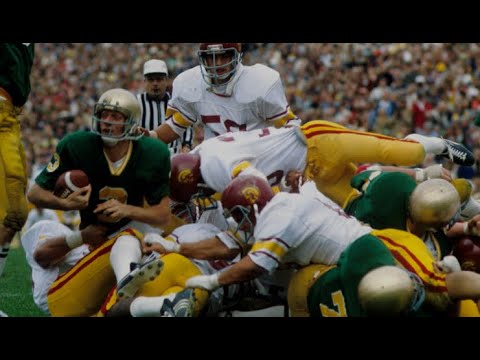
USC vs. Notre Dame. Since their first meeting in 1926, the Trojans and Fighting Irish have collided in contests that transcended football — shaping national championship races, producing Heisman moments, and fueling generations of pride on both coasts. The matchup represents more than just two elite programs; it’s a cultural event, blending Hollywood glitz with Midwestern grit. From Anthony Davis’ impossible comeback to the “Bush Push” and the “Green Jersey Game,” each era has delivered a defining moment. Here are the ten greatest battles ever fought between these two college football giants.
10. 1928 – Notre Dame 27, USC 12: “Win One for the Gipper”
The 1928 clash between Notre Dame and USC wasn’t just a football game — it became the stuff of legend. Playing at Soldier Field before a then-record crowd of over 120,000, Knute Rockne’s Irish sought redemption for a 1927 loss to the Trojans. Rockne, ever the motivator, gave his players one of the most famous locker room speeches in sports history: “Win one for the Gipper,” invoking the memory of George Gipp, Notre Dame’s first true superstar. Inspired by that call to arms, the Irish outplayed USC in every facet of the game. Johnny O’Brien’s running and the Irish defense’s intensity overwhelmed the Trojans, leading to a 27–12 victory. The win restored Notre Dame’s national prestige and immortalized Rockne’s words in American folklore. It was the day Notre Dame’s mystique began — where faith, motivation, and gridiron excellence fused to create the foundation of what would become the sport’s greatest intersectional rivalry.
9. 1931 – USC 16, Notre Dame 14: The Trojans’ First Triumph in South Bend
In 1931, USC achieved a milestone that forever changed its football identity. Coming into South Bend as underdogs, the Trojans faced a Notre Dame team that had not lost at home in 26 games. Behind coach Howard Jones and quarterback Gus Shaver, USC battled through frigid weather and a hostile crowd. The Irish jumped to a 14–0 lead, seemingly on their way to another home win. But Shaver led an extraordinary comeback, using short passes and timely runs to claw back into contention. Kicker Johnny Baker then booted a late field goal to give USC a stunning 16–14 victory — the Trojans’ first-ever win in South Bend. That victory not only broke Notre Dame’s home-field dominance but clinched USC’s first national championship. It was the moment the rivalry became truly national, linking the glamour of Hollywood football with the grit of Midwestern tradition. USC’s win in 1931 put the West Coast firmly on the football map.
Ara Parseghian’s debut season at Notre Dame nearly ended in glory — until USC ripped it away. The Irish were 9–0 and ranked No. 1 heading into Los Angeles. Led by Heisman-winning quarterback John Huarte and All-American receiver Jack Snow, Notre Dame appeared on its way to another national title. But in the closing minutes, USC quarterback Craig Fertig engineered one of the most improbable drives in rivalry history. Down 17–13, Fertig calmly moved the Trojans 80 yards, capped by a clutch touchdown pass to Rod Sherman with just over a minute left. The 20–17 victory stunned the Irish and denied Parseghian his perfect season. For USC, it was a defining moment of grit and resilience; for Notre Dame, an agonizing “what if.” The 1964 battle stands as a perfect example of how one drive, one throw, and one rivalry can reshape the course of a season — and a legacy.
USC vs Notre Dame – Thanksgiving Day, 1964
7. 1977 – Notre Dame 49, USC 19: The “Green Jersey Game”
Few moments in college football history are as theatrical as Notre Dame’s “Green Jersey Game.” Ranked No. 11 and searching for an emotional spark against No. 5 USC, head coach Dan Devine stunned his players when they entered the locker room to find bright green jerseys hanging in place of their traditional blue. The crowd erupted as the Irish stormed the field in their new look. Quarterback Joe Montana orchestrated a near-perfect performance, throwing darts to Ken MacAfee while running back Vagas Ferguson powered through USC’s defense. The Irish dominated from start to finish, dismantling the Trojans 49–19. The psychological blow of the jersey switch left USC flat-footed, while Notre Dame found renewed confidence that carried them to the 1977 national championship. The “Green Jersey Game” perfectly captured Notre Dame’s flair for pageantry and performance — proof that in South Bend, history isn’t just made; it’s staged for the ages.
One of the rivalry’s most controversial moments unfolded in the 1978 Coliseum clash. Notre Dame, led by quarterback Joe Montana, took a 25–24 lead late in the game. But with time running out, USC running back Charles White lunged toward the goal line — and clearly fumbled before crossing. Officials, however, ruled it a touchdown. The replay showed the ball popping loose early, but the score stood, giving USC a 27–25 win. The “Phantom Touchdown” infuriated Notre Dame fans and remains one of college football’s most disputed calls. The victory propelled USC to a share of the national championship, while Notre Dame’s repeat hopes ended amid controversy. Featuring legends like Montana, White, Anthony Munoz, and Ronnie Lott, the game showcased elite talent, high stakes, and the chaos that defines this rivalry. Even decades later, the “Phantom Touchdown” remains the ultimate symbol of Trojan fortune — and Irish fury.
1978 #8 Notre Dame at #3 USC 1 of 1
5. 1980 – Notre Dame 20, USC 3: Freshman Kiel Stuns the Coliseum
While not as chaotic as some previous duels, the 1980 contest was monumental in its own right. Notre Dame, unranked and rebuilding under Dan Devine, marched into the Los Angeles Coliseum led by freshman quarterback
Blair Kiel
and a ferocious defense. USC entered the game as a national power led by Heisman hopeful Marcus Allen, but the Irish suffocated the Trojans at every turn. Kiel’s poise belied his youth, as he managed the game efficiently and repeatedly flipped field position with booming punts — he was also Notre Dame’s punter. The Irish defense forced multiple turnovers, neutralized Allen, and dominated the line of scrimmage. The 20–3 victory was Notre Dame’s first in the Coliseum since 1972 and marked the end of Devine’s tenure on a high note. Though often overlooked, this game proved that Notre Dame could still out-tough USC even in transition years — a throwback win built on grit and execution.
1980 USC Footbal Highlights vs. Notre Dame
4. 1973 – Notre Dame 23, USC 14: Battle of the Unbeatens
In 1973, both teams entered the game unbeaten — Notre Dame ranked No. 8, USC No. 6 — in a contest loaded with national title implications. The Irish defense was determined to stop USC’s explosive offense led by Anthony Davis. Notre Dame struck early, with quarterback Tom Clements distributing the ball efficiently, and running back Eric Penick providing the game’s defining moment: an electrifying 85-yard touchdown run that sent the crowd at
Notre Dame Stadium
into pandemonium. The Irish defense clamped down on Davis, holding him to minimal yardage, and Notre Dame won 23–14. Ara Parseghian’s team went on to win the Sugar Bowl over Alabama and claim the national championship. The ’73 game symbolized old-school football excellence — discipline, toughness, and seizing the moment. For Notre Dame fans, it was one of the sweetest victories ever over USC, a triumph that restored the balance of power between the two dynasties.
1973 #6 USC @ #8 Notre Dame No Huddle
3. 1988 – Notre Dame 27, USC 10: The Clash of the Titans
The 1988 edition of the rivalry may have been the most consequential in modern times. No. 1 Notre Dame and No. 2 USC entered the Coliseum undefeated, their matchup essentially serving as a semifinal for the national championship. Lou Holtz’s Irish played with composure and physicality, led by quarterback Tony Rice, running backs Ricky Watters and Rocket Ismail, and an aggressive defense anchored by Chris Zorich and Frank Stams. Notre Dame controlled the line of scrimmage and stifled Heisman winner Rodney Peete, forcing multiple turnovers. Rice’s option runs and timely passes kept USC’s defense guessing, and the Irish sealed the 27–10 victory to preserve their perfect season. They would go on to beat West Virginia in the Fiesta Bowl for the national title. The 1988 game was a masterpiece of preparation and poise — a rare No. 1 vs. No. 2 showdown that lived up to every ounce of its billing.
1988 #1 Notre Dame @ #2 USC No Huddle
2. 1974 – USC 55, Notre Dame 24: “The Comeback”
The greatest USC–Notre Dame game ever played remains “The Comeback” — a surreal 55–24 Trojan explosion that defied belief. Notre Dame, ranked No. 5 and led by quarterback Tom Clements, stormed to a 24–0 first-half lead. But when Anthony Davis took the second-half kickoff 102 yards for a touchdown, the Coliseum erupted — and USC never stopped scoring. Over the next 17 minutes, the Trojans tallied
49 unanswered points, with quarterback Pat Haden and receiver J.K. McKay torching Notre Dame’s secondary. By game’s end, USC had flipped a 24-point deficit into a 31-point win, setting an NCAA record for fastest turnaround. The victory propelled USC to the 1974 national championship and cemented John McKay’s reputation as a master motivator. For Notre Dame, it was humiliation; for USC, the defining display of Trojan might. Nearly 50 years later, “The Comeback” still stands as the rivalry’s most jaw-dropping performance.
1974 #5 Notre Dame @ #6 USC No Huddle
1. 2005 – USC 34, Notre Dame 31: “The Bush Push”
Few games in college football history have delivered as much late-game chaos as the 2005 showdown in South Bend. No. 1 USC, riding a 27-game winning streak, faced No. 9 Notre Dame in front of a frenzied crowd. Charlie Weis’ Irish pushed the Trojans to the brink, with Brady Quinn engineering a go-ahead drive that gave Notre Dame a 31–28 lead late in the fourth quarter. But Matt Leinart and Reggie Bush responded with one of the most dramatic drives ever. With seconds remaining, Leinart’s QB sneak from the one-yard line was aided by Bush literally shoving him into the end zone — the infamous “Bush Push.” USC escaped with a 34–31 victory, preserving their streak and cementing this game as an instant classic. From the premature field-storming to the final play’s controversy, the 2005 matchup had it all. It embodied everything about USC–Notre Dame: brilliance, heartbreak, and unforgettable theater.
USC @ Notre Dame (2005)
Conclusion
USC vs. Notre Dame isn’t just a rivalry — it’s a mirror of college football itself. It reflects eras of dominance, shifting power, legendary figures, and unforgettable drama. Whether it’s the poetic heartbreak of 1964, the fury of the “Phantom Touchdown,” or the chaos of the “Bush Push,” this series has always been larger than life. Few rivalries can match its impact on national titles, Heisman races, or college lore. Every fall, when the gold helmets meet the cardinal and gold, it’s more than a game — it’s history, tradition, and the soul of college football colliding once again.
Up To $1500 in Bonus Bets Paid Back if your First Bet Does Not Win
T&Cs apply
4.5/5
Gambling problem? Call 1-800-GAMBLER or 1-800-MY-RESET (Available in the US) 877-8-HOPENY or text HOPENY (467369) (NY) 1-800-327-5050 (MA), 1-800-BETS-OFF (IA), 1-800-981-0023 (PR). 21+ only. Please Gamble Responsibly. See BetMGM.com for Terms. First Bet Offer for new customers only (if applicable). Subject to eligibility requirements. Bonus bets are non-withdrawable. In partnership with Kansas Crossing Casino and Hotel. Promotional offers not available in Mississippi, Massachusetts, New York, Ontario, or Puerto Rico.
New DraftKings Customers: Spend $5+ Get $150 in Bonuses
T&Cs apply
4.5/5
GAMBLING PROBLEM? CALL 1-800-GAMBLER or 1-800-MY-RESET, (800) 327-5050 or visit gamblinghelplinema.org (MA). Please Gamble Responsibly. 888-789-7777/visit ccpg.org (CT), or visit www.mdgamblinghelp.org (MD), 1-800-981-0023 (PR). 21+ and present in most states. (18+ DC/NH/PR/WY). Void in CAN. Eligibility restrictions apply. On behalf of Boot Hill Casino (KS). Pass-thru of per wager tax may apply in IL. 1 per new DraftKings customer. $5+ first-time bet req. Max. $150 issued as non-withdrawable Bonus Bets. Stake removed from payout. Reward issued as $50 in Bonus Bets every 7 days via click-to-claim for 14 days. Bonus Bets and click-to-claims expire 7 days (168hrs) after issuance. Terms: sportsbook.draftkings.com/promos. Ends 10/11/26 at 11:59 PM ET. Sponsored by DK.
Must be 21+. GAMBLING PROBLEM? CALL 1-800-GAMBLER OR CALL 1-800-MY-RESET, www.mdgamblinghelp.org (MD), (800)-327-5050 or gamblinghelplinema.org (MA), Call (877)8-HOPENY or text HOPENY (467369) (NY), (888) 789-7777 or ccpg.org (CT), morethanagame.nc.gov (NC), 1800gambler.net (WV)
Bet $1 and get double the winnings up to $25 for your next 10 bets
T&Cs apply
4.4/5
21+ New users only. Must register using eligible promo code. First bet after registration must qualify. Max. Bonus Bet: $1,000. Bonus Bet expires 14 days after receipt. Void where prohibited. See Caesars.com/promos for full terms. Gambling Problem? 1-800-GAMBLER (1-800-426-2537)
21+ and present in OH. Gambling Problem? Call 1-800-GAMBLER.
This site is using
Cloudflare
and adheres to the
Google Safe Browsing Program. We adapted
Google's Privacy Guidelines
to keep your data safe at all times.
Close
Ready to Win Big? Join the Elite with Our Sports Betting Deals!
FanDuel Promo
New Users – Get $250 in Bonus Bets when you wager $5 for 5 days
Up To $1500 in Bonus Bets Paid Back if your First Bet Does Not Win
Best Slots
T&Cs and 21+ apply
Gambling problem? Call 1-800-GAMBLER or 1-800-MY-RESET (Available in the US) 877-8-HOPENY or text HOPENY (467369) (NY) 1-800-327-5050 (MA), 1-800-BETS-OFF (IA), 1-800-981-0023 (PR). 21+ only. Please Gamble Responsibly. See BetMGM.com for Terms. First Bet Offer for new customers only (if applicable). Subject to eligibility requirements. Bonus bets are non-withdrawable. In partnership with Kansas Crossing Casino and Hotel. Promotional offers not available in Mississippi, Massachusetts, New York, Ontario, or Puerto Rico.
Code:
Open BetMGM
Get Bonus
DraftKings Promo
New DraftKings Customers: Spend $5+ Get $150 in Bonuses
Newcomer
T&Cs and 21+ apply
GAMBLING PROBLEM? CALL 1-800-GAMBLER or 1-800-MY-RESET, (800) 327-5050 or visit gamblinghelplinema.org (MA). Please Gamble Responsibly. 888-789-7777/visit ccpg.org (CT), or visit www.mdgamblinghelp.org (MD), 1-800-981-0023 (PR). 21+ and present in most states. (18+ DC/NH/PR/WY). Void in CAN. Eligibility restrictions apply. On behalf of Boot Hill Casino (KS). Pass-thru of per wager tax may apply in IL. 1 per new DraftKings customer. $5+ first-time bet req. Max. $150 issued as non-withdrawable Bonus Bets. Stake removed from payout. Reward issued as $50 in Bonus Bets every 7 days via click-to-claim for 14 days. Bonus Bets and click-to-claims expire 7 days (168hrs) after issuance. Terms: sportsbook.draftkings.com/promos. Ends 10/11/26 at 11:59 PM ET. Sponsored by DK.
Code:
Open DraftKings
Get Bonus
Find out what the legends have to say about sports this week....