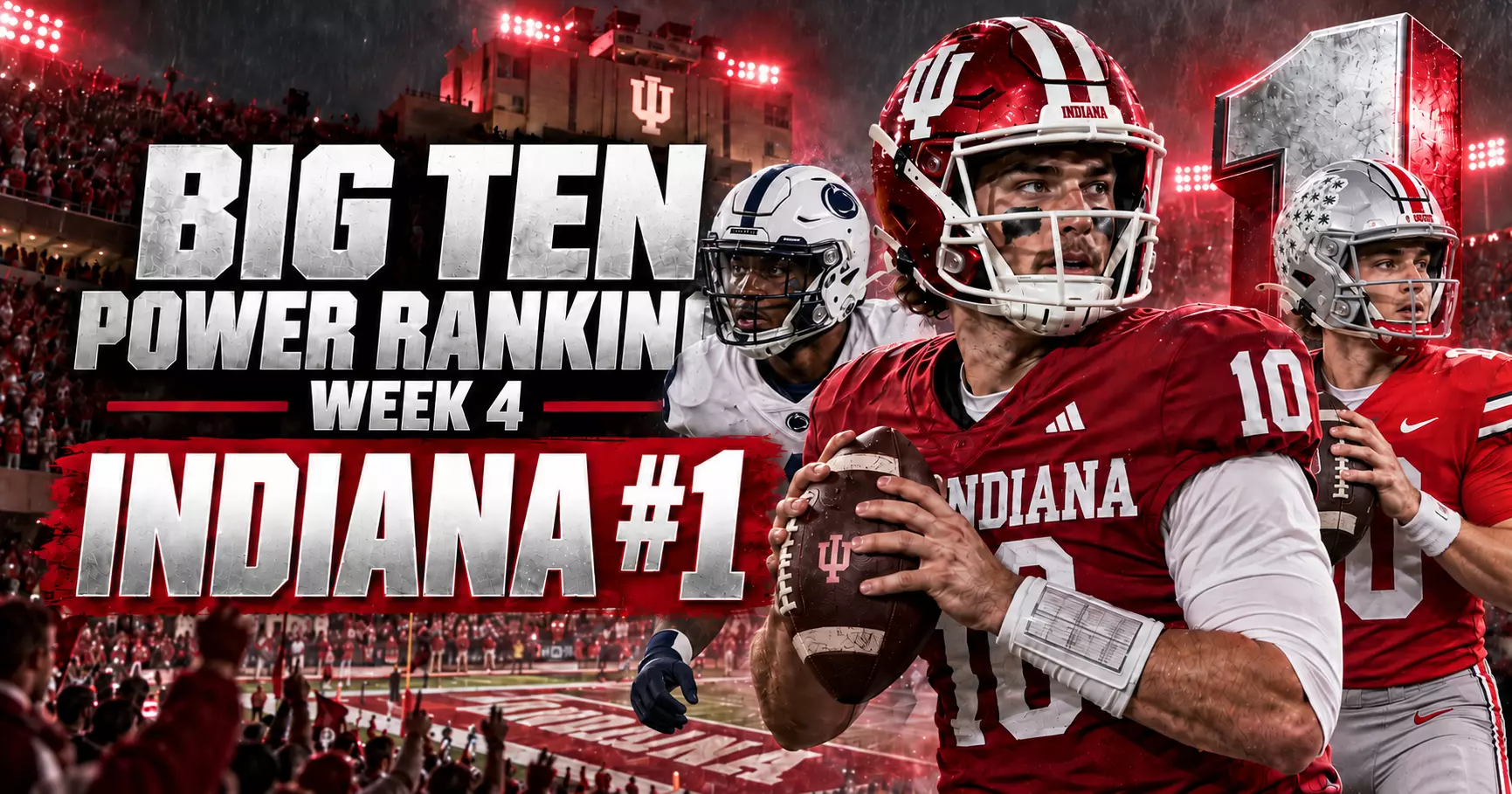
Indiana has opened its national championship defense with three convincing victories, while Penn State and USC have been solid.
The first three weeks of the 2026 college football season have produced wildly different results across the Big Ten.
Indiana has opened its national championship defense with three convincing victories, while Penn State and USC have also emerged as legitimate contenders. Ohio State rebounded from its loss to Texas, Michigan appears to be improving around Bryce Underwood, and several unexpected teams—including UCLA and Northwestern—have entered conference play with momentum.
Oregon remains difficult to evaluate after following an embarrassing loss with an 84-point victory. Maryland and Purdue, meanwhile, are already watching their seasons move in the wrong direction.
These rankings are based on overall performance, quality of competition, roster strength and how each team is playing entering Week 4—not simply win-loss records.
Maryland has fallen to the bottom after losing 35–26 at home to Virginia Tech. The Terrapins trailed 35–14 before mounting a late comeback, but they could not complete either of their two-point attempts or seriously threaten the Hokies during the closing minutes.
Maryland’s defense allowed Virginia Tech quarterback Ethan Grunkemeyer to throw for 314 yards and three touchdowns while also running for another score. The Terrapins were repeatedly beaten in the middle of the field, where Luke Reynolds caught 12 passes for 107 yards.
There were encouraging moments during Maryland’s fourth-quarter rally, but the Terrapins were outplayed for most of the afternoon. Conference competition will only make the schedule more difficult. Virginia Tech’s victory was its first road win under James Franklin.
17. Purdue Boilermakers
Purdue can move the football, but the Boilermakers cannot stop anyone.
Quarterback Ryan Browne threw for a career-high 378 yards and three touchdowns against UCLA, yet Purdue still lost 52–38. The Boilermakers surrendered 645 total yards, including 369 on the ground, and allowed UCLA to convert 11 of 14 third-down opportunities.
Purdue also committed three turnovers and had a touchdown erased by a penalty. Those mistakes prevented a productive offense from keeping pace with a defense that offered practically no resistance.
The Boilermakers have now lost consecutive games after opening the season with a victory over Indiana State. Unless the defense improves quickly, Browne will spend the season producing impressive statistics in losing efforts. Purdue’s defensive problems overwhelmed another productive passing performance.
16. Rutgers Scarlet Knights
Rutgers deserves some credit for competing with USC, but another loss leaves Greg Schiano’s program with serious questions.
The Scarlet Knights remained within striking distance throughout their 42–35 defeat. Antwan Raymond rushed for 122 yards and a touchdown, while KJ Duff caught seven passes for 86 yards and a score. Rutgers also allowed only one sack and successfully executed a 40-yard fake punt.
Unfortunately, quarterback Dylan Lonergan threw two interceptions, including a 99-yard pick-six that completely changed the game. Rutgers’ defense could not get USC off the field during the decisive final possession.
The Scarlet Knights showed more offensive potential than they had earlier in the season, but moral victories will not move them up the Big Ten standings. Rutgers played its best game of the season but still fell short.
15. Wisconsin Badgers
Wisconsin finally produced the kind of complete performance Luke Fickell has been promising.
The Badgers defeated Eastern Michigan 54–10 after scoring 41 unanswered points. Quarterback Colton Joseph threw for 362 yards and three touchdowns while adding another score on the ground. Tyrell Henry set a Wisconsin record with 14 receptions and finished with 160 yards.
The defense forced three turnovers, while the special teams contributed a blocked field goal returned for a touchdown. Wisconsin generated 479 total yards and overwhelmed Eastern Michigan in every phase.
The problem is that the Badgers have not demonstrated this level of execution against serious opposition. Their upcoming trip to Penn State will show whether this was genuine improvement or simply domination of an overmatched opponent. Wisconsin’s 54–10 victory was arguably its most complete under Fickell.
14. Illinois Fighting Illini
Illinois recovered from its disappointing loss to Duke by defeating Southern Illinois 48–10.
Quarterback Katin Houser passed for 305 yards and two touchdowns, while Aidan Laughery added a 77-yard touchdown run. The defense held Southern Illinois to only 29 rushing yards, and Matt Bailey returned an interception 88 yards for a touchdown.
The Illini looked faster, more physical and much more disciplined than they did against Duke. However, beating an FCS opponent does not erase the concerns created one week earlier.
Illinois now faces Ohio State in a game that will provide a clear measurement of the program. The Illini have enough offensive talent to create problems, but they must prove their defense can hold up against an elite opponent. Illinois limited SIU to 257 total yards in the victory.
13. Minnesota Golden Gophers
Minnesota responded to its loss against Mississippi State with a convincing 41–7 victory over Akron.
The Gophers controlled the game defensively and entered halftime with a 20–0 lead. Their most encouraging development came in the second half when the running game finally found some life. Minnesota rushed for 142 yards on 12 consecutive carries during one stretch, highlighted by TJ Thomas’ 71-yard touchdown.
Drake Lindsey also produced a solid performance, but Minnesota still has plenty to prove. Akron’s starting quarterback left during the first quarter, and the Zips scored their only touchdown against Minnesota’s reserves.
The Gophers move up slightly, but their trip to Washington will provide a much more accurate indication of where this team belongs. Minnesota improved to 2–1 with the victory.
12. Michigan State Spartans
Michigan State lost 27–10 at Notre Dame, but the Spartans were considerably more competitive than the final score suggests.
Michigan State trailed only 17–10 at halftime and forced Notre Dame to settle for several field-goal attempts. The Spartans also stopped a fake punt and produced some explosive plays through quarterback Alessio Milivojevic and running quarterback Cam Fancher.
Notre Dame’s superior pass rush eventually took over. Michigan State threw two interceptions and failed to score during the second half.
The Spartans are not ready to challenge the conference’s elite teams, but Pat Fitzgerald appears to have them playing harder and with more structure. Their upcoming game against Nebraska should reveal whether Michigan State can become a respectable middle-tier Big Ten team. The Spartans fell to 2–1 after the loss.
11. Oregon Ducks
How do you evaluate a team that loses to Oklahoma State and then defeats Portland State 84–0?
Oregon scored touchdowns on its first seven possessions, accumulated 726 yards and held Portland State to 103 yards. Dante Moore played well, the young players received valuable experience and freshman transfer Dylan Raiola threw his first touchdown pass as a Duck.
None of that changes what happened against Oklahoma State.
The Ducks were supposed to be a
national championship contender, but the Week 2 upset raised serious questions about their consistency and toughness. Running up 84 points on an FCS opponent does not answer them.
Oregon can rise quickly by defeating USC, but right now the Ducks remain outside the conference’s top 10. Oregon’s blowout tied one of the highest scoring totals in program history.
10. Northwestern Wildcats
Northwestern made the biggest jump in this week’s rankings after humiliating Colorado 41–7.
Aidan Chiles completed 17 of 22 passes for 241 yards and three touchdowns while adding two rushing scores. Joseph Himon II caught only three passes, but every reception went for a touchdown.
Northwestern’s defense forced three first-half turnovers and stopped Colorado on three fourth-down attempts. The Wildcats gave up 348 total yards, but they dominated situational football and punished practically every Colorado mistake.
Northwestern must prove the performance was sustainable, but this was one of the most impressive Big Ten victories of Week 3. The Wildcats now face Indiana, providing an immediate opportunity to show whether they are a real conference contender or simply caught Colorado on a disastrous afternoon.
9. Washington Huskies
Washington’s offense finally looked the way many expected it to look.
The Huskies defeated Eastern Washington 48–16 behind a brilliant performance from Demond Williams. He completed 27 of 33 passes for 373 yards and four touchdowns. Dezmen Roebuck caught nine passes for 121 yards, while Baron Naone produced 103 yards on only two receptions.
Washington had struggled offensively during narrow victories over Washington State and Utah State, so the explosion was encouraging. The Huskies are 3–0, but the quality of their competition prevents them from moving higher.
The defense also allowed more production than it had during the first two weeks. Washington should defeat Minnesota, but the Huskies must continue developing before facing the conference’s strongest teams. Washington produced its best offensive performance in the 48–16 victory.
8. Nebraska Cornhuskers
Nebraska completed an undefeated nonconference schedule with a 34–7 victory over North Dakota.
Anthony Colandrea completed 15 of 21 passes for 195 yards and accounted for two touchdowns. Freshman running back Jamal Rule rushed for 119 yards and two scores, giving Nebraska another dangerous option in an increasingly balanced offense.
The Cornhuskers also limited a productive North Dakota attack to one touchdown and played relatively clean football. That last point matters for a Nebraska program that has repeatedly beaten itself with penalties, turnovers and special-teams mistakes.
Nebraska has not faced an elite opponent, but this looks like Matt Rhule’s deepest and most dependable team. The next step is translating that improvement into victories during Big Ten play. Nebraska completed its nonconference schedule at 3–0.
7. UCLA Bruins
UCLA is 3–0 after opening Big Ten play with a 52–38 victory over Purdue.
The Bruins produced 645 total yards and an overwhelming 369 yards on the ground. They converted 11 of 14 third downs and consistently controlled the line of scrimmage.
UCLA’s offense has been one of the conference’s biggest early surprises. The Bruins possess balance, explosive ability and enough quarterback play to challenge nearly every team on their schedule.
The defense remains a concern. Purdue quarterback Ryan Browne threw for 378 yards, and the Boilermakers scored 38 points despite committing three turnovers. UCLA will not remain undefeated for long if it continues surrendering that level of production.
For now, however, a 3–0 record and a conference victory earn the Bruins a place in the top seven.
6. Iowa Hawkeyes
Iowa’s offense produced its most impressive performance in years during a 55–0 victory over Northern Iowa.
The Hawkeyes accumulated 640 total yards, including 422 on the ground. Xavier Williams rushed for 151 yards, Nathan McNeil added 111 and freshman Braeden Jackson also surpassed 100 yards. It was the first time since 1983 that three Iowa players reached 100 rushing yards in the same game.
Quarterback Hank Brown completed all 12 of his passes, while the defense limited Northern Iowa to 155 yards and recorded two interceptions.
The opponent must be considered, but Iowa finally appears capable of complementing its defense with a functional offense. The upcoming trip to Michigan is an enormous measuring stick. The 55 points were Iowa’s most in a game since 2018.
5. Michigan Wolverines
Michigan overcame an ugly start to defeat UTEP 52–17 and improve to 3–0.
The Wolverines committed two early turnovers and trailed 14–7 during the second quarter. Instead of panicking, Michigan responded with 45 of the game’s final 48 points.
Bryce Underwood made several important throws, freshman running back Savion Hiter scored twice and Andrew Marsh caught a 34-yard touchdown. The defense contributed when Jonah Lea’ea returned an interception for a score.
Michigan’s slow starts remain concerning, but the Wolverines possess enough talent to overcome mistakes against lesser opponents. They may not have that luxury against Iowa’s defense.
The Wolverines are not yet an elite team, but they are improving and remain a serious Big Ten championship threat. Michigan limited UTEP to three second-half points.
4. USC Trojans
USC opened conference play with a 42–35 victory over Rutgers.
The Trojans were not dominant, particularly on defense, but they made the game’s biggest plays. A 99-yard interception return provided the decisive momentum, and USC’s offense controlled the final possession when Rutgers needed one last stop.
Jayden Maiava continues to lead one of the Big Ten’s most explosive offenses. USC can attack vertically, run the football and score quickly enough to overcome defensive mistakes.
That defense remains the reason the Trojans are third rather than first. Allowing Rutgers to score 35 points and remain close into the fourth quarter is not championship-level football.
The upcoming matchup with Oregon will tell us whether USC is a genuine playoff contender or simply the most entertaining team in the conference.
The Nittany Lions led 34–6 at halftime and controlled the game from the opening quarter. Their deep running back rotation finally produced the explosiveness expected entering the season, highlighted by Quinton Martin’s 61-yard run.
Koby Howard provided another weapon with three receptions for 115 yards and a touchdown, plus a second score on a reverse. Penn State’s defense allowed only 101 yards through the first three and a half quarters.
Matt Campbell’s team has yet to be seriously challenged, but Penn State has looked balanced, physical and deep. Wisconsin should provide a tougher conference opener, although the Nittany Lions will be heavily favored. Penn State finished its nonconference schedule with a 55–13 victory.
2. Ohio State Buckeyes
Ohio State responded to its loss against Texas by destroying Kent State 59–3.
Julian Sayin and the passing game created plenty of explosive plays, while Brandon Inniss caught a 49-yard Hail Mary touchdown before halftime. Jeremiah Smith finished with five receptions for 85 yards and became Ohio State’s career leader in receiving yardage, passing Michael Jenkins’ previous record of 2,898 yards. Smith entered the game with 2,873 career yards.
The Buckeyes were far from perfect. They converted only one of eight third downs and averaged 3.8 yards per rushing attempt.
Ohio State remains one of the conference’s most talented teams, but it has not been as consistent as Indiana, Penn State or USC. The Buckeyes can begin changing that against Illinois.
1. Indiana Hoosiers
The defending national champions remain the best team in the Big Ten until someone proves otherwise.
Indiana improved to 3–0 with a 38–0 victory over Western Kentucky. The Hoosiers were not sharp offensively during the first half, but their defense never allowed the Hilltoppers to threaten.
Isaiah Jones’ interception helped Indiana create separation before halftime. Lee Beebe Jr. scored twice on the ground, Charlie Becker produced a long touchdown reception and Turbo Richard averaged 9.9 yards per carry while adding another score.
Josh Hoover completed 18 of 24 passes for 273 yards and two touchdowns, although his intermediate accuracy remains an area to monitor. Indiana does not need Hoover to become Fernando Mendoza immediately because its defense and running game provide an enormous margin for error.
The Hoosiers have allowed only 13 points through three games and just posted their first shutout of the season. Even when the offense starts slowly, Curt Cignetti’s team remains composed, physical and prepared to take control.
Indiana has not played its best football yet—and that may be the strongest argument for keeping the Hoosiers at No. 1.
Up To $1500 in Bonus Bets Paid Back if your First Bet Does Not Win
T&Cs apply
4.5/5
Gambling problem? Call 1-800-GAMBLER or 1-800-MY-RESET (Available in the US) 877-8-HOPENY or text HOPENY (467369) (NY) 1-800-327-5050 (MA), 1-800-BETS-OFF (IA), 1-800-981-0023 (PR). 21+ only. Please Gamble Responsibly. See BetMGM.com for Terms. First Bet Offer for new customers only (if applicable). Subject to eligibility requirements. Bonus bets are non-withdrawable. In partnership with Kansas Crossing Casino and Hotel. Promotional offers not available in Mississippi, Massachusetts, New York, Ontario, or Puerto Rico.
New DraftKings Customers: Spend $5+ Get $150 in Bonuses
T&Cs apply
4.5/5
GAMBLING PROBLEM? CALL 1-800-GAMBLER or 1-800-MY-RESET, (800) 327-5050 or visit gamblinghelplinema.org (MA). Please Gamble Responsibly. 888-789-7777/visit ccpg.org (CT), or visit www.mdgamblinghelp.org (MD), 1-800-981-0023 (PR). 21+ and present in most states. (18+ DC/NH/PR/WY). Void in CAN. Eligibility restrictions apply. On behalf of Boot Hill Casino (KS). Pass-thru of per wager tax may apply in IL. 1 per new DraftKings customer. $5+ first-time bet req. Max. $150 issued as non-withdrawable Bonus Bets. Stake removed from payout. Reward issued as $50 in Bonus Bets every 7 days via click-to-claim for 14 days. Bonus Bets and click-to-claims expire 7 days (168hrs) after issuance. Terms: sportsbook.draftkings.com/promos. Ends 10/11/26 at 11:59 PM ET. Sponsored by DK.
Must be 21+. GAMBLING PROBLEM? CALL 1-800-GAMBLER OR CALL 1-800-MY-RESET, www.mdgamblinghelp.org (MD), (800)-327-5050 or gamblinghelplinema.org (MA), Call (877)8-HOPENY or text HOPENY (467369) (NY), (888) 789-7777 or ccpg.org (CT), morethanagame.nc.gov (NC), 1800gambler.net (WV)
Bet $1 and get double the winnings up to $25 for your next 10 bets
T&Cs apply
4.4/5
21+ New users only. Must register using eligible promo code. First bet after registration must qualify. Max. Bonus Bet: $1,000. Bonus Bet expires 14 days after receipt. Void where prohibited. See Caesars.com/promos for full terms. Gambling Problem? 1-800-GAMBLER (1-800-426-2537)
21+ and present in OH. Gambling Problem? Call 1-800-GAMBLER.
This site is using
Cloudflare
and adheres to the
Google Safe Browsing Program. We adapted
Google's Privacy Guidelines
to keep your data safe at all times.
Close
Ready to Win Big? Join the Elite with Our Sports Betting Deals!
FanDuel Promo
New Users – Get $250 in Bonus Bets when you wager $5 for 5 days
Up To $1500 in Bonus Bets Paid Back if your First Bet Does Not Win
Best Slots
T&Cs and 21+ apply
Gambling problem? Call 1-800-GAMBLER or 1-800-MY-RESET (Available in the US) 877-8-HOPENY or text HOPENY (467369) (NY) 1-800-327-5050 (MA), 1-800-BETS-OFF (IA), 1-800-981-0023 (PR). 21+ only. Please Gamble Responsibly. See BetMGM.com for Terms. First Bet Offer for new customers only (if applicable). Subject to eligibility requirements. Bonus bets are non-withdrawable. In partnership with Kansas Crossing Casino and Hotel. Promotional offers not available in Mississippi, Massachusetts, New York, Ontario, or Puerto Rico.
Code:
Open BetMGM
Get Bonus
DraftKings Promo
New DraftKings Customers: Spend $5+ Get $150 in Bonuses
Newcomer
T&Cs and 21+ apply
GAMBLING PROBLEM? CALL 1-800-GAMBLER or 1-800-MY-RESET, (800) 327-5050 or visit gamblinghelplinema.org (MA). Please Gamble Responsibly. 888-789-7777/visit ccpg.org (CT), or visit www.mdgamblinghelp.org (MD), 1-800-981-0023 (PR). 21+ and present in most states. (18+ DC/NH/PR/WY). Void in CAN. Eligibility restrictions apply. On behalf of Boot Hill Casino (KS). Pass-thru of per wager tax may apply in IL. 1 per new DraftKings customer. $5+ first-time bet req. Max. $150 issued as non-withdrawable Bonus Bets. Stake removed from payout. Reward issued as $50 in Bonus Bets every 7 days via click-to-claim for 14 days. Bonus Bets and click-to-claims expire 7 days (168hrs) after issuance. Terms: sportsbook.draftkings.com/promos. Ends 10/11/26 at 11:59 PM ET. Sponsored by DK.
Code:
Open DraftKings
Get Bonus
Find out what the legends have to say about sports this week....