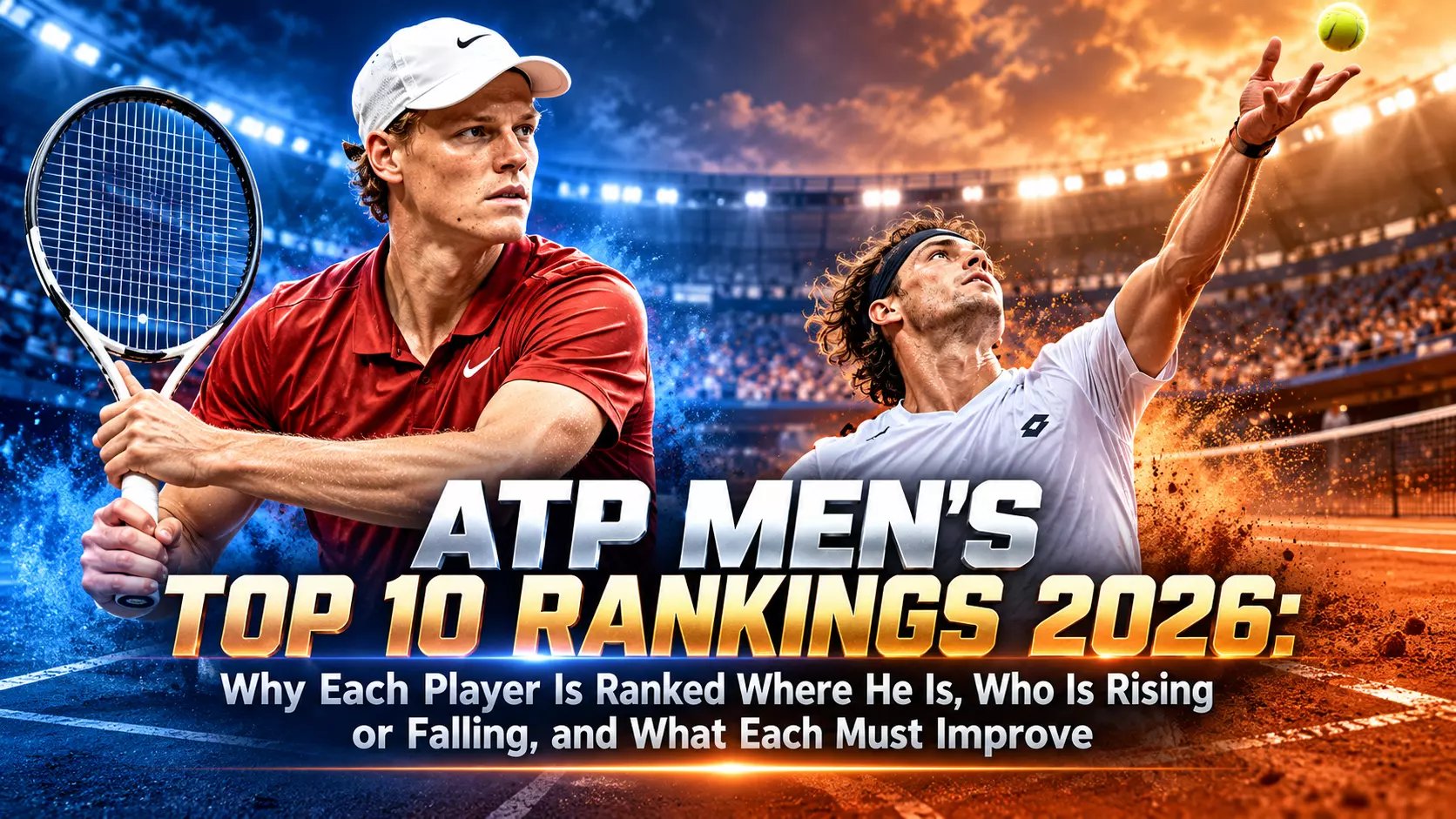
ATP Men's Top 10 Rankings 2026: Why Each Player Is Ranked Where He Is, Who Is Rising or Falling, and What Each Must Improve
The 2026 ATP Tour has produced one of the more intriguing men’s tennis ranking battles in recent years. Jannik Sinner remains the world’s No. 1 player, Alexander Zverev has narrowed the gap, and Carlos Alcaraz continues to be one of the sport’s biggest threats despite sitting third.
Meanwhile, American Ben Shelton has established himself among the elite, Daniil Medvedev is climbing again, and younger players such as Flavio Cobolli and Arthur Fils are challenging the established stars.
But a player’s ranking tells only part of the story. ATP rankings measure results over a rolling 52-week period, meaning a player can improve his tennis without immediately climbing the standings. Likewise, a player can rise in the rankings because opponents have lost points.
Here is a breakdown of the world’s top 10 men, explaining why they occupy their current positions, what they need to improve, and whether their careers are trending upward or downward.
Current ATP Top 10 Singles Rankings
Official weekly rankings dated October 19, 2026, the latest published list as of October 25. Movement compared with October 12.
Rank Player Points
Weekly trend
1 Jannik Sinner 🇮🇹 10,950
2 Alexander Zverev 🇩🇪 10,070
3 Carlos Alcaraz 🇪🇸 5,610
4 Ben Shelton 🇺🇸 4,720
5 Daniil Medvedev 3,660
6 Flavio Cobolli 🇮🇹 3,640
7 Félix Auger-Aliassime 🇨🇦 3,590
8 Alex de Minaur 🇦🇺 3,430
9 Frances Tiafoe 🇺🇸 3,380
10 Arthur Fils 🇫🇷 3,325
1. Jannik Sinner — Italy
World No. 1
10,950 ranking points
Position at risk
Sinner remains the benchmark for consistency and baseline dominance, but his injury-related absence has opened the door for Zverev.
Why he is ranked No. 1: Sinner’s 2026 season has been extraordinary. He won Wimbledon and swept the first five Masters 1000 tournaments of the season: Indian Wells, Miami, Monte Carlo, Madrid and Rome. His 44–3 record demonstrates how difficult he has been to beat.
His greatest weapons are his clean ball-striking, exceptional movement, powerful two-handed backhand and ability to control rallies without taking unnecessary risks.
What he needs to improve: Right now, Sinner’s biggest challenge is physical rather than technical. His right knee injury has kept him out of competition since Wimbledon, and he has announced that he will miss the remainder of the season.
He needs a successful recovery and careful management of his tournament schedule. Upon returning, restoring match fitness and maintaining his movement will be essential.
Is his ranking rising or falling? His official position is unchanged, but his outlook is falling. Zverev is only 880 points behind on the October 19 list, and Sinner has substantial points to defend.
Outlook: A healthy Sinner remains a strong candidate to reclaim or retain the No. 1 position in 2027, but an extended absence could significantly affect his ranking.
2. Alexander Zverev — Germany
World No. 2
10,070 ranking points
Strong upward momentum
Zverev has turned years of Grand Slam frustration into his most successful major championship season.
Why he is ranked No. 2: Zverev captured his first Grand Slam championship at the 2026 French Open, defeating Flavio Cobolli in five sets. He followed that performance by winning the US Open, defeating Ben Shelton in four sets.
The German finished the four Grand Slam tournaments with a combined 25–2 record, establishing himself as the season’s most successful player at the majors.
His enormous first serve, reliable backhand and improved confidence in championship matches have helped transform his career.
What he needs to improve: Zverev can still benefit from greater aggression with his forehand and more consistency in shorter matches. Improving his second-serve effectiveness under pressure would also help him against the best returners.
Avoiding occasional early exits at Masters 1000 events will make him even more difficult to challenge.
Is his ranking rising or falling? His weekly ranking remains unchanged, but his momentum is clearly upward. Zverev has already secured the 2026 year-end No. 1 distinction, even though Sinner still occupies the top position on the October 19 ranking.
Outlook: Zverev is positioned to enter 2027 as one of the favorites at every major championship.
3. Carlos Alcaraz — Spain
World No. 3
5,610 ranking points
Recovering ground
Alcaraz’s ranking reflects a disrupted season rather than a collapse in ability.
Why he is ranked No. 3: Alcaraz began 2026 by winning the Australian Open, becoming the youngest man to complete the career Grand Slam. He also captured the Doha title and appeared capable of controlling the ATP rankings.
However, a right wrist injury sidelined him from April until the US Open, costing him opportunities to defend and accumulate ranking points. He has since returned to winning form, including defending his Tokyo title.
Alcaraz remains one of the most versatile players in
tennis, combining explosive forehands, creative drop shots, exceptional court coverage and outstanding athleticism.
What he needs to improve: Staying healthy must be his first priority. Technically, Alcaraz can improve his shot selection when opponents force him into longer rallies.
Against opponents such as Sinner and Zverev, choosing when to attack rather than constantly pursuing spectacular winners could make him more consistent.
Is his ranking rising or falling? Unchanged this week, with a longer-term downward ranking trend caused primarily by missed tournaments. His post-injury results suggest his playing form is recovering, although his recent Shanghai defeat shows he still has work to do.
Outlook: Alcaraz may be the most dangerous player outside the top two. If he stays healthy, he has the ability to challenge for No. 1 again.
4. Ben Shelton — United States
World No. 4
4,720 ranking points
Rising career trajectory
Shelton has emerged as America’s leading men’s singles player and a genuine Grand Slam contender.
Why he is ranked No. 4: Shelton has captured four ATP titles in 2026, winning in Dallas, Munich, Stuttgart and Montreal. He successfully defended his Canadian Masters 1000 crown and reached his first major final at the US Open before losing to Zverev.
His left-handed serve is among the most dangerous weapons in
men’s tennis. When his first serve and forehand are working together, even elite defenders struggle to neutralize his aggression.
What he needs to improve: Shelton’s return game is the most obvious area for development. Against top-ranked opponents, he needs to generate more break opportunities instead of relying on tiebreaks.
Better consistency in baseline exchanges, particularly with his backhand, could also help him compete more effectively on clay and slower hard courts.
Is his ranking rising or falling? Officially unchanged this week, but his career trajectory is strongly upward. He has reached a career-high ranking of No. 4.
Outlook: Shelton has the athleticism, confidence and serve to become a Grand Slam champion. Improving his return game could make the difference between remaining in the top five and challenging for No. 1.
5. Daniil Medvedev — Russia
World No. 5
3,660 ranking points
Up 1 position
The former world No. 1 has rediscovered his winning rhythm and remains dangerous on hard courts.
Why he is ranked No. 5: Medvedev has returned to winning form in 2026. He reached the Indian Wells final against Sinner and, on October 25, successfully defended his Almaty title by defeating Nikoloz Basilashvili.
That victory gave him his fourth ATP title of the season and the 25th of his career.
Medvedev’s unconventional playing style remains highly effective. His deep defensive positioning, flat groundstrokes and ability to frustrate opponents make him especially difficult on hard courts.
What he needs to improve: Medvedev must become more aggressive against opponents who consistently approach the net or use short angles to pull him out of position.
Improving his willingness to step inside the baseline, particularly against second serves, could create more opportunities to finish points quickly.
Is his ranking rising or falling? Rising. He climbed one position in the latest official ranking, and his Almaty victory adds further momentum. His return to the top five represents meaningful progress.
Outlook: Medvedev remains a legitimate threat to win Masters 1000 events and reach another Grand Slam final. A return to the top three is possible if he maintains his current level.
6. Flavio Cobolli — Italy
World No. 6
3,640 ranking points · Up 1 position
Cobolli has been one of the biggest breakthrough stories of the 2026 season.
Why he is ranked No. 6: Cobolli has transformed himself from a promising prospect into an established top-10 player.
His breakthrough came at Roland Garros, where he reached his first Grand Slam final before losing a five-set battle against Zverev. He also won the Acapulco title, reached the Munich final and advanced to the Cincinnati semifinals.
Cobolli first entered the top 10 in June and has demonstrated that he can compete with the world’s best players on multiple surfaces.
His strengths include aggressive baseline hitting, excellent competitiveness and the ability to take control with his forehand.
What he needs to improve: Cobolli must become more consistent against opponents who possess superior serves and more powerful first strikes.
Developing a more dependable second serve and learning to finish points earlier would help him conserve energy during major tournaments.
He also needs to produce deep runs consistently outside clay-court events.
Is his ranking rising or falling? Rising. He climbed one place to No. 6, and his overall career trajectory is strongly positive.
However, Cobolli will eventually face the challenge of defending the significant ranking points earned during his breakthrough season.
Outlook: Cobolli has realistic top-five potential. His next challenge is proving that his 2026 success can become his normal level rather than a single exceptional season.
7. Félix Auger-Aliassime — Canada
World No. 7
3,590 ranking points · Down 2 positions
Auger-Aliassime has experienced a mixed season, combining strong performances with disappointing exits.
Why he is ranked No. 7: The Canadian began the year strongly by successfully defending his Montpellier championship. He also reached the Rotterdam final and produced quarterfinal appearances at Roland Garros and Wimbledon.
These performances demonstrated his ability to compete across different surfaces, but inconsistent results elsewhere have prevented him from maintaining a place among the top five.
His combination of a powerful serve, aggressive forehand and excellent indoor hard-court game gives him the weapons to challenge almost anyone.
What he needs to improve: His biggest problem is consistency against elite opposition.
Auger-Aliassime needs to improve his return game and his ability to generate offense when his first serve is not producing free points.
He must also avoid stretches of unforced errors that allow opponents back into matches.
Is his ranking rising or falling? Falling. He dropped two positions in the latest official rankings, the biggest decline among the current top 10.
That does not mean his overall game is deteriorating, but he has lost ground in a competitive group separated by relatively few points.
Outlook: Auger-Aliassime has the talent to return to the top five. His challenge is turning occasional outstanding performances into consistent results throughout the season.
8. Alex de Minaur — Australia
World No. 8
3,430 ranking points · Up 1 position
De Minaur remains one of the most consistent competitors on tour, but he needs bigger victories to move higher.
Why he is ranked No. 8: De Minaur’s ranking reflects his consistency, athleticism and ability to win matches across a long season.
He captured the Rotterdam title in February, defeating Auger-Aliassime in the final, and reached additional championship matches during the year. His speed and defensive ability allow him to extend rallies and force opponents into difficult shots.
De Minaur has also developed a more aggressive baseline approach, making him more dangerous against high-level opponents than earlier in his career.
What he needs to improve: The Australian must continue developing his serve and offensive weapons.
Against players such as Sinner, Zverev and Shelton, De Minaur sometimes struggles to generate enough easy points.
Taking the ball earlier, attacking second serves and finishing more points at the net would help him shorten rallies.
Is his ranking rising or falling? His official ranking rose one position this week, although his longer-term ranking has fluctuated below his 2026 career-high No. 5.
Outlook: De Minaur should remain a reliable top-10 contender. Breaking into the top five again will require more victories against players ranked above him, particularly at Grand Slams and Masters 1000 events.
9. Frances Tiafoe — United States
World No. 9
3,380 ranking points · Up 1 position
Tiafoe has enjoyed an impressive resurgence, placing himself back among the best players in
men’s tennis.
Why he is ranked No. 9: Tiafoe’s return to the top 10 has been driven by several strong tournament performances.
He reached the Cincinnati Masters 1000 final, defeating quality opponents before falling to Arthur Fils in three sets. He followed that performance with a semifinal appearance at the US Open, where Shelton ended his run.
His 2026 record of 44 wins and 19 losses demonstrates his improved consistency.
Tiafoe is particularly dangerous when he is serving well, moving forward and using his creativity to disrupt opponents’ rhythm.
What he needs to improve: Tiafoe needs to perform with greater consistency throughout the calendar.
His first-serve percentage and return of serve offer opportunities for improvement. Developing a more reliable backhand under pressure could also help him against stronger baseline players.
Maintaining concentration during early-round matches will be essential if he wants to establish himself in the top five.
Is his ranking rising or falling? Rising. He gained one position, and his second-half performances have restored his standing among the ATP elite.
Outlook: Tiafoe has the game to make another Grand Slam semifinal or final. His challenge is translating impressive tournament runs into regular championship victories.
10. Arthur Fils — France
World No. 10
3,325 ranking points · Up 1 position
Fils is one of the most exciting emerging players on the ATP Tour and a serious candidate to climb higher in 2027.
Why he is ranked No. 10: Fils has enjoyed the biggest season of his young career.
He captured the Barcelona ATP 500 title before winning his first Masters 1000 championship in Cincinnati, defeating Tiafoe 6–3, 1–6, 6–0 in the final.
His Cincinnati victory was particularly impressive because he defeated several highly ranked opponents, including De Minaur and Cobolli, on his way to the championship.
Fils brings exceptional power, athleticism and confidence to the court. His forehand can overwhelm opponents, and his serve has improved substantially.
What he needs to improve: Physical durability remains a significant challenge. Fils missed portions of 2026 because of injuries, including the Australian swing and Roland Garros.
He must improve his ability to remain healthy through demanding tournament stretches.
Technically, his return game also offers room for improvement. ATP statistics during Cincinnati showed substantial progress on serve, but relatively modest gains in return games won.
Is his ranking rising or falling? Rising. He climbed one position into the top 10, and his breakthrough Masters 1000 title suggests that his potential ranking ceiling is considerably higher.
Outlook: Fils may be the most promising long-term riser among the players currently ranked sixth through tenth. If he stays healthy, a top-five breakthrough is a realistic objective.
Which ATP Players Are Most Likely to Rise or Fall?
Based on their 2026 performances, here is my assessment of their momentum entering the closing weeks of the season.
Momentum assessment — editorial analysis, not an official ATP forecast
Jannik Sinner Falling risk
Alexander Zverev Strongly rising
Carlos Alcaraz Recovering
Ben Shelton Strongly rising
Daniil Medvedev Rising
Flavio Cobolli Rising
Félix Auger-Aliassime Falling
Alex de Minaur Mixed
Frances Tiafoe Rising
Arthur Fils Strongly rising
An important player just outside the top 10 is Novak Djokovic, currently No. 12, while Rafael Jódar sits at No. 11. With only 91 ranking points separating Arthur Fils from Jódar on October 19, the lower portion of the top 10 remains highly competitive.
Conclusion: The Future of Men’s Tennis Is Becoming More Competitive
The ATP rankings reveal a fascinating balance between established champions, players experiencing major breakthroughs and younger stars challenging for places among the elite.
Sinner remains No. 1 based on his extraordinary results over the previous 52 weeks. However, his injury has created an opportunity for Zverev, whose two Grand Slam victories have established him as one of the biggest success stories of 2026.
Alcaraz remains a serious threat despite missing a substantial portion of the season. When healthy, his combination of athleticism, creativity and championship experience makes him capable of defeating anyone.
Among the rising challengers, Shelton and Fils stand out. Shelton has already established himself as America’s strongest singles contender, while Fils has demonstrated championship potential with his Cincinnati victory. Cobolli’s breakthrough also suggests that Italy could have two players competing near the very top of the rankings for years to come.
Medvedev and Tiafoe have shown that experienced players can rediscover their
best tennis. De Minaur remains one of the game’s most consistent competitors, while Auger-Aliassime faces the challenge of reversing his recent ranking decline.
Looking toward 2027, three major questions will shape the ATP Tour: Can Sinner return from injury at full strength? Will Zverev build on his Grand Slam breakthrough? And can younger stars such as Shelton, Cobolli and Fils challenge the established leaders?
My prediction: Zverev and Alcaraz are best positioned to benefit immediately from Sinner’s absence, while Shelton and Fils are particularly strong candidates for further long-term improvement.
The ATP Tour is no longer defined by only two or three championship contenders. Its growing depth means that every major tournament offers opportunities for established champions and emerging stars alike.
New Users – Get $350 in Bonus Bets when you wager $5 for 7 days
T&Cs apply
4.6/5
Gambling Problem? Call 1-800-GAMBLER or 1-800-MY-RESET. Call 1-888-789-7777 or visit ccpgg.org/chat (CT). Hope is here. GamblingHelpLineMA.org or call (800) 327-5050 for 24/7 support (MA). Visit www.mdgamblinghelp.org (MD). Call 1-877-8HOPE-NY or text HOPENY (NY). 21+ (18+ DC, WY) and present in select states (for KS, in affiliation with Kansas Star Casino). Find online real money wagering only. Min $5 wager required for 7 consecutive days. $5 free play credit. Bonus issued as non-withdrawable bonus with cash withdrawable bonus with cash withdrawable. Bonus bets which expire 7 days after receipt. Restrictions apply. See terms at sportsbook.fanduel.com. Call 1-877-770-7867 (LA).
Up To $1500 in Bonus Bets Paid Back if your First Bet Does Not Win
T&Cs apply
4.5/5
Gambling problem? Call 1-800-GAMBLER or 1-800-MY-RESET (Available in the US) 877-8-HOPENY or text HOPENY (467369) (NY) 1-800-327-5050 (MA), 1-800-BETS-OFF (IA), 1-800-981-0023 (PR). 21+ only. Please Gamble Responsibly. See BetMGM.com for Terms. First Bet Offer for new customers only (if applicable). Subject to eligibility requirements. Bonus bets are non-withdrawable. In partnership with Kansas Crossing Casino and Hotel. Promotional offers not available in Mississippi, Massachusetts, New York, Ontario, or Puerto Rico.
New DraftKings Customers: Bet $5, Get $200 + 3 Months of NBA League Pass!
T&Cs apply
4.5/5
GAMBLING PROBLEM? CALL 1-800-GAMBLER or 1-800-MY-RESET, (800) 327-5050 or visit gamblinghelplinema.org (MA). Please Gamble Responsibly. 888-789-7777/visit ccpg.org (CT), or visit www.mdgamblinghelp.org (MD), 1-800-981-0023 (PR). 21+ and present in most states. (18+ DC/NH/PR/WY). Void in CAN. Eligibility restrictions apply. On behalf of Boot Hill Casino (KS). Pass-thru of per wager tax may apply in IL. 1 per new Sportsbook customer. $5+ first-time bet req. Max. $200 issued as non-withdrawable Bonus Bets. Stake removed from payout. Reward issued as $50 in Bonus Bets every 7 days via click-to-claim for 21 days. Bonus Bets and click-to-claims expire 7 days (168hrs) after issuance. Terms: dkng.co/offer. Get 1 promo code to redeem a 3-month NBA League Pass subscription, complimentary of DraftKings. Subscription auto-renews monthly at then-current price (currently $16.99/mo); cancel anytime. Terms, restrictions, and eligibility requirements apply. Redeem League Pass by 12/19/26 at 11:59 PM ET. Addt’l terms: support.watch.nba.com/hc/en-us/articles/9165532876183-League-Pass-Terms-of-Use_. Ends 11/29/26 at 11:59 PM ET. Sponsored by DK.
Must be 21+. GAMBLING PROBLEM? CALL 1-800-GAMBLER OR CALL 1-800-MY-RESET, www.mdgamblinghelp.org (MD), (800)-327-5050 or gamblinghelplinema.org (MA), Call (877)8-HOPENY or text HOPENY (467369) (NY), (888) 789-7777 or ccpg.org (CT), morethanagame.nc.gov (NC), 1800gambler.net (WV)
Bet $1 and get double the winnings up to $25 for your next 10 bets
T&Cs apply
4.4/5
21+ New users only. Must register using eligible promo code. First bet after registration must qualify. Max. Bonus Bet: $1,000. Bonus Bet expires 14 days after receipt. Void where prohibited. See Caesars.com/promos for full terms. Gambling Problem? 1-800-GAMBLER (1-800-426-2537)
21+ and present in OH. Gambling Problem? Call 1-800-GAMBLER.
This site is using
Cloudflare
and adheres to the
Google Safe Browsing Program. We adapted
Google's Privacy Guidelines
to keep your data safe at all times.
Close
Ready to Win Big? Join the Elite with Our Sports Betting Deals!
FanDuel Promo
New Users – Get $350 in Bonus Bets when you wager $5 for 7 days
Our Favorite
T&Cs and 21+ apply
Gambling Problem? Call 1-800-GAMBLER or 1-800-MY-RESET. Call 1-888-789-7777 or visit ccpgg.org/chat (CT). Hope is here. GamblingHelpLineMA.org or call (800) 327-5050 for 24/7 support (MA). Visit www.mdgamblinghelp.org (MD). Call 1-877-8HOPE-NY or text HOPENY (NY). 21+ (18+ DC, WY) and present in select states (for KS, in affiliation with Kansas Star Casino). Find online real money wagering only. Min $5 wager required for 7 consecutive days. $5 free play credit. Bonus issued as non-withdrawable bonus with cash withdrawable bonus with cash withdrawable. Bonus bets which expire 7 days after receipt. Restrictions apply. See terms at sportsbook.fanduel.com. Call 1-877-770-7867 (LA).
Code:
Open FanDuel
Get Bonus
BetMGM Promo
Up To $1500 in Bonus Bets Paid Back if your First Bet Does Not Win
Best Slots
T&Cs and 21+ apply
Gambling problem? Call 1-800-GAMBLER or 1-800-MY-RESET (Available in the US) 877-8-HOPENY or text HOPENY (467369) (NY) 1-800-327-5050 (MA), 1-800-BETS-OFF (IA), 1-800-981-0023 (PR). 21+ only. Please Gamble Responsibly. See BetMGM.com for Terms. First Bet Offer for new customers only (if applicable). Subject to eligibility requirements. Bonus bets are non-withdrawable. In partnership with Kansas Crossing Casino and Hotel. Promotional offers not available in Mississippi, Massachusetts, New York, Ontario, or Puerto Rico.
Code:
Open BetMGM
Get Bonus
DraftKings Promo
New DraftKings Customers: Bet $5, Get $200 + 3 Months of NBA League Pass!
Newcomer
T&Cs and 21+ apply
GAMBLING PROBLEM? CALL 1-800-GAMBLER or 1-800-MY-RESET, (800) 327-5050 or visit gamblinghelplinema.org (MA). Please Gamble Responsibly. 888-789-7777/visit ccpg.org (CT), or visit www.mdgamblinghelp.org (MD), 1-800-981-0023 (PR). 21+ and present in most states. (18+ DC/NH/PR/WY). Void in CAN. Eligibility restrictions apply. On behalf of Boot Hill Casino (KS). Pass-thru of per wager tax may apply in IL. 1 per new Sportsbook customer. $5+ first-time bet req. Max. $200 issued as non-withdrawable Bonus Bets. Stake removed from payout. Reward issued as $50 in Bonus Bets every 7 days via click-to-claim for 21 days. Bonus Bets and click-to-claims expire 7 days (168hrs) after issuance. Terms: dkng.co/offer. Get 1 promo code to redeem a 3-month NBA League Pass subscription, complimentary of DraftKings. Subscription auto-renews monthly at then-current price (currently $16.99/mo); cancel anytime. Terms, restrictions, and eligibility requirements apply. Redeem League Pass by 12/19/26 at 11:59 PM ET. Addt’l terms: support.watch.nba.com/hc/en-us/articles/9165532876183-League-Pass-Terms-of-Use_. Ends 11/29/26 at 11:59 PM ET. Sponsored by DK.
Code:
Open DraftKings
Get Bonus
Find out what the legends have to say about sports this week....
New Users – Get $350 in Bonus Bets when you wager $5 for 7 days
Gambling Problem? Call 1-800-GAMBLER or 1-800-MY-RESET. Call 1-888-789-7777 or visit ccpgg.org/chat (CT). Hope is here. GamblingHelpLineMA.org or call (800) 327-5050 for 24/7 support (MA). Visit www.mdgamblinghelp.org (MD). Call 1-877-8HOPE-NY or text HOPENY (NY). 21+ (18+ DC, WY) and present in select states (for KS, in affiliation with Kansas Star Casino). Find online real money wagering only. Min $5 wager required for 7 consecutive days. $5 free play credit. Bonus issued as non-withdrawable bonus with cash withdrawable bonus with cash withdrawable. Bonus bets which expire 7 days after receipt. Restrictions apply. See terms at sportsbook.fanduel.com. Call 1-877-770-7867 (LA).