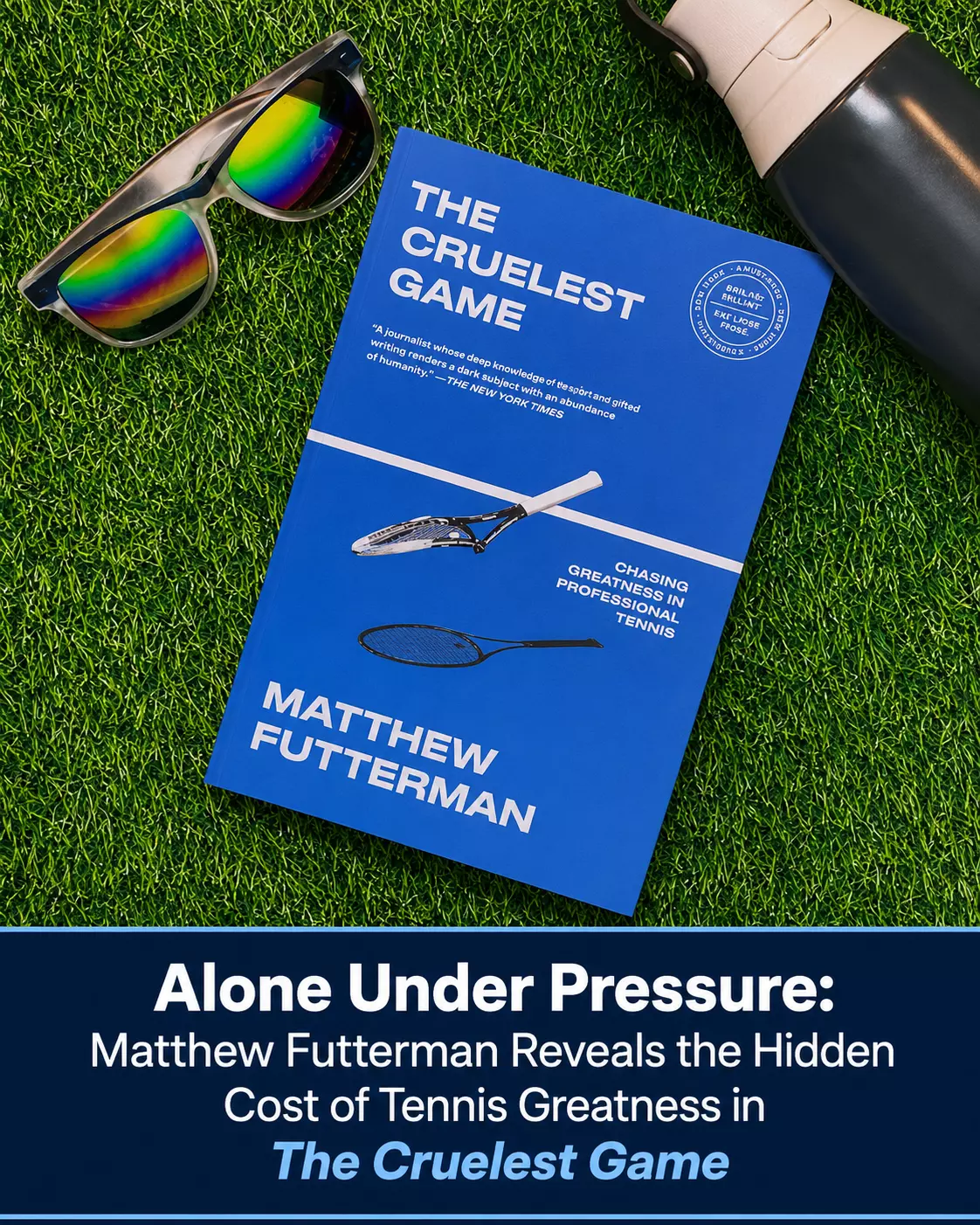
Alone Under Pressure: Matthew Futterman Reveals the Hidden Cost of Tennis Greatness in The Cruelest Game
Professional tennis
is often presented as one of the world’s most glamorous sports. Its greatest players travel internationally, compete before packed stadiums, earn enormous prize money and become instantly recognizable global celebrities. Yet behind the trophies, endorsements and carefully produced highlight reels exists a far more difficult reality—one defined by isolation, exhaustion, relentless expectations and the knowledge that every weakness will eventually be exposed.
In
The Cruelest Game: Chasing Greatness in
Professional Tennis, award-winning sports journalist Matthew Futterman takes readers behind the polished public image of the professional tour. Scheduled for publication by Doubleday on August 4, 2026, the 352-page book examines not merely how elite players win, but what they must surrender physically, psychologically and emotionally for the opportunity to become great.
The Journalist Behind the Book
Matthew Futterman has spent much of his career examining the forces that shape athletes after the competition ends and the cameras turn away.
An award-winning veteran sports journalist, Futterman has worked for
The Athletic,
The New York Times,
The Wall Street Journal,
The Star-Ledger
of New Jersey and
The Philadelphia Inquirer. While at
The Star-Ledger, he was part of the staff that received the 2005 Pulitzer Prize for Breaking News.
That background is important because Futterman is not approaching
tennis
as a distant historian or an admirer collecting familiar championship stories. He has reported from inside the sport and developed the access necessary to observe players during practice sessions, in stadium tunnels, at training academies and away from the carefully managed environment of press conferences.
His real subject has consistently been the pursuit of excellence: who controls it, what produces it and what it eventually costs.
What Is
The Cruelest Game
About?
At its center,
The Cruelest Game
asks a deceptively complicated question: Why does tennis drive so many extraordinary athletes toward frustration, loneliness and emotional exhaustion?
The book arrives during a pivotal transition in the sport. Roger Federer, Rafael Nadal and Serena Williams have left professional competition behind, while Novak Djokovic confronts the closing stages of his historic career. At the same time, Carlos Alcaraz, Jannik Sinner, Coco Gauff, Aryna Sabalenka, Iga Świątek, Ben Shelton and other younger stars are attempting to establish their own places at the top of the game.
Futterman uses this changing of the guard to investigate what he describes as the hidden “codes” of
tennis greatness. Through extensive reporting and access to players and coaches, he explores training, tactical evolution, personal relationships, failure, adaptation and the difficult process of eventually walking away.
The book does not limit greatness to natural talent. It illustrates how championship careers are built through millions of repeated strokes, technical adjustments and years of accumulated experience. One revealing comparison concerns Alcaraz and Shelton. Alcaraz was practicing almost daily by age six, while Shelton enjoyed a more conventional childhood and did not specialize as early. Both became exceptional professionals, but Shelton entered the elite level without the same lifetime volume of repetitions. In the unforgiving mathematics of professional tennis, Futterman suggests, even a healthy and balanced childhood can create a competitive disadvantage.
The psychological lessons may be even more important. Futterman examines Coco Gauff’s struggles and adaptations, Naomi Osaka’s return to a changing tactical environment and Madison Keys’ realization that competing freely required a support system that did not make affection feel dependent upon victory. The book argues that one of tennis’s most difficult secrets is learning to accept losing without allowing defeat to become an identity.
Unlike team-sport athletes, tennis players cannot disappear into a lineup when their confidence vanishes. They stand alone, with no teammate to take the next possession and limited communication with their coaches. Every serve, error, decision and emotional reaction belongs to them. Futterman presents that isolation as one of the sport’s defining characteristics—and one of the primary reasons it can become so mentally destructive.
How It Compares to Futterman’s Previous Books
The Cruelest Game
is Futterman’s third book, following
Players: How Sports Became a Business
and
Running to the Edge: A Band of Misfits and the Guru Who Unlocked the Secrets of Speed. Together, the three books demonstrate his ability to approach sports through very different lenses.
Players
offered the widest view. It examined the transformation of professional sports into a massive global industry, tracing the influence of agents, labor movements, television networks, shoe companies, endorsements and athlete branding. Its cast included figures such as Arnold Palmer, Mark McCormack, Marvin Miller, Catfish Hunter, Michael Jordan and Nick Bollettieri. That book concentrated on the structures surrounding athletes—the people, businesses and financial forces that changed how sports operate.
Running to the Edge
narrowed that focus by telling the story of visionary distance-running coach Bob Larsen, the unconventional Jamul Toads and the training principles that eventually helped runners such as Meb Keflezighi and Deena Kastor reach Olympic success. Futterman blended sports history, physiology, coaching innovation and his own experiences as a runner into an underdog narrative about discovering how the human body can be trained to go farther and faster.
The Cruelest Game
is more psychologically intimate than either of those books. Where
Players
examined the business constructed around athletes and
Running to the Edge
studied a coach’s system for developing them, this book enters the competitors’ interior world.
The progression is fascinating. Futterman has moved from the economics of professional sports, to the science of training, and finally to the mind of the athlete. All three books investigate greatness, but
The Cruelest Game
appears to present his most personal and emotionally complex exploration of the subject.
It is also his most concentrated portrait of a single professional sport. That narrower focus allows him to examine tennis’s scoring, scheduling, coaching relationships, technical evolution and emotional contradictions with exceptional depth.
What Are People Saying About the Book?
Advance reaction has been overwhelmingly positive, with critics and major tennis figures praising both Futterman’s access and his ability to reveal the psychology behind elite competition.
Billie Jean King describes Futterman as one of tennis’s clearest modern journalistic voices and praises the book for exposing the physical and mental challenges professional athletes face. Mary Carillo has highlighted the understanding, empathy and grace Futterman brings to the athletes’ struggles. Jon Wertheim argues that the book reaches beyond traditional sportswriting and succeeds as a work of psychological reporting.
Catherine Whitaker of
The Tennis Podcast
says the book captures both the brutality and beauty of tennis and believes it will change how readers watch the sport. Jason Gay praises its energetic storytelling and its examination of tennis’s history, personalities and future.
The professional reviews have been equally enthusiastic.
Publishers Weekly
awarded the book a starred review, commending the combination of entertaining reporting and convincing psychological analysis.
Kirkus Reviews
also gave it a starred review, calling attention to Futterman’s reporting on the mental and physical pressures of the professional tour.
The book was also selected for
The Boston Globe’s
summer reading list, while Bloomberg praised Futterman’s ability to explore the sport’s psychology, competitive ecosystem and difficult-to-define qualities that separate excellent players from champions.
The common thread running through this praise is that Futterman has produced something more substantial than a collection of athlete profiles. The book is being recognized as an investigation of the emotional machinery behind professional excellence.
Why You Should Read It
Tennis fans should read
The Cruelest Game
because it promises to alter the way they interpret what they see on court.
A double fault will no longer appear to be simply a technical mistake. A mid-match collapse will not seem like an inexplicable failure of character. A coaching change, extended absence or emotional outburst may instead be understood as part of a larger battle involving confidence, repetition, physical fatigue, family expectations and the unbearable pressure of competing alone.
The book should also appeal to readers who do not regularly follow tennis. Its central questions extend far beyond the baseline. How much sacrifice is greatness worth? Can ambition survive without becoming destructive? How does someone accept failure when an entire identity has been built around winning? What happens when the talent, discipline and obsession that created a champion are no longer enough?
Futterman also appears unwilling to reduce athletes to either heroes or cautionary tales. He treats their ambition seriously while remaining alert to its consequences. That balance gives the book its potential power. It admires the beauty of elite performance without pretending that excellence is achieved through inspiration alone.
Most importantly,
The Cruelest Game
restores humanity to athletes who are too often discussed as rankings, statistics and championship totals. It reminds readers that the person across the net is not the only opponent. Professional players must also battle exhaustion, memory, fear, doubt, public expectations and their own instincts.
Conclusion
With
The Cruelest Game, Matthew Futterman turns professional tennis inside out.
The book takes readers beyond center-court glamour and into a world of punishing schedules, private practices, changing techniques, difficult relationships and psychological battles. Its stars may be among the most celebrated athletes on earth, but Futterman presents them as profoundly vulnerable people attempting to control a sport designed to expose every weakness.
Compared with his earlier work, this is Futterman’s deepest examination of the emotional price of athletic excellence.
Players
explained how modern sports became an industry.
Running to the Edge
explored how innovative training can expand human potential.
The Cruelest Game
confronts the final and perhaps most difficult question: What happens inside athletes once they have devoted their lives to becoming great?
The result is a timely portrait of tennis at a generational crossroads and a broader meditation on ambition, sacrifice and identity. It should be essential reading for tennis followers, sports enthusiasts and anyone fascinated by the complicated distance between exceptional talent and lasting greatness.
In tennis, victory may belong to one player. As Futterman reveals, however, no one reaches it without paying a price.
New Users – Get $350 in Bonus Bets when you wager $5 for 7 days
T&Cs apply
4.6/5
Gambling Problem? Call 1-800-GAMBLER or 1-800-MY-RESET. Call 1-888-789-7777 or visit ccpgg.org/chat (CT). Hope is here. GamblingHelpLineMA.org or call (800) 327-5050 for 24/7 support (MA). Visit www.mdgamblinghelp.org (MD). Call 1-877-8HOPE-NY or text HOPENY (NY). 21+ (18+ DC, WY) and present in select states (for KS, in affiliation with Kansas Star Casino). Find online real money wagering only. Min $5 wager required for 7 consecutive days. $5 free play credit. Bonus issued as non-withdrawable bonus with cash withdrawable bonus with cash withdrawable. Bonus bets which expire 7 days after receipt. Restrictions apply. See terms at sportsbook.fanduel.com. Call 1-877-770-7867 (LA).
Up To $1500 in Bonus Bets Paid Back if your First Bet Does Not Win
T&Cs apply
4.5/5
Gambling problem? Call 1-800-GAMBLER or 1-800-MY-RESET (Available in the US) 877-8-HOPENY or text HOPENY (467369) (NY) 1-800-327-5050 (MA), 1-800-BETS-OFF (IA), 1-800-981-0023 (PR). 21+ only. Please Gamble Responsibly. See BetMGM.com for Terms. First Bet Offer for new customers only (if applicable). Subject to eligibility requirements. Bonus bets are non-withdrawable. In partnership with Kansas Crossing Casino and Hotel. Promotional offers not available in Mississippi, Massachusetts, New York, Ontario, or Puerto Rico.
New DraftKings Customers: Bet $5, Get $200 + 3 Months of NBA League Pass!
T&Cs apply
4.5/5
GAMBLING PROBLEM? CALL 1-800-GAMBLER or 1-800-MY-RESET, (800) 327-5050 or visit gamblinghelplinema.org (MA). Please Gamble Responsibly. 888-789-7777/visit ccpg.org (CT), or visit www.mdgamblinghelp.org (MD), 1-800-981-0023 (PR). 21+ and present in most states. (18+ DC/NH/PR/WY). Void in CAN. Eligibility restrictions apply. On behalf of Boot Hill Casino (KS). Pass-thru of per wager tax may apply in IL. 1 per new Sportsbook customer. $5+ first-time bet req. Max. $200 issued as non-withdrawable Bonus Bets. Stake removed from payout. Reward issued as $50 in Bonus Bets every 7 days via click-to-claim for 21 days. Bonus Bets and click-to-claims expire 7 days (168hrs) after issuance. Terms: dkng.co/offer. Get 1 promo code to redeem a 3-month NBA League Pass subscription, complimentary of DraftKings. Subscription auto-renews monthly at then-current price (currently $16.99/mo); cancel anytime. Terms, restrictions, and eligibility requirements apply. Redeem League Pass by 12/19/26 at 11:59 PM ET. Addt’l terms: support.watch.nba.com/hc/en-us/articles/9165532876183-League-Pass-Terms-of-Use_. Ends 11/29/26 at 11:59 PM ET. Sponsored by DK.
Must be 21+. GAMBLING PROBLEM? CALL 1-800-GAMBLER OR CALL 1-800-MY-RESET, www.mdgamblinghelp.org (MD), (800)-327-5050 or gamblinghelplinema.org (MA), Call (877)8-HOPENY or text HOPENY (467369) (NY), (888) 789-7777 or ccpg.org (CT), morethanagame.nc.gov (NC), 1800gambler.net (WV)
Bet $1 and get double the winnings up to $25 for your next 10 bets
T&Cs apply
4.4/5
21+ New users only. Must register using eligible promo code. First bet after registration must qualify. Max. Bonus Bet: $1,000. Bonus Bet expires 14 days after receipt. Void where prohibited. See Caesars.com/promos for full terms. Gambling Problem? 1-800-GAMBLER (1-800-426-2537)
21+ and present in OH. Gambling Problem? Call 1-800-GAMBLER.
This site is using
Cloudflare
and adheres to the
Google Safe Browsing Program. We adapted
Google's Privacy Guidelines
to keep your data safe at all times.
Close
Ready to Win Big? Join the Elite with Our Sports Betting Deals!
FanDuel Promo
New Users – Get $350 in Bonus Bets when you wager $5 for 7 days
Our Favorite
T&Cs and 21+ apply
Gambling Problem? Call 1-800-GAMBLER or 1-800-MY-RESET. Call 1-888-789-7777 or visit ccpgg.org/chat (CT). Hope is here. GamblingHelpLineMA.org or call (800) 327-5050 for 24/7 support (MA). Visit www.mdgamblinghelp.org (MD). Call 1-877-8HOPE-NY or text HOPENY (NY). 21+ (18+ DC, WY) and present in select states (for KS, in affiliation with Kansas Star Casino). Find online real money wagering only. Min $5 wager required for 7 consecutive days. $5 free play credit. Bonus issued as non-withdrawable bonus with cash withdrawable bonus with cash withdrawable. Bonus bets which expire 7 days after receipt. Restrictions apply. See terms at sportsbook.fanduel.com. Call 1-877-770-7867 (LA).
Code:
Open FanDuel
Get Bonus
BetMGM Promo
Up To $1500 in Bonus Bets Paid Back if your First Bet Does Not Win
Best Slots
T&Cs and 21+ apply
Gambling problem? Call 1-800-GAMBLER or 1-800-MY-RESET (Available in the US) 877-8-HOPENY or text HOPENY (467369) (NY) 1-800-327-5050 (MA), 1-800-BETS-OFF (IA), 1-800-981-0023 (PR). 21+ only. Please Gamble Responsibly. See BetMGM.com for Terms. First Bet Offer for new customers only (if applicable). Subject to eligibility requirements. Bonus bets are non-withdrawable. In partnership with Kansas Crossing Casino and Hotel. Promotional offers not available in Mississippi, Massachusetts, New York, Ontario, or Puerto Rico.
Code:
Open BetMGM
Get Bonus
DraftKings Promo
New DraftKings Customers: Bet $5, Get $200 + 3 Months of NBA League Pass!
Newcomer
T&Cs and 21+ apply
GAMBLING PROBLEM? CALL 1-800-GAMBLER or 1-800-MY-RESET, (800) 327-5050 or visit gamblinghelplinema.org (MA). Please Gamble Responsibly. 888-789-7777/visit ccpg.org (CT), or visit www.mdgamblinghelp.org (MD), 1-800-981-0023 (PR). 21+ and present in most states. (18+ DC/NH/PR/WY). Void in CAN. Eligibility restrictions apply. On behalf of Boot Hill Casino (KS). Pass-thru of per wager tax may apply in IL. 1 per new Sportsbook customer. $5+ first-time bet req. Max. $200 issued as non-withdrawable Bonus Bets. Stake removed from payout. Reward issued as $50 in Bonus Bets every 7 days via click-to-claim for 21 days. Bonus Bets and click-to-claims expire 7 days (168hrs) after issuance. Terms: dkng.co/offer. Get 1 promo code to redeem a 3-month NBA League Pass subscription, complimentary of DraftKings. Subscription auto-renews monthly at then-current price (currently $16.99/mo); cancel anytime. Terms, restrictions, and eligibility requirements apply. Redeem League Pass by 12/19/26 at 11:59 PM ET. Addt’l terms: support.watch.nba.com/hc/en-us/articles/9165532876183-League-Pass-Terms-of-Use_. Ends 11/29/26 at 11:59 PM ET. Sponsored by DK.
Code:
Open DraftKings
Get Bonus
Find out what the legends have to say about sports this week....
New Users – Get $350 in Bonus Bets when you wager $5 for 7 days
Gambling Problem? Call 1-800-GAMBLER or 1-800-MY-RESET. Call 1-888-789-7777 or visit ccpgg.org/chat (CT). Hope is here. GamblingHelpLineMA.org or call (800) 327-5050 for 24/7 support (MA). Visit www.mdgamblinghelp.org (MD). Call 1-877-8HOPE-NY or text HOPENY (NY). 21+ (18+ DC, WY) and present in select states (for KS, in affiliation with Kansas Star Casino). Find online real money wagering only. Min $5 wager required for 7 consecutive days. $5 free play credit. Bonus issued as non-withdrawable bonus with cash withdrawable bonus with cash withdrawable. Bonus bets which expire 7 days after receipt. Restrictions apply. See terms at sportsbook.fanduel.com. Call 1-877-770-7867 (LA).