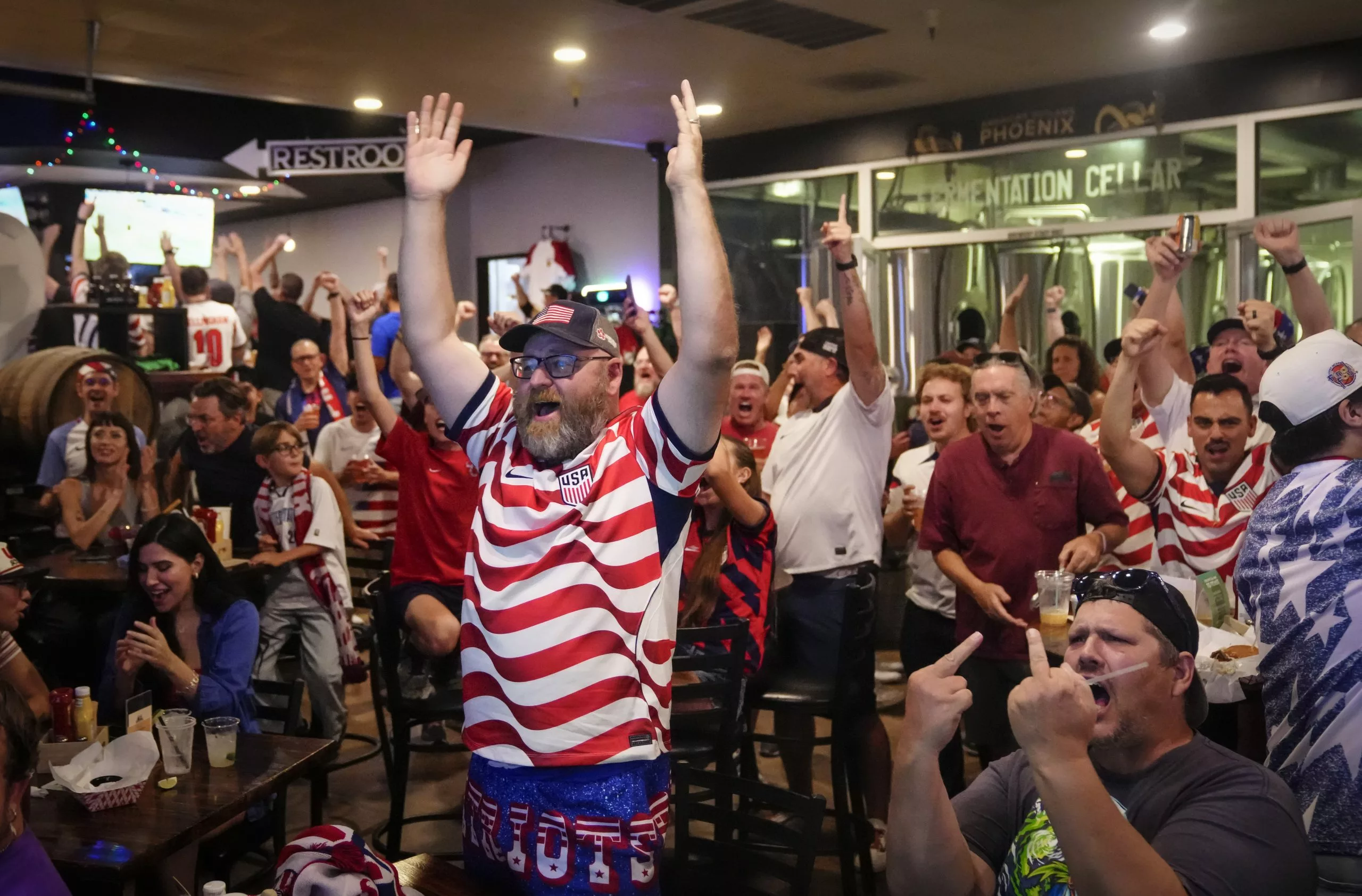
USA fans react during a World Cup watch party at Tombstone Brewing Co. in Phoenix on June 12, 2026.
The biggest World Cup ever played is one day old and already misbehaving. Mexico beat South Africa 2-0 at the Estadio Azteca on Thursday in an opener that produced three red cards, the most ever in a World Cup opening match, and left South Africa with nine men and Mexico with 10. By the time the final whistle blows in New Jersey on July 19, we will have watched 104 matches across 16 cities in three countries, 40 more games than Qatar gave us, spread across 48 teams instead of the usual 32.
Hours later in Guadalajara, South Korea fell behind to a Ladislav Krejčí header and flipped the game after halftime, with Hwang In-beom leveling and Substitute Oh Hyeon-gyu winning it in the 80th minutes, a 2-1 result that put the Koreans level with Mexico atop Group A. One day in, the supposedly watered-down World Cup had produced a red-card record and a comeback.
European writers have complained since FIFA approved the expansion, and the word that keeps coming up is diluted. They worry the giants will cruise through half asleep and that countries with no business here will clog the schedule for a month. Some of that is fair, but most of it misses why this format is such a good time for an American audience.
The setup is simple, with 48 teams split into 12 groups of four and three group games apiece. The top two in each group advance, same as always. The new wrinkle is that the eight best third-place teams also move on, sending 32 of the 48 into the knockout bracket. The old round of 16 became a round of 32, then single elimination to the final.
That is the same logic that powers March Madness. More teams get in, more stay alive deeper, and one hot goalkeeper can carry an underdog past a giant. The NFL did the same with its seventh playoff seed, and college football stretched its bracket to 12 teams. Letting more teams through keeps more fan bases dreaming, and the dreaming is the whole product.
Traditionalists hate that math because a team can sneak through with one win and a couple of draws. What they forget is that the lifeline cuts both ways, keeping the final games alive across all 12 groups, with teams chasing goal difference into stoppage time because one late goal separates a third-place ticket from a flight home. The lat time third place teams advanced, in the 24-team era, Italy finished third in its 1994 group and walked to the final before losing to Brazil on penalties.
The expansion also changed who gets to show up at all. Curaçao, an island of 156,000 people, became the smallest nation ever to qualify for a World Cup. Cape Verde, Jordan, and Uzbekistan are making their debut too, and Haiti is back for the first time since 1974. When Gianni Infantino pitched the 48-team idea in 2016, he promised that “more countries and regions all over the world would be happy”. For the next five weeks, that is exactly what we will get to see and experience.
The co-host gets their turn tonight. In Inglewood, the
United States finished preparations with all 26 players fit, and Mauricio Pochettino declared the time for speeches over, telling reporters, “we need to play with passion”. So pick a sleeper, talk yourself into a third-place darling, and accept that your bracket will be in pieces by the second weekend, because this tournament was built to break it and proved it in less than 24 hours. The United States takes its first swing at Paraguay at 9 PM Eastern tonight at SoFi Stadium.
Up To $1500 in Bonus Bets Paid Back if your First Bet Does Not Win
T&Cs apply
4.5/5
Gambling problem? Call 1-800-GAMBLER or 1-800-MY-RESET (Available in the US) 877-8-HOPENY or text HOPENY (467369) (NY) 1-800-327-5050 (MA), 1-800-BETS-OFF (IA), 1-800-981-0023 (PR). 21+ only. Please Gamble Responsibly. See BetMGM.com for Terms. First Bet Offer for new customers only (if applicable). Subject to eligibility requirements. Bonus bets are non-withdrawable. In partnership with Kansas Crossing Casino and Hotel. Promotional offers not available in Mississippi, Massachusetts, New York, Ontario, or Puerto Rico.
New DraftKings Customers: Spend $5+ Get $150 in Bonuses
T&Cs apply
4.5/5
GAMBLING PROBLEM? CALL 1-800-GAMBLER or 1-800-MY-RESET, (800) 327-5050 or visit gamblinghelplinema.org (MA). Please Gamble Responsibly. 888-789-7777/visit ccpg.org (CT), or visit www.mdgamblinghelp.org (MD), 1-800-981-0023 (PR). 21+ and present in most states. (18+ DC/NH/PR/WY). Void in CAN. Eligibility restrictions apply. On behalf of Boot Hill Casino (KS). Pass-thru of per wager tax may apply in IL. 1 per new DraftKings customer. $5+ first-time bet req. Max. $150 issued as non-withdrawable Bonus Bets. Stake removed from payout. Reward issued as $50 in Bonus Bets every 7 days via click-to-claim for 14 days. Bonus Bets and click-to-claims expire 7 days (168hrs) after issuance. Terms: sportsbook.draftkings.com/promos. Ends 10/11/26 at 11:59 PM ET. Sponsored by DK.
Must be 21+. GAMBLING PROBLEM? CALL 1-800-GAMBLER OR CALL 1-800-MY-RESET, www.mdgamblinghelp.org (MD), (800)-327-5050 or gamblinghelplinema.org (MA), Call (877)8-HOPENY or text HOPENY (467369) (NY), (888) 789-7777 or ccpg.org (CT), morethanagame.nc.gov (NC), 1800gambler.net (WV)
Bet $1 and get double the winnings up to $25 for your next 10 bets
T&Cs apply
4.4/5
21+ New users only. Must register using eligible promo code. First bet after registration must qualify. Max. Bonus Bet: $1,000. Bonus Bet expires 14 days after receipt. Void where prohibited. See Caesars.com/promos for full terms. Gambling Problem? 1-800-GAMBLER (1-800-426-2537)
21+ and present in OH. Gambling Problem? Call 1-800-GAMBLER.
This site is using
Cloudflare
and adheres to the
Google Safe Browsing Program. We adapted
Google's Privacy Guidelines
to keep your data safe at all times.
Close
Ready to Win Big? Join the Elite with Our Sports Betting Deals!
FanDuel Promo
New Users – Get $250 in Bonus Bets when you wager $5 for 5 days
Up To $1500 in Bonus Bets Paid Back if your First Bet Does Not Win
Best Slots
T&Cs and 21+ apply
Gambling problem? Call 1-800-GAMBLER or 1-800-MY-RESET (Available in the US) 877-8-HOPENY or text HOPENY (467369) (NY) 1-800-327-5050 (MA), 1-800-BETS-OFF (IA), 1-800-981-0023 (PR). 21+ only. Please Gamble Responsibly. See BetMGM.com for Terms. First Bet Offer for new customers only (if applicable). Subject to eligibility requirements. Bonus bets are non-withdrawable. In partnership with Kansas Crossing Casino and Hotel. Promotional offers not available in Mississippi, Massachusetts, New York, Ontario, or Puerto Rico.
Code:
Open BetMGM
Get Bonus
DraftKings Promo
New DraftKings Customers: Spend $5+ Get $150 in Bonuses
Newcomer
T&Cs and 21+ apply
GAMBLING PROBLEM? CALL 1-800-GAMBLER or 1-800-MY-RESET, (800) 327-5050 or visit gamblinghelplinema.org (MA). Please Gamble Responsibly. 888-789-7777/visit ccpg.org (CT), or visit www.mdgamblinghelp.org (MD), 1-800-981-0023 (PR). 21+ and present in most states. (18+ DC/NH/PR/WY). Void in CAN. Eligibility restrictions apply. On behalf of Boot Hill Casino (KS). Pass-thru of per wager tax may apply in IL. 1 per new DraftKings customer. $5+ first-time bet req. Max. $150 issued as non-withdrawable Bonus Bets. Stake removed from payout. Reward issued as $50 in Bonus Bets every 7 days via click-to-claim for 14 days. Bonus Bets and click-to-claims expire 7 days (168hrs) after issuance. Terms: sportsbook.draftkings.com/promos. Ends 10/11/26 at 11:59 PM ET. Sponsored by DK.
Code:
Open DraftKings
Get Bonus
Find out what the legends have to say about sports this week....