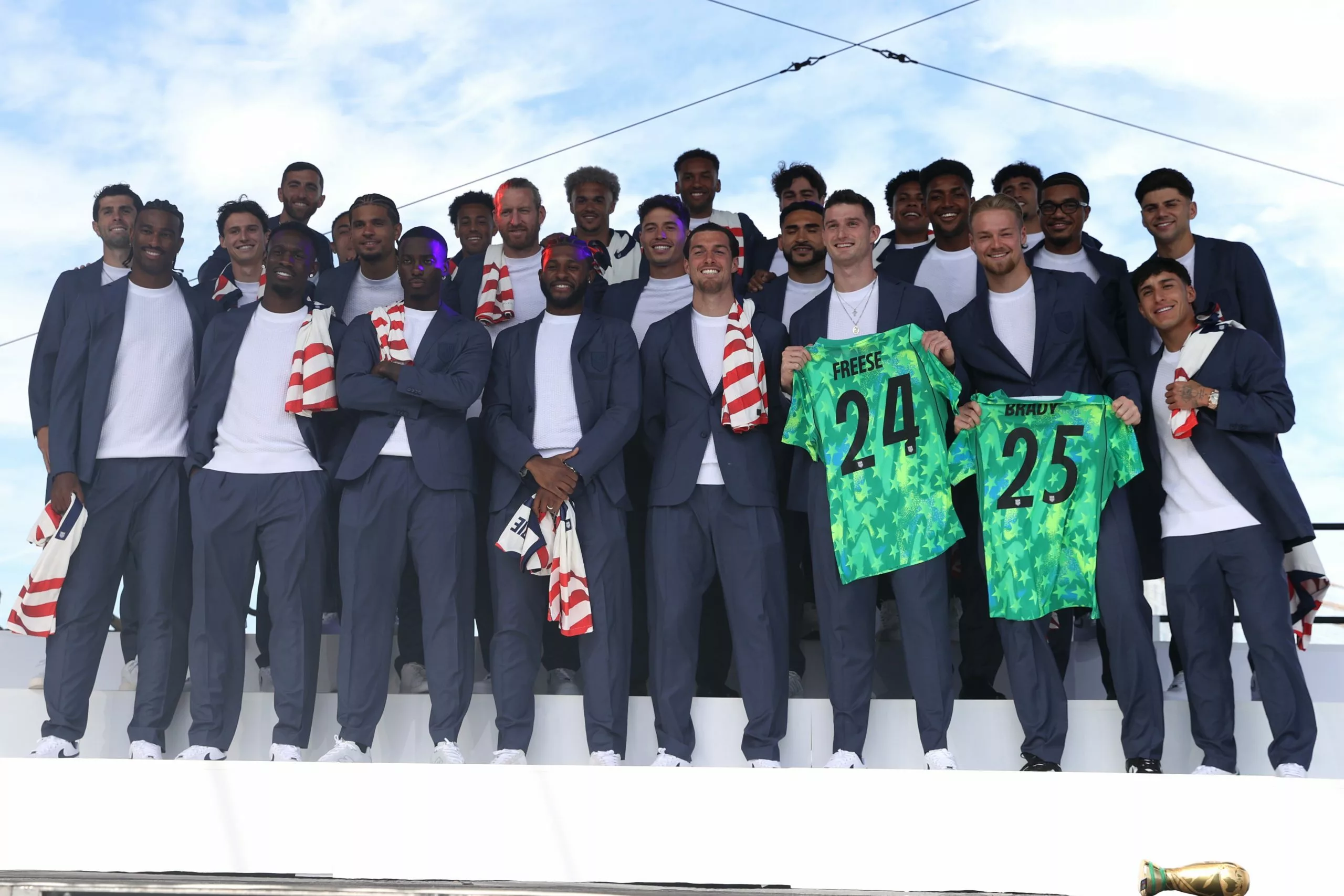
May 26, 2026; New York, New York, USA; The United States men's national team poses for a photo during the roster reveal for the 2026 FIFA World Cup at The Rooftop at Pier 17. Mandatory Credit: Pamela Smith-Imagn Images
The United States Men’s National Team earned its place in the Round of 16 at the 2026 FIFA World Cup. The players fought through qualifying, survived the group stage, and represented their country on the world’s biggest sporting stage. Their reward from FIFA was well deserved.
Yet because of U.S. Soccer’s collective bargaining agreement, the men won’t receive the full financial reward they earned. Instead, after U.S. Soccer takes its agreed-upon share, the remaining prize money is divided equally between the men’s and women’s national teams. The result is that the USMNT players will receive approximately $6.4 million while the USWNT—despite not participating in this tournament—will receive the same amount.
Whether that is “equal” is open for debate.
Whether it is fair should be.
FIFA Didn’t Create This Situation
Many fans mistakenly believe FIFA awarded the women’s team this money.
It didn’t.
FIFA pays prize money separately for the men’s and women’s World Cups. The money awarded to the
USMNT
came from the men’s tournament. The equal split exists because of a collective bargaining agreement negotiated between U.S. Soccer and both national teams.
That distinction matters.
The men earned this prize on the field. The women are receiving part of it because of a labor agreement, not because of anything that occurred during the 2026 men’s World Cup.
The Revenue Gap Is Still Massive
The uncomfortable reality is that men’s international soccer remains one of the biggest television properties on Earth.
The 2026 FIFA World Cup is expected to generate more than $11 billion in revenue for FIFA through broadcasting, sponsorships, hospitality, ticket sales, and commercial partnerships. Broadcast rights alone are worth billions, with media companies fighting aggressively for future tournaments because of enormous television audiences.
Those numbers are not accidental.
Advertisers pay premiums because the men’s World Cup consistently delivers some of the highest television ratings anywhere in sports. Sponsors invest because the global audience is measured in billions of viewers.
The women’s game has grown tremendously over the last decade, but it has not yet generated comparable television audiences, advertising revenue, sponsorship dollars, or commercial value.
That isn’t an insult.
It’s simply how the marketplace currently works.
Even FIFA Recognizes the Difference
Some argue that if equal pay is truly the goal, then every World Cup prize should be identical.
But FIFA itself has never operated that way.
Even after dramatically increasing prize money for the women’s tournament, the men’s competition continues to award significantly larger prize pools because it produces substantially more revenue. The men’s 2026 World Cup features a record $655 million prize fund after a 50 percent increase from 2022.
FIFA’s own financial model reflects the reality that the men’s tournament generates far greater commercial income.
That doesn’t diminish the accomplishments of women’s soccer.
It acknowledges where the money actually comes from.
The Principle Matters
This debate isn’t really about men versus women.
It’s about performance-based compensation.
If the USWNT wins its own World Cup, they absolutely deserve every dollar FIFA awards them.
Likewise, if the USMNT advances deep into the men’s World Cup, the players who earned those victories should receive the financial rewards attached to those accomplishments.
Performance bonuses are intended to reward performance.
Once those bonuses are detached from the people who actually earned them, they cease to be performance bonuses and become redistribution.
Reasonable people can support that policy.
Reasonable people can also oppose it.
The Bigger Question
Supporters of the agreement argue that both national teams represent U.S. Soccer equally and should therefore share in the federation’s success.
Critics argue that tournament prize money should belong to the team that earned it, especially when the men’s World Cup generates dramatically higher television ratings, advertising revenue, sponsorship income, and commercial value than the women’s tournament.
That’s the debate America should be having.
Not whether the women deserve respect.
They do.
Not whether women’s soccer deserves investment.
It does.
The real question is much simpler:
Should athletes receive the financial rewards they earn on the field, or should those rewards be redistributed regardless of who generated them?
The current U.S. Soccer agreement answers that question one way.
Many American
soccer fans
increasingly believe it should answer it another.
Up To $1500 in Bonus Bets Paid Back if your First Bet Does Not Win
T&Cs apply
4.5/5
Gambling problem? Call 1-800-GAMBLER or 1-800-MY-RESET (Available in the US) 877-8-HOPENY or text HOPENY (467369) (NY) 1-800-327-5050 (MA), 1-800-BETS-OFF (IA), 1-800-981-0023 (PR). 21+ only. Please Gamble Responsibly. See BetMGM.com for Terms. First Bet Offer for new customers only (if applicable). Subject to eligibility requirements. Bonus bets are non-withdrawable. In partnership with Kansas Crossing Casino and Hotel. Promotional offers not available in Mississippi, Massachusetts, New York, Ontario, or Puerto Rico.
New DraftKings Customers: Spend $5+ Get $150 in Bonuses
T&Cs apply
4.5/5
GAMBLING PROBLEM? CALL 1-800-GAMBLER or 1-800-MY-RESET, (800) 327-5050 or visit gamblinghelplinema.org (MA). Please Gamble Responsibly. 888-789-7777/visit ccpg.org (CT), or visit www.mdgamblinghelp.org (MD), 1-800-981-0023 (PR). 21+ and present in most states. (18+ DC/NH/PR/WY). Void in CAN. Eligibility restrictions apply. On behalf of Boot Hill Casino (KS). Pass-thru of per wager tax may apply in IL. 1 per new DraftKings customer. $5+ first-time bet req. Max. $150 issued as non-withdrawable Bonus Bets. Stake removed from payout. Reward issued as $50 in Bonus Bets every 7 days via click-to-claim for 14 days. Bonus Bets and click-to-claims expire 7 days (168hrs) after issuance. Terms: sportsbook.draftkings.com/promos. Ends 10/11/26 at 11:59 PM ET. Sponsored by DK.
Must be 21+. GAMBLING PROBLEM? CALL 1-800-GAMBLER OR CALL 1-800-MY-RESET, www.mdgamblinghelp.org (MD), (800)-327-5050 or gamblinghelplinema.org (MA), Call (877)8-HOPENY or text HOPENY (467369) (NY), (888) 789-7777 or ccpg.org (CT), morethanagame.nc.gov (NC), 1800gambler.net (WV)
Bet $1 and get double the winnings up to $25 for your next 10 bets
T&Cs apply
4.4/5
21+ New users only. Must register using eligible promo code. First bet after registration must qualify. Max. Bonus Bet: $1,000. Bonus Bet expires 14 days after receipt. Void where prohibited. See Caesars.com/promos for full terms. Gambling Problem? 1-800-GAMBLER (1-800-426-2537)
21+ and present in OH. Gambling Problem? Call 1-800-GAMBLER.
This site is using
Cloudflare
and adheres to the
Google Safe Browsing Program. We adapted
Google's Privacy Guidelines
to keep your data safe at all times.
Close
Ready to Win Big? Join the Elite with Our Sports Betting Deals!
FanDuel Promo
New Users – Get $250 in Bonus Bets when you wager $5 for 5 days
Up To $1500 in Bonus Bets Paid Back if your First Bet Does Not Win
Best Slots
T&Cs and 21+ apply
Gambling problem? Call 1-800-GAMBLER or 1-800-MY-RESET (Available in the US) 877-8-HOPENY or text HOPENY (467369) (NY) 1-800-327-5050 (MA), 1-800-BETS-OFF (IA), 1-800-981-0023 (PR). 21+ only. Please Gamble Responsibly. See BetMGM.com for Terms. First Bet Offer for new customers only (if applicable). Subject to eligibility requirements. Bonus bets are non-withdrawable. In partnership with Kansas Crossing Casino and Hotel. Promotional offers not available in Mississippi, Massachusetts, New York, Ontario, or Puerto Rico.
Code:
Open BetMGM
Get Bonus
DraftKings Promo
New DraftKings Customers: Spend $5+ Get $150 in Bonuses
Newcomer
T&Cs and 21+ apply
GAMBLING PROBLEM? CALL 1-800-GAMBLER or 1-800-MY-RESET, (800) 327-5050 or visit gamblinghelplinema.org (MA). Please Gamble Responsibly. 888-789-7777/visit ccpg.org (CT), or visit www.mdgamblinghelp.org (MD), 1-800-981-0023 (PR). 21+ and present in most states. (18+ DC/NH/PR/WY). Void in CAN. Eligibility restrictions apply. On behalf of Boot Hill Casino (KS). Pass-thru of per wager tax may apply in IL. 1 per new DraftKings customer. $5+ first-time bet req. Max. $150 issued as non-withdrawable Bonus Bets. Stake removed from payout. Reward issued as $50 in Bonus Bets every 7 days via click-to-claim for 14 days. Bonus Bets and click-to-claims expire 7 days (168hrs) after issuance. Terms: sportsbook.draftkings.com/promos. Ends 10/11/26 at 11:59 PM ET. Sponsored by DK.
Code:
Open DraftKings
Get Bonus
Find out what the legends have to say about sports this week....