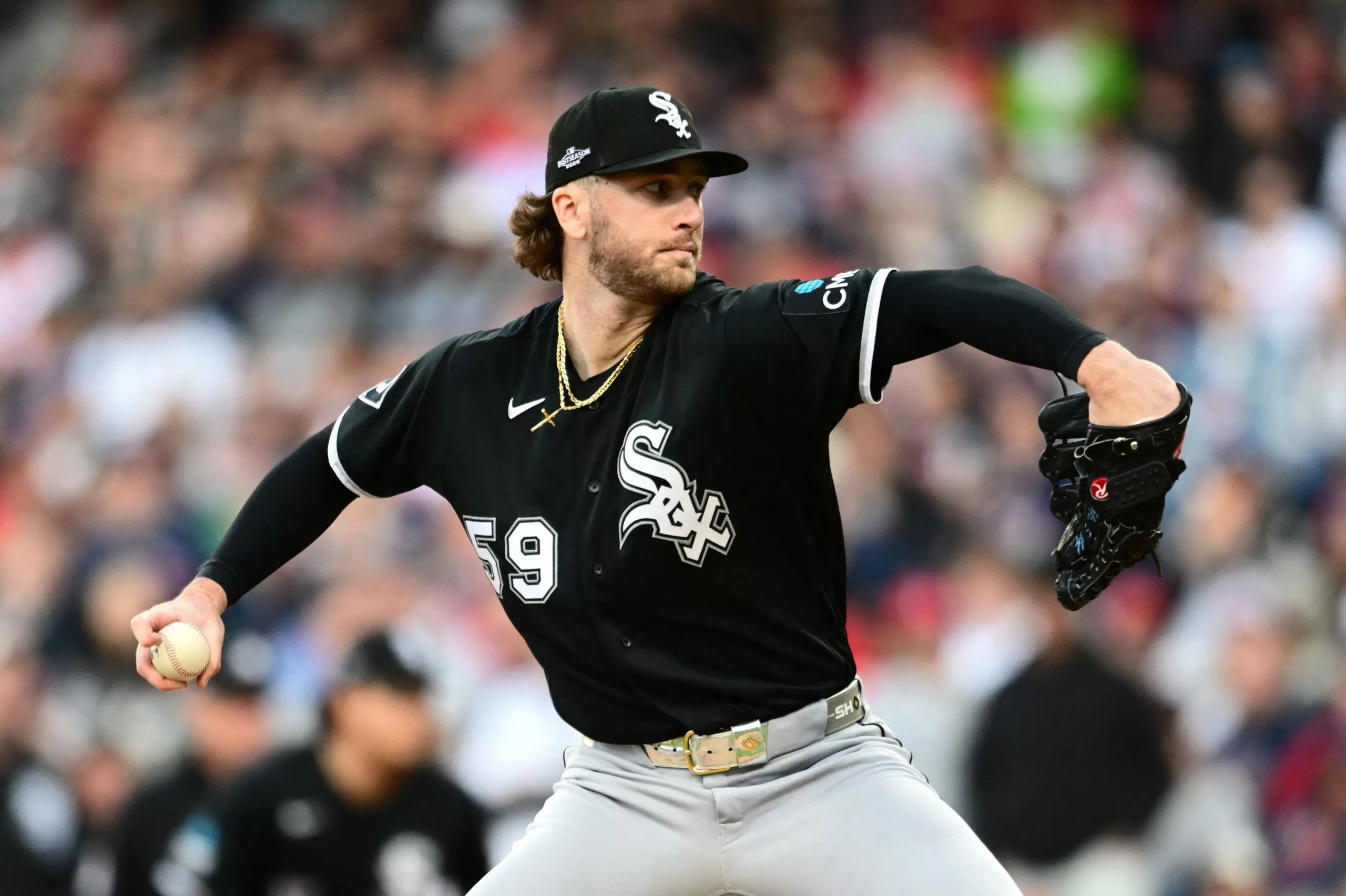
Oct 5, 2026; Cleveland, Ohio, USA; Chicago White Sox pitcher Sean Burke (59) pitches against the Cleveland Guardians during the third inning in game two of the ALDS for the 2026 MLB Playoffs at Progressive Field. Mandatory Credit: Ken Blaze-Imagn Images
Braden Montgomery delivered the hit that put Chicago ahead. Sean Burke delivered the innings that made a comeback possible.
In Monday’s Game 2 of the American League Division Series, Burke allowed one hit over 5⅓ innings of relief as the White Sox rallied past Cleveland, 4–3. He struck out six, walked one and earned the victory. Chicago now leads the series 2–0 and returns home one win from the AL Championship Series.
That pitching line deserves attention beyond the box score.
Burke entered a game Chicago was losing and prevented Cleveland from pulling away. Then, after his teammates took the lead, he kept the Guardians from immediately answering.
October often rewards the player who changes a game with one swing. Burke changed this one by repeatedly denying Cleveland that opportunity.
Chicago Needed Someone to Settle the Game
The
White Sox’s
early pitching strategy did not produce the clean beginning they wanted.
Anthony Kay opened, but Cleveland quickly created trouble. Sean Newcomb followed, and his throwing error on a Nathaniel Lowe grounder allowed two runs to score. Chicago was behind before its offense had established anything against Guardians starter Gavin Williams.
An early deficit on the road can force a postseason team into uncomfortable decisions. The manager starts considering pitching changes sooner. Hitters feel pressure to produce immediately. Every additional run makes the comeback harder.
Burke’s assignment was to keep that deficit manageable.
He was expected to handle bulk innings behind the opener, so his appearance itself was part of Chicago’s plan. The surprise was how completely he took control of the middle of the game.
The White Sox needed dependable innings. Burke gave them dominance.
Thirteen Consecutive Outs Changed the Contest
Burke retired 13 consecutive batters during his outing, a White Sox postseason record for a relief appearance. His first hit allowed did not come until Chase DeLauter singled with two outs in the eighth.
Thirteen straight outs represent more than four innings without a baserunner.
In a close playoff game, that kind of stretch takes away an opponent’s ability to build pressure. There are no runners to move over, no developing rally to energize the crowd and no immediate need for the manager to summon another reliever.
Cleveland kept coming to the plate with a chance to regain control. Burke kept sending the Guardians back to the dugout.
That is why this performance was so valuable. He gave Chicago repeated opportunities to find offense without allowing the game to become more difficult between them.
The comeback took time. Burke supplied it.
His Strikeouts Gave Chicago More Than Survival
Burke’s six strikeouts were another significant part of the performance. He generated outs that required no defensive play beyond the catcher securing the pitch.
That mattered in a game where Chicago had already been hurt by a throwing error.
Pitching to contact can be effective, but a strikeout removes several ways an inning can go wrong. A grounder cannot find a hole. A rushed throw cannot sail past first. A runner cannot advance on a sacrifice fly.
Burke also limited the free passes that can turn an otherwise strong outing into a stressful one.
His one walk and one hit allowed tell the story of a pitcher who gave Cleveland very little to work with. He was missing bats while avoiding the repeated traffic that forces a defense to operate under pressure.
Chicago did not have to survive a succession of dangerous innings. Burke kept most of those situations from developing.
The Rally Belonged to Montgomery; the Opportunity Belonged to Burke
Chicago finally turned the game in the sixth.
Montgomery’s two-run double put the White Sox ahead, and Chase Meidroth followed with an RBI single. What had been a deficit became a 4–2 advantage.
Those hits deserve their place in the highlights. They changed the score and ultimately supplied enough offense to win.
But a comeback requires the team that is trailing to stop conceding runs.
Burke had done that work. Chicago could turn a single productive inning into a lead because Cleveland had not extended its advantage.
This is how winning baseball often works: one player creates the visible turning point, while another makes sure the opportunity remains available.
Montgomery supplied the breakthrough. Burke had kept the game within reach.
He Protected the Lead After Helping Make It Possible
Burke’s contribution continued after the sixth-inning rally.
He retired Cleveland in order in the fifth, sixth and seventh innings, maintaining his control of the game as Chicago moved from chasing runs to protecting an advantage.
Those are different responsibilities.
Pitching while trailing requires preventing further damage. Pitching with a narrow lead requires preserving what the offense has just earned. Burke handled both.
The immediate shutdown inning after a rally can be especially valuable. An opponent’s quick answer can erase the lead and force the offense to start over.
Burke gave the White Sox room to hold their advantage. His teammates did not have to keep producing runs simply to offset Cleveland’s responses.
That consistency was the defining quality of his outing.
The Run on His Line Needs Context
Burke was charged with one run, so this should not be described as a scoreless appearance.
DeLauter’s eighth-inning single ended his outing. Grant Taylor entered, and Jo Adell’s triple brought DeLauter home, narrowing Chicago’s lead to 4–3. Taylor then finished the game and secured the save.
That sequence explains the difference between Burke’s performance and an entirely clean pitching line.
His only hit allowed came near the end of an exceptionally long relief appearance. That runner scored after the pitching change.
The distinction does not remove the run from his record. It shows how little Cleveland accomplished against him before finally breaking through.
Chicago still needed Taylor to close. Burke had carried the pitching staff through the largest share of the game.
This Was the Kind of Performance That Makes a Contender
Postseason attention
naturally gravitates toward recognizable aces and established closers. Burke demonstrated how much a pitcher working between those roles can matter.
A long relief outing of this quality gives a manager something precious: fewer decisions.
There is less need to chase matchups, fewer opportunities for the next pitching change to fail and less pressure to assemble several perfect appearances from different relievers.
Burke provided continuity in a game that had begun with uncertainty.
His own explanation afterward was straightforward: “I was able to settle in and find my groove.”
The impact was much larger than that modest description.
He stabilized Chicago’s pitching, frustrated Cleveland’s offense and gave the White Sox hitters time to turn the game.
Chicago’s October Has a New Defining Performance
The series is unfinished. Cleveland still has an opportunity to respond, and Chicago must win another game to advance.
But Burke’s Game 2 outing already deserves a prominent place in the story of this postseason run.
He did not need to finish the game to become its most consequential pitcher. He did not need a shutout to dominate. And he did not need to start to give Chicago the kind of innings teams hope to receive from their best starter.
The White Sox won because several players delivered when needed.
Burke’s contribution was the longest sustained stretch of excellence in the game.
Montgomery gave Chicago the lead. Burke made sure there was still a game worth taking.
New Users – Get $350 in Bonus Bets when you wager $5 for 7 days
T&Cs apply
4.6/5
Gambling Problem? Call 1-800-GAMBLER or 1-800-MY-RESET. Call 1-888-789-7777 or visit ccpgg.org/chat (CT). Hope is here. GamblingHelpLineMA.org or call (800) 327-5050 for 24/7 support (MA). Visit www.mdgamblinghelp.org (MD). Call 1-877-8HOPE-NY or text HOPENY (NY). 21+ (18+ DC, WY) and present in select states (for KS, in affiliation with Kansas Star Casino). Find online real money wagering only. Min $5 wager required for 7 consecutive days. $5 free play credit. Bonus issued as non-withdrawable bonus with cash withdrawable bonus with cash withdrawable. Bonus bets which expire 7 days after receipt. Restrictions apply. See terms at sportsbook.fanduel.com. Call 1-877-770-7867 (LA).
Up To $1500 in Bonus Bets Paid Back if your First Bet Does Not Win
T&Cs apply
4.5/5
Gambling problem? Call 1-800-GAMBLER or 1-800-MY-RESET (Available in the US) 877-8-HOPENY or text HOPENY (467369) (NY) 1-800-327-5050 (MA), 1-800-BETS-OFF (IA), 1-800-981-0023 (PR). 21+ only. Please Gamble Responsibly. See BetMGM.com for Terms. First Bet Offer for new customers only (if applicable). Subject to eligibility requirements. Bonus bets are non-withdrawable. In partnership with Kansas Crossing Casino and Hotel. Promotional offers not available in Mississippi, Massachusetts, New York, Ontario, or Puerto Rico.
New DraftKings Customers: Bet $5, Get $200 + 3 Months of NBA League Pass!
T&Cs apply
4.5/5
GAMBLING PROBLEM? CALL 1-800-GAMBLER or 1-800-MY-RESET, (800) 327-5050 or visit gamblinghelplinema.org (MA). Please Gamble Responsibly. 888-789-7777/visit ccpg.org (CT), or visit www.mdgamblinghelp.org (MD), 1-800-981-0023 (PR). 21+ and present in most states. (18+ DC/NH/PR/WY). Void in CAN. Eligibility restrictions apply. On behalf of Boot Hill Casino (KS). Pass-thru of per wager tax may apply in IL. 1 per new Sportsbook customer. $5+ first-time bet req. Max. $200 issued as non-withdrawable Bonus Bets. Stake removed from payout. Reward issued as $50 in Bonus Bets every 7 days via click-to-claim for 21 days. Bonus Bets and click-to-claims expire 7 days (168hrs) after issuance. Terms: dkng.co/offer. Get 1 promo code to redeem a 3-month NBA League Pass subscription, complimentary of DraftKings. Subscription auto-renews monthly at then-current price (currently $16.99/mo); cancel anytime. Terms, restrictions, and eligibility requirements apply. Redeem League Pass by 12/19/26 at 11:59 PM ET. Addt’l terms: support.watch.nba.com/hc/en-us/articles/9165532876183-League-Pass-Terms-of-Use_. Ends 11/29/26 at 11:59 PM ET. Sponsored by DK.
Must be 21+. GAMBLING PROBLEM? CALL 1-800-GAMBLER OR CALL 1-800-MY-RESET, www.mdgamblinghelp.org (MD), (800)-327-5050 or gamblinghelplinema.org (MA), Call (877)8-HOPENY or text HOPENY (467369) (NY), (888) 789-7777 or ccpg.org (CT), morethanagame.nc.gov (NC), 1800gambler.net (WV)
Bet $1 and get double the winnings up to $25 for your next 10 bets
T&Cs apply
4.4/5
21+ New users only. Must register using eligible promo code. First bet after registration must qualify. Max. Bonus Bet: $1,000. Bonus Bet expires 14 days after receipt. Void where prohibited. See Caesars.com/promos for full terms. Gambling Problem? 1-800-GAMBLER (1-800-426-2537)
21+ and present in OH. Gambling Problem? Call 1-800-GAMBLER.
This site is using
Cloudflare
and adheres to the
Google Safe Browsing Program. We adapted
Google's Privacy Guidelines
to keep your data safe at all times.
Close
Ready to Win Big? Join the Elite with Our Sports Betting Deals!
FanDuel Promo
New Users – Get $350 in Bonus Bets when you wager $5 for 7 days
Our Favorite
T&Cs and 21+ apply
Gambling Problem? Call 1-800-GAMBLER or 1-800-MY-RESET. Call 1-888-789-7777 or visit ccpgg.org/chat (CT). Hope is here. GamblingHelpLineMA.org or call (800) 327-5050 for 24/7 support (MA). Visit www.mdgamblinghelp.org (MD). Call 1-877-8HOPE-NY or text HOPENY (NY). 21+ (18+ DC, WY) and present in select states (for KS, in affiliation with Kansas Star Casino). Find online real money wagering only. Min $5 wager required for 7 consecutive days. $5 free play credit. Bonus issued as non-withdrawable bonus with cash withdrawable bonus with cash withdrawable. Bonus bets which expire 7 days after receipt. Restrictions apply. See terms at sportsbook.fanduel.com. Call 1-877-770-7867 (LA).
Code:
Open FanDuel
Get Bonus
BetMGM Promo
Up To $1500 in Bonus Bets Paid Back if your First Bet Does Not Win
Best Slots
T&Cs and 21+ apply
Gambling problem? Call 1-800-GAMBLER or 1-800-MY-RESET (Available in the US) 877-8-HOPENY or text HOPENY (467369) (NY) 1-800-327-5050 (MA), 1-800-BETS-OFF (IA), 1-800-981-0023 (PR). 21+ only. Please Gamble Responsibly. See BetMGM.com for Terms. First Bet Offer for new customers only (if applicable). Subject to eligibility requirements. Bonus bets are non-withdrawable. In partnership with Kansas Crossing Casino and Hotel. Promotional offers not available in Mississippi, Massachusetts, New York, Ontario, or Puerto Rico.
Code:
Open BetMGM
Get Bonus
DraftKings Promo
New DraftKings Customers: Bet $5, Get $200 + 3 Months of NBA League Pass!
Newcomer
T&Cs and 21+ apply
GAMBLING PROBLEM? CALL 1-800-GAMBLER or 1-800-MY-RESET, (800) 327-5050 or visit gamblinghelplinema.org (MA). Please Gamble Responsibly. 888-789-7777/visit ccpg.org (CT), or visit www.mdgamblinghelp.org (MD), 1-800-981-0023 (PR). 21+ and present in most states. (18+ DC/NH/PR/WY). Void in CAN. Eligibility restrictions apply. On behalf of Boot Hill Casino (KS). Pass-thru of per wager tax may apply in IL. 1 per new Sportsbook customer. $5+ first-time bet req. Max. $200 issued as non-withdrawable Bonus Bets. Stake removed from payout. Reward issued as $50 in Bonus Bets every 7 days via click-to-claim for 21 days. Bonus Bets and click-to-claims expire 7 days (168hrs) after issuance. Terms: dkng.co/offer. Get 1 promo code to redeem a 3-month NBA League Pass subscription, complimentary of DraftKings. Subscription auto-renews monthly at then-current price (currently $16.99/mo); cancel anytime. Terms, restrictions, and eligibility requirements apply. Redeem League Pass by 12/19/26 at 11:59 PM ET. Addt’l terms: support.watch.nba.com/hc/en-us/articles/9165532876183-League-Pass-Terms-of-Use_. Ends 11/29/26 at 11:59 PM ET. Sponsored by DK.
Code:
Open DraftKings
Get Bonus
Find out what the legends have to say about sports this week....
New Users – Get $350 in Bonus Bets when you wager $5 for 7 days
Gambling Problem? Call 1-800-GAMBLER or 1-800-MY-RESET. Call 1-888-789-7777 or visit ccpgg.org/chat (CT). Hope is here. GamblingHelpLineMA.org or call (800) 327-5050 for 24/7 support (MA). Visit www.mdgamblinghelp.org (MD). Call 1-877-8HOPE-NY or text HOPENY (NY). 21+ (18+ DC, WY) and present in select states (for KS, in affiliation with Kansas Star Casino). Find online real money wagering only. Min $5 wager required for 7 consecutive days. $5 free play credit. Bonus issued as non-withdrawable bonus with cash withdrawable bonus with cash withdrawable. Bonus bets which expire 7 days after receipt. Restrictions apply. See terms at sportsbook.fanduel.com. Call 1-877-770-7867 (LA).