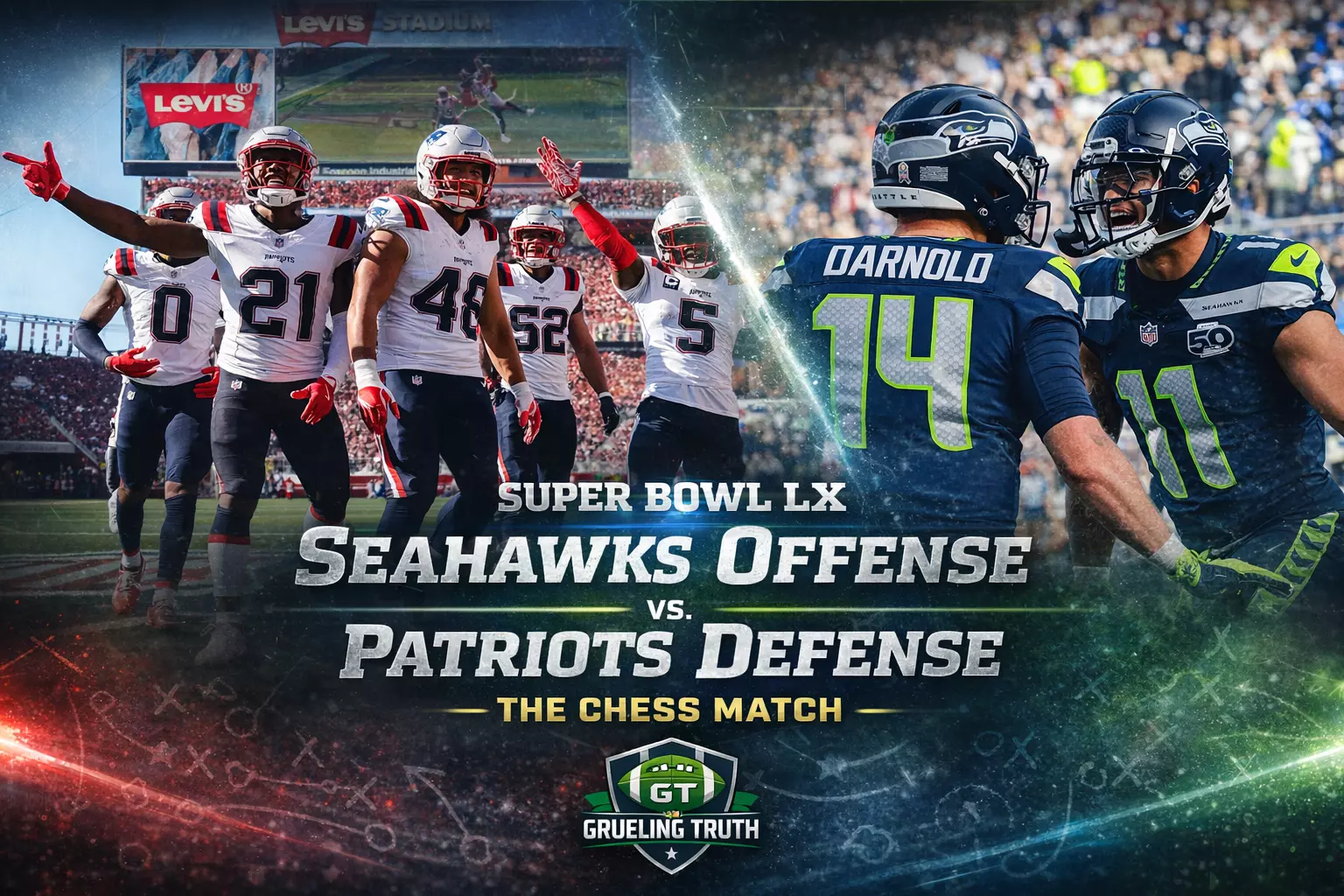
Super Bowl LX (Sunday,
Feb. 8, 2026) at
Levi’s Stadium in Santa Clara
sets up a fascinating contrast: Seattle’s balanced, motion-heavy attack under OC
Klint Kubiak
versus a New England defense led by HC
Mike Vrabel
and DC
Terrell Williams
(with
Zak Kuhr
heavily involved in play-calling duties this season).
Below is a position-by-position, concept-by-concept breakdown of how the Seahawks can move the ball—and how the Patriots are built to stop them.
The personnel that shapes everything
Seattle’s core offensive group
Seattle’s offensive depth chart tells you exactly what kind of game they
want
to play:
QB:
Sam Darnold
RB:
Kenneth Walker III
WRs:
Cooper Kupp, Rashid Shaheed, Jaxon Smith-Njigba
TE:
AJ Barner (with Eric Saubert/Elijah Arroyo behind)
OL:
Charles Cross (LT), Grey Zabel (LG), Jalen Sundell (C), Anthony Bradford (RG), Abraham Lucas (RT)
FB:
Robbie Ouzts (a real “Kubiak-family” indicator—21/12/22 personnel variety)
What that implies:
Expect Seattle to live in
under-center play-action, marry runs and boots, and then use
elite route craft
(Kupp/JSN) plus
vertical stress
(Shaheed) to keep New England from squatting.
Jaxon Smith-Njigba Highlights 🔥 | NFL Offensive Player of the Year
New England’s defensive spine
The Patriots’
Super Bowl
depth charts (team site + Ourlads) line up with a flexible front and a coverage group that can match multiple WR types:
Front/edge:
Christian Barmore, Milton Williams inside; Harold Landry III / K’Lavon Chaisson off the edge
ILBs:
Robert Spillane, Christian Elliss (with Marte Mapu as a movable chess piece)
Corners:
Christian Gonzalez, Carlton Davis III, plus Marcus Jones in the nickel
What that implies:
New England can play
man coverage
with size (Davis), a true
shadow candidate
(Gonzalez), and a
quick nickel
(Jones), while still bringing pressure from multiple body types.
Christian Gonzalez – 2024 Season Highlights – New England Patriots – NFL
1) The early-down battle: Seattle’s run game vs New England’s front math
Seattle’s goal: force “big people” to declare
With Cross–Zabel up front and a real FB (Ouzts), Seattle can lean into
wide zone / split zone / duo
and force the Patriots to show whether they’re living in an
odd (3-down) world
or bumping into
even fronts.
New England has lived in odd-front DNA recently, and even when they’re in nickel, they can present “3-3-5” spacing that muddies blocking angles—especially versus outside zone.
The key matchup: Kenneth Walker vs Spillane/Elliss fits
Walker’s best value isn’t just “hand it off”—it’s forcing the Patriots linebackers to
fit downhill
and then punishing over-pursuit with cutbacks and explosives. The Patriots’ ILB pair (Spillane/Elliss) is sturdy and physical; Seattle has to stress them horizontally with
motion
and
surface changes
(TE/FB shifts).
Seattle’s best answers
21/12 personnel
to create heavier edges (Ouzts + Barner)
Orbit/jet motion
with Shaheed/JSN to widen second-level rules (and set up play-action shots later)
Split-zone
to slow Landry/Chaisson and reduce run-throughs
Patriots’ best counters
Tilt/angle the front to spill zone runs to pursuit
Walk a safety down late to create an extra fitter (without showing it pre-snap)
Kenneth Walker III Highlights | 2025 -26 WELCOME TO THE CHIEFS
2) The passing-game centerpiece: Kupp + JSN vs Gonzalez + Marcus Jones
Where Seattle can win: the “in-breaking” economy
Kubiak-style offenses thrive on
play-action glance routes, deep
over routes, and
high-low stretch
concepts that punish linebackers for stepping up. That’s exactly where
Cooper Kupp
and
Jaxon Smith-Njigba
are most dangerous: option routes, leverage reads, sit-downs versus zone, and timing versus man.
The Patriots’ problem:
If they commit to stopping Walker and bite on PA, those crossers stack behind them quickly.
The Patriots’ solution:
Put
Christian Gonzalez
on the primary separator and use
Marcus Jones
as a robber/rat or sticky nickel, depending on the call.
How New England likely deploys Gonzalez
Gonzalez is the kind of CB you can:
Travel
with the No. 1, or
Play boundary match and bracket inside help
If Seattle treats Kupp as “the chain-mover,” the Patriots can try Gonzalez on Kupp in critical downs (3rd-and-6, red zone) and let Marcus Jones handle JSN underneath—with safety help shading to Shaheed’s side.
3) The explosive-play lever: Rashid Shaheed vs the Patriots’ safety structure
Shaheed changes the geometry. He forces:
More
two-high
looks (or at least “two-high shells”)
More
bail technique
from corners
More “no free access” rules when he’s in the slot
Seattle’s favorite way to cash it:
hard run looks + max protect + a deep over/post to Shaheed, especially if
New England
rotates late and the rotation is readable.
New England’s favorite way to survive it:
disguise the post safety, keep the top on the defense, and make Darnold take
the boring throw—checkdowns and shallow crossers—over and over.
Rashid Shaheed Rare High Quality Clips for Edits! (Seahawks & Saints) (Upscaled With Topaz)
4) Protection and pressure: the Landry/Chaisson edges vs Seattle’s tackles
If the Patriots can win without blitzing, the entire game tilts their way.
Harold Landry III
is the cleanest “win” button for New England’s rush plan.
K’Lavon Chaisson
gives them speed and closing burst opposite him.
Seattle’s tackles (Charles Cross
and
Abraham Lucas) are pivotal: if they hold up, Seattle can keep route concepts intact long enough for Kupp/JSN to separate late in the down.
The hidden fight: interior disruption
Even if the edges are stable, the Patriots’ interior (Barmore/Milton Williams) can ruin play-action by collapsing the launch point before the boot develops.
Seattle’s best protection answers
Move the pocket
(boots, half-rolls)
Chip help
with Barner/Ouzts and release late
Condense formations
to reduce edge runway (tight splits help tackles)
Patriots’ best pressure answers
Simulated pressures (show blitz, drop out, rush four)
Interior stunts to attack communication between LG–C–RG
5) Third down: can Seattle stay out of “Gonzalez time”?
On money downs, defenses want to:
Remove the first read
Speed up the QB
Rally and tackle short of the sticks
The Patriots have the corners to
challenge separators
and the front to
win with four—the ideal third-down combo.
Seattle’s third-down plan should revolve around:
Bunch/stack releases
(free Kupp/JSN from press)
RB choice routes
and quick check releases to punish man
TE seams
off play-action if the Patriots become too “flat” in coverage
6) Red zone: condensed field, condensed answers
In the low red zone, Shaheed’s vertical stress matters less—space disappears—so you often see defenses lean into:
Tight man coverage
Brackets on top options
Fast pressure (because throws take longer in tight windows)
That’s where Seattle’s
personnel variety
is crucial: Barner + Ouzts create real play-action threats on the goal line, and Kupp’s route IQ can still win quickly if Darnold’s first read is clean.
For New England, the red-zone blueprint is simple:
Keep eyes on Kupp on pivots/returns and JSN on option routes
The “if-this-then-that” summary
If Seattle runs efficiently early
(Walker forcing safeties down), the play-action crosser game to Kupp/JSN becomes a nightmare to defend—New England can’t both fit the run and sit on in-breakers.
If New England’s front wins on early downs
(stonewall runs + muddy boots), Seattle gets pushed into longer dropbacks where Gonzalez + pressure packages can tilt the down.
Up To $1500 in Bonus Bets Paid Back if your First Bet Does Not Win
T&Cs apply
4.5/5
Gambling problem? Call 1-800-GAMBLER or 1-800-MY-RESET (Available in the US) 877-8-HOPENY or text HOPENY (467369) (NY) 1-800-327-5050 (MA), 1-800-BETS-OFF (IA), 1-800-981-0023 (PR). 21+ only. Please Gamble Responsibly. See BetMGM.com for Terms. First Bet Offer for new customers only (if applicable). Subject to eligibility requirements. Bonus bets are non-withdrawable. In partnership with Kansas Crossing Casino and Hotel. Promotional offers not available in Mississippi, Massachusetts, New York, Ontario, or Puerto Rico.
New DraftKings Customers: Spend $5+ Get $150 in Bonuses
T&Cs apply
4.5/5
GAMBLING PROBLEM? CALL 1-800-GAMBLER or 1-800-MY-RESET, (800) 327-5050 or visit gamblinghelplinema.org (MA). Please Gamble Responsibly. 888-789-7777/visit ccpg.org (CT), or visit www.mdgamblinghelp.org (MD), 1-800-981-0023 (PR). 21+ and present in most states. (18+ DC/NH/PR/WY). Void in CAN. Eligibility restrictions apply. On behalf of Boot Hill Casino (KS). Pass-thru of per wager tax may apply in IL. 1 per new DraftKings customer. $5+ first-time bet req. Max. $150 issued as non-withdrawable Bonus Bets. Stake removed from payout. Reward issued as $50 in Bonus Bets every 7 days via click-to-claim for 14 days. Bonus Bets and click-to-claims expire 7 days (168hrs) after issuance. Terms: sportsbook.draftkings.com/promos. Ends 10/11/26 at 11:59 PM ET. Sponsored by DK.
Must be 21+. GAMBLING PROBLEM? CALL 1-800-GAMBLER OR CALL 1-800-MY-RESET, www.mdgamblinghelp.org (MD), (800)-327-5050 or gamblinghelplinema.org (MA), Call (877)8-HOPENY or text HOPENY (467369) (NY), (888) 789-7777 or ccpg.org (CT), morethanagame.nc.gov (NC), 1800gambler.net (WV)
Bet $1 and get double the winnings up to $25 for your next 10 bets
T&Cs apply
4.4/5
21+ New users only. Must register using eligible promo code. First bet after registration must qualify. Max. Bonus Bet: $1,000. Bonus Bet expires 14 days after receipt. Void where prohibited. See Caesars.com/promos for full terms. Gambling Problem? 1-800-GAMBLER (1-800-426-2537)
21+ and present in OH. Gambling Problem? Call 1-800-GAMBLER.
This site is using
Cloudflare
and adheres to the
Google Safe Browsing Program. We adapted
Google's Privacy Guidelines
to keep your data safe at all times.
Close
Ready to Win Big? Join the Elite with Our Sports Betting Deals!
FanDuel Promo
New Users – Get $250 in Bonus Bets when you wager $5 for 5 days
Up To $1500 in Bonus Bets Paid Back if your First Bet Does Not Win
Best Slots
T&Cs and 21+ apply
Gambling problem? Call 1-800-GAMBLER or 1-800-MY-RESET (Available in the US) 877-8-HOPENY or text HOPENY (467369) (NY) 1-800-327-5050 (MA), 1-800-BETS-OFF (IA), 1-800-981-0023 (PR). 21+ only. Please Gamble Responsibly. See BetMGM.com for Terms. First Bet Offer for new customers only (if applicable). Subject to eligibility requirements. Bonus bets are non-withdrawable. In partnership with Kansas Crossing Casino and Hotel. Promotional offers not available in Mississippi, Massachusetts, New York, Ontario, or Puerto Rico.
Code:
Open BetMGM
Get Bonus
DraftKings Promo
New DraftKings Customers: Spend $5+ Get $150 in Bonuses
Newcomer
T&Cs and 21+ apply
GAMBLING PROBLEM? CALL 1-800-GAMBLER or 1-800-MY-RESET, (800) 327-5050 or visit gamblinghelplinema.org (MA). Please Gamble Responsibly. 888-789-7777/visit ccpg.org (CT), or visit www.mdgamblinghelp.org (MD), 1-800-981-0023 (PR). 21+ and present in most states. (18+ DC/NH/PR/WY). Void in CAN. Eligibility restrictions apply. On behalf of Boot Hill Casino (KS). Pass-thru of per wager tax may apply in IL. 1 per new DraftKings customer. $5+ first-time bet req. Max. $150 issued as non-withdrawable Bonus Bets. Stake removed from payout. Reward issued as $50 in Bonus Bets every 7 days via click-to-claim for 14 days. Bonus Bets and click-to-claims expire 7 days (168hrs) after issuance. Terms: sportsbook.draftkings.com/promos. Ends 10/11/26 at 11:59 PM ET. Sponsored by DK.
Code:
Open DraftKings
Get Bonus
Find out what the legends have to say about sports this week....