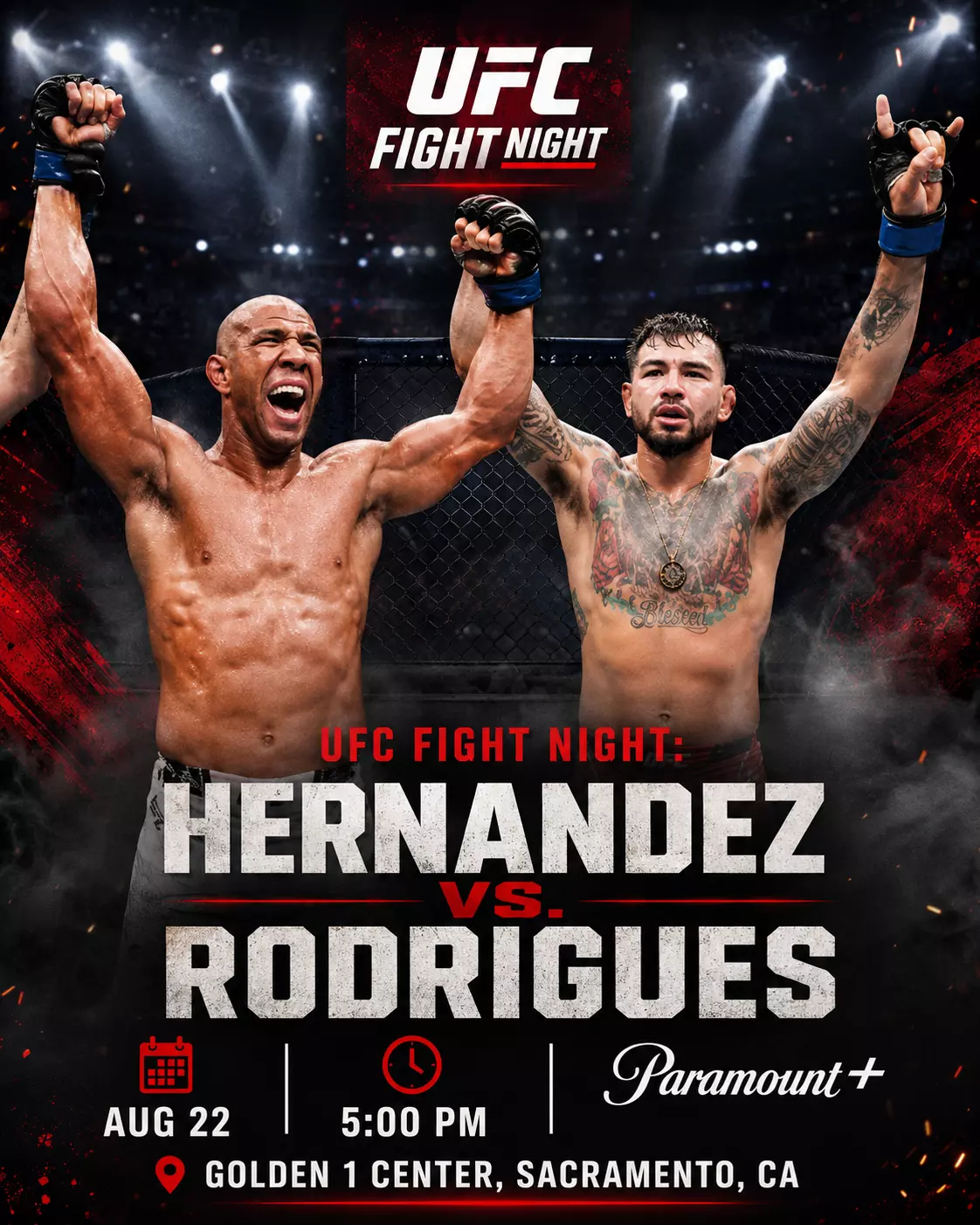
The UFC returns to Sacramento on Saturday, August 22, with Anthony “Fluffy” Hernandez facing Gregory “Robocop” Rodrigues in a pivotal five-round middleweight main event. The preliminaries begin at 5:00 PM ET, followed by the main card at 8:00 PM ET exclusively on Paramount+ in the United States.
Hernandez vs. Rodrigues Betting Odds
Anthony Hernandez:
Approximately -165
Gregory Rodrigues:
Approximately +150
Hernandez enters the main event as the betting favorite. Current odds have Hernandez around -165, with Rodrigues returning approximately +150, although prices may continue moving before Saturday night.
The betting market reflects the stylistic question surrounding this matchup: Can Hernandez use his relentless wrestling, conditioning and submission game to neutralize Rodrigues’ considerable punching power?
Hernandez vs. Rodrigues Prediction & Fight Preview
A high-stakes middleweight matchup between one of the UFC’s most relentless pressure grapplers and one of the division’s most dangerous knockout artists headlines the promotion’s return to Sacramento.
Anthony Hernandez enters with a
15-3 professional record and one no contest
and is currently ranked No. 6 in the UFC middleweight division. Gregory Rodrigues is
19-6
and ranked No. 11. Both men are attempting to establish themselves as legitimate championship contenders in a division that continues to evolve.
For Hernandez, Saturday represents an opportunity to restart the momentum that carried him through an eight-fight winning streak.
“Fluffy” had won eight consecutive UFC fights before facing Sean Strickland in February 2026. That run included victories over Roman Dolidze, Brendan Allen, Michel Pereira, Roman Kopylov, Edmen Shahbazyan and Marc-André Barriault. Six of the eight victories came inside the distance.
Strickland finally stopped the streak.
The former champion used his jab, defensive awareness and disciplined striking to prevent Hernandez from establishing his normal rhythm. Hernandez was ultimately stopped by strikes at 2:23 of the third round.
That defeat does not eliminate what made Hernandez so dangerous during his rise through the middleweight rankings.
His greatest weapon remains pressure.
Hernandez averages approximately
5.88 takedowns per 15 minutes, completing 48 percent of his attempts. He also averages 1.63 submission attempts per 15 minutes and has recorded nine professional submission victories.
Those numbers demonstrate why fighting Hernandez can become exhausting.
He does not necessarily need to complete his first takedown attempt. Hernandez is comfortable transitioning from a single-leg attempt into a body lock, changing directions, attacking another leg and continuing to wrestle after an opponent initially returns to his feet.
That repeated pressure forces opponents to constantly defend.
Eventually, defending takedowns becomes almost as exhausting as being taken down.
Rodrigues presents a particularly interesting challenge because he is not simply a striker who becomes uncomfortable once the fight reaches the ground.
“Robocop” possesses a Brazilian jiu-jitsu black belt, is an IBJJF world champion and has three professional submission victories. He also owns a strong 75 percent takedown-defense rate.
However, Rodrigues’ greatest danger remains his striking.
The Brazilian has recorded
12 knockout victories, including six inside the UFC. Nine of his professional victories have occurred during the opening round.
Rodrigues enters Sacramento with substantial momentum.
After suffering a stoppage loss against Jared Cannonier in February 2025, Rodrigues responded with three consecutive victories. He knocked out Jack Hermansson during the first round, defeated Roman Kopylov by unanimous decision and then avenged an earlier loss against Brunno Ferreira with a devastating first-round knockout at UFC 326 in March.
The Ferreira victory was particularly impressive.
Rodrigues needed only 1:47 to land the right hand that ended the fight. It was another reminder that very few middleweights can afford to make repeated defensive mistakes against him.
Statistically, Rodrigues produces more striking offense than Hernandez.
He lands approximately
5.53 significant strikes per minute, compared with Hernandez’s 4.57. Rodrigues connects at approximately 51 percent accuracy, while Hernandez has been credited with an even higher striking accuracy in the UFC’s statistical database.
The defensive numbers, however, strongly favor Hernandez.
Rodrigues absorbs approximately
4.78 significant strikes per minute, while Hernandez absorbs approximately 3.10. Rodrigues’ willingness to remain in dangerous exchanges is part of what makes his fights entertaining, but it also creates opportunities for opponents to damage him.
That difference could become important if Hernandez can survive the opening rounds.
Rodrigues is extremely dangerous when both fighters are fresh. His right hand, left hook, uppercuts and knees can quickly change a fight.
Hernandez therefore cannot simply rush forward with predictable takedown attempts.
Strickland demonstrated that Hernandez can be punished while closing distance if his entries become obvious. Rodrigues possesses considerably more one-punch finishing power than many of the opponents Hernandez defeated during his winning streak.
One poorly timed level change could result in an uppercut or knee.
Hernandez should instead create his wrestling opportunities through pressure.
He needs to force Rodrigues backward, make the Brazilian defend combinations and then attack the hips when Rodrigues begins reacting to punches.
The cage should become extremely important.
Rodrigues has the physical strength and grappling skill to defend takedowns in open space. Maintaining that defense becomes more difficult when Hernandez can drive him against the fence and repeatedly transition between takedown attempts.
Hernandez does some of his best work when an opponent believes the takedown exchange is over.
He remains attached, changes positions and forces another scramble.
That style produced one of the most impressive submission victories of Hernandez’s career against elite grappler Rodolfo Vieira. Hernandez survived difficult early exchanges and eventually submitted the highly accomplished Brazilian jiu-jitsu specialist with a guillotine choke.
Rodrigues must prevent Hernandez from establishing that type of exhausting fight.
His best opportunity should come during the first two rounds.
Rodrigues needs to establish the center, punish Hernandez whenever he attempts to enter wrestling range and attack the body whenever possible.
Body damage could become particularly important.
Hernandez’s entire strategy depends on pace. He wants to continuously move forward, wrestle, scramble and force opponents to work.
Hard kicks, knees and punches to the body could gradually reduce that pressure.
Rodrigues also needs to trust his grappling background without becoming overly willing to wrestle.
He averages approximately
1.90 takedowns per 15 minutes, but attempting to turn this matchup into a prolonged grappling contest would likely favor Hernandez’s conditioning and transition-heavy style. Hernandez averages more than three times as many takedowns per 15 minutes.
Rodrigues should use his grappling defensively.
Sprawl.
Establish underhooks.
Separate.
Return to striking range.
Make Hernandez pay for every failed entry.
The physical dimensions create another interesting element.
Rodrigues stands
6-foot-3, giving him a three-inch height advantage over the 6-foot Hernandez. Surprisingly, both fighters possess the same 75-inch reach. Hernandez is 32 years old, while Rodrigues is 34.
Because their reach is identical, Rodrigues cannot simply depend on his height to keep Hernandez outside.
Hernandez should still be capable of connecting with straight punches during his entries.
The major difference should instead be where those exchanges occur.
At kicking and kneeing distance, Rodrigues holds the advantage.
At boxing-clinch distance, the matchup becomes more competitive.
Against the cage, Hernandez should have the advantage.
The mat could produce the most fascinating exchanges.
Rodrigues is a legitimate high-level Brazilian jiu-jitsu practitioner and should understand many of the positions Hernandez attempts to create.
But Hernandez’s grappling success is based heavily on pace rather than simply superior technique.
He makes technically sound fighters defend repeatedly until their reactions begin slowing down.
The five-round format therefore strongly favors his preferred strategy.
Hernandez has previously demonstrated that he can remain dangerous deep into main events. He submitted Roman Dolidze in the fourth round and stopped Michel Pereira in the fifth.
Rodrigues has five-round experience as well, but his greatest success tends to come when he is able to establish damaging exchanges before opponents can impose a grinding pace.
That creates the central question of Saturday’s main event:
Can Rodrigues hurt Hernandez before Hernandez’s pressure begins taking control?
If Rodrigues lands cleanly during the first 10 minutes, the underdog possesses more than enough power to produce the upset.
If Hernandez survives those rounds without absorbing fight-changing damage, his wrestling and conditioning should become increasingly difficult to stop.
Top 4 Prop Bets
Prop prices can differ considerably between sportsbooks and may move before Saturday’s opening bell. Bettors should compare available prices before making a selection.
Prop Bet #1: Anthony Hernandez Moneyline
DraftKings
4.5/5
Tip: Anthony Hernandez Moneyline
Relentless Wrestling
Superior Cardio
Five-Round Pressure
New DraftKings Customers: Bet $5, Get $200 + 3 Months of NBA League Pass!
Get bonus now
GAMBLING PROBLEM? CALL 1-800-GAMBLER or 1-800-MY-RESET, (800) 327-5050 or visit gamblinghelplinema.org (MA). Please Gamble Responsibly. 888-789-7777/visit ccpg.org (CT), or visit www.mdgamblinghelp.org (MD), 1-800-981-0023 (PR). 21+ and present in most states. (18+ DC/NH/PR/WY). Void in CAN. Eligibility restrictions apply. On behalf of Boot Hill Casino (KS). Pass-thru of per wager tax may apply in IL. 1 per new Sportsbook customer. $5+ first-time bet req. Max. $200 issued as non-withdrawable Bonus Bets. Stake removed from payout. Reward issued as $50 in Bonus Bets every 7 days via click-to-claim for 21 days. Bonus Bets and click-to-claims expire 7 days (168hrs) after issuance. Terms: dkng.co/offer. Get 1 promo code to redeem a 3-month NBA League Pass subscription, complimentary of DraftKings. Subscription auto-renews monthly at then-current price (currently $16.99/mo); cancel anytime. Terms, restrictions, and eligibility requirements apply. Redeem League Pass by 12/19/26 at 11:59 PM ET. Addt’l terms: support.watch.nba.com/hc/en-us/articles/9165532876183-League-Pass-Terms-of-Use_. Ends 11/29/26 at 11:59 PM ET. Sponsored by DK.
Hernandez on the moneyline is the strongest overall selection.
The favorite possesses the clearest repeatable path to victory.
Rodrigues needs opportunities to establish his striking. Hernandez’s wrestling gives him the ability to repeatedly interrupt those exchanges.
The statistics clearly illustrate the stylistic difference.
Hernandez averages 5.88 takedowns per 15 minutes compared with Rodrigues’ 1.90. He also averages substantially more submission attempts.
Rodrigues’ 75 percent takedown defense is excellent, but Hernandez does not need to complete every attempt.
Forcing Rodrigues to defend five, eight or 10 takedown attempts can still accomplish the favorite’s objective.
Every defensive scramble consumes energy.
Every clinch reduces the amount of time Rodrigues can spend setting up combinations.
Every successful takedown creates another opportunity for Hernandez to accumulate control and damage.
At approximately -165, Hernandez’s moneyline requires respect for Rodrigues’ knockout power, but the favorite possesses more ways to consistently win rounds.
Prop Bet #2: Fight Does Not Go the Distance
FanDuel
4.6/5
Tip: Fight Does Not Go the Distance
Five-Round Fight
Elite Finishing Ability
Multiple Submission and KO Paths
New Users – Get $350 in Bonus Bets when you wager $5 for 7 days
Get bonus now
Gambling Problem? Call 1-800-GAMBLER or 1-800-MY-RESET. Call 1-888-789-7777 or visit ccpgg.org/chat (CT). Hope is here. GamblingHelpLineMA.org or call (800) 327-5050 for 24/7 support (MA). Visit www.mdgamblinghelp.org (MD). Call 1-877-8HOPE-NY or text HOPENY (NY). 21+ (18+ DC, WY) and present in select states (for KS, in affiliation with Kansas Star Casino). Find online real money wagering only. Min $5 wager required for 7 consecutive days. $5 free play credit. Bonus issued as non-withdrawable bonus with cash withdrawable bonus with cash withdrawable. Bonus bets which expire 7 days after receipt. Restrictions apply. See terms at sportsbook.fanduel.com. Call 1-877-770-7867 (LA).
This matchup contains significant finishing potential on both sides.
Hernandez has recorded
12 finishes among his 15 professional victories, including nine submissions and three knockouts. Rodrigues has recorded
15 finishes among 19 victories, including 12 knockouts and three submissions.
The five-round format increases the opportunity for a stoppage.
Rodrigues is most dangerous early.
Hernandez becomes increasingly dangerous as opponents become tired.
That creates potential finishing windows throughout the entire matchup.
Rodrigues could produce a first- or second-round knockout before Hernandez completely establishes his wrestling.
If that does not happen, Hernandez’s accumulated pressure could produce a submission or ground-and-pound stoppage during the third, fourth or fifth round.
The stylistic contrast makes the inside-the-distance market attractive because both fighters’ most dangerous weapons directly attack the other’s primary vulnerabilities.
Prop Bet #3: Anthony Hernandez by Submission
Caesars
4.4/5
Tip: Hernandez by Submission
Nine Career Submissions
Relentless Scrambles
Late-Round Conditioning
Bet $1 and get double the winnings up to $25 for your next 10 bets
–
21+ New users only. Must register using eligible promo code. First bet after registration must qualify. Max. Bonus Bet: $1,000. Bonus Bet expires 14 days after receipt. Void where prohibited. See Caesars.com/promos for full terms. Gambling Problem? 1-800-GAMBLER (1-800-426-2537)
Hernandez by submission provides a stronger payout than his moneyline while matching one of his most realistic paths to victory.
Nine of Hernandez’s 15 professional victories have come by submission. His UFC résumé includes submissions over Rodolfo Vieira, Roman Dolidze, Roman Kopylov, Marc-André Barriault and Jun Yong Park.
Rodrigues is unquestionably a dangerous grappler himself.
His Brazilian jiu-jitsu background means Hernandez should not expect an easy submission during the opening exchanges.
The opportunity should develop through exhaustion.
Hernandez’s goal should be to force Rodrigues through repeated wrestling exchanges during the first 10 to 15 minutes.
Eventually, the Brazilian may begin standing more slowly or exposing his neck while attempting to escape.
That is when Hernandez becomes especially dangerous.
Rear-naked chokes, arm-triangle attacks and front-headlock submissions could all become available if Rodrigues begins prioritizing getting back to his feet instead of maintaining perfect defensive position.
Prop Bet #4: Gregory Rodrigues by KO or TKO
BetMGM
4.5/5
Tip: Rodrigues by KO/TKO
Elite Knockout Power
Early-Round Danger
Hernandez Entry Vulnerability
Up To $1500 in Bonus Bets Paid Back if your First Bet Does Not Win
Get bonus now
Gambling problem? Call 1-800-GAMBLER or 1-800-MY-RESET (Available in the US) 877-8-HOPENY or text HOPENY (467369) (NY) 1-800-327-5050 (MA), 1-800-BETS-OFF (IA), 1-800-981-0023 (PR). 21+ only. Please Gamble Responsibly. See BetMGM.com for Terms. First Bet Offer for new customers only (if applicable). Subject to eligibility requirements. Bonus bets are non-withdrawable. In partnership with Kansas Crossing Casino and Hotel. Promotional offers not available in Mississippi, Massachusetts, New York, Ontario, or Puerto Rico.
Rodrigues by knockout or technical knockout represents the strongest underdog alternative.
If Rodrigues wins this fight, an early or middle-round knockout is his clearest route.
The Brazilian has 12 professional knockout victories and nine first-round finishes. He has also scored six UFC knockouts.
His recent performances have demonstrated that the power remains extremely dangerous.
Rodrigues knocked out Jack Hermansson during the first round in June 2025 and then stopped Brunno Ferreira with a right hand just 1:47 into their March 2026 rematch.
Hernandez’s aggressive style creates opportunities for counterstrikes.
He must enter punching range to establish his wrestling.
Rodrigues should prepare uppercuts, knees and short right hands for those moments.
The Strickland loss also demonstrated that Hernandez can be hurt when an opponent controls the striking exchanges. Strickland ultimately stopped him during the third round.
Rodrigues possesses considerably more explosive knockout power.
At plus-money odds, Rodrigues by KO/TKO represents the most attractive way to back the underdog rather than simply taking his moneyline.
Keys to Victory
Anthony Hernandez
Pressure Rodrigues without recklessly entering striking range.
Use combinations and feints before changing levels.
Avoid naked takedown attempts from long distance.
Force Rodrigues backward toward the cage.
Chain multiple takedown attempts together.
Make Rodrigues continuously defend scrambles.
Attack the body during clinch exchanges.
Avoid uppercuts and knees while changing levels.
Maintain the relentless pace that fueled his eight-fight winning streak.
Extend the matchup beyond the second round.
Look for submission opportunities when Rodrigues becomes tired.
Gregory Rodrigues
Control the center of the Octagon.
Keep Hernandez from establishing forward pressure.
Attack Hernandez’s body early.
Punish predictable takedown entries with knees and uppercuts.
Use underhooks to separate rather than accepting prolonged clinches.
Avoid unnecessary grappling exchanges.
Make Hernandez pay for every failed takedown.
Remain patient when searching for the knockout.
Avoid allowing Hernandez to build momentum late in rounds.
Preserve enough conditioning for a potential five-round fight.
The Matchup Context: Pressure Grappler vs. Knockout Artist
This fight represents an important moment for both middleweights.
Hernandez remains one of the division’s highest-ranked contenders, but his loss to Strickland stopped the momentum of an eight-fight winning streak that had brought him close to championship consideration.
Saturday provides an immediate opportunity to prove that the defeat was a temporary setback.
A convincing victory over Rodrigues would return Hernandez to the win column and strengthen his argument for another matchup against one of the division’s elite contenders.
The location adds another dimension.
Hernandez was born in Oakland and will compete in Northern California as the UFC returns to Sacramento. UFC has promoted the matchup as his first UFC “home game.”
That support should give Hernandez additional energy.
It could also create danger.
Hernandez cannot allow the crowd to convince him that he must immediately force a spectacular finish.
Rodrigues is too dangerous during uncontrolled exchanges.
The favorite needs to maintain the same disciplined approach he would use anywhere else: pressure, wrestle, exhaust and eventually attack the finish.
Rodrigues enters with a different opportunity.
“Robocop” has won three consecutive fights since his loss to Cannonier and six of his last seven overall. A victory against the No. 6-ranked Hernandez would become one of the most significant wins of his UFC career.
It could also propel Rodrigues toward the middleweight top 10 and establish him as a serious title contender.
At 34, Rodrigues understands the importance of the opportunity.
He cannot afford to spend several additional fights slowly moving through the rankings.
Beating Hernandez would accelerate that process immediately.
Stylistically, Rodrigues may also believe he has the tools necessary to expose Hernandez.
His takedown defense, Brazilian jiu-jitsu background and considerable punching power create legitimate answers to the favorite’s pressure.
But he must prove those answers can remain effective for 25 minutes.
Hernandez is fighting to reestablish himself as a championship contender.
Rodrigues is fighting to prove he deserves to join that group.
Fighters to Watch
Anthony Hernandez
Hernandez remains one of the UFC’s most relentless middleweight grapplers. His 5.88 takedowns per 15 minutes and nine career submission victories make him dangerous against virtually anyone once he establishes sustained pressure.
Gregory Rodrigues
“Robocop” combines legitimate high-level Brazilian jiu-jitsu credentials with devastating punching power. Twelve of his victories have come by knockout, and a fourth consecutive win could significantly change his position in the middleweight division.
Reinier de Ridder
Former two-division ONE Championship titleholder Reinier de Ridder moves back to light heavyweight to face Roman Dolidze in one of the card’s most interesting supporting fights. De Ridder began his UFC career with four consecutive victories before back-to-back defeats prompted the move to 205 pounds.
Roman Dolidze
Dolidze also moves back to light heavyweight after consecutive middleweight defeats. He owns a 3-0 UFC record at 205 pounds, making his matchup against de Ridder especially intriguing.
Serghei Spivac
Spivac brings an 18-6 record into a heavyweight matchup against Vitor Petrino. His wrestling-heavy approach provides an interesting stylistic challenge against the athletic Brazilian.
Vitor Petrino
Petrino enters with a 14-2 professional record and receives another significant heavyweight opportunity. Handling Spivac’s clinch pressure and takedowns should determine whether Petrino can impose his more explosive offense.
Anthony Wint
The undefeated heavyweight enters his UFC debut with a 7-0 record against Terrance Chatman. Wint was added to the Sacramento card shortly after earning a UFC contract on Dana White’s Contender Series.
Shanelle Dyer
Dyer brings a 7-1 record into her strawweight matchup against Elise Reed. The developing British prospect receives another opportunity to establish herself on a card featuring several emerging fighters.
The Verdict
Prediction:
Anthony Hernandez by Fourth-Round Submission
Best Bet:
Anthony Hernandez Moneyline
Best Supporting Prop:
Fight Does Not Go the Distance
Best Method-of-Victory Bet:
Anthony Hernandez by Submission
Long-Shot Bet:
Gregory Rodrigues by KO/TKO
Rodrigues represents a legitimate threat.
He possesses the power to end this matchup with one clean combination, and his Brazilian jiu-jitsu background should prevent Hernandez from simply taking him down and immediately securing a submission.
Expect Rodrigues to have his best moments during the opening round.
He should establish the center, attack Hernandez’s body and look for uppercuts whenever the favorite changes levels.
Hernandez may absorb several difficult strikes while attempting to establish his preferred rhythm.
But Hernandez does not need to dominate the opening minutes.
He needs to make Rodrigues work.
Expect “Fluffy” to repeatedly force clinches and takedown exchanges against the fence.
Rodrigues may initially defend many of them.
That does not mean Hernandez’s strategy is failing.
Each defensive sequence forces Rodrigues to use his legs, hips and upper body while preventing him from establishing extended striking combinations.
During the second round, Hernandez should begin finding more success.
His pressure will force Rodrigues backward more consistently, making it easier to attack takedowns against the cage.
Rodrigues will remain dangerous.
A knee or uppercut during an entry could completely change the fight.
However, Hernandez should gradually reduce those opportunities by shortening the distance before changing levels.
By the third round, the pace should begin favoring the favorite.
Hernandez has repeatedly demonstrated his ability to maintain pressure deep into fights. He previously submitted Dolidze in Round 4 and stopped Pereira during Round 5.
Rodrigues will continue throwing damaging counters, but the Brazilian’s output should decrease as he spends more time defending takedowns and attempting to stand.
The decisive moment should arrive during the fourth round.
Expect Hernandez to force another extended wrestling exchange along the cage.
Rodrigues initially defends the takedown but exposes his back while attempting to separate.
Hernandez follows him, establishes a body lock and drags the Brazilian toward the canvas.
Rodrigues attempts to immediately stand.
That creates the opening.
Hernandez takes the back, secures control and begins attacking the neck.
After several defensive attempts, Rodrigues can no longer protect himself while simultaneously trying to escape the position.
Hernandez secures the rear-naked choke and forces the submission.
Rodrigues proves why he remains one of the most dangerous middleweights in the UFC, but Hernandez’s pressure, conditioning and wrestling eventually become the decisive factors.
Anthony Hernandez wins by fourth-round submission, rebounds from the Strickland loss and reestablishes himself as a serious contender near the top of the UFC middleweight division.
New Users – Get $350 in Bonus Bets when you wager $5 for 7 days
T&Cs apply
4.6/5
Gambling Problem? Call 1-800-GAMBLER or 1-800-MY-RESET. Call 1-888-789-7777 or visit ccpgg.org/chat (CT). Hope is here. GamblingHelpLineMA.org or call (800) 327-5050 for 24/7 support (MA). Visit www.mdgamblinghelp.org (MD). Call 1-877-8HOPE-NY or text HOPENY (NY). 21+ (18+ DC, WY) and present in select states (for KS, in affiliation with Kansas Star Casino). Find online real money wagering only. Min $5 wager required for 7 consecutive days. $5 free play credit. Bonus issued as non-withdrawable bonus with cash withdrawable bonus with cash withdrawable. Bonus bets which expire 7 days after receipt. Restrictions apply. See terms at sportsbook.fanduel.com. Call 1-877-770-7867 (LA).
Up To $1500 in Bonus Bets Paid Back if your First Bet Does Not Win
T&Cs apply
4.5/5
Gambling problem? Call 1-800-GAMBLER or 1-800-MY-RESET (Available in the US) 877-8-HOPENY or text HOPENY (467369) (NY) 1-800-327-5050 (MA), 1-800-BETS-OFF (IA), 1-800-981-0023 (PR). 21+ only. Please Gamble Responsibly. See BetMGM.com for Terms. First Bet Offer for new customers only (if applicable). Subject to eligibility requirements. Bonus bets are non-withdrawable. In partnership with Kansas Crossing Casino and Hotel. Promotional offers not available in Mississippi, Massachusetts, New York, Ontario, or Puerto Rico.
New DraftKings Customers: Bet $5, Get $200 + 3 Months of NBA League Pass!
T&Cs apply
4.5/5
GAMBLING PROBLEM? CALL 1-800-GAMBLER or 1-800-MY-RESET, (800) 327-5050 or visit gamblinghelplinema.org (MA). Please Gamble Responsibly. 888-789-7777/visit ccpg.org (CT), or visit www.mdgamblinghelp.org (MD), 1-800-981-0023 (PR). 21+ and present in most states. (18+ DC/NH/PR/WY). Void in CAN. Eligibility restrictions apply. On behalf of Boot Hill Casino (KS). Pass-thru of per wager tax may apply in IL. 1 per new Sportsbook customer. $5+ first-time bet req. Max. $200 issued as non-withdrawable Bonus Bets. Stake removed from payout. Reward issued as $50 in Bonus Bets every 7 days via click-to-claim for 21 days. Bonus Bets and click-to-claims expire 7 days (168hrs) after issuance. Terms: dkng.co/offer. Get 1 promo code to redeem a 3-month NBA League Pass subscription, complimentary of DraftKings. Subscription auto-renews monthly at then-current price (currently $16.99/mo); cancel anytime. Terms, restrictions, and eligibility requirements apply. Redeem League Pass by 12/19/26 at 11:59 PM ET. Addt’l terms: support.watch.nba.com/hc/en-us/articles/9165532876183-League-Pass-Terms-of-Use_. Ends 11/29/26 at 11:59 PM ET. Sponsored by DK.
Must be 21+. GAMBLING PROBLEM? CALL 1-800-GAMBLER OR CALL 1-800-MY-RESET, www.mdgamblinghelp.org (MD), (800)-327-5050 or gamblinghelplinema.org (MA), Call (877)8-HOPENY or text HOPENY (467369) (NY), (888) 789-7777 or ccpg.org (CT), morethanagame.nc.gov (NC), 1800gambler.net (WV)
Bet $1 and get double the winnings up to $25 for your next 10 bets
T&Cs apply
4.4/5
21+ New users only. Must register using eligible promo code. First bet after registration must qualify. Max. Bonus Bet: $1,000. Bonus Bet expires 14 days after receipt. Void where prohibited. See Caesars.com/promos for full terms. Gambling Problem? 1-800-GAMBLER (1-800-426-2537)
21+ and present in OH. Gambling Problem? Call 1-800-GAMBLER.
This site is using
Cloudflare
and adheres to the
Google Safe Browsing Program. We adapted
Google's Privacy Guidelines
to keep your data safe at all times.
Close
Ready to Win Big? Join the Elite with Our Sports Betting Deals!
FanDuel Promo
New Users – Get $350 in Bonus Bets when you wager $5 for 7 days
Our Favorite
T&Cs and 21+ apply
Gambling Problem? Call 1-800-GAMBLER or 1-800-MY-RESET. Call 1-888-789-7777 or visit ccpgg.org/chat (CT). Hope is here. GamblingHelpLineMA.org or call (800) 327-5050 for 24/7 support (MA). Visit www.mdgamblinghelp.org (MD). Call 1-877-8HOPE-NY or text HOPENY (NY). 21+ (18+ DC, WY) and present in select states (for KS, in affiliation with Kansas Star Casino). Find online real money wagering only. Min $5 wager required for 7 consecutive days. $5 free play credit. Bonus issued as non-withdrawable bonus with cash withdrawable bonus with cash withdrawable. Bonus bets which expire 7 days after receipt. Restrictions apply. See terms at sportsbook.fanduel.com. Call 1-877-770-7867 (LA).
Code:
Open FanDuel
Get Bonus
BetMGM Promo
Up To $1500 in Bonus Bets Paid Back if your First Bet Does Not Win
Best Slots
T&Cs and 21+ apply
Gambling problem? Call 1-800-GAMBLER or 1-800-MY-RESET (Available in the US) 877-8-HOPENY or text HOPENY (467369) (NY) 1-800-327-5050 (MA), 1-800-BETS-OFF (IA), 1-800-981-0023 (PR). 21+ only. Please Gamble Responsibly. See BetMGM.com for Terms. First Bet Offer for new customers only (if applicable). Subject to eligibility requirements. Bonus bets are non-withdrawable. In partnership with Kansas Crossing Casino and Hotel. Promotional offers not available in Mississippi, Massachusetts, New York, Ontario, or Puerto Rico.
Code:
Open BetMGM
Get Bonus
DraftKings Promo
New DraftKings Customers: Bet $5, Get $200 + 3 Months of NBA League Pass!
Newcomer
T&Cs and 21+ apply
GAMBLING PROBLEM? CALL 1-800-GAMBLER or 1-800-MY-RESET, (800) 327-5050 or visit gamblinghelplinema.org (MA). Please Gamble Responsibly. 888-789-7777/visit ccpg.org (CT), or visit www.mdgamblinghelp.org (MD), 1-800-981-0023 (PR). 21+ and present in most states. (18+ DC/NH/PR/WY). Void in CAN. Eligibility restrictions apply. On behalf of Boot Hill Casino (KS). Pass-thru of per wager tax may apply in IL. 1 per new Sportsbook customer. $5+ first-time bet req. Max. $200 issued as non-withdrawable Bonus Bets. Stake removed from payout. Reward issued as $50 in Bonus Bets every 7 days via click-to-claim for 21 days. Bonus Bets and click-to-claims expire 7 days (168hrs) after issuance. Terms: dkng.co/offer. Get 1 promo code to redeem a 3-month NBA League Pass subscription, complimentary of DraftKings. Subscription auto-renews monthly at then-current price (currently $16.99/mo); cancel anytime. Terms, restrictions, and eligibility requirements apply. Redeem League Pass by 12/19/26 at 11:59 PM ET. Addt’l terms: support.watch.nba.com/hc/en-us/articles/9165532876183-League-Pass-Terms-of-Use_. Ends 11/29/26 at 11:59 PM ET. Sponsored by DK.
Code:
Open DraftKings
Get Bonus
Find out what the legends have to say about sports this week....
New Users – Get $350 in Bonus Bets when you wager $5 for 7 days
Gambling Problem? Call 1-800-GAMBLER or 1-800-MY-RESET. Call 1-888-789-7777 or visit ccpgg.org/chat (CT). Hope is here. GamblingHelpLineMA.org or call (800) 327-5050 for 24/7 support (MA). Visit www.mdgamblinghelp.org (MD). Call 1-877-8HOPE-NY or text HOPENY (NY). 21+ (18+ DC, WY) and present in select states (for KS, in affiliation with Kansas Star Casino). Find online real money wagering only. Min $5 wager required for 7 consecutive days. $5 free play credit. Bonus issued as non-withdrawable bonus with cash withdrawable bonus with cash withdrawable. Bonus bets which expire 7 days after receipt. Restrictions apply. See terms at sportsbook.fanduel.com. Call 1-877-770-7867 (LA).