ESPN lists the preliminaries for 5:00 PM ET and the main card for 8:00 PM ET, with every fight streaming on Paramount+.
Gamrot vs. Salkilld Betting Odds
Mateusz Gamrot:
Approximately +110 to +120
Quillan Salkilld:
Approximately -130 to -154
Salkilld enters the lightweight main event as a modest betting favorite. Available prices have ranged from approximately -130 to -154, while Gamrot has been listed between approximately +110 and +120. Betting lines and prop prices remain subject to change before the opening bell.
Gamrot vs. Salkilld Prediction & Fight Preview
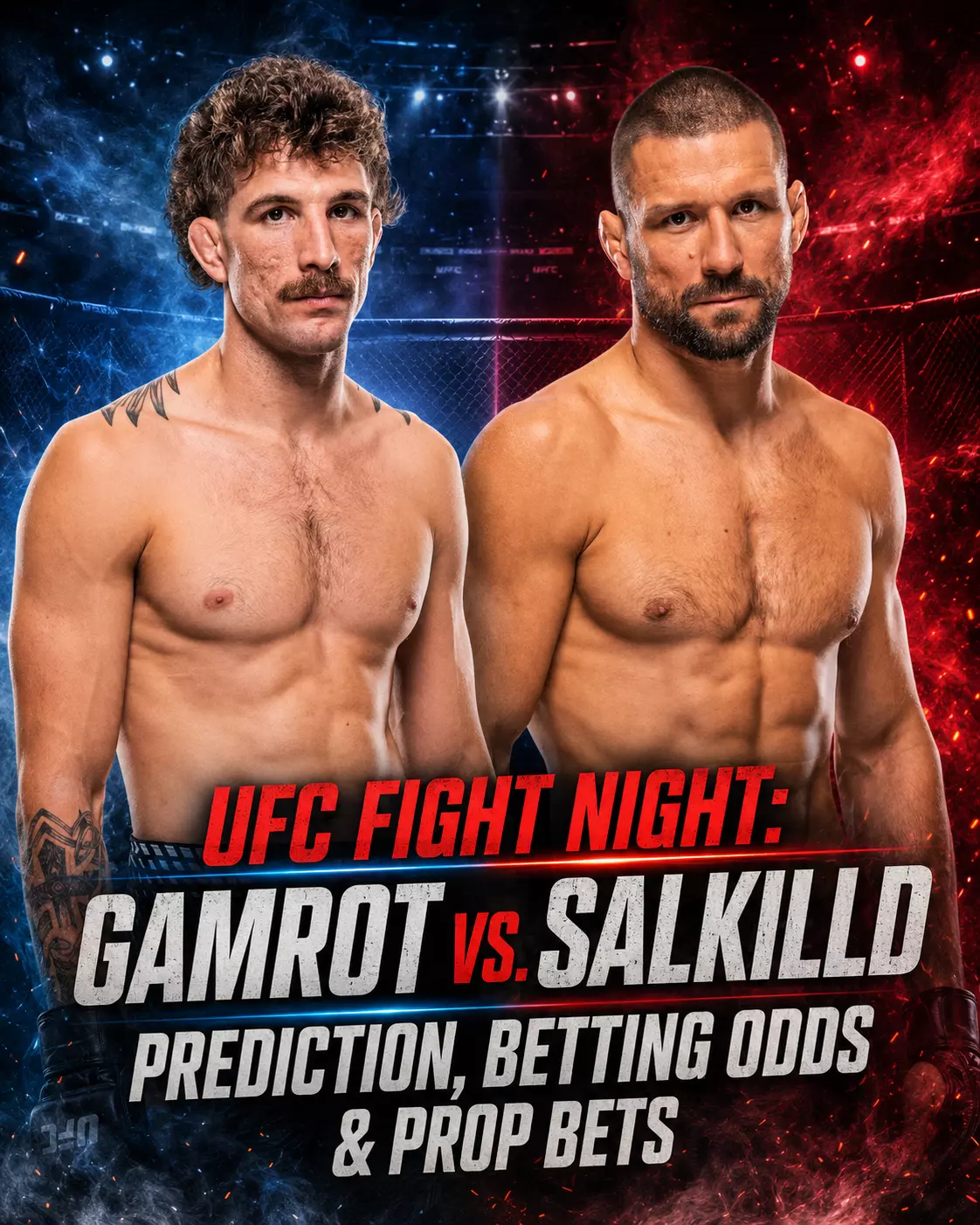
A fascinating lightweight matchup between an established contender and one of the UFC’s fastest-rising prospects headlines UFC Fight Night inside the Meta APEX.
Mateusz Gamrot enters the five-round main event with a 26-4 professional record and years of experience competing against elite lightweights. Quillan Salkilld arrives with a 12-1 record, a perfect 5-0 UFC mark and the momentum created by four first-round finishes during his first five appearances inside the Octagon.
Gamrot recently returned to the win column by submitting Esteban Ribovics with an arm-triangle choke during the second round of their April 2026 matchup. The victory improved his UFC record to 9-4 and reminded the lightweight division that his wrestling, scrambling and submission skills remain capable of overwhelming dangerous opponents.
The Polish contender has spent several years fighting near the top of the division. His recent schedule has included victories over Ribovics and Ludovit Klein, along with losses against former champion Charles Oliveira and veteran contender Dan Hooker. That level of competition gives Gamrot a substantial experience advantage entering Saturday’s main event.
Salkilld represents a completely different challenge.
The 26-year-old Australian has quickly developed from an interesting prospect into a legitimate ranked contender. He has won five consecutive UFC fights and finished four of those opponents during the opening round. His most recent performance produced his most important victory, as he stopped longtime contender Beneil Dariush during the first round in May.
Salkilld encountered early adversity against Dariush after being dropped by a jab. Rather than becoming discouraged, he recovered, defended subsequent takedown attempts and responded with an aggressive combination that forced the stoppage at 3:29 of the first round. That performance demonstrated composure, recovery ability and finishing instincts against the most accomplished opponent of his career.
After defeating Dariush, Salkilld publicly requested a matchup with Gamrot. The UFC granted that request, giving the Australian an opportunity to defeat another established contender and potentially move into the lightweight top 10.
The physical differences immediately stand out.
Gamrot is 5-foot-10 with a reach of approximately 70.5 inches. Salkilld stands 6 feet tall and possesses a 75-inch reach. The Australian therefore enters with a two-inch height advantage and approximately four-and-a-half inches of additional reach. He is also nine years younger than the 35-year-old Gamrot.
Those advantages could become extremely important during the striking exchanges.
Salkilld lands approximately 5.01 significant strikes per minute, compared with Gamrot’s 3.21. He also connects at a higher reported percentage, although the Australian’s statistics have been accumulated across a much smaller UFC sample against less experienced competition.
Salkilld uses his length effectively when he maintains distance. He attacks with straight punches, kicks and long combinations before changing levels for takedowns. His offensive versatility makes it difficult for opponents to determine whether he will strike, wrestle or pressure them against the fence.
Gamrot is not primarily a knockout-focused striker.
His striking is designed to create wrestling opportunities. The Polish contender changes levels underneath punches, attacks single-leg and double-leg takedowns and immediately transitions between positions when an opponent begins defending.
Gamrot averages approximately 5.22 takedowns per 15 minutes. Surprisingly, Salkilld’s early UFC statistics show an even higher average of approximately 7.25 takedowns per 15 minutes, emphasizing that the Australian is more than a long-range striker.
However, the numbers do not fully explain Gamrot’s grappling ability.
Gamrot’s greatest strength is not simply completing the first takedown. It is his ability to continue wrestling through multiple defensive reactions. When an opponent sprawls, Gamrot attacks another leg. When a fighter attempts to stand, he changes his grip and forces another scramble. When he loses position, he immediately begins working toward a reversal.
That constant activity can become mentally and physically exhausting.
Salkilld must avoid allowing Gamrot to transform the fight into a continuous series of scrambles. The younger fighter may successfully defend the first takedown, but Gamrot frequently wins exchanges by attacking the second, third or fourth opportunity.
The Australian’s size could make that process more difficult than usual.
Salkilld has the length to frame against Gamrot’s shoulders, attack with knees during level changes and force the veteran to cover additional distance before reaching his hips. His reported takedown-defense rate has also been excellent through his early UFC career.
Gamrot must therefore disguise his entries.
Attempting predictable takedowns from long distance would allow Salkilld to sprawl, circle away or attack with uppercuts and knees. Gamrot should establish his left hand, force reactions with feints and move the Australian toward the fence before committing to his wrestling.
The five-round format creates another important question.
Gamrot has competed in extended, high-level fights and understands how to distribute his energy across 25 minutes. Salkilld is participating in his first UFC main event after finishing four of his five UFC opponents during the opening round.
Salkilld’s early finishes have been impressive, but they have not required him to demonstrate how his explosiveness, defense and decision-making will hold up during the fourth and fifth rounds against an experienced pressure wrestler.
Gamrot will attempt to answer those questions.
The veteran should be willing to lose some early striking exchanges if he can consistently force Salkilld to defend takedowns. Every sprawl, underhook and scramble requires energy. Even unsuccessful takedown attempts can benefit Gamrot if they prevent Salkilld from establishing a comfortable striking rhythm.
Salkilld’s clearest path to victory involves maintaining separation and punishing Gamrot’s entries.
The Australian should use his jab, front kick and straight right hand to control the distance. When Gamrot changes levels, Salkilld must respond with underhooks, frames and immediate lateral movement rather than retreating directly toward the fence.
Body attacks could also become extremely effective.
Gamrot relies on a relentless pace. Kicks and knees to the body could reduce his ability to repeatedly explode through takedown attempts. Salkilld does not need to pursue an immediate knockout. A patient approach built around distance, body damage and takedown defense could gradually make the matchup easier.
The greatest danger for Salkilld is becoming too confident after his recent finishes.
Gamrot has faced more accomplished competition and will not be intimidated by Salkilld’s early success. If the Australian recklessly chases another first-round stoppage, he may give Gamrot opportunities to change levels underneath wide punches and establish control.
The main event should become a test of discipline.
Gamrot must remain patient while working through the younger fighter’s physical advantages. Salkilld must resist the temptation to force another highlight-reel finish against the most experienced wrestler he has faced.
Top 4 Prop Bets
Prop prices can differ significantly between sportsbooks and may continue moving before Saturday’s event. Bettors should compare available lines before making a selection.
Prop Bet #1: Quillan Salkilld Moneyline
DraftKings
4.5/5
Tip: Salkilld Moneyline
Reach Advantage
Finishing Momentum
Strong Takedown Defense
New DraftKings Customers: Spend $5+ Get $150 in Bonuses
Get bonus now
GAMBLING PROBLEM? CALL 1-800-GAMBLER or 1-800-MY-RESET, (800) 327-5050 or visit gamblinghelplinema.org (MA). Please Gamble Responsibly. 888-789-7777/visit ccpg.org (CT), or visit www.mdgamblinghelp.org (MD), 1-800-981-0023 (PR). 21+ and present in most states. (18+ DC/NH/PR/WY). Void in CAN. Eligibility restrictions apply. On behalf of Boot Hill Casino (KS). Pass-thru of per wager tax may apply in IL. 1 per new DraftKings customer. $5+ first-time bet req. Max. $150 issued as non-withdrawable Bonus Bets. Stake removed from payout. Reward issued as $50 in Bonus Bets every 7 days via click-to-claim for 14 days. Bonus Bets and click-to-claims expire 7 days (168hrs) after issuance. Terms: sportsbook.draftkings.com/promos. Ends 10/11/26 at 11:59 PM ET. Sponsored by DK.
Salkilld’s moneyline is the strongest overall selection.
The Australian enters with advantages in age, height, reach, striking output and recent momentum. He has also demonstrated legitimate wrestling ability, meaning Gamrot cannot assume that he will control every grappling exchange simply because wrestling is his preferred path.
Salkilld’s five-inch reach advantage should help him establish his jab and punish Gamrot whenever the veteran attempts to close the distance. The favorite can attack from outside while forcing Gamrot to take additional risks before entering wrestling range.
Gamrot remains capable of winning through pressure, takedowns and accumulated control time. However, Salkilld appears physically equipped to make those exchanges unusually difficult.
At approximately -130 to -154, the favorite’s moneyline still offers a more reasonable price than many rising contenders receive after producing several consecutive finishes.
Prop Bet #2: Fight Goes the Distance
FanDuel
4.6/5
Tip: Fight Goes the Distance
Elite Grappling
Durable Contenders
Tactical Five-Round Matchup
New Users – Get $250 in Bonus Bets when you wager $5 for 5 days
The market may focus heavily on Salkilld’s four first-round UFC finishes, but this matchup could become more tactical than his recent appearances.
Gamrot understands how to survive difficult positions, create scrambles and prevent opponents from maintaining a comfortable offensive rhythm. He is unlikely to stand directly in front of Salkilld and exchange recklessly for an extended period.
The veteran should use takedown attempts and clinch pressure to slow the pace whenever Salkilld begins building momentum.
Salkilld must also respect Gamrot’s grappling. Pursuing an early knockout with uncontrolled combinations could expose his hips and allow the Polish contender to take him down.
Both fighters may therefore become more cautious than usual.
Gamrot’s experience makes him difficult to dominate, while Salkilld’s size and defensive athleticism should prevent the veteran from quickly securing a submission. A competitive fight built around striking at distance, clinches and extended scrambles could require the judges’ scorecards.
Prop Bet #3: Quillan Salkilld by Decision
Caesars
4.4/5
Tip: Salkilld by Decision
Long-Range Striking
Defensive Wrestling
Five-Round Volume
Bet $1 and get double the winnings up to $25 for your next 10 bets
–
21+ New users only. Must register using eligible promo code. First bet after registration must qualify. Max. Bonus Bet: $1,000. Bonus Bet expires 14 days after receipt. Void where prohibited. See Caesars.com/promos for full terms. Gambling Problem? 1-800-GAMBLER (1-800-426-2537)
Salkilld by decision provides a more aggressive alternative to his moneyline.
The Australian does not need to knock Gamrot out to win. He can build rounds by landing the cleaner strikes, defending enough takedowns and quickly returning to his feet whenever the veteran completes an entry.
His reach advantage should become increasingly valuable if the fight remains competitive during the later rounds. Salkilld can score with straight punches and kicks while forcing Gamrot to pursue him across the Octagon.
Gamrot may still complete several takedowns, but modern judging emphasizes meaningful damage more heavily than control that produces little offense. Salkilld can lose portions of rounds in grappling positions and still earn the scorecards if he lands the more damaging strikes.
The greatest concern is Salkilld’s lack of five-round UFC experience.
He must avoid wasting energy during unnecessary scrambles and cannot pursue every finishing opportunity with maximum aggression. A measured performance should allow him to use his physical advantages without providing Gamrot an opportunity to take over late.
Prop Bet #4: Mateusz Gamrot by Decision
BetMGM
4.5/5
Tip: Gamrot by Decision
Underdog Value
Five-Round Experience
Relentless Wrestling
Up To $1500 in Bonus Bets Paid Back if your First Bet Does Not Win
Get bonus now
Gambling problem? Call 1-800-GAMBLER or 1-800-MY-RESET (Available in the US) 877-8-HOPENY or text HOPENY (467369) (NY) 1-800-327-5050 (MA), 1-800-BETS-OFF (IA), 1-800-981-0023 (PR). 21+ only. Please Gamble Responsibly. See BetMGM.com for Terms. First Bet Offer for new customers only (if applicable). Subject to eligibility requirements. Bonus bets are non-withdrawable. In partnership with Kansas Crossing Casino and Hotel. Promotional offers not available in Mississippi, Massachusetts, New York, Ontario, or Puerto Rico.
Gamrot by decision represents the strongest long-shot alternative.
The underdog is unlikely to defeat Salkilld by attempting to win a kickboxing match at long range. His clearest path involves turning the fight into an exhausting wrestling contest and forcing the Australian to defend throughout all five rounds.
Gamrot must move forward, close the distance behind combinations and repeatedly drive Salkilld toward the fence. Even when a takedown fails, the veteran can score with clinch control, knees and short punches while forcing the favorite to carry his weight.
Salkilld has never encountered a UFC opponent who creates Gamrot’s level of sustained grappling pressure.
If the Australian becomes tired after repeatedly defending takedowns, Gamrot could begin controlling longer portions of the final three rounds. His experience in competitive, high-level fights would become increasingly important during a close decision.
Gamrot is a live underdog because his style can eliminate many of Salkilld’s physical advantages. If he wins, a wrestling-heavy decision is the most likely outcome.
Keys to Victory
Mateusz Gamrot
Move forward without entering recklessly.
Use striking combinations to disguise takedown attempts.
Avoid shooting from outside Salkilld’s punching range.
Force Salkilld backward toward the fence.
Chain multiple takedown attempts together.
Make the younger fighter work during every scramble.
Attack the body during clinch exchanges.
Avoid absorbing knees and uppercuts during level changes.
Extend the matchup into the fourth and fifth rounds.
Trust his experience if the fight becomes closely contested.
Quillan Salkilld
Establish the jab immediately.
Use his height and reach to control distance.
Attack Gamrot’s body with kicks and knees.
Maintain lateral movement instead of retreating toward the fence.
Punish predictable takedown attempts.
Use underhooks and frames before attempting to escape.
Avoid wasting energy during extended scrambles.
Remain patient if an early finish does not develop.
Force Gamrot to reset after every failed entry.
Increase his striking volume when the veteran begins slowing down.
The Matchup Context: Established Contender vs. Rising Prospect
This main event carries major consequences for both lightweights.
Gamrot is attempting to protect his position among the division’s leading contenders. He has already defeated several talented opponents, but alternating victories and losses has prevented him from building the sustained momentum required for a championship opportunity.
A convincing victory over Salkilld would demonstrate that Gamrot remains capable of stopping the division’s fastest-rising prospects. It would also strengthen his argument for another matchup against a highly ranked lightweight.
A loss would be significantly more damaging.
At 35 years old, Gamrot cannot afford to surrender his ranking to a younger contender without facing questions about his place in the division. The lightweight class remains crowded, and another defeat could force him to rebuild against opponents outside the immediate title picture.
Salkilld enters with a different type of pressure.
The Australian has generated excitement through first-round finishes and rapid improvement, but Gamrot represents the most complete test of his career. Defeating an established contender would confirm that Salkilld belongs near the top of the division rather than simply being an exciting prospect.
A victory could move him into the top 10 and place him within one or two fights of championship consideration.
Salkilld specifically requested this challenge after defeating Dariush. That decision demonstrates confidence, but it also creates expectations. He must now prove that his skills are effective against a durable wrestler who has competed against the division’s elite.
The matchup represents an important stage in the natural transition of a division.
Gamrot is fighting to prove that experience, technique and relentless pressure remain enough to defeat a younger, longer and more explosive opponent.
Salkilld is fighting to prove that the lightweight division has a new contender capable of defeating established names.
Fighters to Watch
Mateusz Gamrot
Gamrot remains one of the lightweight division’s most accomplished wrestlers. His ability to chain takedowns, create scrambles and maintain a demanding pace gives him a realistic opportunity to derail Salkilld’s rapid rise.
Quillan Salkilld
Salkilld has won five consecutive UFC fights and finished four during the opening round. His combination of size, striking output, wrestling and athleticism makes him one of the most intriguing young lightweights in the promotion.
Diego Ferreira
Ferreira faces Billy Quarantillo in the lightweight co-main event. Both veterans are known for aggressive exchanges and well-rounded skill sets, creating the potential for one of the card’s most entertaining matchups.
Billy Quarantillo
Quarantillo returns against Ferreira after an extended absence. His pressure, striking volume and willingness to participate in chaotic exchanges should test Ferreira throughout the co-main event.
Amanda Lemos
The former strawweight title challenger meets rising Brazilian prospect Alexia Thainara. Lemos brings substantially more experience against elite competition and remains dangerous because of her power and counterstriking.
Alexia Thainara
Thainara enters with a 14-1 record and a perfect 3-0 UFC mark. A victory over an established contender such as Lemos would become the most important win of her career and move her closer to the top of the strawweight division.
Ty Miller
The undefeated welterweight prospect faces Billy Ray Goff. Miller enters with significant advantages in height and reach and will attempt to continue building momentum after earning a stoppage victory in his previous appearance.
Yadier del Valle
Del Valle meets longtime featherweight veteran Darren Elkins. The younger fighter will attempt to use his strength and wrestling against one of the most experienced and durable competitors on the card.
The Verdict
Prediction:
Quillan Salkilld by Unanimous Decision
Best Bet:
Quillan Salkilld Moneyline
Best Supporting Prop:
Fight Goes the Distance
Best Method-of-Victory Bet:
Quillan Salkilld by Decision
Long-Shot Bet:
Mateusz Gamrot by Decision
Gamrot presents the most difficult stylistic challenge of Salkilld’s UFC career.
The veteran’s wrestling, scrambling ability and five-round experience should prevent the Australian from producing another effortless first-round finish. Gamrot will force Salkilld to defend repeated takedowns and make difficult decisions whenever the fight reaches the fence.
Expect Gamrot to begin aggressively.
He should move forward behind his southpaw left hand and attempt to close the distance before Salkilld establishes his jab. The veteran will likely complete at least one early takedown and use the success to remind Salkilld that every extended striking combination carries grappling risk.
Salkilld should gradually become more comfortable.
His length will allow him to connect from positions where Gamrot cannot immediately counter. The Australian can use straight punches and front kicks to interrupt the veteran’s forward movement before circling away from the fence.
The first two rounds should be competitive.
Gamrot may control portions of both rounds through wrestling, but Salkilld should land the more damaging strikes. The favorite’s ability to return to his feet will prevent Gamrot from establishing prolonged control.
During the middle rounds, Salkilld’s body attacks should begin reducing Gamrot’s pace.
The Australian will increasingly recognize the veteran’s level changes and respond with underhooks, knees and short combinations. Gamrot will continue pursuing takedowns, but his entries should become easier to anticipate as the matchup progresses.
Salkilld cannot become careless.
Gamrot remains dangerous whenever an opponent overcommits. A wide combination or poorly timed kick could allow the Polish contender to secure a takedown and spend several minutes controlling the round.
The championship rounds should determine the result.
Gamrot’s experience will help him remain competitive, but Salkilld’s size and cleaner long-range offense should allow him to finish strongly. Expect the Australian to increase his jab and kicking volume while avoiding the extended grappling exchanges Gamrot needs.
The fight reaches the judges after five demanding rounds.
Gamrot earns respect by testing the younger contender in every phase, but Salkilld lands the cleaner and more damaging strikes, defends enough takedowns and proves that his rapid rise can continue against elite competition.
Salkilld wins a competitive unanimous decision, enters the lightweight top-10 conversation and establishes himself as one of the division’s most important emerging contenders.
Up To $1500 in Bonus Bets Paid Back if your First Bet Does Not Win
T&Cs apply
4.5/5
Gambling problem? Call 1-800-GAMBLER or 1-800-MY-RESET (Available in the US) 877-8-HOPENY or text HOPENY (467369) (NY) 1-800-327-5050 (MA), 1-800-BETS-OFF (IA), 1-800-981-0023 (PR). 21+ only. Please Gamble Responsibly. See BetMGM.com for Terms. First Bet Offer for new customers only (if applicable). Subject to eligibility requirements. Bonus bets are non-withdrawable. In partnership with Kansas Crossing Casino and Hotel. Promotional offers not available in Mississippi, Massachusetts, New York, Ontario, or Puerto Rico.
New DraftKings Customers: Spend $5+ Get $150 in Bonuses
T&Cs apply
4.5/5
GAMBLING PROBLEM? CALL 1-800-GAMBLER or 1-800-MY-RESET, (800) 327-5050 or visit gamblinghelplinema.org (MA). Please Gamble Responsibly. 888-789-7777/visit ccpg.org (CT), or visit www.mdgamblinghelp.org (MD), 1-800-981-0023 (PR). 21+ and present in most states. (18+ DC/NH/PR/WY). Void in CAN. Eligibility restrictions apply. On behalf of Boot Hill Casino (KS). Pass-thru of per wager tax may apply in IL. 1 per new DraftKings customer. $5+ first-time bet req. Max. $150 issued as non-withdrawable Bonus Bets. Stake removed from payout. Reward issued as $50 in Bonus Bets every 7 days via click-to-claim for 14 days. Bonus Bets and click-to-claims expire 7 days (168hrs) after issuance. Terms: sportsbook.draftkings.com/promos. Ends 10/11/26 at 11:59 PM ET. Sponsored by DK.
Must be 21+. GAMBLING PROBLEM? CALL 1-800-GAMBLER OR CALL 1-800-MY-RESET, www.mdgamblinghelp.org (MD), (800)-327-5050 or gamblinghelplinema.org (MA), Call (877)8-HOPENY or text HOPENY (467369) (NY), (888) 789-7777 or ccpg.org (CT), morethanagame.nc.gov (NC), 1800gambler.net (WV)
Bet $1 and get double the winnings up to $25 for your next 10 bets
T&Cs apply
4.4/5
21+ New users only. Must register using eligible promo code. First bet after registration must qualify. Max. Bonus Bet: $1,000. Bonus Bet expires 14 days after receipt. Void where prohibited. See Caesars.com/promos for full terms. Gambling Problem? 1-800-GAMBLER (1-800-426-2537)
21+ and present in OH. Gambling Problem? Call 1-800-GAMBLER.
This site is using
Cloudflare
and adheres to the
Google Safe Browsing Program. We adapted
Google's Privacy Guidelines
to keep your data safe at all times.
Close
Ready to Win Big? Join the Elite with Our Sports Betting Deals!
FanDuel Promo
New Users – Get $250 in Bonus Bets when you wager $5 for 5 days
Up To $1500 in Bonus Bets Paid Back if your First Bet Does Not Win
Best Slots
T&Cs and 21+ apply
Gambling problem? Call 1-800-GAMBLER or 1-800-MY-RESET (Available in the US) 877-8-HOPENY or text HOPENY (467369) (NY) 1-800-327-5050 (MA), 1-800-BETS-OFF (IA), 1-800-981-0023 (PR). 21+ only. Please Gamble Responsibly. See BetMGM.com for Terms. First Bet Offer for new customers only (if applicable). Subject to eligibility requirements. Bonus bets are non-withdrawable. In partnership with Kansas Crossing Casino and Hotel. Promotional offers not available in Mississippi, Massachusetts, New York, Ontario, or Puerto Rico.
Code:
Open BetMGM
Get Bonus
DraftKings Promo
New DraftKings Customers: Spend $5+ Get $150 in Bonuses
Newcomer
T&Cs and 21+ apply
GAMBLING PROBLEM? CALL 1-800-GAMBLER or 1-800-MY-RESET, (800) 327-5050 or visit gamblinghelplinema.org (MA). Please Gamble Responsibly. 888-789-7777/visit ccpg.org (CT), or visit www.mdgamblinghelp.org (MD), 1-800-981-0023 (PR). 21+ and present in most states. (18+ DC/NH/PR/WY). Void in CAN. Eligibility restrictions apply. On behalf of Boot Hill Casino (KS). Pass-thru of per wager tax may apply in IL. 1 per new DraftKings customer. $5+ first-time bet req. Max. $150 issued as non-withdrawable Bonus Bets. Stake removed from payout. Reward issued as $50 in Bonus Bets every 7 days via click-to-claim for 14 days. Bonus Bets and click-to-claims expire 7 days (168hrs) after issuance. Terms: sportsbook.draftkings.com/promos. Ends 10/11/26 at 11:59 PM ET. Sponsored by DK.
Code:
Open DraftKings
Get Bonus
Find out what the legends have to say about sports this week....