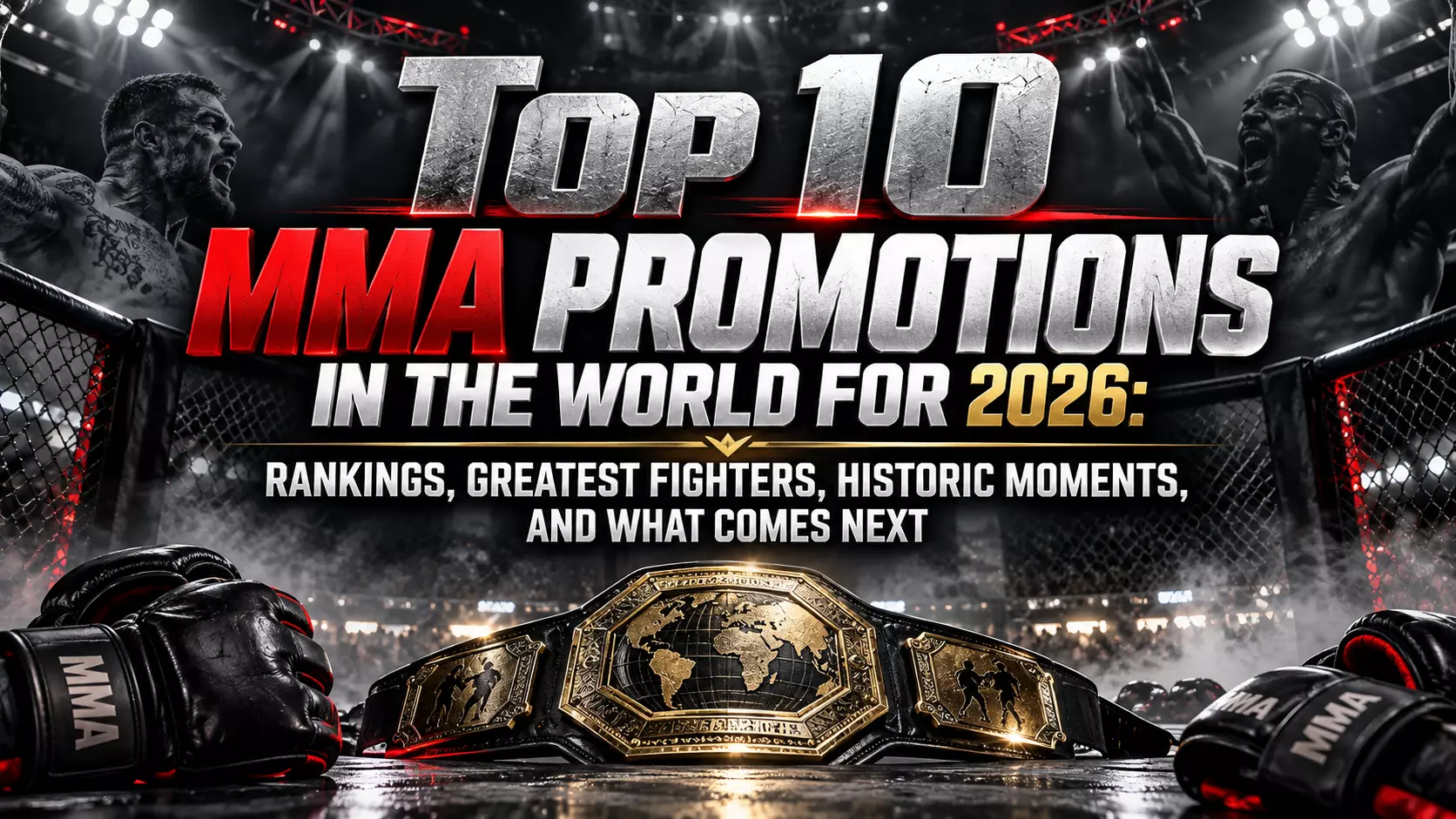
Top 10 MMA Promotions in the World for 2026: Rankings, Greatest Fighters, Historic Moments, and What Comes Next
Mixed martial arts has evolved from a controversial combat sports experiment into a global industry featuring major television contracts, international superstars, championship organizations, and millions of passionate fans.
For decades, the Ultimate Fighting Championship has been the unquestioned leader in MMA. However, the UFC is no longer the only organization producing world-class fighters or filling major arenas. Promotions throughout Europe, Asia, the Middle East, and North America have developed their own championship traditions, recognizable stars, and devoted audiences.
Organizations such as the Professional Fighters League, ONE Championship, RIZIN, KSW, and OKTAGON have established themselves as important players in the international MMA landscape. Meanwhile, promotions including Legacy Fighting Alliance, Cage Warriors, and BRAVE Combat Federation have demonstrated the importance of developing the next generation of professional fighters.
But which organizations deserve to be considered the best?
For The Grueling Truth’s 2026 rankings, we evaluated promotions using five primary criteria:
Fighter quality (35%): Strength of the roster, championship talent, and competitive depth.
International recognition (20%): Brand awareness, geographic reach, and reputation.
Event production and audience (20%): Presentation, attendance, and fan engagement.
Historical significance (15%): Legendary fighters, landmark events, and influence on MMA.
Future growth potential (10%): Ability to attract talent, expand into new markets, and become more competitive.
These are editorial weightings rather than a statistical audit of company finances or television audiences. The rankings assess the overall prominence of each organization, not solely its active roster.
Fight Matrix’s October 4, 2026, rankings provide a useful independent comparison of fighter quality, with the UFC, PFL, RIZIN, ACA, and KSW occupying its top five positions. Our rankings differ because they also consider international influence, legacy, live events, and audience reach.
1. Ultimate Fighting Championship (UFC)
UNITED STATES • GLOBAL PROMOTION
Ultimate Fighting Championship
The industry’s established global leader, with unmatched historical influence and exceptional championship depth.
Why the UFC ranks No. 1
The UFC’s position at the top of these rankings is not particularly controversial. No other MMA organization matches its combination of championship talent, worldwide recognition, historical significance, and cultural influence.
Since its first event in 1993, the UFC has helped transform mixed martial arts into a mainstream professional sport. Its roster has featured legendary champions across nearly every weight class, including Georges St-Pierre, Anderson Silva, Amanda Nunes, Khabib Nurmagomedov, Demetrious Johnson, and Jon Jones.
One of the UFC’s greatest advantages is the perceived importance of its championship titles. Becoming a UFC champion remains an extraordinary achievement, and the organization continues to attract many of the sport’s most accomplished fighters.
The UFC also possesses an extensive event infrastructure, a globally recognized brand, and the ability to create international sporting attractions.
Its success is the standard against which other promotions are measured.
Greatest fighter: Jon Jones
Jon Jones earns our selection because of his extraordinary combination of championship accomplishments, versatility, and longevity near the top of the sport.
Jones captured the
UFC
light heavyweight championship in 2011 and established himself as one of the most successful champions in MMA history. His victories over elite opponents helped define an era.
He later captured the UFC heavyweight championship, reinforcing his place among the sport’s greatest competitors.
His career has also included controversies, disciplinary issues, and setbacks that complicate assessments of his legacy. Nevertheless, his accomplishments inside the Octagon make him a defensible selection as the greatest fighter associated with the UFC.
Georges St-Pierre, Anderson Silva, and Amanda Nunes are equally important candidates in any serious greatest-of-all-time debate.
Greatest moment: UFC 1 — November 12, 1993
The UFC’s most important moment remains its beginning.
On November 12, 1993, Royce Gracie entered an eight-man tournament in Denver, Colorado, and demonstrated the effectiveness of Brazilian jiu-jitsu against opponents representing different martial arts disciplines.
The event helped introduce millions of people to the concept of mixed-style competition and eventually laid the foundation for modern MMA.
Without UFC 1, the history of the sport would look dramatically different.
What the UFC must do to maintain its No. 1 ranking
The UFC cannot move any higher on this list. Its challenge is maintaining the position while competitors improve.
Preserving that dominance requires the organization to continue recruiting elite international talent, staging compelling championship fights, protecting competitive credibility, and finding new ways to make its athletes recognizable stars.
The UFC must also balance commercial interests with competitive sporting integrity. Fans need to believe championship opportunities are determined by merit rather than popularity alone.
The verdict: The
UFC
remains the gold standard of professional mixed martial arts. Its biggest opponent is not another promotion but the challenge of maintaining its own extraordinary expectations.
2. Professional Fighters League (PFL)
UNITED STATES • GLOBAL PROMOTION
Professional Fighters League
A major global MMA competitor with significant roster depth and a history of innovative tournament competition.
Why PFL ranks No. 2
The Professional Fighters League has emerged as one of the most significant alternatives to the UFC.
Its early identity centered on a sports-league approach to MMA, featuring regular-season competition, playoffs, and championship tournaments with substantial financial rewards.
That structure distinguished the
PFL
from traditional MMA organizations and gave fighters a pathway toward championships based on tournament results.
The promotion’s expansion, international operations, and acquisition of Bellator helped strengthen its talent base and overall industry profile.
In addition, the organization has attracted recognizable names such as Francis Ngannou, Kayla Harrison, and Cris Cyborg during its history.
PFL ranks second because of its roster quality and ambitious international presence. However, it still faces a significant challenge in converting its competitive assets into a consistent, universally recognizable brand.
Greatest fighter: Kayla Harrison
Although Francis Ngannou may have brought greater mainstream attention to the organization, Kayla Harrison represents the PFL’s competitive history more completely.
The two-time Olympic judo gold medalist became the PFL women’s lightweight champion in 2019 and again in 2021.
Her combination of elite grappling, physical strength, and championship success made her one of the promotion’s defining athletes.
Harrison subsequently moved to the UFC, but her contributions to establishing the PFL’s credibility remain significant.
Professional Fighters League News
Greatest moment: Francis Ngannou’s spectacular PFL debut
On October 19, 2024, Francis Ngannou returned to mixed martial arts after more than two years away from the sport.
Facing Renan Ferreira in the main event of PFL: Battle of the Giants, Ngannou delivered a powerful performance, securing a first-round stoppage through ground-and-pound.
The victory represented more than a successful comeback. It gave the organization a major international attraction and demonstrated its ability to stage a fight featuring one of MMA’s best-known heavyweights.
What PFL must do to reach No. 1
PFL’s biggest opportunity is building a brand identity that casual fans immediately recognize.
To seriously challenge the UFC, it needs consistent championship storylines, a stable roster of marketable stars, strong broadcasting arrangements, and regular events featuring fighters widely considered among the world’s best.
The organization should also continue developing international talent while ensuring fans clearly understand its championship structure.
The verdict:
PFL
possesses the competitive resources to remain a leading UFC alternative. Its next major challenge is turning organizational scale into lasting mainstream popularity.
3. ONE Championship
SINGAPORE • INTERNATIONAL COMBAT SPORTS
ONE Championship
An internationally recognized combat sports organization with a distinctive blend of martial arts disciplines.
Why ONE Championship ranks No. 3
ONE Championship has established a distinct position in the global combat sports industry by combining mixed martial arts, Muay Thai, kickboxing, and submission grappling.
That diversity creates a unique product. Fans can watch high-level competitors from several martial arts backgrounds on the same event.
The organization has also helped introduce Asian fighters to a broader international audience while bringing established Western stars into its competition.
ONE’s promotional history includes respected names such as Demetrious Johnson, Adriano Moraes, Angela Lee, and Anatoly Malykhin.
However, ONE’s diversified combat sports approach creates an important distinction. Its total international profile should not automatically be confused with the strength of its dedicated MMA roster.
Fight Matrix ranked ONE eighth by average MMA fighter ranking in its October 2026 assessment. ONE finishes third in our editorial rankings largely because of its brand recognition, cross-discipline production, and historical significance.
Greatest fighter: Demetrious Johnson
Demetrious “Mighty Mouse” Johnson is one of the most technically accomplished fighters in MMA history.
After establishing his legacy in the UFC, Johnson continued competing at an elite level in ONE Championship.
His exceptional wrestling, submission skills, movement, and understanding of fighting made him an ideal representative of ONE’s emphasis on martial arts excellence.
Although Angela Lee and Adriano Moraes have stronger claims based on their long-term contributions specifically within ONE, Johnson remains the most accomplished overall MMA fighter to compete for the organization.
Greatest moment: Demetrious Johnson’s flying-knee knockout of Adriano Moraes
On August 26, 2022, Johnson delivered one of the most memorable finishes in
ONE Championship history.
After previously losing to Adriano Moraes by knockout, Johnson returned in their rematch and landed a spectacular flying knee in the fourth round to capture the ONE flyweight championship.
The finish became one of the organization’s signature highlights and earned ONE’s 2022 MMA Knockout of the Year recognition.
What ONE must do to move to No. 2
ONE needs to build a deeper, more consistently active MMA roster while preserving its successful multi-discipline identity.
More regular MMA championship fights, greater international exposure for its champions, and the development of recognizable stars would strengthen its claim to being the world’s second-best MMA organization.
Its biggest opportunity is attracting fans who appreciate the entire spectrum of martial arts while ensuring MMA remains a central and highly competitive part of the product.
The verdict: ONE has a powerful international identity, but it must strengthen the depth and visibility of its MMA competition to challenge PFL in these rankings.
4. RIZIN Fighting Federation
JAPAN • MAJOR INTERNATIONAL PROMOTION
RIZIN Fighting Federation
Japan’s leading MMA spectacle, combining top-level talent with extraordinary fight-night presentation.
Why RIZIN ranks No. 4
RIZIN carries forward Japan’s tradition of presenting mixed martial arts as a major entertainment event.
Its elaborate entrances, dramatic lighting, tournament formats, and enthusiastic live audiences help distinguish the promotion from many of its competitors.
RIZIN also benefits from Japan’s rich MMA history, particularly the influence of PRIDE Fighting Championships.
The organization has attracted high-level competitors including Kyoji Horiguchi, Jiří Procházka, Kai Asakura, and other prominent Japanese and international fighters.
RIZIN ranks fourth because of its strong fighter quality, compelling production, and meaningful position in the Asian MMA market.
It also ranks third behind only UFC and PFL in Fight Matrix’s October 2026 average-fighter assessment, giving it a credible argument for an even higher placement.
Greatest fighter: Kyoji Horiguchi
Kyoji Horiguchi stands among the finest Japanese mixed martial artists of his generation.
Following his UFC career, Horiguchi became a defining RIZIN fighter through his speed, technical striking, and championship success.
He won the RIZIN bantamweight Grand Prix and later defeated Bellator champion Darrion Caldwell to become RIZIN bantamweight champion.
His accomplishments reinforced RIZIN’s credibility as an organization featuring legitimate world-class athletes.
Greatest moment: Kyoji Horiguchi defeats Darrion Caldwell at RIZIN 14
On December 31, 2018, Horiguchi faced Bellator bantamweight champion Darrion Caldwell in a major cross-promotional matchup.
Horiguchi submitted Caldwell with a guillotine choke to capture the inaugural RIZIN bantamweight championship.
The victory demonstrated that RIZIN’s leading fighters could compete successfully against champions from other established international organizations.
What RIZIN must do to move to No. 3
RIZIN needs to continue expanding beyond Japan while maintaining its distinctive event atmosphere.
Additional international television distribution, English-language programming, cross-promotional championship bouts, and consistent appearances by elite international fighters would increase its worldwide influence.
It should not abandon the characteristics that make Japanese MMA unique. Instead, those traditions could become an advantage in attracting new audiences.
The verdict: RIZIN already possesses a world-class sporting product. Its greatest opportunity is introducing that product to a larger global audience.
5. Konfrontacja Sztuk Walki (KSW)
POLAND • EUROPEAN MMA
KSW
One of Europe’s most established MMA brands, renowned for its major live events and passionate fan base.
Why KSW ranks No. 5
KSW has played an enormous role in transforming mixed martial arts into a major spectator sport in Poland.
The promotion combines strong regional fighter development with professional event production, championship competition, and substantial audience support.
Unlike organizations that depend primarily on international superstars, KSW has successfully developed fighters with deep connections to its domestic audience.
Mamed Khalidov, Mariusz Pudzianowski, and other well-known athletes have helped create an identity that resonates with Polish sports fans.
KSW’s ability to stage stadium-sized events has demonstrated the commercial potential of MMA outside North America.
Greatest fighter: Mamed Khalidov
Mamed Khalidov is arguably the most important fighter in KSW history.
Known for his creative submissions, striking ability, and aggressive fighting style, Khalidov became one of the promotion’s most recognizable stars.
His championship achievements and longevity helped establish the credibility of KSW’s competitive product.
While Pudzianowski brought extraordinary mainstream attention, Khalidov’s fighting accomplishments make him the stronger selection for greatest fighter.
Greatest moment: KSW 39 — Colosseum
On May 27, 2017, KSW staged one of the most significant events in European MMA history at PGE Narodowy Stadium in Warsaw.
The promotion reported approximately 58,000 spectators, creating a remarkable atmosphere for an MMA event.
Khalidov defeated Borys Mańkowski in the main event, but the importance of the evening extended beyond the result.
KSW had demonstrated that a European MMA organization could fill a massive stadium and compete with the world’s biggest promotions in live-event scale.
What KSW must do to move to No. 4
To surpass RIZIN, KSW needs to extend its influence beyond its traditional markets.
Expanded English-language broadcasts, international championship matchups, additional events outside Poland, and a greater presence among globally ranked fighters would strengthen its position.
KSW must also continue creating new stars as its most recognizable veterans move into later stages of their careers.
The verdict: KSW has already proven itself as a major European promotion. Its next challenge is becoming equally important to audiences outside Europe.
6. OKTAGON MMA
CZECH REPUBLIC / SLOVAKIA • EUROPEAN MMA
OKTAGON MMA
One of Europe’s most ambitious MMA organizations and a major force in large-scale live events.
Why OKTAGON ranks No. 6
OKTAGON MMA has demonstrated that a relatively young promotion can become a significant international brand through aggressive marketing, exceptional event presentation, and strong relationships with local audiences.
The promotion has developed devoted followings in countries such as the Czech Republic, Slovakia, and Germany while continuing to explore other European markets.
Its success is especially impressive because it has built its brand around regional rivalries and recognizable personalities rather than relying entirely on established international stars.
OKTAGON’s event production is among the best in the sport. Its lighting, fighter entrances, promotional videos, and arena atmospheres often rival those of organizations ranked considerably higher.
Perhaps its greatest accomplishment is demonstrating that European MMA has the commercial potential to produce truly enormous live audiences.
Greatest fighter: Karlos Vémola
Karlos Vémola is one of the most influential personalities in OKTAGON history.
The Czech fighter previously competed in the UFC before becoming a major attraction in European MMA.
His rivalry with Slovak star Attila Végh became one of the organization’s defining narratives.
Vémola’s championship success, recognizable personality, and ability to generate interest among casual fans helped establish OKTAGON as a significant entertainment brand.
He may not be the most technically accomplished fighter ever to compete for the promotion, but his contributions to its growth make him an appropriate historical representative.
Greatest moment: OKTAGON 62 — Frankfurt, Germany
On October 12, 2024, OKTAGON staged an extraordinary event at Deutsche Bank Park in Frankfurt.
An announced crowd of 59,148 spectators attended, with Christian Eckerlin defeating Christian Jungwirth in the main event.
The attendance surpassed the figure reported for KSW’s historic 2017 stadium event, providing a compelling illustration of European MMA’s continued growth.
For an organization founded only years earlier, filling a major football stadium was a remarkable achievement.
What OKTAGON must do to reach No. 5
OKTAGON is already capable of competing with the organizations ranked above it in live-event production.
Its next challenge is strengthening the international recognition and competitive depth of its roster.
The promotion should recruit more globally ranked fighters, expand its championship divisions, and continue developing international broadcasting relationships.
Producing multiple champions who are recognized among the world’s best would considerably strengthen its ranking.
The verdict: OKTAGON may have one of the strongest growth cases on this list. Its ability to attract enormous live audiences gives it the potential to move into the world’s top five.
7. Absolute Championship Akhmat (ACA)
RUSSIA • INTERNATIONAL MMA
Absolute Championship Akhmat
A talent-rich organization with strong competition and considerable depth in several weight classes.
Why ACA ranks No. 7
ACA is arguably the most underrated organization in these rankings when considering pure competitive ability.
The promotion has featured numerous high-level Russian and international fighters, particularly competitors with backgrounds in wrestling, sambo, and other grappling disciplines.
Its roster has produced consistently competitive fights across multiple divisions.
Unlike some organizations that prioritize elaborate entertainment presentations and mainstream personalities, ACA’s strongest selling point is its actual fighting talent.
Fight Matrix ranked ACA fourth in October 2026 by average fighter ranking, ahead of KSW, OKTAGON, and ONE Championship. That is a significant accomplishment and suggests ACA deserves greater international attention.
However, its comparatively limited mainstream visibility in Western markets and narrower international media presence affect its placement in our overall rankings.
Greatest fighter: Abdul-Aziz Abdulvakhabov
Abdul-Aziz Abdulvakhabov is one of ACA’s most accomplished representatives.
The former lightweight champion has developed an exceptional professional record through his combination of striking, grappling, and championship-level experience.
His rivalry with Ali Bagov has been particularly significant within the organization.
In July 2025, Abdulvakhabov knocked out Bagov, adding another important victory to his résumé.
On October 4, 2026, he made a successful welterweight debut by defeating former UFC veteran Gleison Tibau at ACA 208.
Greatest moment: Abdulvakhabov’s knockout of Ali Bagov
The July 11, 2025, meeting between Abdulvakhabov and Bagov is our choice as a defining competitive moment.
Their longstanding rivalry represented the kind of elite competition ACA has built its reputation around.
Abdulvakhabov’s second-round knockout was a decisive and memorable result, reinforcing his position among the organization’s leading fighters.
What ACA must do to reach No. 6
ACA needs greater international visibility.
Its roster already contains the talent to compete with many higher-profile promotions. The challenge is presenting that talent to international fans.
Consistent global streaming access, more English-language coverage, international promotional partnerships, and recognizable championship storylines would help.
Cross-promotional competition could also demonstrate the quality of ACA fighters to audiences unfamiliar with the organization.
The verdict: ACA may rank seventh in overall organizational influence, but its competitive roster deserves consideration among the sport’s best. Improved international exposure could quickly elevate its reputation.
8. Legacy Fighting Alliance (LFA)
UNITED STATES • DEVELOPMENTAL MMA
Legacy Fighting Alliance
A premier development platform for prospects preparing to compete at MMA’s highest levels.
Why LFA ranks No. 8
The
Legacy Fighting Alliance
has established a unique and important position within American mixed martial arts.
The organization was created through the merger of Resurrection Fighting Alliance and Legacy Fighting Championship, bringing together two established developmental promotions.
Rather than attempting to compete directly with the UFC for international superstar contracts,
LFA
has focused heavily on discovering, showcasing, and developing talented professional fighters.
Its athletes gain valuable experience in competitive fights, championship contests, professional broadcasts, and organized event environments.
This makes LFA an essential part of the MMA development system.
The promotion has also expanded beyond the United States, including events in Brazil, while maintaining a regular schedule in American markets.
Its reputation for advancing fighters to the UFC has become one of its greatest strengths.
Greatest fighter: Brandon Moreno
Brandon Moreno is our selection because his career illustrates the importance of promotions such as LFA.
After leaving the UFC in 2018, Moreno rebuilt his career and captured the LFA flyweight championship in June 2019.
He subsequently returned to the UFC and became a world champion, completing one of the sport’s most memorable career turnarounds.
Moreno’s story demonstrates that a developmental promotion can offer established professionals an opportunity to rebuild their careers, not merely provide inexperienced prospects with their first major exposure.
Greatest moment: The creation of LFA in 2017
Rather than choosing a single knockout or submission, LFA’s defining moment was its formation following the merger of RFA and Legacy FC.
The merger was announced in 2016, and the new promotion launched in January 2017.
Combining the organizations created a larger platform with stronger matchmaking opportunities, established television exposure, and a deeper pool of emerging talent.
It also provided a blueprint for how developmental MMA organizations could work together to strengthen the sport.
What LFA must do to reach No. 7
LFA faces a strategic decision.
Its developmental identity has been extremely successful, but that same identity limits its position among organizations that retain established international champions.
To move higher, LFA would need to develop stronger long-term relationships with its top fighters, create championships that retain greater recognition, and attract more international competitors.
An expanded broadcast footprint and larger championship events would also improve its profile.
However, it should not sacrifice its successful talent-development mission simply to climb a ranking.
The verdict:
LFA
might not be the biggest MMA promotion, but it is among the most valuable to the sport’s long-term development.
9. Cage Warriors
UNITED KINGDOM • EUROPEAN DEVELOPMENTAL MMA
Cage Warriors
A historic European organization with an outstanding record of producing future MMA superstars.
Why Cage Warriors ranks No. 9
Cage Warriors is one of the most important promotions in European mixed martial arts history.
The organization has provided an early professional platform for numerous fighters who later achieved international recognition.
Its emphasis on competitive matchmaking, organized championship divisions, and fighter development has made it a respected stepping stone toward larger organizations.
Cage Warriors has also developed a strong reputation for showcasing British and Irish MMA talent.
While its financial and commercial reach may not rival those of major global organizations, its historical contribution to the sport is substantial.
Perhaps more than any organization on this list outside the UFC, Cage Warriors is closely associated with the early development of athletes who later became household names.
Greatest fighter: Conor McGregor
Conor McGregor is unquestionably the most internationally famous fighter to emerge from Cage Warriors.
Before becoming one of the biggest attractions in UFC history, McGregor established himself as a championship-level competitor in Europe.
He captured the Cage Warriors featherweight title in June 2012 before adding the lightweight championship later that year.
His achievements with Cage Warriors foreshadowed his historic UFC success and helped demonstrate the quality of talent emerging from European promotions.
Although other Cage Warriors veterans have built outstanding careers, McGregor’s cultural impact makes him the clear choice.
Greatest moment: McGregor becomes a two-division champion
On December 31, 2012, McGregor defeated Ivan Buchinger by first-round knockout at Cage Warriors 51 in Dublin.
The victory earned him the Cage Warriors lightweight title while he already held the featherweight championship.
That made McGregor a simultaneous two-division champion, years before accomplishing a similar feat in the UFC.
The performance helped launch the next stage of his extraordinary career.
What Cage Warriors must do to reach No. 8
To overtake LFA, Cage Warriors needs to strengthen its global presence while preserving its identity as a leading European development platform.
More international events, expanded television distribution, and stronger links with emerging MMA markets would create growth opportunities.
The organization could also benefit from retaining a few of its most successful champions for longer periods to develop recognizable promotional stars.
The verdict: Cage Warriors remains a vital institution in European MMA. Its greatest strength is developing future champions, and its biggest opportunity is converting that reputation into broader international influence.
10. BRAVE Combat Federation (BRAVE CF)
BAHRAIN • INTERNATIONAL MMA
BRAVE Combat Federation
An ambitious international promotion committed to developing professional MMA in emerging markets.
Why BRAVE CF ranks No. 10
BRAVE Combat Federation has taken a different approach to international expansion than many of its competitors.
Rather than concentrating primarily on one country, BRAVE has staged events in markets throughout Europe, Asia, the Middle East, Africa, and other regions.
The organization has helped provide opportunities for fighters who might otherwise struggle to receive international exposure.
Its emphasis on geographic expansion, professional development, and cross-border competition makes it an important part of the global MMA landscape.
BRAVE has also demonstrated that emerging MMA markets can support professionally organized international events.
Its challenge is translating geographic reach into a deeper roster of elite fighters and a larger, more consistent worldwide audience.
Greatest fighter: Muhammad Mokaev
Muhammad “The Punisher” Mokaev represents BRAVE’s ability to showcase talented young fighters with significant international potential.
After gaining recognition through his undefeated UFC run, Mokaev returned to BRAVE and became a central figure in its championship picture.
His wrestling, conditioning, confidence, and competitive accomplishments have made him one of the promotion’s most important recognizable athletes.
On November 7, 2025, Mokaev captured the organization’s inaugural flyweight championship by stopping Gerard Burns at BRAVE CF 100.
Ilia Topuria, another former BRAVE competitor, has a stronger claim based on overall career accomplishments. However, Mokaev’s championship significance within BRAVE makes him our selection as the organization’s defining representative in 2026.
Greatest moment: BRAVE CF 100
On November 7, 2025, BRAVE celebrated its 100th event at Khalifa Sports City in Isa Town, Bahrain.
The milestone event featured championship bouts and showcased the organization’s growth since its founding in 2016.
Mokaev’s flyweight championship victory was one of the evening’s defining performances.
In the main event, Borislav Nikolić successfully defended his bantamweight championship against Hamza Kooheji.
Reaching 100 events represented a significant achievement for an organization seeking to establish itself across multiple international markets.
What BRAVE must do to reach No. 9
BRAVE’s greatest opportunity is developing a stronger group of international championship stars.
Its geographic reach is already substantial, but successful expansion requires more than staging events in different countries.
The organization needs consistent broadcasting, recognizable rivalries, competitive championship divisions, and fighters who remain with the promotion long enough to become major attractions.
Creating stronger regional followings in its most successful markets could also produce more sustainable long-term growth.
The verdict: BRAVE has established an important international footprint. Continued investment in elite talent and audience development could make it a serious contender for a higher ranking.
Which MMA Promotion Has the Greatest Opportunity to Rise?
Every organization on this list faces different challenges. Some need better fighters, others need stronger marketing, and several already have excellent competitors but lack the international exposure necessary to become truly global brands.
Three organizations stand out as particularly interesting candidates for future growth.
OKTAGON MMA: The strongest growth candidate
OKTAGON’s ability to attract nearly 60,000 spectators to a single event demonstrates exceptional potential.
If the organization combines its proven promotional abilities with more internationally ranked fighters, it could eventually challenge KSW and RIZIN.
Its biggest advantage is that it has already demonstrated an ability to make MMA feel like a major mainstream sporting event.
RIZIN: The promotion capable of challenging the top three
RIZIN has the talent, history, and production quality necessary to compete with organizations ranked above it.
Its biggest limitation is international distribution and recognition outside its strongest markets.
If RIZIN attracts more globally recognized fighters and expands its broadcast reach, it has an opportunity to challenge ONE Championship and potentially PFL.
ACA: The most underrated competitive promotion
ACA might have the greatest discrepancy between roster quality and international recognition.
Its fighters are highly competitive, but many international MMA fans remain unfamiliar with its champions.
Greater exposure, easier access to broadcasts, and more international competition could significantly improve its position.
What About the Next Generation of MMA Promotions?
The organizations ranked eighth through tenth illustrate how important regional and developmental MMA remains to the sport.
Not every successful promotion needs to become the next UFC.
Some organizations contribute by developing young fighters. Others build strong local audiences, create career opportunities for professionals, and introduce mixed martial arts to new communities.
This is where organizations such as Legends Fight Series, Fury Fighting Championship, Cage Fury Fighting Championships, and other developing or established regional promotions fit into the larger MMA ecosystem.
A smaller organization can build toward major-promotion status by developing five critical areas: regular professional events, recognizable championship talent, reliable streaming distribution, sustainable sponsorship revenue, and the ability to attract audiences in multiple cities.
The jump from local to regional recognition is significant. Moving from regional success to national prominence is considerably harder.
However, organizations such as LFA, Cage Warriors, and OKTAGON demonstrate that a respected MMA brand can develop from a smaller foundation into an influential operation.
Conclusion: MMA’s Future Is Bigger Than One Organization
The UFC remains the undisputed leader of mixed martial arts in 2026, but the sport’s growth cannot be measured by the success of one company alone.
The Professional Fighters League has demonstrated that an alternative international organization can assemble a deep professional roster and attract major stars. ONE Championship has brought different martial arts disciplines together under a globally recognized brand. RIZIN continues Japan’s tradition of spectacular combat sports events, while KSW and OKTAGON have demonstrated the remarkable drawing power of European MMA.
ACA has established a strong reputation for competitive fighting talent, even without comparable international recognition. LFA and Cage Warriors continue to demonstrate the importance of giving promising fighters an opportunity to develop, and BRAVE CF has helped introduce professional MMA to audiences in emerging international markets.
Perhaps the most interesting aspect of these rankings is that the organizations are not all competing to accomplish the same objective.
Some want to challenge the UFC for global supremacy. Others seek to dominate particular regions, develop elite fighters, or provide professional opportunities in underserved markets.
Those different approaches are healthy for the industry.
A sport becomes stronger when fighters have multiple opportunities to build careers, earn championships, develop professional skills, and reach new audiences.
It also becomes stronger when fans have more choices.
The greatest challenge for the organizations ranked below the UFC is not simply producing talented fighters. It is convincing audiences that their championships matter, their stars deserve international recognition, and their events are worth watching.
That process requires investment, creativity, consistent matchmaking, reliable media distribution, and a long-term commitment to developing relationships with fans.
For regional promotions hoping to enter these rankings someday, the lesson is clear: major organizations are built through consistency, credible competition, strong business practices, and memorable events.
The UFC owns the top position today. But the worldwide MMA landscape is far more competitive, diverse, and interesting than it was a generation ago.
Up To $1500 in Bonus Bets Paid Back if your First Bet Does Not Win
T&Cs apply
4.5/5
Gambling problem? Call 1-800-GAMBLER or 1-800-MY-RESET (Available in the US) 877-8-HOPENY or text HOPENY (467369) (NY) 1-800-327-5050 (MA), 1-800-BETS-OFF (IA), 1-800-981-0023 (PR). 21+ only. Please Gamble Responsibly. See BetMGM.com for Terms. First Bet Offer for new customers only (if applicable). Subject to eligibility requirements. Bonus bets are non-withdrawable. In partnership with Kansas Crossing Casino and Hotel. Promotional offers not available in Mississippi, Massachusetts, New York, Ontario, or Puerto Rico.
New DraftKings Customers: Spend $5+ Get $150 in Bonuses
T&Cs apply
4.5/5
GAMBLING PROBLEM? CALL 1-800-GAMBLER or 1-800-MY-RESET, (800) 327-5050 or visit gamblinghelplinema.org (MA). Please Gamble Responsibly. 888-789-7777/visit ccpg.org (CT), or visit www.mdgamblinghelp.org (MD), 1-800-981-0023 (PR). 21+ and present in most states. (18+ DC/NH/PR/WY). Void in CAN. Eligibility restrictions apply. On behalf of Boot Hill Casino (KS). Pass-thru of per wager tax may apply in IL. 1 per new DraftKings customer. $5+ first-time bet req. Max. $150 issued as non-withdrawable Bonus Bets. Stake removed from payout. Reward issued as $50 in Bonus Bets every 7 days via click-to-claim for 14 days. Bonus Bets and click-to-claims expire 7 days (168hrs) after issuance. Terms: sportsbook.draftkings.com/promos. Ends 10/11/26 at 11:59 PM ET. Sponsored by DK.
Must be 21+. GAMBLING PROBLEM? CALL 1-800-GAMBLER OR CALL 1-800-MY-RESET, www.mdgamblinghelp.org (MD), (800)-327-5050 or gamblinghelplinema.org (MA), Call (877)8-HOPENY or text HOPENY (467369) (NY), (888) 789-7777 or ccpg.org (CT), morethanagame.nc.gov (NC), 1800gambler.net (WV)
Bet $1 and get double the winnings up to $25 for your next 10 bets
T&Cs apply
4.4/5
21+ New users only. Must register using eligible promo code. First bet after registration must qualify. Max. Bonus Bet: $1,000. Bonus Bet expires 14 days after receipt. Void where prohibited. See Caesars.com/promos for full terms. Gambling Problem? 1-800-GAMBLER (1-800-426-2537)
21+ and present in OH. Gambling Problem? Call 1-800-GAMBLER.
This site is using
Cloudflare
and adheres to the
Google Safe Browsing Program. We adapted
Google's Privacy Guidelines
to keep your data safe at all times.
Close
Ready to Win Big? Join the Elite with Our Sports Betting Deals!
FanDuel Promo
New Users – Get $250 in Bonus Bets when you wager $5 for 5 days
Up To $1500 in Bonus Bets Paid Back if your First Bet Does Not Win
Best Slots
T&Cs and 21+ apply
Gambling problem? Call 1-800-GAMBLER or 1-800-MY-RESET (Available in the US) 877-8-HOPENY or text HOPENY (467369) (NY) 1-800-327-5050 (MA), 1-800-BETS-OFF (IA), 1-800-981-0023 (PR). 21+ only. Please Gamble Responsibly. See BetMGM.com for Terms. First Bet Offer for new customers only (if applicable). Subject to eligibility requirements. Bonus bets are non-withdrawable. In partnership with Kansas Crossing Casino and Hotel. Promotional offers not available in Mississippi, Massachusetts, New York, Ontario, or Puerto Rico.
Code:
Open BetMGM
Get Bonus
DraftKings Promo
New DraftKings Customers: Spend $5+ Get $150 in Bonuses
Newcomer
T&Cs and 21+ apply
GAMBLING PROBLEM? CALL 1-800-GAMBLER or 1-800-MY-RESET, (800) 327-5050 or visit gamblinghelplinema.org (MA). Please Gamble Responsibly. 888-789-7777/visit ccpg.org (CT), or visit www.mdgamblinghelp.org (MD), 1-800-981-0023 (PR). 21+ and present in most states. (18+ DC/NH/PR/WY). Void in CAN. Eligibility restrictions apply. On behalf of Boot Hill Casino (KS). Pass-thru of per wager tax may apply in IL. 1 per new DraftKings customer. $5+ first-time bet req. Max. $150 issued as non-withdrawable Bonus Bets. Stake removed from payout. Reward issued as $50 in Bonus Bets every 7 days via click-to-claim for 14 days. Bonus Bets and click-to-claims expire 7 days (168hrs) after issuance. Terms: sportsbook.draftkings.com/promos. Ends 10/11/26 at 11:59 PM ET. Sponsored by DK.
Code:
Open DraftKings
Get Bonus
Find out what the legends have to say about sports this week....