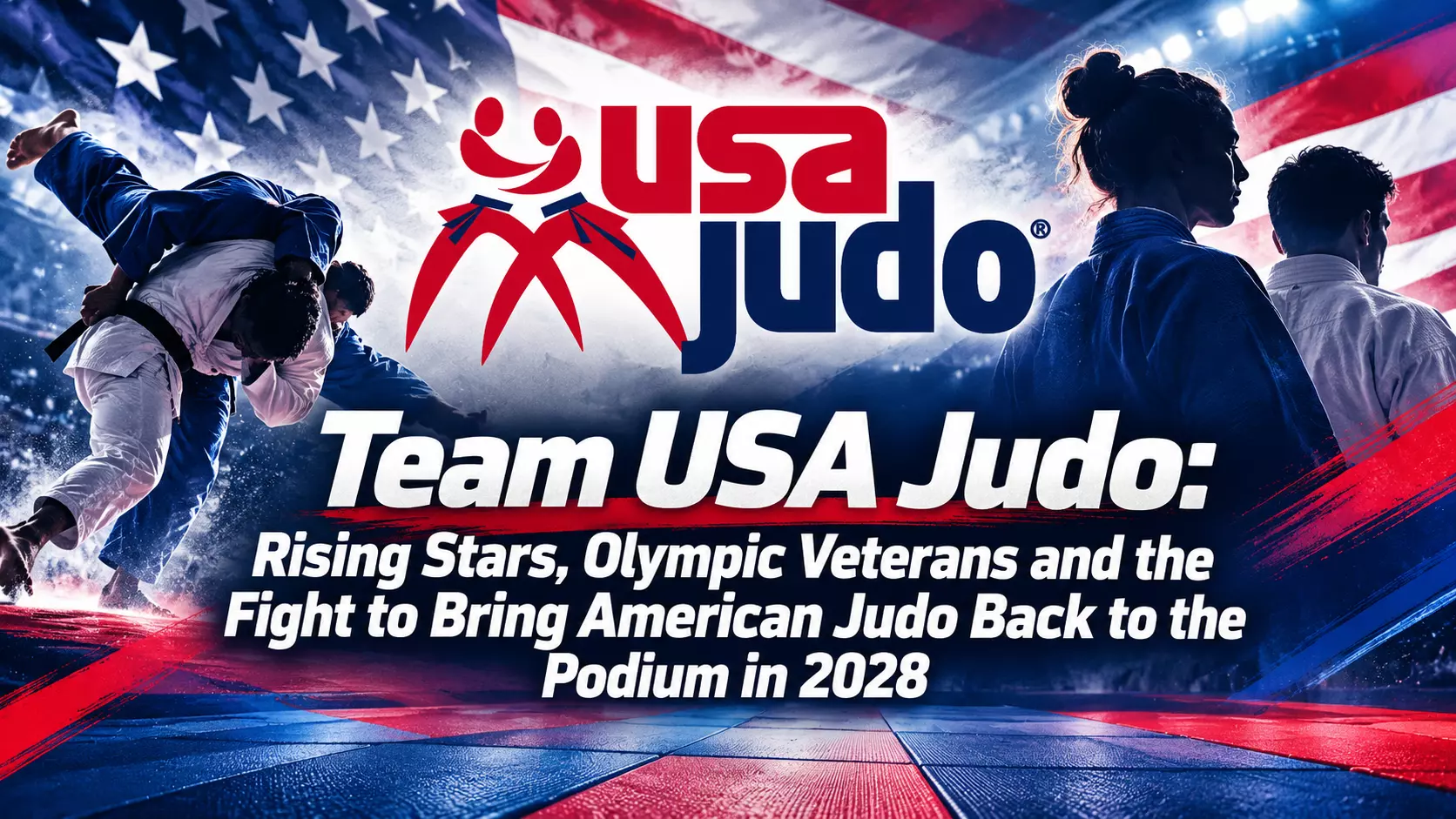
Team USA Judo: Rising Stars, Olympic Veterans and the Fight to Bring American Judo Back to the Podium in 2028
With the 2028 Los Angeles Olympics approaching, Team USA Judo is building around international veterans, emerging young stars and a generation determined to make American judo a global force.
American judo is approaching one of the most important opportunities in its history. With the 2028 Summer Olympic Games coming to Los Angeles, Team USA has a chance to compete on home soil, increase national interest in the sport and potentially end a lengthy Olympic medal drought.
The United States has produced Olympic champions, world-class competitors and influential martial artists. However, competing consistently against international powers such as Japan, France, Georgia and Brazil remains a major challenge.
The current American program combines experienced Olympians with a promising group of younger athletes who have already demonstrated their ability to succeed internationally.
With less than two years remaining before Los Angeles 2028, the question is whether this developing talent can turn encouraging performances into Olympic medals.
Team USA’s 2026 World Championship Roster
The United States sent 18 competitors, including nine men and nine women, to the 2026 Senior World Judo Championships in Baku, Azerbaijan.
The roster represented a blend of international experience and developmental talent, with several competitors making their first appearances at the senior world level.
On the men’s side, Jonathan Yang and Christopher Velazco represented the 60-kilogram division, while Ari Berliner competed at 66 kilograms and Jack Yonezuka at 73 kilograms.
Johan Silot and Dominic Rodriguez competed at 81 kilograms, Alexander Knauf and John Jayne represented the 90-kilogram division, and Alex Semenenko competed in the heavyweight category above 100 kilograms.
The women’s roster featured Maria Celia Laborde at 48 kilograms; Toni Pepia and Monica Reyes at 52 kilograms; Mariah Holguin at 57 kilograms; Karlee Carrouth and Emily Jaspe at 63 kilograms; Melissa Myers and Isabella Garriga at 70 kilograms; and Lotanna Onua at 78 kilograms.
While the team did not produce a World Championship medal, several performances demonstrated that American judo continues to make progress.
Jack Yonezuka: America’s Leading Men’s Medal Hope
One of the biggest names in American judo is Jack Yonezuka, who competes in the men’s 73-kilogram division.
Yonezuka represented the United States at the 2024 Paris Olympics and has established himself as one of America’s most accomplished active international competitors.
During 2026, he earned silver medals at the Ulaanbaatar Grand Slam and Lima Grand Prix, demonstrating his ability to compete against elite international opposition.
Yonezuka also climbed to sixth in the world rankings, placing him among the strongest competitors in his weight division.
His combination of international experience, technical ability and competitive maturity makes him one of America’s leading prospects for an Olympic podium finish in 2028.
For Yonezuka, the challenge is maintaining that consistency against the world’s strongest competitors.
Maria Celia Laborde: Experience and International Success
On the women’s side, Maria Celia Laborde provides Team USA with one of its most experienced competitors.
A former Cuban international who became an American citizen in 2022, Laborde brings extensive experience from elite international competition.
Competing at 48 kilograms, she has represented the United States at the Olympics and achieved significant success on the international circuit.
Her 2026 performances included medals at the Tashkent Grand Slam and Lima Grand Prix, helping her reach seventh in the world rankings.
Laborde’s international background gives the American women’s program an important veteran presence.
As the Los Angeles Olympics approach, she remains a legitimate contender to represent the United States and challenge for a medal.
Jonathan Yang: The Future of American Judo?
Perhaps no young American judoka has generated more excitement than Jonathan Yang.
Competing in the men’s 60-kilogram division, Yang has already accomplished something few Americans have achieved.
In 2024, he became a Cadet World Champion, establishing himself as one of the sport’s leading young prospects.
He followed that achievement with a bronze medal at the 2025 Junior World Championships.
Yang continued his progress in October 2026, finishing seventh at the Senior World Championships.
His performance was historic for American men’s judo. He became the first American man since Jimmy Pedro in 1999 to advance to the quarterfinals of a Senior World Championship.
Yang’s success demonstrates that the United States is developing athletes capable of competing with the world’s best before reaching their athletic prime.
With the 2028 Olympics approaching, his continued development could become one of the most important stories in American judo.
Other Americans Making Their Mark
Team USA has additional competitors capable of making an international impact.
Johan Silot has developed into a significant talent in the 81-kilogram division, earning silver at the 2025 Lima Grand Prix and bronze at the same competition in 2026.
Christopher Velazco has also emerged as an exciting lightweight prospect, capturing his first Grand Prix bronze medal in Lima.
His presence creates valuable competition within the American 60-kilogram division, where Jonathan Yang is also making impressive progress.
Dominic Rodriguez brings championship experience from Pan American competition, while John Jayne offers Olympic experience in the 90-kilogram category.
On the women’s side, Mariah Holguin provides veteran leadership, while Emily Jaspe, Melissa Myers and other developing competitors represent important pieces of the program’s future.
The challenge for these athletes is converting competitive international performances into consistent results at World Championships and Olympic Games.
The Next Generation of American Judo
One of the most encouraging developments for USA Judo is the emergence of talented athletes at the cadet and junior levels.
Sebastian Teran added another historic accomplishment in 2026 by winning gold in the boys’ 55-kilogram division at the Cadet World Championships in Ecuador.
His victory made him the second American Cadet World Champion, following Jonathan Yang.
Other developing athletes include Jannaco Searcy, Daniel Lima, Mackenzie McPherson, David Vinner, Daniel Shulgin and Rhadi Ferguson Jr.
These competitors represent the foundation of American judo’s future.
Although not every young prospect will become an Olympian, developing internationally competitive athletes at younger ages is essential to building a stronger national program.
American Judo’s Olympic Legacy
The United States has a history of Olympic success in judo, although medals have been relatively rare.
American judoka have won 14 Olympic medals, including two gold, four silver and eight bronze.
Kayla Harrison remains the country’s only Olympic judo gold medalist, winning championships in London in 2012 and Rio de Janeiro in 2016.
Other influential American competitors include Jimmy Pedro, Ronda Rousey, Marti Malloy and Mike Swain.
Their achievements helped establish American judo internationally and demonstrated that U.S. athletes could compete with the world’s elite.
However, Team USA has not won an Olympic judo medal since 2016.
Ending that drought in Los Angeles would be a defining achievement for the current generation.
The Road to Los Angeles 2028
The next two years will be critical for Team USA.
Athletes must continue earning international ranking points, developing technical skills and demonstrating consistency against world-class opposition.
Judo is an exceptionally demanding Olympic sport, requiring explosive athleticism, advanced grappling techniques, conditioning, tactical awareness and mental toughness.
The United States has promising talent, but success will depend on preparation, international experience and the ability to perform under pressure.
Jack Yonezuka and Maria Laborde provide proven international experience, while Jonathan Yang, Johan Silot and Christopher Velazco represent potential breakthroughs.
The country’s improving youth development program also provides hope beyond 2028.
Conclusion: Can Team USA Deliver Olympic Glory?
Team USA Judo is not yet among the sport’s dominant international programs, but the foundation for future success is becoming increasingly visible.
The combination of experienced Olympians, internationally successful competitors and emerging young champions gives American judo legitimate reasons for optimism.
The United States has demonstrated that it can produce world-class individual athletes. The next challenge is developing a national team capable of consistently competing for medals at major championships.
For Yonezuka, Laborde, Yang and their teammates, Los Angeles 2028 represents an extraordinary opportunity.
Competing in front of American fans, they will have the chance to inspire a new generation of judoka and potentially produce one of the most memorable moments in American Olympic martial arts history.
The talent is emerging, the opportunity is approaching, and Team USA Judo now faces its greatest challenge: turning potential into Olympic glory.
New Users – Get $350 in Bonus Bets when you wager $5 for 7 days
T&Cs apply
4.6/5
Gambling Problem? Call 1-800-GAMBLER or 1-800-MY-RESET. Call 1-888-789-7777 or visit ccpgg.org/chat (CT). Hope is here. GamblingHelpLineMA.org or call (800) 327-5050 for 24/7 support (MA). Visit www.mdgamblinghelp.org (MD). Call 1-877-8HOPE-NY or text HOPENY (NY). 21+ (18+ DC, WY) and present in select states (for KS, in affiliation with Kansas Star Casino). Find online real money wagering only. Min $5 wager required for 7 consecutive days. $5 free play credit. Bonus issued as non-withdrawable bonus with cash withdrawable bonus with cash withdrawable. Bonus bets which expire 7 days after receipt. Restrictions apply. See terms at sportsbook.fanduel.com. Call 1-877-770-7867 (LA).
Up To $1500 in Bonus Bets Paid Back if your First Bet Does Not Win
T&Cs apply
4.5/5
Gambling problem? Call 1-800-GAMBLER or 1-800-MY-RESET (Available in the US) 877-8-HOPENY or text HOPENY (467369) (NY) 1-800-327-5050 (MA), 1-800-BETS-OFF (IA), 1-800-981-0023 (PR). 21+ only. Please Gamble Responsibly. See BetMGM.com for Terms. First Bet Offer for new customers only (if applicable). Subject to eligibility requirements. Bonus bets are non-withdrawable. In partnership with Kansas Crossing Casino and Hotel. Promotional offers not available in Mississippi, Massachusetts, New York, Ontario, or Puerto Rico.
New DraftKings Customers: Bet $5, Get $200 + 3 Months of NBA League Pass!
T&Cs apply
4.5/5
GAMBLING PROBLEM? CALL 1-800-GAMBLER or 1-800-MY-RESET, (800) 327-5050 or visit gamblinghelplinema.org (MA). Please Gamble Responsibly. 888-789-7777/visit ccpg.org (CT), or visit www.mdgamblinghelp.org (MD), 1-800-981-0023 (PR). 21+ and present in most states. (18+ DC/NH/PR/WY). Void in CAN. Eligibility restrictions apply. On behalf of Boot Hill Casino (KS). Pass-thru of per wager tax may apply in IL. 1 per new Sportsbook customer. $5+ first-time bet req. Max. $200 issued as non-withdrawable Bonus Bets. Stake removed from payout. Reward issued as $50 in Bonus Bets every 7 days via click-to-claim for 21 days. Bonus Bets and click-to-claims expire 7 days (168hrs) after issuance. Terms: dkng.co/offer. Get 1 promo code to redeem a 3-month NBA League Pass subscription, complimentary of DraftKings. Subscription auto-renews monthly at then-current price (currently $16.99/mo); cancel anytime. Terms, restrictions, and eligibility requirements apply. Redeem League Pass by 12/19/26 at 11:59 PM ET. Addt’l terms: support.watch.nba.com/hc/en-us/articles/9165532876183-League-Pass-Terms-of-Use_. Ends 11/29/26 at 11:59 PM ET. Sponsored by DK.
Must be 21+. GAMBLING PROBLEM? CALL 1-800-GAMBLER OR CALL 1-800-MY-RESET, www.mdgamblinghelp.org (MD), (800)-327-5050 or gamblinghelplinema.org (MA), Call (877)8-HOPENY or text HOPENY (467369) (NY), (888) 789-7777 or ccpg.org (CT), morethanagame.nc.gov (NC), 1800gambler.net (WV)
Bet $1 and get double the winnings up to $25 for your next 10 bets
T&Cs apply
4.4/5
21+ New users only. Must register using eligible promo code. First bet after registration must qualify. Max. Bonus Bet: $1,000. Bonus Bet expires 14 days after receipt. Void where prohibited. See Caesars.com/promos for full terms. Gambling Problem? 1-800-GAMBLER (1-800-426-2537)
21+ and present in OH. Gambling Problem? Call 1-800-GAMBLER.
This site is using
Cloudflare
and adheres to the
Google Safe Browsing Program. We adapted
Google's Privacy Guidelines
to keep your data safe at all times.
Close
Ready to Win Big? Join the Elite with Our Sports Betting Deals!
FanDuel Promo
New Users – Get $350 in Bonus Bets when you wager $5 for 7 days
Our Favorite
T&Cs and 21+ apply
Gambling Problem? Call 1-800-GAMBLER or 1-800-MY-RESET. Call 1-888-789-7777 or visit ccpgg.org/chat (CT). Hope is here. GamblingHelpLineMA.org or call (800) 327-5050 for 24/7 support (MA). Visit www.mdgamblinghelp.org (MD). Call 1-877-8HOPE-NY or text HOPENY (NY). 21+ (18+ DC, WY) and present in select states (for KS, in affiliation with Kansas Star Casino). Find online real money wagering only. Min $5 wager required for 7 consecutive days. $5 free play credit. Bonus issued as non-withdrawable bonus with cash withdrawable bonus with cash withdrawable. Bonus bets which expire 7 days after receipt. Restrictions apply. See terms at sportsbook.fanduel.com. Call 1-877-770-7867 (LA).
Code:
Open FanDuel
Get Bonus
BetMGM Promo
Up To $1500 in Bonus Bets Paid Back if your First Bet Does Not Win
Best Slots
T&Cs and 21+ apply
Gambling problem? Call 1-800-GAMBLER or 1-800-MY-RESET (Available in the US) 877-8-HOPENY or text HOPENY (467369) (NY) 1-800-327-5050 (MA), 1-800-BETS-OFF (IA), 1-800-981-0023 (PR). 21+ only. Please Gamble Responsibly. See BetMGM.com for Terms. First Bet Offer for new customers only (if applicable). Subject to eligibility requirements. Bonus bets are non-withdrawable. In partnership with Kansas Crossing Casino and Hotel. Promotional offers not available in Mississippi, Massachusetts, New York, Ontario, or Puerto Rico.
Code:
Open BetMGM
Get Bonus
DraftKings Promo
New DraftKings Customers: Bet $5, Get $200 + 3 Months of NBA League Pass!
Newcomer
T&Cs and 21+ apply
GAMBLING PROBLEM? CALL 1-800-GAMBLER or 1-800-MY-RESET, (800) 327-5050 or visit gamblinghelplinema.org (MA). Please Gamble Responsibly. 888-789-7777/visit ccpg.org (CT), or visit www.mdgamblinghelp.org (MD), 1-800-981-0023 (PR). 21+ and present in most states. (18+ DC/NH/PR/WY). Void in CAN. Eligibility restrictions apply. On behalf of Boot Hill Casino (KS). Pass-thru of per wager tax may apply in IL. 1 per new Sportsbook customer. $5+ first-time bet req. Max. $200 issued as non-withdrawable Bonus Bets. Stake removed from payout. Reward issued as $50 in Bonus Bets every 7 days via click-to-claim for 21 days. Bonus Bets and click-to-claims expire 7 days (168hrs) after issuance. Terms: dkng.co/offer. Get 1 promo code to redeem a 3-month NBA League Pass subscription, complimentary of DraftKings. Subscription auto-renews monthly at then-current price (currently $16.99/mo); cancel anytime. Terms, restrictions, and eligibility requirements apply. Redeem League Pass by 12/19/26 at 11:59 PM ET. Addt’l terms: support.watch.nba.com/hc/en-us/articles/9165532876183-League-Pass-Terms-of-Use_. Ends 11/29/26 at 11:59 PM ET. Sponsored by DK.
Code:
Open DraftKings
Get Bonus
Find out what the legends have to say about sports this week....
New Users – Get $350 in Bonus Bets when you wager $5 for 7 days
Gambling Problem? Call 1-800-GAMBLER or 1-800-MY-RESET. Call 1-888-789-7777 or visit ccpgg.org/chat (CT). Hope is here. GamblingHelpLineMA.org or call (800) 327-5050 for 24/7 support (MA). Visit www.mdgamblinghelp.org (MD). Call 1-877-8HOPE-NY or text HOPENY (NY). 21+ (18+ DC, WY) and present in select states (for KS, in affiliation with Kansas Star Casino). Find online real money wagering only. Min $5 wager required for 7 consecutive days. $5 free play credit. Bonus issued as non-withdrawable bonus with cash withdrawable bonus with cash withdrawable. Bonus bets which expire 7 days after receipt. Restrictions apply. See terms at sportsbook.fanduel.com. Call 1-877-770-7867 (LA).