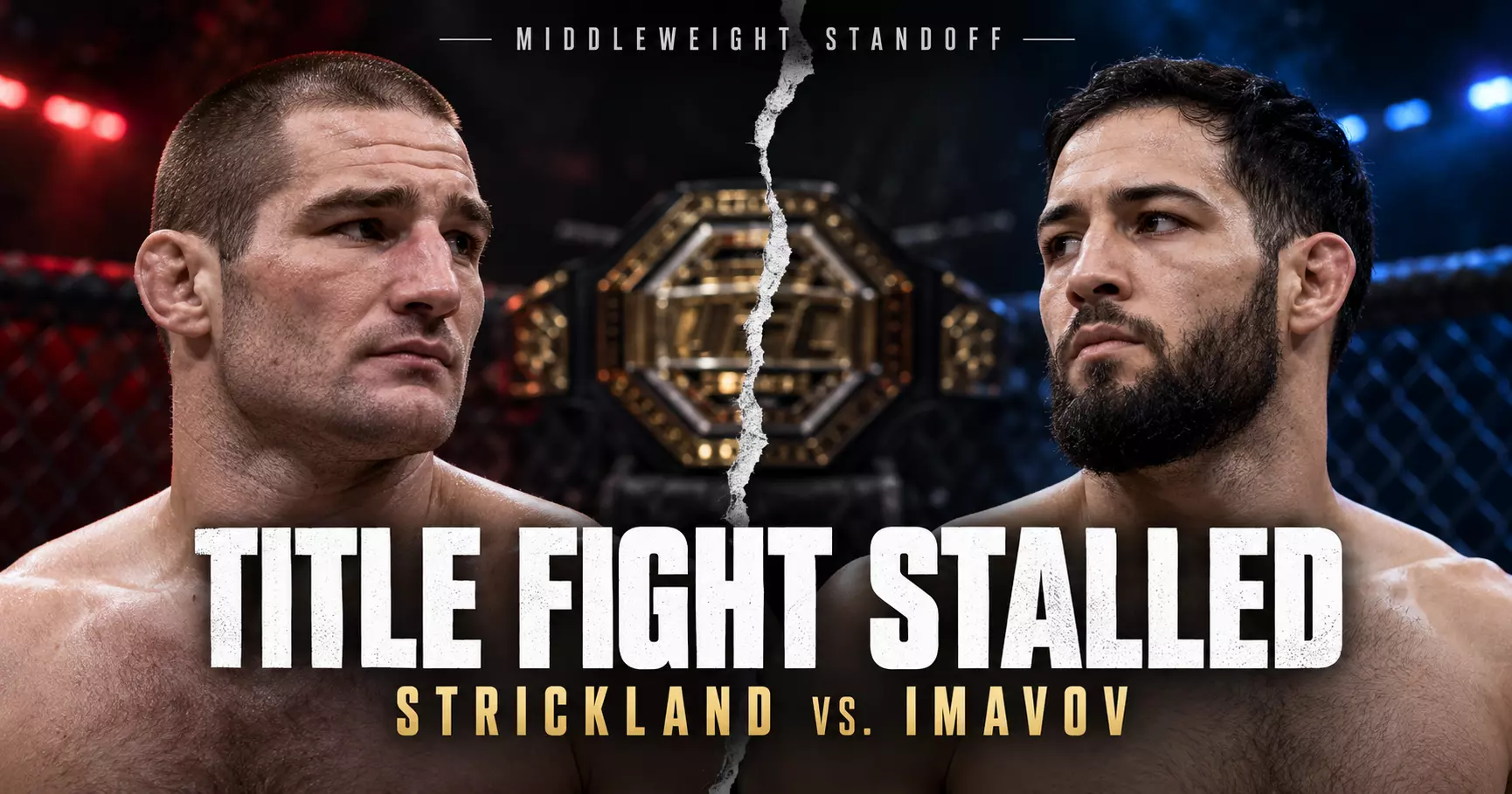
Nassourdine Imavov wants his championship opportunity. Sean Strickland wants financial terms he considers acceptable.
Nassourdine Imavov wants his championship opportunity. Sean Strickland wants financial terms he considers acceptable. The UFC has yet to publicly finalize their fight.
Now that disagreement has produced a confrontation outside the Octagon.
Footage circulated of Imavov approaching the middleweight champion at the UFC Performance Institute in Las Vegas, questioning why their potential title fight remained unsigned. Security intervened as the exchange became heated.
The scene gives a potential matchup another promotional hook. It also exposes a more consequential problem: the division’s championship schedule remains uncertain while the champion and promotion negotiate.
Imavov’s frustration is understandable. Strickland’s desire to negotiate his compensation is legitimate. Neither changes the fact that middleweight needs a clear path forward.
What We Know About the Contract Dispute
Strickland previously identified compensation as the remaining obstacle to a defense against Imavov.
“We’re discussing pay now,” he wrote in September, indicating that an agreement on that issue would allow the matchup to move forward. At that point, the UFC had not publicly confirmed the challenger.
His comments have since become more forceful. Strickland has publicly floated vacating the championship, moving to light heavyweight to complete his contract and eventually pursuing a fight with Jake Paul.
Those statements establish his dissatisfaction. They do not establish that he has relinquished the belt or secured another career route.
That distinction matters. A fighter discussing his options is different from a fighter making an irreversible decision.
The publicly available information also does not provide a complete picture of the negotiations. Without the full terms, it is difficult to determine precisely how far apart the sides are or which additional conditions might matter.
The responsible conclusion is narrower: Strickland has made pay a public issue, and the anticipated Imavov defense remains unresolved.
Imavov Has a Sporting Case That Deserves Attention
His recent résumé includes victories over Israel Adesanya and Caio Borralho, following wins against Roman Dolidze, Jared Cannonier and Brendan Allen. That five-fight winning streak explains why he has been positioned for a title opportunity.
He has done the competitive work required to make this a serious discussion.
That makes waiting particularly difficult. A contender approaching a championship fight must plan training, manage recovery and decide whether accepting another opponent would help or jeopardize the opportunity.
An indefinite promise provides little certainty.
Imavov’s mistake would be allowing the argument to become entirely about whether Strickland is willing to engage him in a hallway. His strongest case comes from the opponents he has beaten and the championship fight those results justify.
The confrontation attracts attention. His résumé should drive the matchmaking decision.
Walking Away From an Argument Does Not Prove Fear
The footage invites an easy interpretation: Imavov approached, Strickland did not want to participate in an escalating confrontation, and therefore the champion must be avoiding him.
That conclusion goes beyond the evidence.
A fighter’s behavior outside a sanctioned contest does not establish how he would perform inside one. It certainly does not settle a contract negotiation.
The two have already fought, with Strickland winning their January 2023 meeting.
That result does not guarantee a repeat. Fighters develop, circumstances change and a championship rematch presents its own demands. But it makes the claim that Strickland simply fears facing Imavov especially difficult to substantiate.
Fans can criticize the delay without pretending a brief confrontation reveals every motive behind it.
The relevant question is whether a reasonable agreement can be reached—not who appeared more aggressive outside the gym.
Promotion and Negotiation Can Exist at the Same Time
A genuine disagreement can also become useful promotion.
The confrontation gives broadcasters footage, fans an argument and both fighters another reason to discuss the matchup. If the fight is eventually signed, this exchange will likely become part of its buildup.
That does not prove it was staged.
Equally, the fact that the exchange looked heated does not reveal the private negotiating positions of Strickland, his representatives or the UFC.
Public statements often serve several purposes. They can express frustration, build support and apply pressure simultaneously.
My view is that the confrontation should be treated as evidence of public tension, while the contract remains a separate business question.
A compelling promotional package still needs a signed fight.
The Delay Reaches Beyond Imavov
Khamzat Chimaev has been seeking another meeting with Strickland after losing their championship fight by split decision in May. He recently made a public offer of $1 million to fight Strickland, even outside the UFC.
That offer is a public challenge, not a confirmed bout or proof of an available contractual arrangement.
It nevertheless illustrates the pressure surrounding the championship. Imavov wants his opportunity, Chimaev wants a rematch, and other contenders must decide how to advance while the next title defense remains unsettled.
The consequences are practical. Fighters can wait and risk inactivity, or compete and risk losing their place.
Saturday’s Brendan Allen–Christian Leroy Duncan main event offers another opportunity for a middleweight to strengthen his position.
The longer uncertainty persists at the top, the more complicated those competing claims become.
The UFC Needs to Help Resolve the Standoff
It would be too easy to assign every responsibility to either fighter.
Strickland should negotiate for himself. Imavov should advocate for an opportunity he has earned. The UFC must manage both the business relationship and the division’s competitive progression.
That means working toward an agreement and providing a credible next step if negotiations fail.
An interim championship should not automatically become the answer to a pay dispute. Nor should stripping the champion be treated as the obvious response to negotiations that have not produced a defense.
The immediate priority should be clarity: whether this matchup can happen, on what realistic timetable, and what the contenders should expect if it cannot.
The Championship Needs a Fight, Not Another Confrontation
Imavov succeeded in bringing more attention to the
stalled matchup. Strickland has succeeded in making his compensation concerns public.
Neither has yet produced the result the division needs.
The challenger has a substantial sporting claim. The champion has the right to seek terms he considers fair. The promotion has a responsibility to keep its championship meaningful and its contenders moving.
Strickland–Imavov deserves to be decided in the Octagon. Until the contracts are settled, every confrontation generates more publicity for a fight fans still cannot put on their calendars.
Up To $1500 in Bonus Bets Paid Back if your First Bet Does Not Win
T&Cs apply
4.5/5
Gambling problem? Call 1-800-GAMBLER or 1-800-MY-RESET (Available in the US) 877-8-HOPENY or text HOPENY (467369) (NY) 1-800-327-5050 (MA), 1-800-BETS-OFF (IA), 1-800-981-0023 (PR). 21+ only. Please Gamble Responsibly. See BetMGM.com for Terms. First Bet Offer for new customers only (if applicable). Subject to eligibility requirements. Bonus bets are non-withdrawable. In partnership with Kansas Crossing Casino and Hotel. Promotional offers not available in Mississippi, Massachusetts, New York, Ontario, or Puerto Rico.
New DraftKings Customers: Spend $5+ Get $150 in Bonuses
T&Cs apply
4.5/5
GAMBLING PROBLEM? CALL 1-800-GAMBLER or 1-800-MY-RESET, (800) 327-5050 or visit gamblinghelplinema.org (MA). Please Gamble Responsibly. 888-789-7777/visit ccpg.org (CT), or visit www.mdgamblinghelp.org (MD), 1-800-981-0023 (PR). 21+ and present in most states. (18+ DC/NH/PR/WY). Void in CAN. Eligibility restrictions apply. On behalf of Boot Hill Casino (KS). Pass-thru of per wager tax may apply in IL. 1 per new DraftKings customer. $5+ first-time bet req. Max. $150 issued as non-withdrawable Bonus Bets. Stake removed from payout. Reward issued as $50 in Bonus Bets every 7 days via click-to-claim for 14 days. Bonus Bets and click-to-claims expire 7 days (168hrs) after issuance. Terms: sportsbook.draftkings.com/promos. Ends 10/11/26 at 11:59 PM ET. Sponsored by DK.
Must be 21+. GAMBLING PROBLEM? CALL 1-800-GAMBLER OR CALL 1-800-MY-RESET, www.mdgamblinghelp.org (MD), (800)-327-5050 or gamblinghelplinema.org (MA), Call (877)8-HOPENY or text HOPENY (467369) (NY), (888) 789-7777 or ccpg.org (CT), morethanagame.nc.gov (NC), 1800gambler.net (WV)
Bet $1 and get double the winnings up to $25 for your next 10 bets
T&Cs apply
4.4/5
21+ New users only. Must register using eligible promo code. First bet after registration must qualify. Max. Bonus Bet: $1,000. Bonus Bet expires 14 days after receipt. Void where prohibited. See Caesars.com/promos for full terms. Gambling Problem? 1-800-GAMBLER (1-800-426-2537)
21+ and present in OH. Gambling Problem? Call 1-800-GAMBLER.
This site is using
Cloudflare
and adheres to the
Google Safe Browsing Program. We adapted
Google's Privacy Guidelines
to keep your data safe at all times.
Close
Ready to Win Big? Join the Elite with Our Sports Betting Deals!
FanDuel Promo
New Users – Get $250 in Bonus Bets when you wager $5 for 5 days
Up To $1500 in Bonus Bets Paid Back if your First Bet Does Not Win
Best Slots
T&Cs and 21+ apply
Gambling problem? Call 1-800-GAMBLER or 1-800-MY-RESET (Available in the US) 877-8-HOPENY or text HOPENY (467369) (NY) 1-800-327-5050 (MA), 1-800-BETS-OFF (IA), 1-800-981-0023 (PR). 21+ only. Please Gamble Responsibly. See BetMGM.com for Terms. First Bet Offer for new customers only (if applicable). Subject to eligibility requirements. Bonus bets are non-withdrawable. In partnership with Kansas Crossing Casino and Hotel. Promotional offers not available in Mississippi, Massachusetts, New York, Ontario, or Puerto Rico.
Code:
Open BetMGM
Get Bonus
DraftKings Promo
New DraftKings Customers: Spend $5+ Get $150 in Bonuses
Newcomer
T&Cs and 21+ apply
GAMBLING PROBLEM? CALL 1-800-GAMBLER or 1-800-MY-RESET, (800) 327-5050 or visit gamblinghelplinema.org (MA). Please Gamble Responsibly. 888-789-7777/visit ccpg.org (CT), or visit www.mdgamblinghelp.org (MD), 1-800-981-0023 (PR). 21+ and present in most states. (18+ DC/NH/PR/WY). Void in CAN. Eligibility restrictions apply. On behalf of Boot Hill Casino (KS). Pass-thru of per wager tax may apply in IL. 1 per new DraftKings customer. $5+ first-time bet req. Max. $150 issued as non-withdrawable Bonus Bets. Stake removed from payout. Reward issued as $50 in Bonus Bets every 7 days via click-to-claim for 14 days. Bonus Bets and click-to-claims expire 7 days (168hrs) after issuance. Terms: sportsbook.draftkings.com/promos. Ends 10/11/26 at 11:59 PM ET. Sponsored by DK.
Code:
Open DraftKings
Get Bonus
Find out what the legends have to say about sports this week....