Location:
Bojangles Coliseum, Charlotte, North Carolina
TV/Streaming:
ESPN in the United States; early card available through the ESPN App
The 7:00 PM start time represents the beginning of the preliminary card. Bryan Battle and Dalton Rosta will headline the main card, which begins at 10:00 PM ET.
Battle vs. Rosta Betting Odds
Bryan Battle:
-163 to -165
Dalton Rosta:
+120 to +130
Bryan Battle enters fight week as the betting favorite, with his moneyline generally available around -165. Dalton Rosta is the underdog, with prices ranging from approximately +120 to +130 as of August 5.
The line reflects Battle’s height, finishing versatility, hometown advantage and the questions surrounding Rosta after consecutive knockout losses. However, the relatively competitive price acknowledges Rosta’s physical strength, wrestling ability and experience against high-level PFL and Bellator competition.
All betting lines and prop markets remain subject to change before the opening bell.
Battle vs. Rosta Prediction & Fight Preview
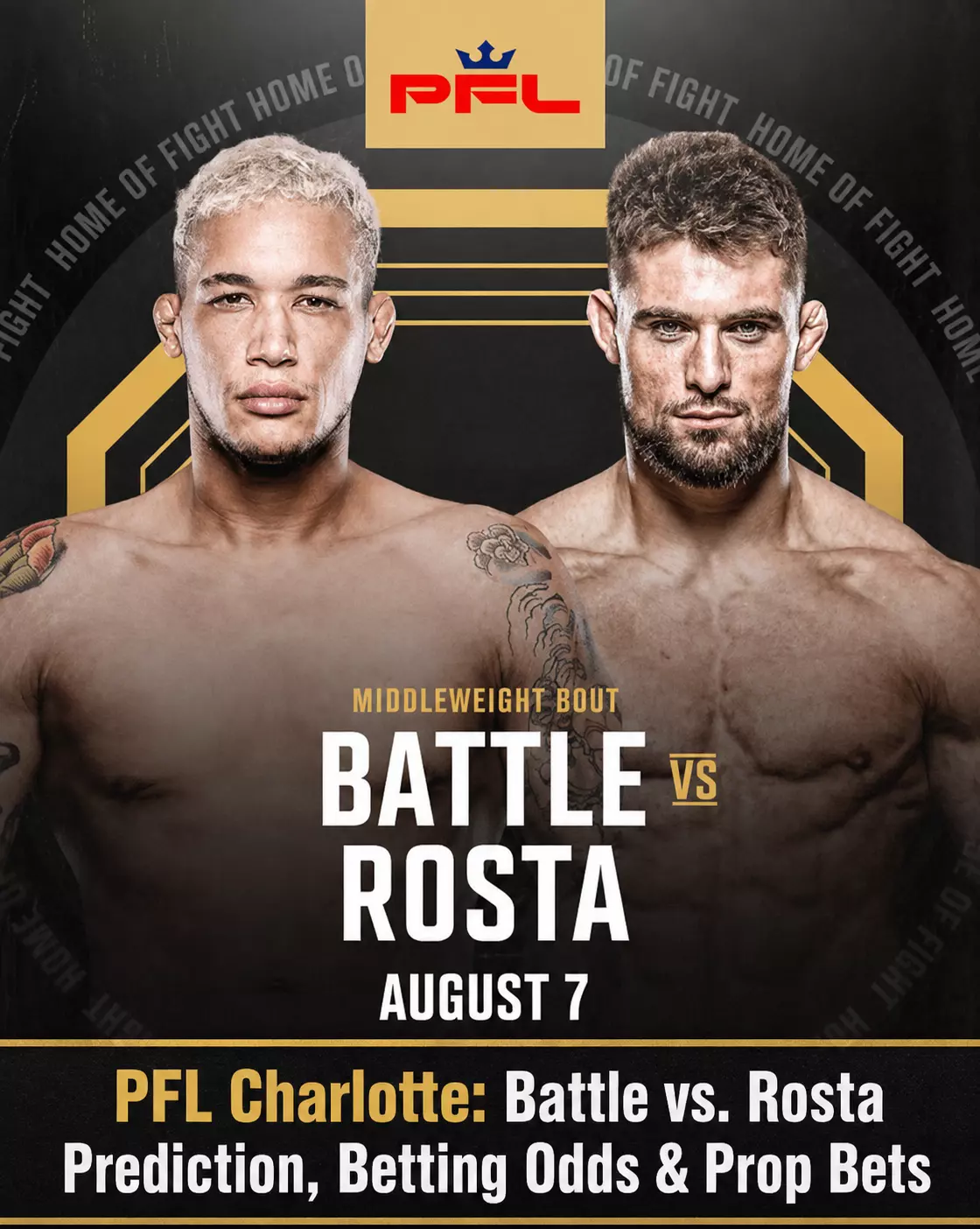
Two middleweights searching for redemption collide when Charlotte-based contender Bryan “The Butcher” Battle faces Dalton “Hercules” Rosta in the main event of PFL Charlotte at Bojangles Coliseum.
The PFL officially announced the matchup as a meeting between its No. 8-ranked Battle and No. 4-ranked Rosta. Battle enters with a 12-3 professional record and one no-contest, while Rosta carries an 11-3 record. Both men are attempting to rebound from difficult losses suffered on the same March card in Pittsburgh.
Battle made his promotional debut against former Bellator middleweight champion Johnny Eblen. The former champion repeatedly took Battle to the ground, controlled the positional exchanges and eventually forced him to submit to a face crank late in the first round.
The loss ended Battle’s strong run of success following his departure from the UFC, but it also exposed the most important question surrounding him entering this matchup: Can he consistently defend takedowns and escape underneath a physically powerful middleweight?
Battle has acknowledged that his preparation for the Eblen fight was affected by significant changes in his personal and professional life. He has since described the defeat as a necessary lesson and says he entered this training camp with a greater level of commitment and focus.
Before joining the PFL, Battle won Season 29 of “The Ultimate Fighter” and compiled a 7-1 record during his official UFC career. His notable victories included finishes over Gilbert Urbina, Takashi Sato, Gabriel Green, A.J. Fletcher and Kevin Jousset, along with a split decision over Randy Brown.
Battle’s overall record demonstrates his versatility.
Four of his professional victories have come by knockout or technical knockout, five have come by submission and three have reached the judges. Battle has never officially lost by knockout or technical knockout, with his three defeats coming through two submissions and one decision.
At 6-foot-2, Battle will have a two-inch height advantage over the 6-foot Rosta. He uses his length effectively by attacking with straight punches, kicks, knees and long combinations. He is most dangerous when he establishes forward pressure and forces opponents to defend multiple attacks while moving backward.
Battle is not a traditional outside striker who wants to win a slow technical contest from long range.
He applies pressure, creates physical exchanges and increases his offensive output as opponents begin to tire. His combination of length and aggression allows him to land from positions where shorter fighters may struggle to respond.
Battle is also dangerous during transitions.
Opponents who become careless while attempting takedowns can leave their necks exposed. Five submission victories show that Battle is capable of converting scrambles into fight-ending opportunities.
Rosta presents a significantly different challenge from Battle’s previous opponents.
The American Top Team representative is a compact, physically powerful middleweight who can combine pressure striking with takedowns, clinch control and positional wrestling. He does not need to remain at kicking distance and exchange with Battle for extended periods.
Rosta’s clearest path requires him to close the distance, force Battle toward the SmartCage and make the taller fighter defend repeated takedowns.
“Hercules” has recorded four knockout victories, one submission and six decisions during his professional career. His ability to maintain pressure across three-round contests has helped him earn victories over Aaron Jeffery, Sadibou Sy and Norbert Novenyi Jr.
Rosta advanced to the 2025 PFL Middleweight World Tournament final by submitting Sy and winning a split decision over Jeffery. He appeared positioned to become one of the promotion’s leading middleweights before suffering a third-round head-kick knockout against Fabian Edwards in the championship fight.
His comeback attempt produced another concerning result.
Rosta faced former PFL light heavyweight champion Impa Kasanganay at PFL Pittsburgh in March. Kasanganay found openings during an aggressive exchange and stopped Rosta with punches at 3:18 of the first round.
Rosta has therefore lost consecutive fights by knockout after avoiding that result throughout the first 12 appearances of his professional career. Two of his three career defeats have now come by knockout or technical knockout.
That history creates the central question of the matchup.
Can Rosta apply his physical pressure without leaving defensive openings for Battle’s straight punches, knees and kicks?
Rosta cannot afford to remain directly in front of Battle while entering with single punches. Battle’s length will allow him to land first, particularly if Rosta reaches for takedowns without setting them up.
The underdog must use feints, level changes and combinations to enter safely. Once he reaches the clinch, Rosta should connect his hands, force Battle against the SmartCage and prevent the hometown favorite from separating.
Battle must avoid repeating the mistakes that resulted in his loss to Eblen.
He cannot stand upright against the fence, accept bottom position or depend on his submission game to rescue him after conceding takedowns. Rosta may not possess Eblen’s complete grappling arsenal, but he is strong enough to control extended portions of the fight if Battle allows him to establish favorable positions.
Battle’s advantage should become more pronounced whenever the fight returns to open space.
He is taller, more varied offensively and capable of attacking at multiple levels. Battle can use front kicks and straight punches to maintain distance before punishing Rosta’s entries with knees and uppercuts.
Rosta’s confidence remains unchanged despite his recent results. He has predicted a finish in Charlotte and continues to believe he belongs among the best middleweights in the promotion.
Battle has made a similarly aggressive prediction, describing a knockout victory as inevitable and emphasizing that losing in front of his Charlotte supporters is not an acceptable outcome.
The emotional intensity surrounding the fight should produce an aggressive opening round.
Rosta will likely attempt to silence the crowd by pressuring immediately. Battle must remain composed rather than searching for an immediate highlight-reel finish.
If Battle survives the early wrestling exchanges and consistently returns to the center, his length, variety and durability should gradually take control.
Top 4 Prop Bets
Major sportsbooks had not widely published complete method-of-victory and round markets at the time of writing. The following are betting angles to consider once official prices become available.
Prop Bet #1: Bryan Battle by KO/TKO
DraftKings
4.5/5
Tip: Battle by KO/TKO
Height Advantage
Rosta’s Recent Knockouts
Hometown Pressure
New DraftKings Customers: Bet $5, Get $200 + 3 Months of NBA League Pass!
Get bonus now
GAMBLING PROBLEM? CALL 1-800-GAMBLER or 1-800-MY-RESET, (800) 327-5050 or visit gamblinghelplinema.org (MA). Please Gamble Responsibly. 888-789-7777/visit ccpg.org (CT), or visit www.mdgamblinghelp.org (MD), 1-800-981-0023 (PR). 21+ and present in most states. (18+ DC/NH/PR/WY). Void in CAN. Eligibility restrictions apply. On behalf of Boot Hill Casino (KS). Pass-thru of per wager tax may apply in IL. 1 per new Sportsbook customer. $5+ first-time bet req. Max. $200 issued as non-withdrawable Bonus Bets. Stake removed from payout. Reward issued as $50 in Bonus Bets every 7 days via click-to-claim for 21 days. Bonus Bets and click-to-claims expire 7 days (168hrs) after issuance. Terms: dkng.co/offer. Get 1 promo code to redeem a 3-month NBA League Pass subscription, complimentary of DraftKings. Subscription auto-renews monthly at then-current price (currently $16.99/mo); cancel anytime. Terms, restrictions, and eligibility requirements apply. Redeem League Pass by 12/19/26 at 11:59 PM ET. Addt’l terms: support.watch.nba.com/hc/en-us/articles/9165532876183-League-Pass-Terms-of-Use_. Ends 11/29/26 at 11:59 PM ET. Sponsored by DK.
Battle’s length and offensive variety make a knockout or technical knockout the most appealing method-of-victory selection.
Rosta has been stopped by strikes in consecutive appearances. Edwards landed a head kick during the third round of their tournament final, while Kasanganay finished him with punches during a first-round exchange.
Battle can attack many of the same defensive openings.
The hometown favorite uses straight punches, kicks and knees effectively against opponents attempting to close the distance. Rosta may be forced to take additional risks if he struggles to complete takedowns or maintain clinch control.
Battle does not need to produce a one-punch knockout. His pressure and volume could gradually wear Rosta down before forcing a referee stoppage during the middle rounds.
Prop Bet #2: Fight Does Not Go the Distance
FanDuel
4.6/5
Tip: Fight Does Not Go the Distance
Combined Finishing Ability
Defensive Questions
Aggressive Styles
New Users – Get $350 in Bonus Bets when you wager $5 for 7 days
Get bonus now
Gambling Problem? Call 1-800-GAMBLER or 1-800-MY-RESET. Call 1-888-789-7777 or visit ccpgg.org/chat (CT). Hope is here. GamblingHelpLineMA.org or call (800) 327-5050 for 24/7 support (MA). Visit www.mdgamblinghelp.org (MD). Call 1-877-8HOPE-NY or text HOPENY (NY). 21+ (18+ DC, WY) and present in select states (for KS, in affiliation with Kansas Star Casino). Find online real money wagering only. Min $5 wager required for 7 consecutive days. $5 free play credit. Bonus issued as non-withdrawable bonus with cash withdrawable bonus with cash withdrawable. Bonus bets which expire 7 days after receipt. Restrictions apply. See terms at sportsbook.fanduel.com. Call 1-877-770-7867 (LA).
Both fighters have multiple paths to a finish.
Nine of Battle’s 12 professional victories have come by knockout or submission. Rosta has recorded five finishes, including four knockouts and a submission victory over former tournament champion Sadibou Sy.
Battle’s loss to Eblen demonstrated that he can be vulnerable underneath a strong wrestler. Rosta may have opportunities to attack from dominant positions if he completes takedowns early.
Rosta’s recent knockout defeats create danger in the opposite direction. Battle can finish with punches, kicks, knees or a submission if Rosta becomes desperate during a scramble.
The matchup contains too many defensive questions and too much offensive urgency to automatically expect a judges’ decision.
Prop Bet #3: Fight Over 1.5 Rounds
Caesars
4.4/5
Tip: Over 1.5 Rounds
Measured Opening
Wrestling Exchanges
Durable Favorite
Bet $1 and get double the winnings up to $25 for your next 10 bets
–
21+ New users only. Must register using eligible promo code. First bet after registration must qualify. Max. Bonus Bet: $1,000. Bonus Bet expires 14 days after receipt. Void where prohibited. See Caesars.com/promos for full terms. Gambling Problem? 1-800-GAMBLER (1-800-426-2537)
The fight can end inside the distance without necessarily producing an immediate stoppage.
Rosta should prioritize wrestling and clinch control during the opening round. Even unsuccessful takedown attempts can consume time and reduce the number of extended striking exchanges.
Battle has also never suffered a professional knockout loss. He has shown that he can absorb significant strikes and continue competing, making an immediate Rosta knockout less likely than a longer physical contest.
Battle should remain cautious after being submitted in the first round of his PFL debut. Instead of recklessly chasing a hometown knockout, he can establish his distance and make Rosta work before increasing his offensive pace.
A Battle finish during the second half of the contest would allow both the over 1.5 rounds and fight-does-not-go-the-distance wagers to succeed.
Prop Bet #4: Dalton Rosta by Decision
BetMGM
4.5/5
Tip: Rosta by Decision
Underdog Value
Wrestling Control
SmartCage Pressure
Up To $1500 in Bonus Bets Paid Back if your First Bet Does Not Win
Get bonus now
Gambling problem? Call 1-800-GAMBLER or 1-800-MY-RESET (Available in the US) 877-8-HOPENY or text HOPENY (467369) (NY) 1-800-327-5050 (MA), 1-800-BETS-OFF (IA), 1-800-981-0023 (PR). 21+ only. Please Gamble Responsibly. See BetMGM.com for Terms. First Bet Offer for new customers only (if applicable). Subject to eligibility requirements. Bonus bets are non-withdrawable. In partnership with Kansas Crossing Casino and Hotel. Promotional offers not available in Mississippi, Massachusetts, New York, Ontario, or Puerto Rico.
Rosta by decision represents the most logical long-shot alternative.
The underdog’s safest route does not involve exchanging at long range with the taller and more versatile Battle. Rosta must turn the matchup into a wrestling contest.
He can win rounds by pushing Battle toward the SmartCage, completing takedowns and controlling extended portions of the fight from top position or the clinch.
Eblen provided a successful blueprint by repeatedly grounding Battle and limiting his offensive opportunities. Rosta is not as accomplished as the former champion, but his physical strength should still allow him to test Battle’s defensive improvements.
Rosta has earned six of his 11 professional victories by decision. Bettors interested in the underdog should compare his decision price with his standard moneyline before placing a wager.
Keys to Victory
Bryan Battle
Control the center of the SmartCage.
Use his height and reach to establish the jab.
Attack Rosta’s body and lead leg from distance.
Avoid backing straight toward the fence.
Use knees and uppercuts when Rosta changes levels.
Separate immediately after defending takedowns.
Force Rosta to repeatedly reset his wrestling entries.
Remain patient during the opening round.
Increase his combinations once Rosta begins slowing down.
Avoid chasing submissions from underneath.
Dalton Rosta
Pressure Battle before he establishes his kicking range.
Use punches and feints to disguise takedown attempts.
Force Battle toward the SmartCage.
Connect multiple wrestling attacks instead of relying on one entry.
Maintain a protected head position during level changes.
Avoid extended exchanges at the end of Battle’s reach.
Attack the body to reduce Battle’s movement and conditioning.
Control position before pursuing submissions or heavy ground strikes.
Remain defensively responsible after breaking from the clinch.
Avoid allowing the hometown crowd to influence his pace.
The Matchup Context: Two Contenders Facing a Critical Moment
PFL Charlotte represents an important career crossroads for both middleweights.
Battle received an immediate opportunity against Eblen when he joined the promotion. A victory would have established the former UFC contender as a potential championship challenger, but the one-sided submission loss created questions about his ability to compete against the PFL’s elite wrestlers.
The promotion has nevertheless placed Battle in another main event, this time in the city where he trains and built much of his fighting career.
A victory would restore Battle’s momentum and establish him as a legitimate member of the middleweight title picture. A second consecutive defeat would leave him winless through his first two PFL appearances.
Rosta may be facing even greater pressure.
He entered the 2025 tournament final with an 11-1 record and appeared close to becoming the division’s next major star. Consecutive knockout losses have changed the direction of his career.
A victory over Battle would prove that Rosta remains one of the promotion’s leading middleweights. It would also demonstrate that his recent defensive problems can be corrected.
A third consecutive defeat, particularly another knockout, would create serious questions about his position in the division.
Both fighters have publicly predicted finishes.
Battle is fighting to deliver a memorable victory in front of his hometown supporters. Rosta is attempting to enter hostile territory and show that his championship ambitions remain realistic.
The pressure surrounding the matchup should create one of the most emotionally intense fights on the card.
Fighters to Watch
Bryan Battle:
The Charlotte-based middleweight combines size, pressure, submission ability and finishing power. His response to the one-sided loss against Johnny Eblen will reveal whether he can become a serious PFL championship contender.
Dalton Rosta:
The former tournament finalist possesses physical strength, wrestling ability and compact punching power. He must demonstrate improved defensive awareness after suffering consecutive knockout losses.
Dovlet Yagshimuradov:
The experienced light heavyweight enters his matchup with a 26-8-1 record and faces 12-2 contender Simeon Powell in one of the card’s most important non-main-event fights.
Simeon Powell:
The younger light heavyweight has an opportunity to earn a major victory against one of the most experienced fighters on the Charlotte card.
Josh Silveira:
The 2023 PFL middleweight tournament finalist faces Aaron Jeffery in another matchup with possible championship implications. Silveira enters at 15-5, while Jeffery carries a 16-6 record.
Aaron Jeffery:
The former Bellator title challenger owns a previous victory over Rosta and brings a physical, high-output style into his matchup with Silveira.
Denis Goltsov:
The veteran heavyweight brings a 36-9 record into his fight against undefeated 15-0 prospect Hasan Mezhiev. The matchup gives Mezhiev an immediate opportunity to prove that he belongs among the PFL’s leading heavyweights.
The Verdict
Prediction:
Bryan Battle by Third-Round TKO
Best Bet:
Bryan Battle Moneyline
Best Supporting Prop:
Fight Over 1.5 Rounds
Best Finish Prop:
Bryan Battle by KO/TKO
Long-Shot Bet:
Dalton Rosta by Decision
Rosta should have success during the early portion of the fight.
Battle struggled significantly against Eblen’s takedowns and positional pressure. Rosta is physically strong enough to create similar problems, particularly if he can force Battle backward and establish connected hands around the taller fighter’s hips.
Expect Rosta to pressure immediately, attempt to silence the Charlotte crowd and avoid giving Battle room to establish his kicking game.
He may complete early takedowns or control Battle against the SmartCage.
The difference should emerge once Battle begins maintaining distance.
Rosta has suffered consecutive knockout defeats, and both losses resulted from moments when his offensive aggression created defensive openings. Battle is capable of exploiting those openings with a more varied attack than either Edwards or Kasanganay.
Battle can land straight punches as Rosta moves forward, attack with knees during level changes and use front kicks to prevent the underdog from entering safely.
The hometown favorite also has greater finishing versatility.
If Rosta becomes hurt on the feet, Battle can pursue a striking stoppage. If Rosta attempts a desperate takedown, Battle can attack the neck during the resulting transition.
Rosta’s wrestling should prevent Battle from dominating immediately. His control and physical strength may be enough to win the opening round or make the second round competitive.
However, repeatedly closing the distance against a taller fighter requires significant energy.
As Rosta’s entries become slower and more predictable, Battle should begin landing cleaner combinations. The favorite’s jab, knees and straight right hand will gradually force Rosta into increasingly desperate exchanges.
Battle’s durability is another important advantage. He has never been stopped by strikes as a professional, while Rosta has suffered knockouts in each of his last two appearances.
Expect an aggressive and competitive beginning before Battle’s length, offensive variety and conditioning take over.
Rosta pushes Battle through difficult wrestling exchanges, but the hometown favorite survives the early pressure, establishes his striking rhythm and forces a third-round stoppage in front of the Charlotte crowd.
New Users – Get $350 in Bonus Bets when you wager $5 for 7 days
T&Cs apply
4.6/5
Gambling Problem? Call 1-800-GAMBLER or 1-800-MY-RESET. Call 1-888-789-7777 or visit ccpgg.org/chat (CT). Hope is here. GamblingHelpLineMA.org or call (800) 327-5050 for 24/7 support (MA). Visit www.mdgamblinghelp.org (MD). Call 1-877-8HOPE-NY or text HOPENY (NY). 21+ (18+ DC, WY) and present in select states (for KS, in affiliation with Kansas Star Casino). Find online real money wagering only. Min $5 wager required for 7 consecutive days. $5 free play credit. Bonus issued as non-withdrawable bonus with cash withdrawable bonus with cash withdrawable. Bonus bets which expire 7 days after receipt. Restrictions apply. See terms at sportsbook.fanduel.com. Call 1-877-770-7867 (LA).
Up To $1500 in Bonus Bets Paid Back if your First Bet Does Not Win
T&Cs apply
4.5/5
Gambling problem? Call 1-800-GAMBLER or 1-800-MY-RESET (Available in the US) 877-8-HOPENY or text HOPENY (467369) (NY) 1-800-327-5050 (MA), 1-800-BETS-OFF (IA), 1-800-981-0023 (PR). 21+ only. Please Gamble Responsibly. See BetMGM.com for Terms. First Bet Offer for new customers only (if applicable). Subject to eligibility requirements. Bonus bets are non-withdrawable. In partnership with Kansas Crossing Casino and Hotel. Promotional offers not available in Mississippi, Massachusetts, New York, Ontario, or Puerto Rico.
New DraftKings Customers: Bet $5, Get $200 + 3 Months of NBA League Pass!
T&Cs apply
4.5/5
GAMBLING PROBLEM? CALL 1-800-GAMBLER or 1-800-MY-RESET, (800) 327-5050 or visit gamblinghelplinema.org (MA). Please Gamble Responsibly. 888-789-7777/visit ccpg.org (CT), or visit www.mdgamblinghelp.org (MD), 1-800-981-0023 (PR). 21+ and present in most states. (18+ DC/NH/PR/WY). Void in CAN. Eligibility restrictions apply. On behalf of Boot Hill Casino (KS). Pass-thru of per wager tax may apply in IL. 1 per new Sportsbook customer. $5+ first-time bet req. Max. $200 issued as non-withdrawable Bonus Bets. Stake removed from payout. Reward issued as $50 in Bonus Bets every 7 days via click-to-claim for 21 days. Bonus Bets and click-to-claims expire 7 days (168hrs) after issuance. Terms: dkng.co/offer. Get 1 promo code to redeem a 3-month NBA League Pass subscription, complimentary of DraftKings. Subscription auto-renews monthly at then-current price (currently $16.99/mo); cancel anytime. Terms, restrictions, and eligibility requirements apply. Redeem League Pass by 12/19/26 at 11:59 PM ET. Addt’l terms: support.watch.nba.com/hc/en-us/articles/9165532876183-League-Pass-Terms-of-Use_. Ends 11/29/26 at 11:59 PM ET. Sponsored by DK.
Must be 21+. GAMBLING PROBLEM? CALL 1-800-GAMBLER OR CALL 1-800-MY-RESET, www.mdgamblinghelp.org (MD), (800)-327-5050 or gamblinghelplinema.org (MA), Call (877)8-HOPENY or text HOPENY (467369) (NY), (888) 789-7777 or ccpg.org (CT), morethanagame.nc.gov (NC), 1800gambler.net (WV)
Bet $1 and get double the winnings up to $25 for your next 10 bets
T&Cs apply
4.4/5
21+ New users only. Must register using eligible promo code. First bet after registration must qualify. Max. Bonus Bet: $1,000. Bonus Bet expires 14 days after receipt. Void where prohibited. See Caesars.com/promos for full terms. Gambling Problem? 1-800-GAMBLER (1-800-426-2537)
21+ and present in OH. Gambling Problem? Call 1-800-GAMBLER.
This site is using
Cloudflare
and adheres to the
Google Safe Browsing Program. We adapted
Google's Privacy Guidelines
to keep your data safe at all times.
Close
Ready to Win Big? Join the Elite with Our Sports Betting Deals!
FanDuel Promo
New Users – Get $350 in Bonus Bets when you wager $5 for 7 days
Our Favorite
T&Cs and 21+ apply
Gambling Problem? Call 1-800-GAMBLER or 1-800-MY-RESET. Call 1-888-789-7777 or visit ccpgg.org/chat (CT). Hope is here. GamblingHelpLineMA.org or call (800) 327-5050 for 24/7 support (MA). Visit www.mdgamblinghelp.org (MD). Call 1-877-8HOPE-NY or text HOPENY (NY). 21+ (18+ DC, WY) and present in select states (for KS, in affiliation with Kansas Star Casino). Find online real money wagering only. Min $5 wager required for 7 consecutive days. $5 free play credit. Bonus issued as non-withdrawable bonus with cash withdrawable bonus with cash withdrawable. Bonus bets which expire 7 days after receipt. Restrictions apply. See terms at sportsbook.fanduel.com. Call 1-877-770-7867 (LA).
Code:
Open FanDuel
Get Bonus
BetMGM Promo
Up To $1500 in Bonus Bets Paid Back if your First Bet Does Not Win
Best Slots
T&Cs and 21+ apply
Gambling problem? Call 1-800-GAMBLER or 1-800-MY-RESET (Available in the US) 877-8-HOPENY or text HOPENY (467369) (NY) 1-800-327-5050 (MA), 1-800-BETS-OFF (IA), 1-800-981-0023 (PR). 21+ only. Please Gamble Responsibly. See BetMGM.com for Terms. First Bet Offer for new customers only (if applicable). Subject to eligibility requirements. Bonus bets are non-withdrawable. In partnership with Kansas Crossing Casino and Hotel. Promotional offers not available in Mississippi, Massachusetts, New York, Ontario, or Puerto Rico.
Code:
Open BetMGM
Get Bonus
DraftKings Promo
New DraftKings Customers: Bet $5, Get $200 + 3 Months of NBA League Pass!
Newcomer
T&Cs and 21+ apply
GAMBLING PROBLEM? CALL 1-800-GAMBLER or 1-800-MY-RESET, (800) 327-5050 or visit gamblinghelplinema.org (MA). Please Gamble Responsibly. 888-789-7777/visit ccpg.org (CT), or visit www.mdgamblinghelp.org (MD), 1-800-981-0023 (PR). 21+ and present in most states. (18+ DC/NH/PR/WY). Void in CAN. Eligibility restrictions apply. On behalf of Boot Hill Casino (KS). Pass-thru of per wager tax may apply in IL. 1 per new Sportsbook customer. $5+ first-time bet req. Max. $200 issued as non-withdrawable Bonus Bets. Stake removed from payout. Reward issued as $50 in Bonus Bets every 7 days via click-to-claim for 21 days. Bonus Bets and click-to-claims expire 7 days (168hrs) after issuance. Terms: dkng.co/offer. Get 1 promo code to redeem a 3-month NBA League Pass subscription, complimentary of DraftKings. Subscription auto-renews monthly at then-current price (currently $16.99/mo); cancel anytime. Terms, restrictions, and eligibility requirements apply. Redeem League Pass by 12/19/26 at 11:59 PM ET. Addt’l terms: support.watch.nba.com/hc/en-us/articles/9165532876183-League-Pass-Terms-of-Use_. Ends 11/29/26 at 11:59 PM ET. Sponsored by DK.
Code:
Open DraftKings
Get Bonus
Find out what the legends have to say about sports this week....
New Users – Get $350 in Bonus Bets when you wager $5 for 7 days
Gambling Problem? Call 1-800-GAMBLER or 1-800-MY-RESET. Call 1-888-789-7777 or visit ccpgg.org/chat (CT). Hope is here. GamblingHelpLineMA.org or call (800) 327-5050 for 24/7 support (MA). Visit www.mdgamblinghelp.org (MD). Call 1-877-8HOPE-NY or text HOPENY (NY). 21+ (18+ DC, WY) and present in select states (for KS, in affiliation with Kansas Star Casino). Find online real money wagering only. Min $5 wager required for 7 consecutive days. $5 free play credit. Bonus issued as non-withdrawable bonus with cash withdrawable bonus with cash withdrawable. Bonus bets which expire 7 days after receipt. Restrictions apply. See terms at sportsbook.fanduel.com. Call 1-877-770-7867 (LA).