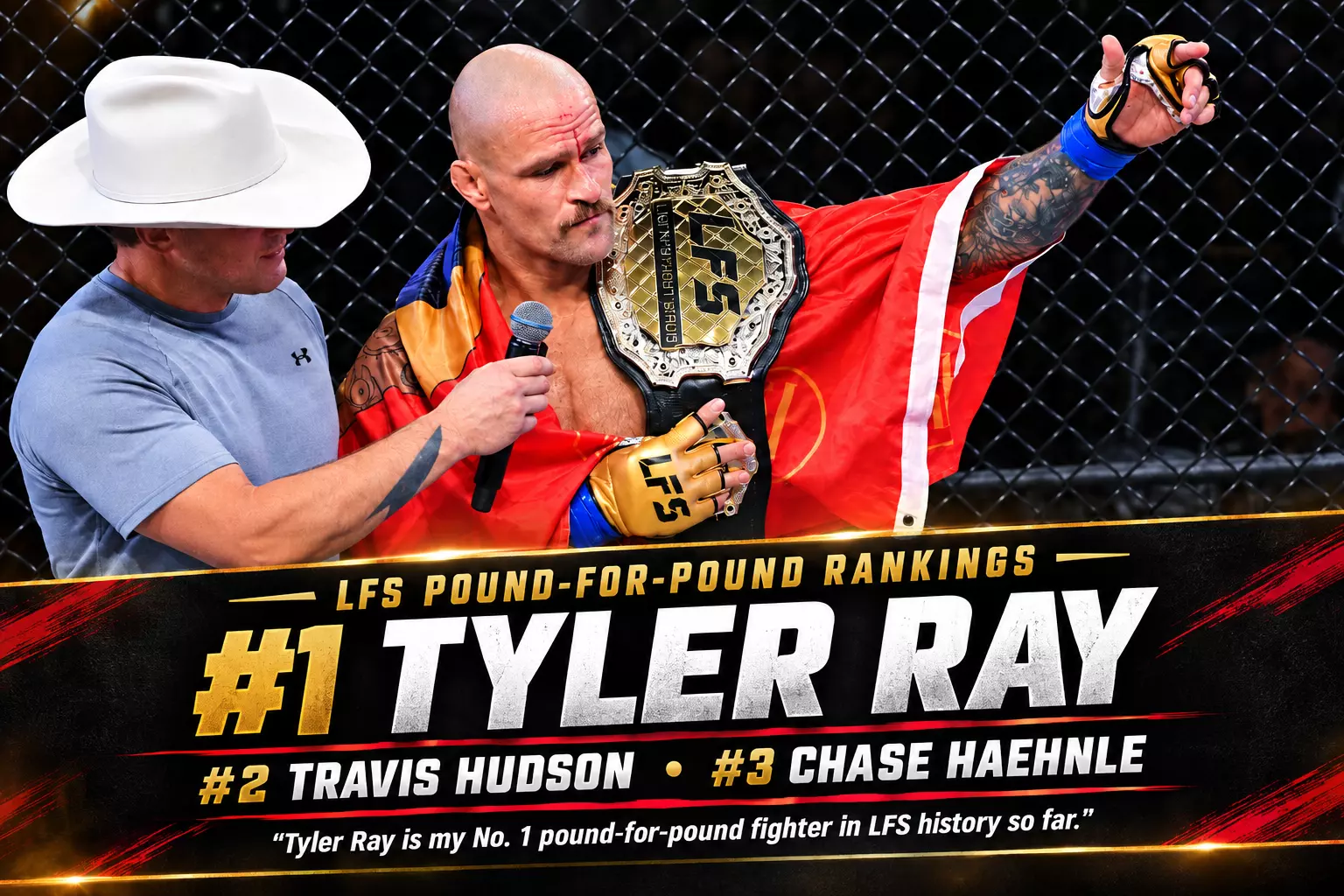
add this information Tyler Ray is my No. 1 pound-for-pound fighter in LFS history so far, followed by Travis Hudson and Chase Haehnle.
This is an
editorial ranking through October 29, 2026, covering completed fights under the
Legends Fight Series name, consistent with the roster above. It excludes the earlier Ohio Combat League era. I’m weighing LFS victories, opposition, championship accomplishments, and repeat success. Professionals and amateurs are included, with their competition level considered; the order is my judgment, not an official LFS ranking.
1. Tyler Ray — Professional middleweight
Who, what, when and where:
Ray captured the LFS professional middleweight championship by submitting Shaun Asher with an arm-triangle choke at
2:19 of Round 1, September 12, 2026, at
Night of Champions, MegaCorp Pavilion in Newport, Kentucky.
Why No. 1:Ray
has the strongest combination of championship significance, experienced opposition, and a decisive finish. Winning a professional title against Asher gives his performance more weight than a quick victory against an inexperienced opponent. His lead rests on the quality of that accomplishment, although additional defenses would strengthen his historical standing.
2. Travis Hudson — Professional lightweight/catchweight
Who, what, when and where:
Hudson submitted Darnell Truett with a guillotine in
37 seconds on June 5, then stopped Nick Walls at
4:35 of Round 2 on August 1. Both victories occurred at
ForeFront Field in Avon, Ohio, at Friday Night Fights and Midsummer Clash, respectively.
Why No. 2:
Two professional victories, both finishes, give Hudson one of the strongest sustained records within
LFS. Finishing one opponent by submission and another by strikes also provides evidence of multiple routes to victory. I place Ray above him because of the professional championship and opposition, but Hudson has a strong argument based on volume.
3. Chase Haehnle — Amateur lightweight
Who, what, when and where:
Haehnle defeated Joel Aldridge by
first-round TKO at 2:20 on September 12, winning the
amateur lightweight championship
at
MegaCorp Pavilion in Newport. The victory moved him to
4–0 overall as an amateur.
Why No. 3:
Haehnle defeated an established LFS champion who had already demonstrated finishing ability in the promotion. That makes his victory particularly meaningful within LFS’s own competitive history. He is my highest-ranked amateur because he combined championship success with a decisive win over a previously unbeaten opponent.
4. Joshua Neal — Amateur middleweight
Who, what, when and where:
Neal defeated Joseph Lewis by
rear-naked choke at 2:43 of Round 2 on September 12, in their amateur middleweight championship matchup at
Night of Champions in Newport. His recorded amateur record improved to
4–1.
Why No. 4:
Neal’s case rests on a championship-level victory over an experienced amateur opponent. Lewis’s record and experience make this more substantial than a win over a debutant. Haehnle narrowly gets the higher position because he dethroned an existing
LFS champion; Neal’s submission victory keeps him close.
5. Hunter Frazer — Professional welterweight
Who, what, when and where:
Frazer stopped William Davis by
first-round TKO at 1:11 on September 12, at
MegaCorp Pavilion in Newport. The completed event results list Frazer at
3–2
afterward and Davis at
4–3.
c
Why No. 5:
A fast professional victory over an opponent who entered with a winning record deserves substantial credit. Frazer’s placement reflects the quality and decisiveness of that result. He sits below the championship winners and Hudson’s two-win campaign because his verified LFS résumé contains only one appearance.
6. Elijah Woodruff — Professional lightweight
Who, what, when and where:
Woodruff—listed as
Elijah Woodroof
by Sherdog—stopped Corey Dulaney in
30 seconds on July 11, at
Middletown Mayhem, Land of Illusion Adventure Park in Middletown, Ohio. Sherdog records the finish as a TKO by knee.
Why No. 6:
His direct victory over Dulaney is the deciding factor in their ordering. It was an exceptionally quick professional finish, and Dulaney’s subsequent LFS victory adds context to the opponent Woodruff defeated. One performance limits how high I would place him, but that performance warrants a prominent position.
7. Corey Dulaney — Professional lightweight
Who, what, when and where:
Dulaney knocked out Jimmy Sandlin at
4:14 of Round 1 on October 24, in the main event of
Buckeye Fight Night at KEMBA Live! in Columbus, Ohio. This followed his July loss to Woodruff.
Why No. 7:
Stopping an experienced professional opponent gives Dulaney a credible top-10 achievement. His comeback also demonstrates that the earlier defeat did not prevent him from producing a major LFS result. However, the Woodruff loss must count: the October knockout earns him a place without erasing the head-to-head outcome.
8. Alexander Collett — Professional heavyweight
Who, what, when and where:
Collett defeated William Baxter by
TKO at 2:21 of Round 1 on August 1, at
Midsummer Clash, ForeFront Field in Avon. He improved to
2–0 professionally. Baxter had won at LFS’s June event.
Why No. 8:
Collett finished a fellow LFS winner in his first recorded appearance for the promotion. That provides a useful comparison within the heavyweight field. His size itself earns no pound-for-pound advantage; the professional victory and its decisiveness earn the position. A limited sample and Baxter’s losing overall record keep him outside the upper tier.
9. Joel Aldridge — Amateur lightweight
Who, what, when and where:
Aldridge stopped Brian Kern at
2:50 of Round 1 on July 11, at
Land of Illusion in Middletown, becoming LFS’s inaugural amateur lightweight champion. He subsequently lost the championship to Haehnle in September.
Why No. 9:
Aldridge’s championship victory remains a significant accomplishment despite the later defeat. He established the division’s first benchmark and earned his belt with a finish. I give that achievement enough weight for a top-10 place, while the unsuccessful defense prevents a higher ranking.
10. Marc Izzi — Amateur featherweight/catchweight
Who, what, when and where:
Izzi stopped Landen Fulton in the first round on
September 12 at MegaCorp Pavilion, then submitted Brandon Pietroytys with a rear-naked choke in the first round on
October 24 at KEMBA Live!
Why No. 10:
Two appearances and two first-round finishes give Izzi a stronger LFS body of work than many one-fight winners. Success through both strikes and submission strengthens his case. Championship stakes and more established opposition would be needed to move him substantially higher.
Three honorable mentions
Jeremiah Slagle — Professional welterweight
Won his professional debut by unanimous decision over Ethan Riley on
September 12 at MegaCorp Pavilion, Newport. A full three-round professional victory deserves credit alongside quick finishes. He narrowly misses because his LFS résumé currently consists of one non-title win.
Brody Rutledge — Amateur light heavyweight
Stopped Jacob Ross at
1:31 of Round 1 on October 24 at KEMBA Live!, Columbus, improving to
4–1 overall. An emphatic finish against an opponent with prior winning experience makes him a strong contender for the final places. Another significant LFS win could change his position quickly.
Daniel Beebe — Amateur welterweight
Submitted Diego Sterling with a guillotine in
36 seconds on October 24 at KEMBA Live!, Columbus, improving to
3–0 overall. His unbeaten record and rapid finish are compelling. Izzi gets the edge here because he has two verified LFS victories, while Beebe’s earlier wins occurred elsewhere.
New Users - Get $200 in Bonus Bets when you wager $5 for 4 days
T&Cs apply
4.6/5
Gambling Problem? Call 1-800-GAMBLER or 1-800-MY-RESET. Visit www.mdgamblinghelp.org (MD). 1-888-789-7777 or ccpg.org/chat (CT). Hope is here. GamblingHelpLineMA.org or (800) 327-5050 for 24/7 support (MA). 1-877-8-HOPENY or text HOPENY (467369) (NY). 21+ (18+ D.C., WY) and present in select states (for KS, in affiliation with Kansas Star Casino). First online real money wager only. Min $5 wager required for 4 consecutive days. $5 first deposit required. Bonus issued as nonwithdrawable bonus bets which expire 5 days after receipt. Restrictions apply. See terms at sportsbook.fanduel.com. Call 1-877-770-7867 (LA).
Get Up to $1,000 Back in Bonus Bets Over Your First 10 Days
T&Cs apply
4.5/5
Gambling problem? Call 1-800-GAMBLER or 1-800-MY-RESET (Available in the US) 877-8-HOPENY or text HOPENY (467369) (NY) 1-800-327-5050 (MA), 1-800-BETS-OFF (IA), 21+ only. Please Gamble Responsibly. Visit mdgamblinghelp.org (MD). See BetMGM.com for Terms. New Player Offer for new players only. Subject to eligibility requirements. Bonus bets are non-withdrawable. In partnership with Kansas Crossing Casino and Hotel. This promotional offer is not available in NJ, MA, MI, NV, NY, ON, PA, PR, and WV.
New DraftKings Customers: Bet $5, Get $200 + 3 Months of NBA League Pass
T&Cs apply
4.5/5
GAMBLING PROBLEM? CALL 1-800-GAMBLER or 1-800-MY-RESET, (800) 327-5050 or visit gamblinghelplinema.org (MA). Please Gamble Responsibly. 888-789-7777/visit ccpg.org (CT), or visit www.mdgamblinghelp.org (MD), 1-800-981-0023 (PR). 21+ and present in most states. (18+ DC/NH/PR/WY). Void in CAN. Eligibility restrictions apply. On behalf of Boot Hill Casino (KS). Pass-thru of per wager tax may apply in IL. 1 per new Sportsbook customer. $5+ first-time bet req. Max. $200 issued as non-withdrawable Bonus Bets. Stake removed from payout. Reward issued as $50 in Bonus Bets every 7 days via click-to-claim for 21 days. Bonus Bets and click-to-claims expire 7 days (168hrs) after issuance. Terms: dkng.co/offer. Get 1 promo code to redeem a 3-month NBA League Pass subscription, complimentary of DraftKings. Subscription auto-renews monthly at then-current price (currently $16.99/mo); cancel anytime. Terms, restrictions, and eligibility requirements apply. Redeem League Pass by 12/19/26 at 11:59 PM ET. Addt’l terms: support.watch.nba.com/hc/en-us/articles/9165532876183-League-Pass-Terms-of-Use_. Ends 11/29/26 at 11:59 PM ET. Sponsored by DK.
Must be 21+. GAMBLING PROBLEM? CALL 1-800-GAMBLER OR CALL 1-800-MY-RESET, www.mdgamblinghelp.org (MD), (800)-327-5050 or gamblinghelplinema.org (MA), Call (877)8-HOPENY or text HOPENY (467369) (NY), (888) 789-7777 or ccpg.org (CT), morethanagame.nc.gov (NC), 1800gambler.net (WV)
Bet $1 and get double the winnings up to $25 for your next 10 bets
T&Cs apply
4.4/5
21+ New users only. Must register using eligible promo code. First bet after registration must qualify. Max. Bonus Bet: $1,000. Bonus Bet expires 14 days after receipt. Void where prohibited. See Caesars.com/promos for full terms. Gambling Problem? 1-800-GAMBLER (1-800-426-2537)
21+ and present in OH. Gambling Problem? Call 1-800-GAMBLER.
This site is using
Cloudflare
and adheres to the
Google Safe Browsing Program. We adapted
Google's Privacy Guidelines
to keep your data safe at all times.
Close
Ready to Win Big? Join the Elite with Our Sports Betting Deals!
FanDuel Promo
New Users - Get $200 in Bonus Bets when you wager $5 for 4 days
Our Favorite
T&Cs and 21+ apply
Gambling Problem? Call 1-800-GAMBLER or 1-800-MY-RESET. Visit www.mdgamblinghelp.org (MD). 1-888-789-7777 or ccpg.org/chat (CT). Hope is here. GamblingHelpLineMA.org or (800) 327-5050 for 24/7 support (MA). 1-877-8-HOPENY or text HOPENY (467369) (NY). 21+ (18+ D.C., WY) and present in select states (for KS, in affiliation with Kansas Star Casino). First online real money wager only. Min $5 wager required for 4 consecutive days. $5 first deposit required. Bonus issued as nonwithdrawable bonus bets which expire 5 days after receipt. Restrictions apply. See terms at sportsbook.fanduel.com. Call 1-877-770-7867 (LA).
Code:
Open FanDuel
Get Bonus
BetMGM Promo
Get Up to $1,000 Back in Bonus Bets Over Your First 10 Days
Best Slots
T&Cs and 21+ apply
Gambling problem? Call 1-800-GAMBLER or 1-800-MY-RESET (Available in the US) 877-8-HOPENY or text HOPENY (467369) (NY) 1-800-327-5050 (MA), 1-800-BETS-OFF (IA), 21+ only. Please Gamble Responsibly. Visit mdgamblinghelp.org (MD). See BetMGM.com for Terms. New Player Offer for new players only. Subject to eligibility requirements. Bonus bets are non-withdrawable. In partnership with Kansas Crossing Casino and Hotel. This promotional offer is not available in NJ, MA, MI, NV, NY, ON, PA, PR, and WV.
Code:
Open BetMGM
Get Bonus
DraftKings Promo
New DraftKings Customers: Bet $5, Get $200 + 3 Months of NBA League Pass
Newcomer
T&Cs and 21+ apply
GAMBLING PROBLEM? CALL 1-800-GAMBLER or 1-800-MY-RESET, (800) 327-5050 or visit gamblinghelplinema.org (MA). Please Gamble Responsibly. 888-789-7777/visit ccpg.org (CT), or visit www.mdgamblinghelp.org (MD), 1-800-981-0023 (PR). 21+ and present in most states. (18+ DC/NH/PR/WY). Void in CAN. Eligibility restrictions apply. On behalf of Boot Hill Casino (KS). Pass-thru of per wager tax may apply in IL. 1 per new Sportsbook customer. $5+ first-time bet req. Max. $200 issued as non-withdrawable Bonus Bets. Stake removed from payout. Reward issued as $50 in Bonus Bets every 7 days via click-to-claim for 21 days. Bonus Bets and click-to-claims expire 7 days (168hrs) after issuance. Terms: dkng.co/offer. Get 1 promo code to redeem a 3-month NBA League Pass subscription, complimentary of DraftKings. Subscription auto-renews monthly at then-current price (currently $16.99/mo); cancel anytime. Terms, restrictions, and eligibility requirements apply. Redeem League Pass by 12/19/26 at 11:59 PM ET. Addt’l terms: support.watch.nba.com/hc/en-us/articles/9165532876183-League-Pass-Terms-of-Use_. Ends 11/29/26 at 11:59 PM ET. Sponsored by DK.
Code:
Open DraftKings
Get Bonus
Find out what the legends have to say about sports this week....
New Users - Get $200 in Bonus Bets when you wager $5 for 4 days
Gambling Problem? Call 1-800-GAMBLER or 1-800-MY-RESET. Visit www.mdgamblinghelp.org (MD). 1-888-789-7777 or ccpg.org/chat (CT). Hope is here. GamblingHelpLineMA.org or (800) 327-5050 for 24/7 support (MA). 1-877-8-HOPENY or text HOPENY (467369) (NY). 21+ (18+ D.C., WY) and present in select states (for KS, in affiliation with Kansas Star Casino). First online real money wager only. Min $5 wager required for 4 consecutive days. $5 first deposit required. Bonus issued as nonwithdrawable bonus bets which expire 5 days after receipt. Restrictions apply. See terms at sportsbook.fanduel.com. Call 1-877-770-7867 (LA).