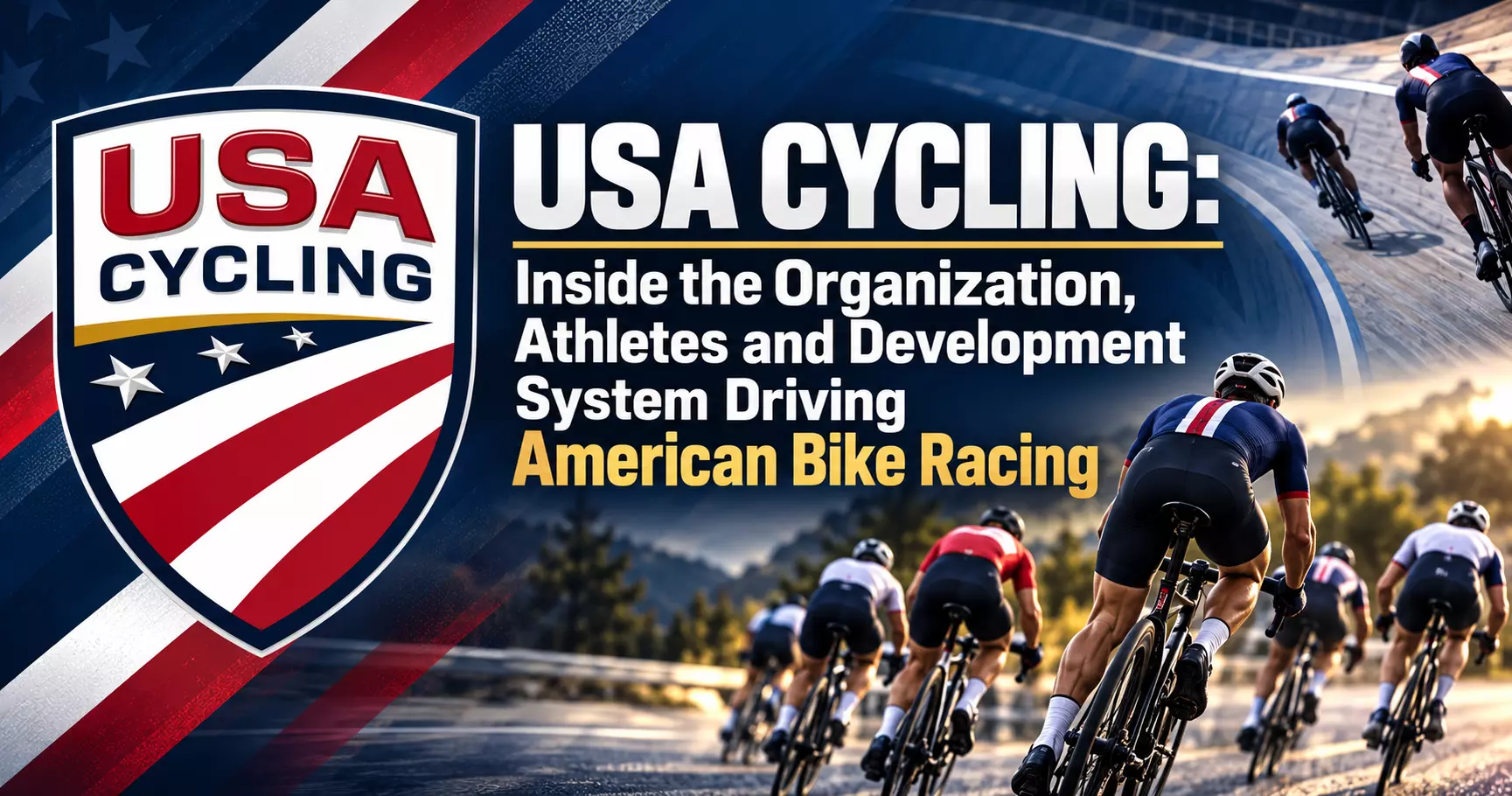
USA Cycling: Inside the Organization, Athletes and Development System Driving American Bike Racing
From a young rider’s first race to the pressure of an Olympic final, USA Cycling connects many levels of American bicycle racing. Its work spans local clubs, collegiate competition, national championships and the
athletes
selected to represent the United States internationally.
That range explains why USA Cycling is best understood as both a governing organization and a development system. The riders wearing American colors are its most visible representatives, but their performances depend on a larger community of coaches, officials, organizers, mechanics, families and supporters.
USA Cycling traces its roots to 1920. Today, the nonprofit serves as the national governing body for competitive cycling, recognized by the United States Olympic & Paralympic Committee and the Union Cycliste Internationale, or UCI. Its headquarters are in Colorado Springs, Colorado, and Brendan Quirk serves as president and CEO. Its mission combines growing domestic bike racing with pursuing Olympic and Paralympic success.
The organization’s responsibilities touch the practical details that make competition possible: licensing, rankings, clubs, collegiate programs and support for the people who run races. For newcomers, that structure offers a way to enter organized competition and progress alongside riders of similar experience.
There are signs of growth. In its April 2026 release discussing the 2025 Annual Impact Report, USA Cycling reported membership of approximately 70,000 and a 10% increase in national championship participation across 19 events. The organization also said its membership was trending younger. Those figures describe the reporting period, rather than a live membership count.
The national team itself is divided among disciplines. Road, track, mountain biking, BMX racing, BMX freestyle and para-cycling require different skills, equipment and preparation. A national-team designation also differs from selection for a particular championship: event rosters depend on eligibility, qualification, available places and selection criteria.
Road cycling offers one of the clearest examples of individual achievement built on teamwork. Mass-start races reward endurance and tactical judgment, while time trials test sustained speed against the clock. Riders who normally compete for different professional teams can come together under the American flag.
USA Cycling’s road directory features Kristen Faulkner, Chloé Dygert, Matteo Jorgenson, Sepp Kuss, Neilson Powless, Brandon McNulty, Magnus Sheffield, Quinn Simmons, Kevin Vermaerke, Matthew Riccitello and Ashlin Barry.
McNulty supplied a defining result at the 2026 Road World Championships in Montréal. According to USA Cycling’s race report, he won the elite men’s road title after attacking with 32 kilometers remaining. Simmons finished fourth and Jorgenson eighth, with both contributing to the strategy that helped McNulty stay clear.
That performance demonstrated the value of having several credible threats. An early attack can force opponents to spend energy, while teammates behind a leader can follow dangerous moves without helping the chase.
The road program also has talent spanning disciplines and generations. Faulkner is a two-time Olympic gold medalist in road and track. Barry won the 2026 under-23 men’s road world title and subsequently joined the American track World Championship squad.
Mountain biking adds technical terrain to the endurance challenge. Riders must judge lines, maintain traction and navigate descents while managing the energy required for repeated climbs. USA Cycling’s national-team directory features Haley Batten, Savilia Blunk, Christopher Blevins, Riley Amos and Vida Lopez de San Roman.
The 2026 mountain-bike World Championship announcement showed that the competitive pool extends beyond those directory names. Bjorn Riley entered after a breakthrough World Cup campaign that included his first elite victory. Blunk had collected four World Cup podiums, while Blevins returned from a broken collarbone to reach a podium in his second race weekend back. Under-23 rider Makena Kellerman also attracted attention with consecutive short-track World Cup wins.
Track cycling brings competition into the velodrome, where small differences in positioning and timing can decide races. Endurance events demand sustained power and tactical awareness; sprint events emphasize acceleration and precise execution. Team events add the challenge of coordinating riders moving at high speed.
The announced 2026 Track World Championship squad included Faulkner, Megan Jastrab and Emma Jimenez Palos among the women’s endurance riders. Barry, Grant Koontz, Anders Johnson, Graeme Frislie, Peter Moore and Brendan Rhim were among the men’s endurance selections. The women’s sprint group comprised Kayla Hankins, Emily Hayes, McKenna McKee and Hayley Yoslov.
BMX racing compresses the contest into a short, intense effort over jumps and banked turns. A strong start can establish favorable position, while a mistake can leave little time for recovery.
USA Cycling’s national-team directory lists Alise Willoughby, Payton Ridenour, Daleny Vaughn, Cameron Wood, Derin Merten and Alexis Alden. Its separate 2026 World Championship roster included elite men Kamren Larsen, Drew Polk and Wood, alongside elite women Ridenour and Vaughn. Alden and Merten represented the developing generation in younger categories.
BMX freestyle presents a different challenge. Riders perform judged routines, combining difficult tricks with control and effective use of the course. USA Cycling lists Hannah Roberts, Perris Benegas, Nick Bruce and Marcus Christopher in its national group. Coach Jamie Bestwick brings extensive competitive and coaching experience to preparations for major international events and Los Angeles 2028.
Para-cycling is another substantial part of the American program. Competition uses classifications and equipment suited to different
athletes, including bicycles, handcycles, tricycles and tandems. Results must be understood within the relevant class and event.
USA Cycling selected 28 athletes for the 2026 Para-Cycling Road World Championships in Huntsville, Alabama. The squad included Samantha Bosco, Kate Brim, Clara Brown, Jenna Rollman, Dennis Connors, Elouan Gardon, Shawn Morelli and Grace Norman. The selection announcement identified Bosco, Rollman and Connors as World Cup overall champions entering the event. A separate para-track group further expands the program.
Beyond these squads, USA Cycling supports competition in areas including cyclocross and gravel. Its collegiate program encompasses road, mountain bike, cyclocross, BMX, track and gravel, with both varsity and club teams participating through regional conferences and national championships.
Development remains essential to sustaining international results. Junior and under-23 programs help riders gain experience, while the USA Cycling Foundation’s Centers of Excellence program supports clubs committed to developing younger
athletes. Collegiate racing offers another route, allowing students to compete while pursuing their education.
The larger challenge is connecting all these opportunities. Equipment, travel, coaching and access to suitable places to train can shape whether a promising rider continues. A successful American program therefore needs both exceptional athletes and local organizations capable of helping people enter and remain in the
sport.
With the Los Angeles 2028 Olympic and Paralympic Games approaching, USA Cycling has a powerful opportunity to attract attention. The organization has made those Games a focus of its planning; converting that interest into lasting participation will matter alongside the pursuit of medals.
USA Cycling’s story ultimately belongs to the entire racing community. International champions demonstrate what is possible; clubs, colleges, families and race organizers help make the next generation possible. The organization’s long-term success will depend on keeping those parts of American cycling connected.
New Users - Get $200 in Bonus Bets when you wager $5 for 4 days
T&Cs apply
4.6/5
Gambling Problem? Call 1-800-GAMBLER or 1-800-MY-RESET. Visit www.mdgamblinghelp.org (MD). 1-888-789-7777 or ccpg.org/chat (CT). Hope is here. GamblingHelpLineMA.org or (800) 327-5050 for 24/7 support (MA). 1-877-8-HOPENY or text HOPENY (467369) (NY). 21+ (18+ D.C., WY) and present in select states (for KS, in affiliation with Kansas Star Casino). First online real money wager only. Min $5 wager required for 4 consecutive days. $5 first deposit required. Bonus issued as nonwithdrawable bonus bets which expire 5 days after receipt. Restrictions apply. See terms at sportsbook.fanduel.com. Call 1-877-770-7867 (LA).
Get Up to $1,000 Back in Bonus Bets Over Your First 10 Days
T&Cs apply
4.5/5
Gambling problem? Call 1-800-GAMBLER or 1-800-MY-RESET (Available in the US) 877-8-HOPENY or text HOPENY (467369) (NY) 1-800-327-5050 (MA), 1-800-BETS-OFF (IA), 21+ only. Please Gamble Responsibly. Visit mdgamblinghelp.org (MD). See BetMGM.com for Terms. New Player Offer for new players only. Subject to eligibility requirements. Bonus bets are non-withdrawable. In partnership with Kansas Crossing Casino and Hotel. This promotional offer is not available in NJ, MA, MI, NV, NY, ON, PA, PR, and WV.
New DraftKings Customers: Bet $5, Get $200 + 3 Months of NBA League Pass
T&Cs apply
4.5/5
GAMBLING PROBLEM? CALL 1-800-GAMBLER or 1-800-MY-RESET, (800) 327-5050 or visit gamblinghelplinema.org (MA). Please Gamble Responsibly. 888-789-7777/visit ccpg.org (CT), or visit www.mdgamblinghelp.org (MD), 1-800-981-0023 (PR). 21+ and present in most states. (18+ DC/NH/PR/WY). Void in CAN. Eligibility restrictions apply. On behalf of Boot Hill Casino (KS). Pass-thru of per wager tax may apply in IL. 1 per new Sportsbook customer. $5+ first-time bet req. Max. $200 issued as non-withdrawable Bonus Bets. Stake removed from payout. Reward issued as $50 in Bonus Bets every 7 days via click-to-claim for 21 days. Bonus Bets and click-to-claims expire 7 days (168hrs) after issuance. Terms: dkng.co/offer. Get 1 promo code to redeem a 3-month NBA League Pass subscription, complimentary of DraftKings. Subscription auto-renews monthly at then-current price (currently $16.99/mo); cancel anytime. Terms, restrictions, and eligibility requirements apply. Redeem League Pass by 12/19/26 at 11:59 PM ET. Addt’l terms: support.watch.nba.com/hc/en-us/articles/9165532876183-League-Pass-Terms-of-Use_. Ends 11/29/26 at 11:59 PM ET. Sponsored by DK.
Must be 21+. GAMBLING PROBLEM? CALL 1-800-GAMBLER OR CALL 1-800-MY-RESET, www.mdgamblinghelp.org (MD), (800)-327-5050 or gamblinghelplinema.org (MA), Call (877)8-HOPENY or text HOPENY (467369) (NY), (888) 789-7777 or ccpg.org (CT), morethanagame.nc.gov (NC), 1800gambler.net (WV)
Bet $1 and get double the winnings up to $25 for your next 10 bets
T&Cs apply
4.4/5
21+ New users only. Must register using eligible promo code. First bet after registration must qualify. Max. Bonus Bet: $1,000. Bonus Bet expires 14 days after receipt. Void where prohibited. See Caesars.com/promos for full terms. Gambling Problem? 1-800-GAMBLER (1-800-426-2537)
21+ and present in OH. Gambling Problem? Call 1-800-GAMBLER.
This site is using
Cloudflare
and adheres to the
Google Safe Browsing Program. We adapted
Google's Privacy Guidelines
to keep your data safe at all times.
Close
Ready to Win Big? Join the Elite with Our Sports Betting Deals!
FanDuel Promo
New Users - Get $200 in Bonus Bets when you wager $5 for 4 days
Our Favorite
T&Cs and 21+ apply
Gambling Problem? Call 1-800-GAMBLER or 1-800-MY-RESET. Visit www.mdgamblinghelp.org (MD). 1-888-789-7777 or ccpg.org/chat (CT). Hope is here. GamblingHelpLineMA.org or (800) 327-5050 for 24/7 support (MA). 1-877-8-HOPENY or text HOPENY (467369) (NY). 21+ (18+ D.C., WY) and present in select states (for KS, in affiliation with Kansas Star Casino). First online real money wager only. Min $5 wager required for 4 consecutive days. $5 first deposit required. Bonus issued as nonwithdrawable bonus bets which expire 5 days after receipt. Restrictions apply. See terms at sportsbook.fanduel.com. Call 1-877-770-7867 (LA).
Code:
Open FanDuel
Get Bonus
BetMGM Promo
Get Up to $1,000 Back in Bonus Bets Over Your First 10 Days
Best Slots
T&Cs and 21+ apply
Gambling problem? Call 1-800-GAMBLER or 1-800-MY-RESET (Available in the US) 877-8-HOPENY or text HOPENY (467369) (NY) 1-800-327-5050 (MA), 1-800-BETS-OFF (IA), 21+ only. Please Gamble Responsibly. Visit mdgamblinghelp.org (MD). See BetMGM.com for Terms. New Player Offer for new players only. Subject to eligibility requirements. Bonus bets are non-withdrawable. In partnership with Kansas Crossing Casino and Hotel. This promotional offer is not available in NJ, MA, MI, NV, NY, ON, PA, PR, and WV.
Code:
Open BetMGM
Get Bonus
DraftKings Promo
New DraftKings Customers: Bet $5, Get $200 + 3 Months of NBA League Pass
Newcomer
T&Cs and 21+ apply
GAMBLING PROBLEM? CALL 1-800-GAMBLER or 1-800-MY-RESET, (800) 327-5050 or visit gamblinghelplinema.org (MA). Please Gamble Responsibly. 888-789-7777/visit ccpg.org (CT), or visit www.mdgamblinghelp.org (MD), 1-800-981-0023 (PR). 21+ and present in most states. (18+ DC/NH/PR/WY). Void in CAN. Eligibility restrictions apply. On behalf of Boot Hill Casino (KS). Pass-thru of per wager tax may apply in IL. 1 per new Sportsbook customer. $5+ first-time bet req. Max. $200 issued as non-withdrawable Bonus Bets. Stake removed from payout. Reward issued as $50 in Bonus Bets every 7 days via click-to-claim for 21 days. Bonus Bets and click-to-claims expire 7 days (168hrs) after issuance. Terms: dkng.co/offer. Get 1 promo code to redeem a 3-month NBA League Pass subscription, complimentary of DraftKings. Subscription auto-renews monthly at then-current price (currently $16.99/mo); cancel anytime. Terms, restrictions, and eligibility requirements apply. Redeem League Pass by 12/19/26 at 11:59 PM ET. Addt’l terms: support.watch.nba.com/hc/en-us/articles/9165532876183-League-Pass-Terms-of-Use_. Ends 11/29/26 at 11:59 PM ET. Sponsored by DK.
Code:
Open DraftKings
Get Bonus
Find out what the legends have to say about sports this week....
New Users - Get $200 in Bonus Bets when you wager $5 for 4 days
Gambling Problem? Call 1-800-GAMBLER or 1-800-MY-RESET. Visit www.mdgamblinghelp.org (MD). 1-888-789-7777 or ccpg.org/chat (CT). Hope is here. GamblingHelpLineMA.org or (800) 327-5050 for 24/7 support (MA). 1-877-8-HOPENY or text HOPENY (467369) (NY). 21+ (18+ D.C., WY) and present in select states (for KS, in affiliation with Kansas Star Casino). First online real money wager only. Min $5 wager required for 4 consecutive days. $5 first deposit required. Bonus issued as nonwithdrawable bonus bets which expire 5 days after receipt. Restrictions apply. See terms at sportsbook.fanduel.com. Call 1-877-770-7867 (LA).