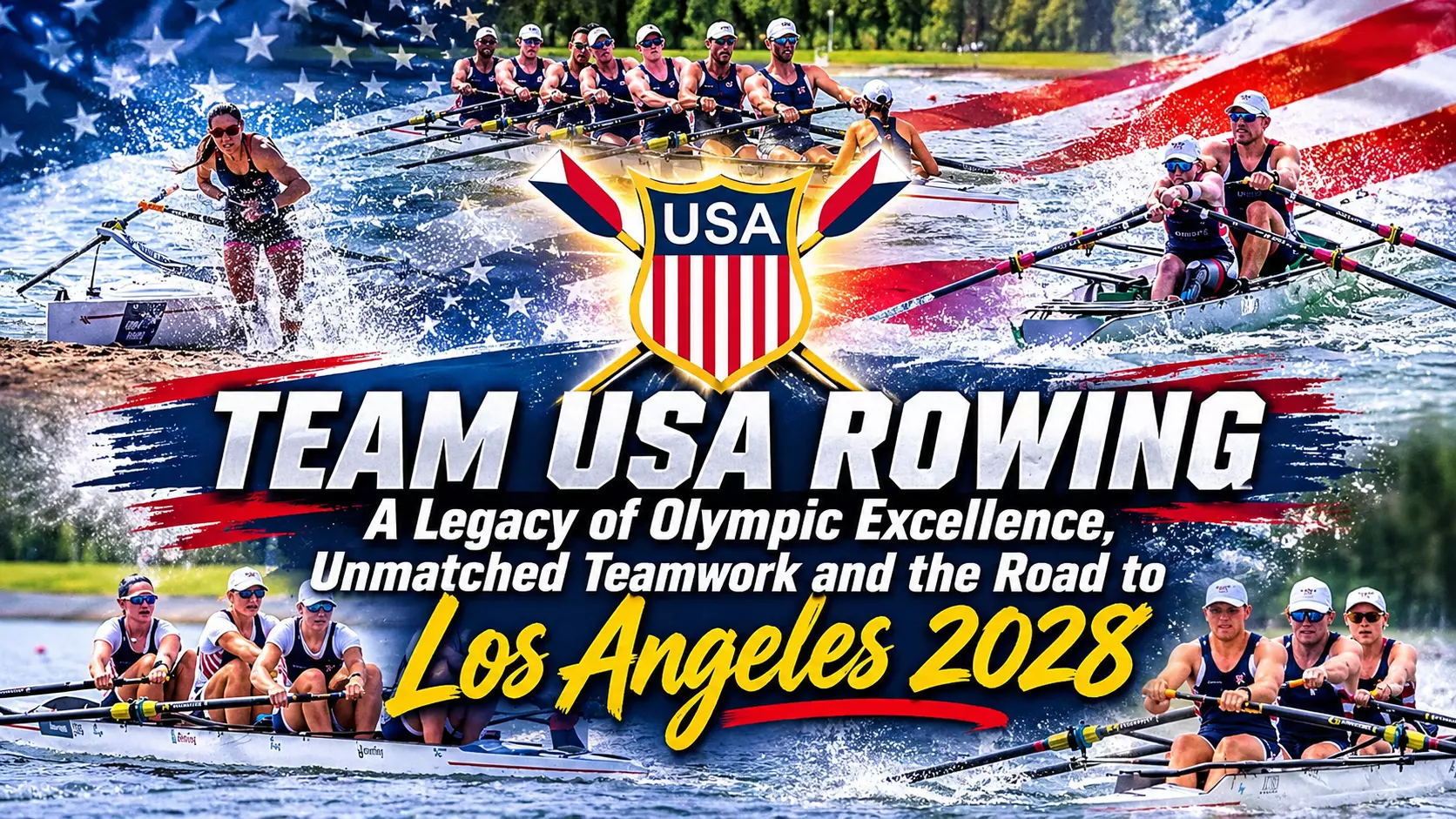
add this information Team USA Rowing: A Legacy of Olympic Excellence, Unmatched Teamwork and the Road to Los Angeles 2028
Team USA Rowing has a long and distinguished history in American sports, built on determination, discipline, teamwork, and Olympic success. From the legendary University of Washington crew that captured gold at the 1936 Berlin Olympics to the modern national team competing against the world’s best, American rowing has produced athletes and accomplishments that deserve greater recognition.
Behind every medal is a tremendous amount of sacrifice. Rowers spend countless hours training on the water and in the gym, developing the strength, endurance, and coordination necessary to compete internationally. Unlike many sports, rowing requires athletes to put individual accomplishments aside and work together toward a common goal. That combination of individual commitment and collective responsibility makes rowing one of the most demanding Olympic
sports.
The organization responsible for developing American rowing is USRowing, the national governing body overseeing the national team, collegiate and youth development, and preparation for Olympic and Paralympic competition. With encouraging international results in 2026, the organization is now focused on building momentum toward the 2028 Los Angeles Olympics.
The History of American Rowing
Rowing has deep roots in American
sports history. In 1852, Harvard and Yale competed in what became the first intercollegiate athletic event in the United States. The sport continued expanding through universities, athletic clubs, and amateur organizations.
Rowing made its Olympic debut at the 1900 Paris Games and has remained part of the Olympic program ever since.
One of the most recognizable moments in American rowing history came at the 1936 Berlin Olympics, when the University of Washington men’s eight captured gold. Their remarkable journey later inspired the bestselling book and motion picture The Boys in the Boat.
American rowing continued building its international reputation over the following decades. The women’s program became particularly successful during the modern Olympic era, winning three consecutive Olympic gold medals in the women’s eight in 2008, 2012, and 2016.
Those accomplishments established a legacy that today’s American athletes hope to continue.
Understanding the Sport and Its Challenges
There are two primary forms of competitive rowing: sweep rowing and sculling.
In sweep rowing, each athlete uses one oar. Events include pairs, fours, and eights. In sculling, each athlete uses two oars, with competitions including single, double, and quadruple sculls.
The eight is among the sport’s most recognizable events. Eight rowers work together, generally guided by a coxswain who steers the boat and communicates race strategy.
Success requires much more than physical strength. Athletes must develop cardiovascular endurance, explosive leg power, core stability, technical precision, and mental toughness.
Perhaps the most important element is synchronization. Eight talented individuals cannot succeed unless they learn to move together. A breakdown in timing can affect the entire boat.
That makes rowing a fascinating sport because individual talent must ultimately serve the team.
USRowing: Building America’s National Team
USRowing is recognized by the United States Olympic & Paralympic Committee as the national governing body for rowing.
Its responsibilities include selecting national teams, organizing competitions, developing junior and under-23 athletes, supporting collegiate programs, and expanding opportunities for participation.
The organization serves more than 77,000 individuals and approximately 1,400 member organizations, according to its published organizational information.
Leadership is also entering a new chapter. On October 7, 2026, USRowing announced the appointment of Joel Shinofield as its new chief executive officer. He previously served as managing director of sport development at USA Swimming and brings extensive experience in Olympic-sport administration.
Josy Verdonkschot serves as chief high-performance officer, overseeing the development of the national team’s competitive program.
Together, organizational leadership, coaching, athlete development, and financial support will play important roles in preparing American rowers for Los Angeles.
Paris 2024 and the 2026 World Championships
The Paris 2024 Olympics provided an important opportunity for American rowing to return to the medal podium.
The U.S. men’s four captured gold, marking the first American victory in that event since 1960. The men’s eight added a bronze medal, giving the Olympic rowing team two medals.
The U.S. Paralympic team also earned silver in the PR3 mixed four with coxswain.
Those performances provided a foundation for the next Olympic cycle.
The 2026 World Rowing Championships in Amsterdam offered another encouraging sign. The United States finished with nine medals: three gold and six bronze, placing third in the overall medal standings.
The American gold medals came in the men’s four, women’s four, and PR3 mixed four with coxswain. The women’s four also defended its world championship title, establishing a world-best time of 6:09.87.
The nine-medal performance represented the United States’ strongest World Championship medal-table finish since 2018. Five medals came in events on the LA28 Olympic program.
These results demonstrate that American crews are capable of competing for international championships as the organization prepares for 2028.
Athletes to Watch
Several athletes provide interesting stories heading into the next Olympic cycle.
Molly Bruggeman, who has connections to Dayton, Ohio, and the University of Notre Dame, represented the United States at the Paris Olympics and returned to international competition in 2026. She was part of the women’s four that defended its world championship title.
Peter Chatain represented the United States in the men’s eight at the Paris Olympics before earning selection to the 2026 men’s four.
Sophia Vitas is an experienced international sculler who represented the United States in Paris and competed in the women’s quadruple sculls in Amsterdam.
Nina Castagna, a Cincinnati native and University of Washington representative, served as the coxswain of the 2026 U.S. women’s eight. Her local connection provides an especially interesting storyline for Ohio
sports fans.
These athletes illustrate the importance of collegiate development and the opportunities available to rowers who reach the national-team level.
The Road to Los Angeles 2028
The next major objective for American rowing is the 2028 Los Angeles Olympics.
USRowing received a historic $6.5 million contribution from Cameron and Tyler Winklevoss in 2025 to support the national team through the LA28 Olympic and Paralympic Games. The investment will also support expansion of the national-team training center in West Windsor, New Jersey.
That financial commitment is significant because elite rowing requires substantial resources, including boats, coaching,
sports
medicine, nutrition, training facilities, and international travel.
The organization must continue developing younger athletes, improving international competitiveness, and building successful crews across men’s, women’s, and Para-rowing events.
The challenge is turning the encouraging results of 2026 into sustained Olympic success.
Conclusion: More Than a Race Against the Clock
Team USA Rowing represents much more than medals and international championships. It is a sport built around sacrifice, trust, discipline, and teamwork.
From the historic 1936 Washington crew to the Olympic champions of the modern era, American rowing has produced stories that deserve recognition.
The 2026 World Championships demonstrated that the United States can compete for world titles, while new financial investment and continued athlete development provide opportunities to strengthen the program.
As America prepares to host the 2028 Olympics, the spotlight will increasingly turn toward the athletes representing the country.
Ultimately, the greatest strength of rowing may not be any individual athlete. It is the ability to bring people together, overcome adversity, and work toward a shared goal.
When eight athletes enter the water in pursuit of an Olympic medal, they are no longer competing as eight individuals. They are competing as one team.
The Grueling Truth — Finding the grit behind the legend, not just the highlight reel.
New Users – Get $350 in Bonus Bets when you wager $5 for 7 days
T&Cs apply
4.6/5
Gambling Problem? Call 1-800-GAMBLER or 1-800-MY-RESET. Call 1-888-789-7777 or visit ccpgg.org/chat (CT). Hope is here. GamblingHelpLineMA.org or call (800) 327-5050 for 24/7 support (MA). Visit www.mdgamblinghelp.org (MD). Call 1-877-8HOPE-NY or text HOPENY (NY). 21+ (18+ DC, WY) and present in select states (for KS, in affiliation with Kansas Star Casino). Find online real money wagering only. Min $5 wager required for 7 consecutive days. $5 free play credit. Bonus issued as non-withdrawable bonus with cash withdrawable bonus with cash withdrawable. Bonus bets which expire 7 days after receipt. Restrictions apply. See terms at sportsbook.fanduel.com. Call 1-877-770-7867 (LA).
Get Up to $1,000 Back in Bonus Bets Over Your First 10 Days
T&Cs apply
4.5/5
Gambling problem? Call 1-800-GAMBLER or 1-800-MY-RESET (Available in the US) 877-8-HOPENY or text HOPENY (467369) (NY) 1-800-327-5050 (MA), 1-800-BETS-OFF (IA), 21+ only. Please Gamble Responsibly. Visit mdgamblinghelp.org (MD). See BetMGM.com for Terms. New Player Offer for new players only. Subject to eligibility requirements. Bonus bets are non-withdrawable. In partnership with Kansas Crossing Casino and Hotel. This promotional offer is not available in NJ, MA, MI, NV, NY, ON, PA, PR, and WV.
New DraftKings Customers: Bet $5, Get $200 + 3 Months of NBA League Pass
T&Cs apply
4.5/5
GAMBLING PROBLEM? CALL 1-800-GAMBLER or 1-800-MY-RESET, (800) 327-5050 or visit gamblinghelplinema.org (MA). Please Gamble Responsibly. 888-789-7777/visit ccpg.org (CT), or visit www.mdgamblinghelp.org (MD), 1-800-981-0023 (PR). 21+ and present in most states. (18+ DC/NH/PR/WY). Void in CAN. Eligibility restrictions apply. On behalf of Boot Hill Casino (KS). Pass-thru of per wager tax may apply in IL. 1 per new Sportsbook customer. $5+ first-time bet req. Max. $200 issued as non-withdrawable Bonus Bets. Stake removed from payout. Reward issued as $50 in Bonus Bets every 7 days via click-to-claim for 21 days. Bonus Bets and click-to-claims expire 7 days (168hrs) after issuance. Terms: dkng.co/offer. Get 1 promo code to redeem a 3-month NBA League Pass subscription, complimentary of DraftKings. Subscription auto-renews monthly at then-current price (currently $16.99/mo); cancel anytime. Terms, restrictions, and eligibility requirements apply. Redeem League Pass by 12/19/26 at 11:59 PM ET. Addt’l terms: support.watch.nba.com/hc/en-us/articles/9165532876183-League-Pass-Terms-of-Use_. Ends 11/29/26 at 11:59 PM ET. Sponsored by DK.
Must be 21+. GAMBLING PROBLEM? CALL 1-800-GAMBLER OR CALL 1-800-MY-RESET, www.mdgamblinghelp.org (MD), (800)-327-5050 or gamblinghelplinema.org (MA), Call (877)8-HOPENY or text HOPENY (467369) (NY), (888) 789-7777 or ccpg.org (CT), morethanagame.nc.gov (NC), 1800gambler.net (WV)
Bet $1 and get double the winnings up to $25 for your next 10 bets
T&Cs apply
4.4/5
21+ New users only. Must register using eligible promo code. First bet after registration must qualify. Max. Bonus Bet: $1,000. Bonus Bet expires 14 days after receipt. Void where prohibited. See Caesars.com/promos for full terms. Gambling Problem? 1-800-GAMBLER (1-800-426-2537)
21+ and present in OH. Gambling Problem? Call 1-800-GAMBLER.
This site is using
Cloudflare
and adheres to the
Google Safe Browsing Program. We adapted
Google's Privacy Guidelines
to keep your data safe at all times.
Close
Ready to Win Big? Join the Elite with Our Sports Betting Deals!
FanDuel Promo
New Users – Get $350 in Bonus Bets when you wager $5 for 7 days
Our Favorite
T&Cs and 21+ apply
Gambling Problem? Call 1-800-GAMBLER or 1-800-MY-RESET. Call 1-888-789-7777 or visit ccpgg.org/chat (CT). Hope is here. GamblingHelpLineMA.org or call (800) 327-5050 for 24/7 support (MA). Visit www.mdgamblinghelp.org (MD). Call 1-877-8HOPE-NY or text HOPENY (NY). 21+ (18+ DC, WY) and present in select states (for KS, in affiliation with Kansas Star Casino). Find online real money wagering only. Min $5 wager required for 7 consecutive days. $5 free play credit. Bonus issued as non-withdrawable bonus with cash withdrawable bonus with cash withdrawable. Bonus bets which expire 7 days after receipt. Restrictions apply. See terms at sportsbook.fanduel.com. Call 1-877-770-7867 (LA).
Code:
Open FanDuel
Get Bonus
BetMGM Promo
Get Up to $1,000 Back in Bonus Bets Over Your First 10 Days
Best Slots
T&Cs and 21+ apply
Gambling problem? Call 1-800-GAMBLER or 1-800-MY-RESET (Available in the US) 877-8-HOPENY or text HOPENY (467369) (NY) 1-800-327-5050 (MA), 1-800-BETS-OFF (IA), 21+ only. Please Gamble Responsibly. Visit mdgamblinghelp.org (MD). See BetMGM.com for Terms. New Player Offer for new players only. Subject to eligibility requirements. Bonus bets are non-withdrawable. In partnership with Kansas Crossing Casino and Hotel. This promotional offer is not available in NJ, MA, MI, NV, NY, ON, PA, PR, and WV.
Code:
Open BetMGM
Get Bonus
DraftKings Promo
New DraftKings Customers: Bet $5, Get $200 + 3 Months of NBA League Pass
Newcomer
T&Cs and 21+ apply
GAMBLING PROBLEM? CALL 1-800-GAMBLER or 1-800-MY-RESET, (800) 327-5050 or visit gamblinghelplinema.org (MA). Please Gamble Responsibly. 888-789-7777/visit ccpg.org (CT), or visit www.mdgamblinghelp.org (MD), 1-800-981-0023 (PR). 21+ and present in most states. (18+ DC/NH/PR/WY). Void in CAN. Eligibility restrictions apply. On behalf of Boot Hill Casino (KS). Pass-thru of per wager tax may apply in IL. 1 per new Sportsbook customer. $5+ first-time bet req. Max. $200 issued as non-withdrawable Bonus Bets. Stake removed from payout. Reward issued as $50 in Bonus Bets every 7 days via click-to-claim for 21 days. Bonus Bets and click-to-claims expire 7 days (168hrs) after issuance. Terms: dkng.co/offer. Get 1 promo code to redeem a 3-month NBA League Pass subscription, complimentary of DraftKings. Subscription auto-renews monthly at then-current price (currently $16.99/mo); cancel anytime. Terms, restrictions, and eligibility requirements apply. Redeem League Pass by 12/19/26 at 11:59 PM ET. Addt’l terms: support.watch.nba.com/hc/en-us/articles/9165532876183-League-Pass-Terms-of-Use_. Ends 11/29/26 at 11:59 PM ET. Sponsored by DK.
Code:
Open DraftKings
Get Bonus
Find out what the legends have to say about sports this week....
New Users – Get $350 in Bonus Bets when you wager $5 for 7 days
Gambling Problem? Call 1-800-GAMBLER or 1-800-MY-RESET. Call 1-888-789-7777 or visit ccpgg.org/chat (CT). Hope is here. GamblingHelpLineMA.org or call (800) 327-5050 for 24/7 support (MA). Visit www.mdgamblinghelp.org (MD). Call 1-877-8HOPE-NY or text HOPENY (NY). 21+ (18+ DC, WY) and present in select states (for KS, in affiliation with Kansas Star Casino). Find online real money wagering only. Min $5 wager required for 7 consecutive days. $5 free play credit. Bonus issued as non-withdrawable bonus with cash withdrawable bonus with cash withdrawable. Bonus bets which expire 7 days after receipt. Restrictions apply. See terms at sportsbook.fanduel.com. Call 1-877-770-7867 (LA).