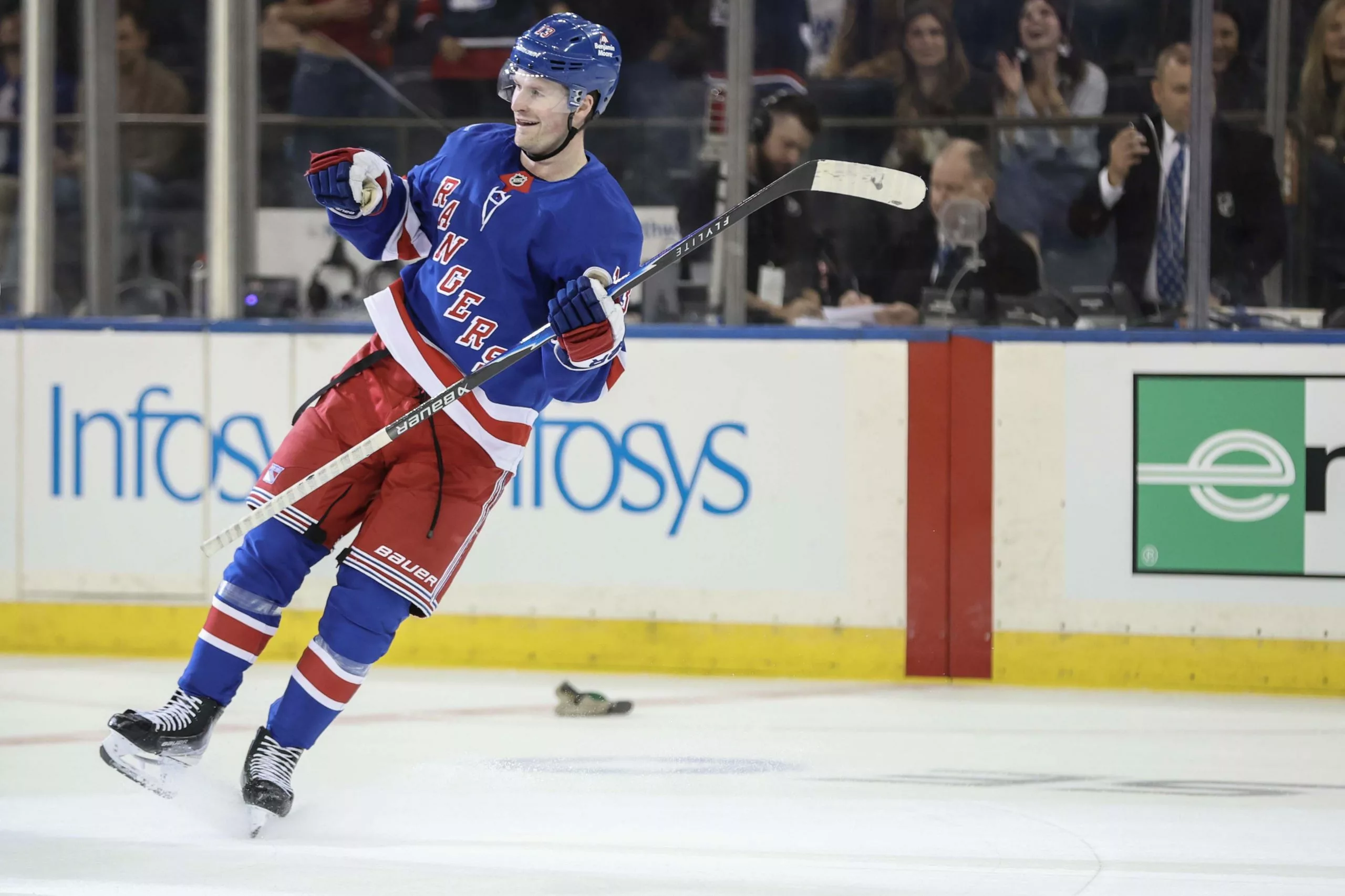
Oct 6, 2026; New York, New York, USA; New York Rangers left wing Alexis Lafreniere (13) celebrates after scoring a third goal for a hat trick in the third period against the New York Islanders at Madison Square Garden. Mandatory Credit: Wendell Cruz-Imagn Images
Alexis Lafrenière gave Rangers fans a hat trick to celebrate Tuesday night. The more important question is whether he is giving New York a player it can increasingly depend on.
Lafrenière recorded three goals and an assist in a 5–2 victory over the Islanders, helping the Rangers extend their winning streak to four games. Two of his goals came into an empty net, a detail that belongs in any honest assessment of his performance.
Still, dismissing the night because of those late finishes would overlook what made it encouraging.
Lafrenière helped create offense before the Islanders pulled their goaltender. He also received responsibility when New York was protecting its lead.
For a former first overall pick whose career has carried enormous expectations, that combination matters. Becoming a leading player requires more than occasional scoring bursts. It requires influencing games in different situations—and doing it repeatedly.
He won the puck along the end boards against Matthew Schaefer, then found Oliver Bjorkstrand for the finish. Early in the second period, Lafrenière converted a stretch pass from Mika Zibanejad to extend the advantage to 2–0.
Those plays provide a better foundation for evaluating his night than the final goal total alone.
The first showed how puck retrieval can become offense. The second showed the value of recognizing an opportunity and finishing it.
For Lafrenière, the next step is making those contributions dependable. He needs to affect possessions even when a scoring chance does not arrive immediately.
A winger who wins a contested puck, keeps an attack alive and delivers a useful pass can improve an entire line. That work gives his skill more opportunities to matter.
Tuesday’s opening goal was an example of exactly that.
Empty-Net Goals Still Reveal Something About His Role
Two empty-net goals should not be treated as equivalent to repeatedly beating a set defense and goaltender.
They do, however, reveal something about the situations in which Mike Sullivan is willing to use Lafrenière.
Sullivan explained after the game that the Rangers are deploying him against an extra attacker and challenging him to handle the defensive responsibility that comes with it.
That is a meaningful opportunity.
Protecting a one-goal lead requires awareness, positioning and sound decisions under pressure. A player must understand when to pursue the puck and when doing so could expose a dangerous passing lane.
Lafrenière’s development should include becoming trustworthy in those moments.
The empty-net finishes rewarded his presence on the ice. The larger test is whether he continues earning those assignments through effective play.
His Opportunity Is Becoming Clearer
Lafrenière entered the season skating with Zibanejad and Gabe Perreault, a combination Sullivan wanted to build on after encouraging chemistry late last season.
That gives him a chance to establish a more substantial influence within the offense.
A productive line needs players who understand how their strengths fit together. One player retrieves the puck. Another creates separation. Somebody recognizes the passing option before the defense closes it.
Lafrenière can contribute at several points in that sequence.
But opportunity creates an expectation of consistency. He cannot rely on the occasional outstanding night to answer every question about his development.
The Rangers need him to remain involved when opponents take away his preferred space, when the puck is not finding him and when his line has to defend for an extended shift.
That is how a talented winger becomes a player who helps drive results.
The Rangers’ Response Was More Encouraging Than the Final Margin
New York’s victory was not as comfortable throughout as the 5–2 score might suggest.
The Islanders erased a 2–0 deficit before Bjorkstrand’s power-play goal late in the second period restored the Rangers’ lead.
That sequence matters when assessing whether this early success can last.
A team will surrender momentum during an NHL season. The question is whether it responds by making the next useful play or compounds the problem through rushed decisions.
The Rangers recovered their advantage Tuesday and finished the game.
That is encouraging because sustainable success requires more than starting well. It requires managing the periods when an opponent pushes back.
New York has begun demonstrating that ability. It still needs to prove it across a much larger sample.
Madison Square Garden Is Becoming an Advantage Again
The Rangers are 4–1–0 overall and 3–0–0 at home. Last season, they lost their first seven home games and did not record their third Garden victory until December 2.
The difference is significant.
Winning early at home allows a team to build confidence without immediately carrying the frustration of another poor start. It also gives supporters tangible evidence of progress.
Tuesday added the satisfaction of beating a rival that swept all four meetings with the Rangers last season.
None of that guarantees a successful season. It does establish a much healthier starting position.
The Rangers have given themselves results to build on. Their challenge is to preserve the habits behind those results as the schedule becomes more demanding.
What Would Make This Start Sustainable?
The next stage of evaluation should focus on how New York plays when the favorable moments become less frequent.
Can the Rangers generate enough offense when the power play does not provide a decisive goal? Can they protect the middle of the ice without spending entire stretches defending? Can they recover from a bad period without abandoning their structure?
Lafrenière belongs at the center of those questions.
If his influence extends beyond scoring—through puck retrieval, passing and responsible play—the Rangers become less dependent on a few isolated moments.
Bjorkstrand’s two-goal night also showed the value of receiving a major contribution from another forward.
New York needs that variety. A team with several players capable of changing a game is harder to contain than one waiting for the same star to rescue it.
Lafrenière Has Given New York Evidence—Now Comes the Repetition
Is Lafrenière finally ready to take over?
He has given
the Rangers
a reason to ask the question seriously. Declaring the answer settled would go further than the evidence supports.
His next step is to become a consistent source of good possessions, useful decisions and meaningful offense. The scoring totals should follow from that broader influence.
My view is that Tuesday’s most promising feature was the range of his involvement. He helped create a goal, scored with a goaltender in the net and participated in closing out the victory.
That is a performance worth building on.
The Rangers’ four-game winning streak has restored some optimism. Lafrenière now has an opportunity to make his development one of the reasons that optimism lasts.
New Users – Get $350 in Bonus Bets when you wager $5 for 7 days
T&Cs apply
4.6/5
Gambling Problem? Call 1-800-GAMBLER or 1-800-MY-RESET. Call 1-888-789-7777 or visit ccpgg.org/chat (CT). Hope is here. GamblingHelpLineMA.org or call (800) 327-5050 for 24/7 support (MA). Visit www.mdgamblinghelp.org (MD). Call 1-877-8HOPE-NY or text HOPENY (NY). 21+ (18+ DC, WY) and present in select states (for KS, in affiliation with Kansas Star Casino). Find online real money wagering only. Min $5 wager required for 7 consecutive days. $5 free play credit. Bonus issued as non-withdrawable bonus with cash withdrawable bonus with cash withdrawable. Bonus bets which expire 7 days after receipt. Restrictions apply. See terms at sportsbook.fanduel.com. Call 1-877-770-7867 (LA).
Up To $1500 in Bonus Bets Paid Back if your First Bet Does Not Win
T&Cs apply
4.5/5
Gambling problem? Call 1-800-GAMBLER or 1-800-MY-RESET (Available in the US) 877-8-HOPENY or text HOPENY (467369) (NY) 1-800-327-5050 (MA), 1-800-BETS-OFF (IA), 1-800-981-0023 (PR). 21+ only. Please Gamble Responsibly. See BetMGM.com for Terms. First Bet Offer for new customers only (if applicable). Subject to eligibility requirements. Bonus bets are non-withdrawable. In partnership with Kansas Crossing Casino and Hotel. Promotional offers not available in Mississippi, Massachusetts, New York, Ontario, or Puerto Rico.
New DraftKings Customers: Bet $5, Get $200 + 3 Months of NBA League Pass!
T&Cs apply
4.5/5
GAMBLING PROBLEM? CALL 1-800-GAMBLER or 1-800-MY-RESET, (800) 327-5050 or visit gamblinghelplinema.org (MA). Please Gamble Responsibly. 888-789-7777/visit ccpg.org (CT), or visit www.mdgamblinghelp.org (MD), 1-800-981-0023 (PR). 21+ and present in most states. (18+ DC/NH/PR/WY). Void in CAN. Eligibility restrictions apply. On behalf of Boot Hill Casino (KS). Pass-thru of per wager tax may apply in IL. 1 per new Sportsbook customer. $5+ first-time bet req. Max. $200 issued as non-withdrawable Bonus Bets. Stake removed from payout. Reward issued as $50 in Bonus Bets every 7 days via click-to-claim for 21 days. Bonus Bets and click-to-claims expire 7 days (168hrs) after issuance. Terms: dkng.co/offer. Get 1 promo code to redeem a 3-month NBA League Pass subscription, complimentary of DraftKings. Subscription auto-renews monthly at then-current price (currently $16.99/mo); cancel anytime. Terms, restrictions, and eligibility requirements apply. Redeem League Pass by 12/19/26 at 11:59 PM ET. Addt’l terms: support.watch.nba.com/hc/en-us/articles/9165532876183-League-Pass-Terms-of-Use_. Ends 11/29/26 at 11:59 PM ET. Sponsored by DK.
Must be 21+. GAMBLING PROBLEM? CALL 1-800-GAMBLER OR CALL 1-800-MY-RESET, www.mdgamblinghelp.org (MD), (800)-327-5050 or gamblinghelplinema.org (MA), Call (877)8-HOPENY or text HOPENY (467369) (NY), (888) 789-7777 or ccpg.org (CT), morethanagame.nc.gov (NC), 1800gambler.net (WV)
Bet $1 and get double the winnings up to $25 for your next 10 bets
T&Cs apply
4.4/5
21+ New users only. Must register using eligible promo code. First bet after registration must qualify. Max. Bonus Bet: $1,000. Bonus Bet expires 14 days after receipt. Void where prohibited. See Caesars.com/promos for full terms. Gambling Problem? 1-800-GAMBLER (1-800-426-2537)
21+ and present in OH. Gambling Problem? Call 1-800-GAMBLER.
This site is using
Cloudflare
and adheres to the
Google Safe Browsing Program. We adapted
Google's Privacy Guidelines
to keep your data safe at all times.
Close
Ready to Win Big? Join the Elite with Our Sports Betting Deals!
FanDuel Promo
New Users – Get $350 in Bonus Bets when you wager $5 for 7 days
Our Favorite
T&Cs and 21+ apply
Gambling Problem? Call 1-800-GAMBLER or 1-800-MY-RESET. Call 1-888-789-7777 or visit ccpgg.org/chat (CT). Hope is here. GamblingHelpLineMA.org or call (800) 327-5050 for 24/7 support (MA). Visit www.mdgamblinghelp.org (MD). Call 1-877-8HOPE-NY or text HOPENY (NY). 21+ (18+ DC, WY) and present in select states (for KS, in affiliation with Kansas Star Casino). Find online real money wagering only. Min $5 wager required for 7 consecutive days. $5 free play credit. Bonus issued as non-withdrawable bonus with cash withdrawable bonus with cash withdrawable. Bonus bets which expire 7 days after receipt. Restrictions apply. See terms at sportsbook.fanduel.com. Call 1-877-770-7867 (LA).
Code:
Open FanDuel
Get Bonus
BetMGM Promo
Up To $1500 in Bonus Bets Paid Back if your First Bet Does Not Win
Best Slots
T&Cs and 21+ apply
Gambling problem? Call 1-800-GAMBLER or 1-800-MY-RESET (Available in the US) 877-8-HOPENY or text HOPENY (467369) (NY) 1-800-327-5050 (MA), 1-800-BETS-OFF (IA), 1-800-981-0023 (PR). 21+ only. Please Gamble Responsibly. See BetMGM.com for Terms. First Bet Offer for new customers only (if applicable). Subject to eligibility requirements. Bonus bets are non-withdrawable. In partnership with Kansas Crossing Casino and Hotel. Promotional offers not available in Mississippi, Massachusetts, New York, Ontario, or Puerto Rico.
Code:
Open BetMGM
Get Bonus
DraftKings Promo
New DraftKings Customers: Bet $5, Get $200 + 3 Months of NBA League Pass!
Newcomer
T&Cs and 21+ apply
GAMBLING PROBLEM? CALL 1-800-GAMBLER or 1-800-MY-RESET, (800) 327-5050 or visit gamblinghelplinema.org (MA). Please Gamble Responsibly. 888-789-7777/visit ccpg.org (CT), or visit www.mdgamblinghelp.org (MD), 1-800-981-0023 (PR). 21+ and present in most states. (18+ DC/NH/PR/WY). Void in CAN. Eligibility restrictions apply. On behalf of Boot Hill Casino (KS). Pass-thru of per wager tax may apply in IL. 1 per new Sportsbook customer. $5+ first-time bet req. Max. $200 issued as non-withdrawable Bonus Bets. Stake removed from payout. Reward issued as $50 in Bonus Bets every 7 days via click-to-claim for 21 days. Bonus Bets and click-to-claims expire 7 days (168hrs) after issuance. Terms: dkng.co/offer. Get 1 promo code to redeem a 3-month NBA League Pass subscription, complimentary of DraftKings. Subscription auto-renews monthly at then-current price (currently $16.99/mo); cancel anytime. Terms, restrictions, and eligibility requirements apply. Redeem League Pass by 12/19/26 at 11:59 PM ET. Addt’l terms: support.watch.nba.com/hc/en-us/articles/9165532876183-League-Pass-Terms-of-Use_. Ends 11/29/26 at 11:59 PM ET. Sponsored by DK.
Code:
Open DraftKings
Get Bonus
Find out what the legends have to say about sports this week....
New Users – Get $350 in Bonus Bets when you wager $5 for 7 days
Gambling Problem? Call 1-800-GAMBLER or 1-800-MY-RESET. Call 1-888-789-7777 or visit ccpgg.org/chat (CT). Hope is here. GamblingHelpLineMA.org or call (800) 327-5050 for 24/7 support (MA). Visit www.mdgamblinghelp.org (MD). Call 1-877-8HOPE-NY or text HOPENY (NY). 21+ (18+ DC, WY) and present in select states (for KS, in affiliation with Kansas Star Casino). Find online real money wagering only. Min $5 wager required for 7 consecutive days. $5 free play credit. Bonus issued as non-withdrawable bonus with cash withdrawable bonus with cash withdrawable. Bonus bets which expire 7 days after receipt. Restrictions apply. See terms at sportsbook.fanduel.com. Call 1-877-770-7867 (LA).