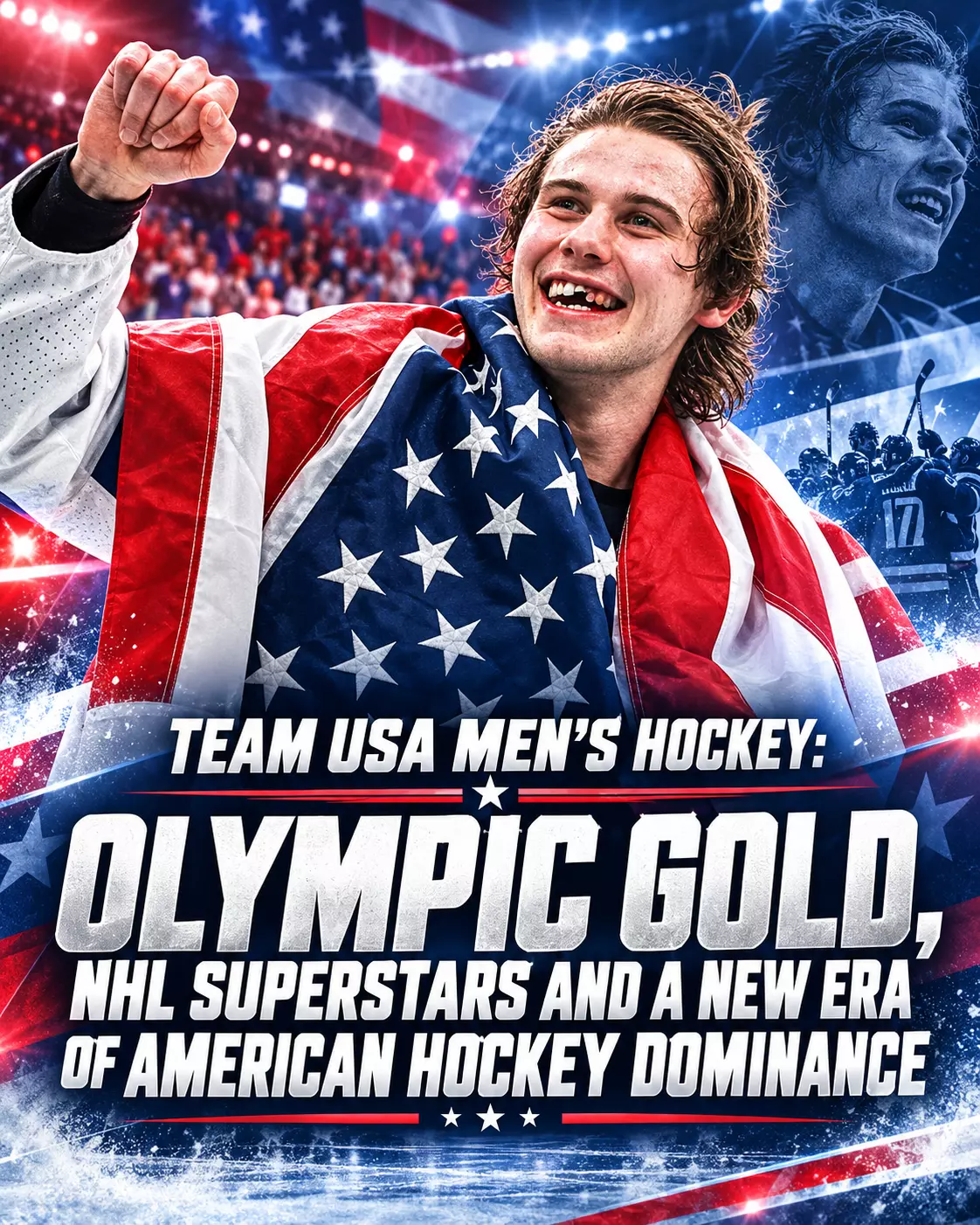
Team USA Men's Hockey: Olympic Gold, NHL Superstars and a New Era of American Hockey Dominance
The United States men’s national hockey program is experiencing one of the most successful periods in its history.
With Olympic gold in 2026, a World Championship title in 2025 and an impressive collection of NHL superstars, American hockey has established itself among the world’s elite.
Led by Auston Matthews, Jack Hughes, Jack Eichel, Quinn Hughes, Matthew Tkachuk, Zach Werenski and goaltender Connor Hellebuyck, Team USA possesses an extraordinary combination of offensive talent, defensive strength, physicality and goaltending.
However, following a disappointing eighth-place finish at the 2026 IIHF World Championship, the Americans face an important challenge: turning their Olympic success into sustained international excellence.
A Historic Olympic Gold Medal
February 22, 2026, will forever hold a special place in American hockey history.
On that day, Team USA defeated Canada 2–1 in overtime at the Winter Olympics in Milan, Italy, capturing its first men’s Olympic hockey gold medal since the legendary Miracle on Ice team of 1980.
New Jersey Devils forward Jack Hughes became an American hockey hero when he scored the championship-winning goal just 1:41 into overtime.
The victory completed an undefeated six-game tournament in which the Americans defeated Latvia, Denmark, Germany, Sweden, Slovakia and Canada.
Team USA scored 26 goals while allowing only nine, demonstrating its balance between offensive production and defensive discipline.
Unlike the 1980 team built primarily around college players, the 2026 Americans featured established NHL stars competing against the world’s finest professionals.
The championship represented more than a gold medal. It demonstrated how far American player development has progressed over the past several decades.
Jack Hughes and America’s Offensive Firepower
One of Team USA’s greatest advantages is its remarkable collection of offensive talent.
Jack Hughes headlines a group capable of generating scoring opportunities through speed, creativity and exceptional puck handling.
Hughes finished the Olympic tournament with four goals and three assists, including the most important goal of his international career against Canada.
Toronto Maple Leafs superstar Auston Matthews served as captain, providing leadership and elite goal-scoring ability. Matthews contributed three goals and four assists during the tournament.
Vegas Golden Knights center Jack Eichel added another offensive dimension with his powerful skating, playmaking and ability to control possession.
The Americans also benefited from the versatility of Tampa Bay’s Jake Guentzel, Winnipeg’s Kyle Connor, Buffalo’s Tage Thompson and Minnesota’s Matt Boldy.
Meanwhile, brothers Matthew and Brady Tkachuk provided the physical intensity that makes American hockey difficult to play against.
Matthew contributed six Olympic assists, while Brady recorded three goals and two assists.
Together, the group offered a dangerous combination of speed, scoring ability, toughness and leadership.
Quinn Hughes and a Championship-Caliber Defense
While America’s forwards attract significant attention, its defensive depth may be equally important.
Minnesota Wild defenseman Quinn Hughes emerged as one of the tournament’s outstanding players, leading Team USA with eight points.
His exceptional skating, vision and ability to move the puck helped transform defensive situations into scoring opportunities.
Columbus Blue Jackets star Zach Werenski also played an important role, recording six points while providing offensive creativity from the blue line.
Werenski’s performance reinforced his reputation as one of the NHL’s premier American defensemen.
Charlie McAvoy of Boston added physical strength and defensive reliability, while Ottawa’s Jake Sanderson and Minnesota’s Brock Faber represented the program’s younger defensive talent.
Carolina’s Jaccob Slavin brought experience and exceptional defensive positioning.
This combination of offensive defensemen and shutdown specialists allowed head coach Mike Sullivan to deploy balanced defensive pairings against elite international competition.
Connor Hellebuyck: The Backbone of Team USA
Every championship team needs outstanding goaltending, and Connor Hellebuyck delivered when America needed him most.
The Winnipeg Jets superstar produced one of the defining performances of the Olympic tournament.
Hellebuyck finished with a remarkable .956 save percentage and 1.18 goals-against average.
His greatest performance came in the gold-medal game against Canada, when he stopped 41 of 42 shots.
Facing superstars including Connor McDavid, Nathan MacKinnon and Macklin Celebrini, Hellebuyck repeatedly prevented Canada from taking control.
His performance gave the Americans an opportunity to win despite spending significant stretches defending against Canada’s relentless offensive pressure.
Beyond Hellebuyck, Team USA possessed tremendous depth with Dallas Stars goaltender Jake Oettinger and Boston Bruins netminder Jeremy Swayman.
Few countries could match that collection of established NHL goaltending talent.
Mike Sullivan and the Leadership Behind the Championship
Head coach Mike Sullivan played a significant role in Team USA’s Olympic success.
A two-time Stanley Cup-winning coach with the Pittsburgh Penguins, Sullivan brought championship experience and an emphasis on accountability, structure and teamwork.
His coaching staff included John Tortorella, John Hynes, David Quinn and goaltending coach Mike Buckley.
General manager Bill Guerin assembled a roster designed to combine elite talent with the physical and defensive characteristics necessary for international success.
Rather than simply selecting the highest-scoring American players, management emphasized balance, chemistry and specific roles.
The result was a team capable of winning high-scoring games while also surviving defensive battles against powerful opponents.
From World Champions to World Championship Disappointment
America’s Olympic success followed another historic achievement.
In May 2025, Team USA defeated Switzerland 1–0 in overtime to win its first standalone IIHF Men’s World Championship since 1933.
Buffalo Sabres forward Tage Thompson scored the championship-winning goal, ending a 92-year title drought.
However, the Americans experienced a setback at the 2026 World Championship in Switzerland.
That tournament featured a significantly different roster from the Olympic championship team.
Coached by Don Granato, the Americans relied on a mixture of NHL veterans and emerging prospects, including Matthew Tkachuk, Ryan Leonard, James Hagens, Isaac Howard and Oliver Moore.
Veteran defenseman Justin Faulk served as captain.
After an inconsistent preliminary round, Team USA advanced to the quarterfinals but suffered a 4–0 defeat against Canada.
The Americans finished eighth overall.
Although disappointing, the result demonstrated the challenges of international competition when many established NHL stars are unavailable.
The Olympics and annual World Championships are separate competitions with different roster-selection circumstances.
Consequently, the World Championship finish should not be viewed as a direct measure of America’s strongest possible national team.
The Next Generation of American Hockey Stars
The future of Team USA appears promising thanks to another wave of talented young players.
Washington Capitals forward Ryan Leonard brings physicality, scoring ability and competitive intensity.
James Hagens offers exceptional creativity and offensive instincts, while Isaac Howard possesses the shooting ability needed to become a dangerous international scorer.
Chicago Blackhawks forward Oliver Moore adds tremendous skating speed, and Max Plante represents another promising prospect within the American development system.
These players could eventually compete for positions alongside established stars such as Hughes, Eichel, Matthews and the Tkachuk brothers.
Their development will be essential as USA Hockey prepares for future international championships.
What Comes Next for Team USA?
The next major challenge arrives at the 2027 IIHF World Championship in Germany.
That tournament will provide another opportunity for American players to compete internationally and potentially restore the United States to the medal podium.
A more significant best-on-best competition arrives in February 2028 with the return of the World Cup of Hockey.
The tournament will feature eight nations and games in Calgary, Edmonton and Prague, providing another opportunity for the Americans to test their Olympic championship core.
Looking further ahead, the 2030 Winter Olympics in the French Alps will give Team USA an opportunity to defend its gold medal.
Whether the Americans can maintain their championship standard will depend on player health, roster development, coaching decisions and continued contributions from the next generation.
Conclusion: A New Golden Era for American Hockey
Team USA has entered a new chapter in international men’s hockey.
The 2026 Olympic championship demonstrated that America can defeat the world’s strongest competition with a combination of outstanding goaltending, disciplined defense, offensive creativity and physical determination.
With Jack Hughes emerging as an international superstar, Auston Matthews providing leadership, Quinn Hughes and Zach Werenski strengthening the blue line, and Connor Hellebuyck delivering championship-level goaltending, the American foundation remains impressive.
The emergence of younger players provides additional reason for optimism.
The challenge now is consistency.
Winning Olympic gold was a historic achievement. Building a program capable of competing for championships at every major international tournament represents the next objective.
For Team USA men’s hockey, the 2026 gold medal may ultimately be remembered not as the culmination of a great generation, but as the beginning of a new golden era.
New Users – Get $350 in Bonus Bets when you wager $5 for 7 days
T&Cs apply
4.6/5
Gambling Problem? Call 1-800-GAMBLER or 1-800-MY-RESET. Call 1-888-789-7777 or visit ccpgg.org/chat (CT). Hope is here. GamblingHelpLineMA.org or call (800) 327-5050 for 24/7 support (MA). Visit www.mdgamblinghelp.org (MD). Call 1-877-8HOPE-NY or text HOPENY (NY). 21+ (18+ DC, WY) and present in select states (for KS, in affiliation with Kansas Star Casino). Find online real money wagering only. Min $5 wager required for 7 consecutive days. $5 free play credit. Bonus issued as non-withdrawable bonus with cash withdrawable bonus with cash withdrawable. Bonus bets which expire 7 days after receipt. Restrictions apply. See terms at sportsbook.fanduel.com. Call 1-877-770-7867 (LA).
Get Up to $1,000 Back in Bonus Bets Over Your First 10 Days
T&Cs apply
4.5/5
Gambling problem? Call 1-800-GAMBLER or 1-800-MY-RESET (Available in the US) 877-8-HOPENY or text HOPENY (467369) (NY) 1-800-327-5050 (MA), 1-800-BETS-OFF (IA), 21+ only. Please Gamble Responsibly. Visit mdgamblinghelp.org (MD). See BetMGM.com for Terms. New Player Offer for new players only. Subject to eligibility requirements. Bonus bets are non-withdrawable. In partnership with Kansas Crossing Casino and Hotel. This promotional offer is not available in NJ, MA, MI, NV, NY, ON, PA, PR, and WV.
New DraftKings Customers: Bet $5, Get $200 + 3 Months of NBA League Pass!
T&Cs apply
4.5/5
GAMBLING PROBLEM? CALL 1-800-GAMBLER or 1-800-MY-RESET, (800) 327-5050 or visit gamblinghelplinema.org (MA). Please Gamble Responsibly. 888-789-7777/visit ccpg.org (CT), or visit www.mdgamblinghelp.org (MD), 1-800-981-0023 (PR). 21+ and present in most states. (18+ DC/NH/PR/WY). Void in CAN. Eligibility restrictions apply. On behalf of Boot Hill Casino (KS). Pass-thru of per wager tax may apply in IL. 1 per new Sportsbook customer. $5+ first-time bet req. Max. $200 issued as non-withdrawable Bonus Bets. Stake removed from payout. Reward issued as $50 in Bonus Bets every 7 days via click-to-claim for 21 days. Bonus Bets and click-to-claims expire 7 days (168hrs) after issuance. Terms: dkng.co/offer. Get 1 promo code to redeem a 3-month NBA League Pass subscription, complimentary of DraftKings. Subscription auto-renews monthly at then-current price (currently $16.99/mo); cancel anytime. Terms, restrictions, and eligibility requirements apply. Redeem League Pass by 12/19/26 at 11:59 PM ET. Addt’l terms: support.watch.nba.com/hc/en-us/articles/9165532876183-League-Pass-Terms-of-Use_. Ends 11/29/26 at 11:59 PM ET. Sponsored by DK.
Must be 21+. GAMBLING PROBLEM? CALL 1-800-GAMBLER OR CALL 1-800-MY-RESET, www.mdgamblinghelp.org (MD), (800)-327-5050 or gamblinghelplinema.org (MA), Call (877)8-HOPENY or text HOPENY (467369) (NY), (888) 789-7777 or ccpg.org (CT), morethanagame.nc.gov (NC), 1800gambler.net (WV)
Bet $1 and get double the winnings up to $25 for your next 10 bets
T&Cs apply
4.4/5
21+ New users only. Must register using eligible promo code. First bet after registration must qualify. Max. Bonus Bet: $1,000. Bonus Bet expires 14 days after receipt. Void where prohibited. See Caesars.com/promos for full terms. Gambling Problem? 1-800-GAMBLER (1-800-426-2537)
21+ and present in OH. Gambling Problem? Call 1-800-GAMBLER.
This site is using
Cloudflare
and adheres to the
Google Safe Browsing Program. We adapted
Google's Privacy Guidelines
to keep your data safe at all times.
Close
Ready to Win Big? Join the Elite with Our Sports Betting Deals!
FanDuel Promo
New Users – Get $350 in Bonus Bets when you wager $5 for 7 days
Our Favorite
T&Cs and 21+ apply
Gambling Problem? Call 1-800-GAMBLER or 1-800-MY-RESET. Call 1-888-789-7777 or visit ccpgg.org/chat (CT). Hope is here. GamblingHelpLineMA.org or call (800) 327-5050 for 24/7 support (MA). Visit www.mdgamblinghelp.org (MD). Call 1-877-8HOPE-NY or text HOPENY (NY). 21+ (18+ DC, WY) and present in select states (for KS, in affiliation with Kansas Star Casino). Find online real money wagering only. Min $5 wager required for 7 consecutive days. $5 free play credit. Bonus issued as non-withdrawable bonus with cash withdrawable bonus with cash withdrawable. Bonus bets which expire 7 days after receipt. Restrictions apply. See terms at sportsbook.fanduel.com. Call 1-877-770-7867 (LA).
Code:
Open FanDuel
Get Bonus
BetMGM Promo
Get Up to $1,000 Back in Bonus Bets Over Your First 10 Days
Best Slots
T&Cs and 21+ apply
Gambling problem? Call 1-800-GAMBLER or 1-800-MY-RESET (Available in the US) 877-8-HOPENY or text HOPENY (467369) (NY) 1-800-327-5050 (MA), 1-800-BETS-OFF (IA), 21+ only. Please Gamble Responsibly. Visit mdgamblinghelp.org (MD). See BetMGM.com for Terms. New Player Offer for new players only. Subject to eligibility requirements. Bonus bets are non-withdrawable. In partnership with Kansas Crossing Casino and Hotel. This promotional offer is not available in NJ, MA, MI, NV, NY, ON, PA, PR, and WV.
Code:
Open BetMGM
Get Bonus
DraftKings Promo
New DraftKings Customers: Bet $5, Get $200 + 3 Months of NBA League Pass!
Newcomer
T&Cs and 21+ apply
GAMBLING PROBLEM? CALL 1-800-GAMBLER or 1-800-MY-RESET, (800) 327-5050 or visit gamblinghelplinema.org (MA). Please Gamble Responsibly. 888-789-7777/visit ccpg.org (CT), or visit www.mdgamblinghelp.org (MD), 1-800-981-0023 (PR). 21+ and present in most states. (18+ DC/NH/PR/WY). Void in CAN. Eligibility restrictions apply. On behalf of Boot Hill Casino (KS). Pass-thru of per wager tax may apply in IL. 1 per new Sportsbook customer. $5+ first-time bet req. Max. $200 issued as non-withdrawable Bonus Bets. Stake removed from payout. Reward issued as $50 in Bonus Bets every 7 days via click-to-claim for 21 days. Bonus Bets and click-to-claims expire 7 days (168hrs) after issuance. Terms: dkng.co/offer. Get 1 promo code to redeem a 3-month NBA League Pass subscription, complimentary of DraftKings. Subscription auto-renews monthly at then-current price (currently $16.99/mo); cancel anytime. Terms, restrictions, and eligibility requirements apply. Redeem League Pass by 12/19/26 at 11:59 PM ET. Addt’l terms: support.watch.nba.com/hc/en-us/articles/9165532876183-League-Pass-Terms-of-Use_. Ends 11/29/26 at 11:59 PM ET. Sponsored by DK.
Code:
Open DraftKings
Get Bonus
Find out what the legends have to say about sports this week....
New Users – Get $350 in Bonus Bets when you wager $5 for 7 days
Gambling Problem? Call 1-800-GAMBLER or 1-800-MY-RESET. Call 1-888-789-7777 or visit ccpgg.org/chat (CT). Hope is here. GamblingHelpLineMA.org or call (800) 327-5050 for 24/7 support (MA). Visit www.mdgamblinghelp.org (MD). Call 1-877-8HOPE-NY or text HOPENY (NY). 21+ (18+ DC, WY) and present in select states (for KS, in affiliation with Kansas Star Casino). Find online real money wagering only. Min $5 wager required for 7 consecutive days. $5 free play credit. Bonus issued as non-withdrawable bonus with cash withdrawable bonus with cash withdrawable. Bonus bets which expire 7 days after receipt. Restrictions apply. See terms at sportsbook.fanduel.com. Call 1-877-770-7867 (LA).