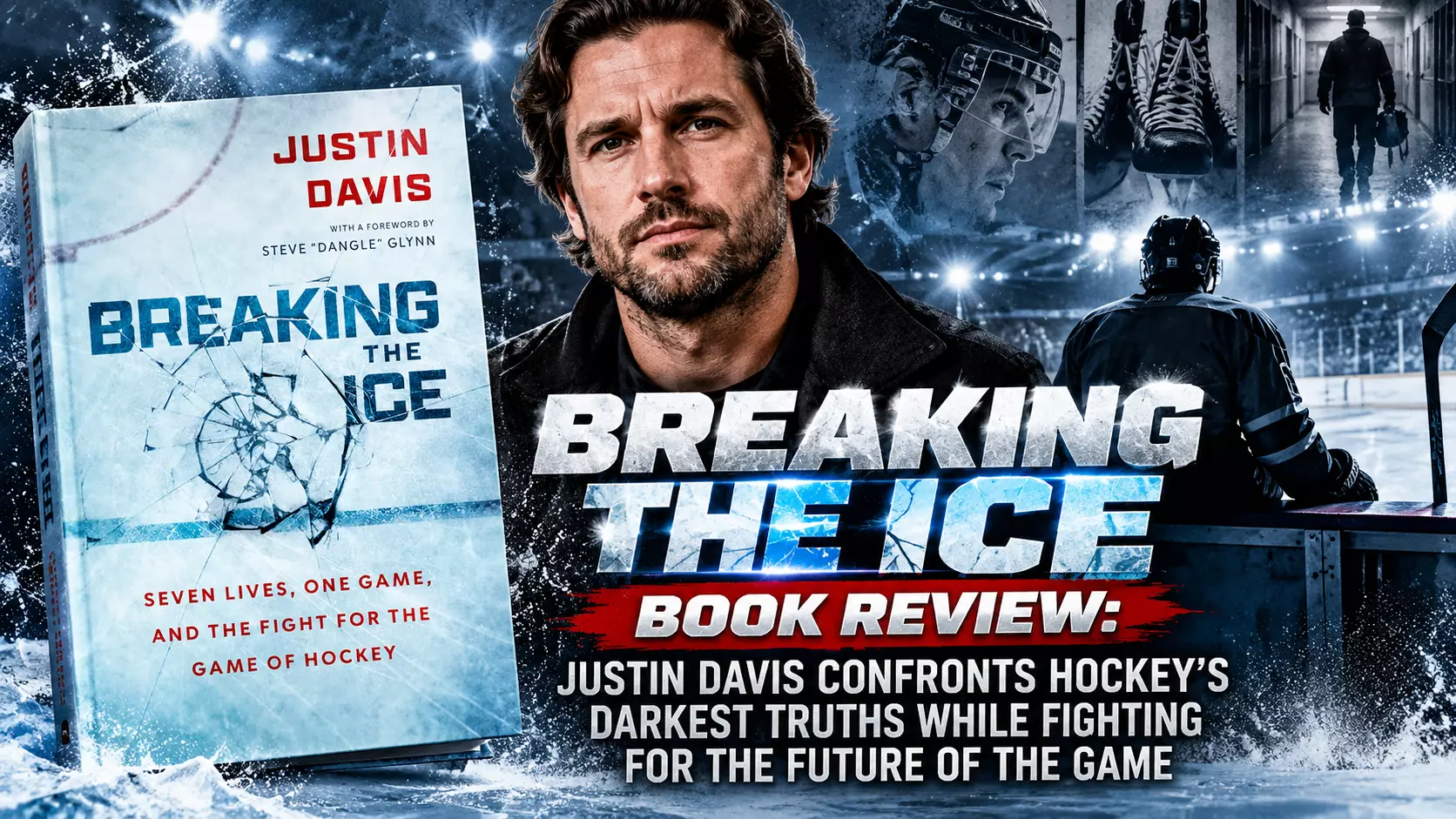
Breaking the Ice Book Review: Justin Davis Confronts Hockey’s Darkest Truths While Fighting for the Future of the Game
Book:Breaking the Ice: Seven Lives, One Game, and the Fight for the Game of Hockey
Author:
Justin Davis
Publisher:
ECW Press
Release Date:
October 20, 2026
Genre:
Sports Nonfiction / Hockey / Investigative Journalism
Introduction: A Different Kind of Hockey Story
Hockey has always been a sport built on toughness, sacrifice, loyalty, and an unwavering commitment to teammates. From frozen ponds to packed NHL arenas, generations of players have embraced the physical and emotional demands of the game while chasing their dreams of professional success.
But what happens when the same culture that produces champions also creates environments where bullying, hazing, violence, and emotional trauma become accepted parts of the journey?
Former professional hockey player Justin Davis confronts those difficult questions in his latest book,
Breaking the Ice: Seven Lives, One Game, and the Fight for the Game of Hockey.
Following his revealing memoir,
Conflicted Scars: An Average Player’s Journey to the NHL, Davis expands his investigation beyond his personal experiences. This time, he gives others an opportunity to share their stories, challenge hockey’s traditions, and explore what the sport must do to protect future generations.
Rather than portraying hockey as fundamentally broken, Davis presents a more complicated picture of a beloved sport struggling to reconcile its proud traditions with the need for meaningful change.
The result is a timely and thought-provoking examination of hockey’s past, present, and potential future.
From Memorial Cup Champion to Hockey Culture Advocate
Justin Davis brings considerable credibility to this conversation because he understands professional hockey’s development system from firsthand experience.
Selected by the Washington Capitals in the fourth round of the 1996 NHL Draft, Davis established himself as a talented junior
hockey player
before helping the Ottawa 67’s capture the 1999 Memorial Cup championship.
He also earned the Ed Chynoweth Trophy as the tournament’s leading scorer, demonstrating his ability to perform on one of junior hockey’s biggest stages.
However, beneath those accomplishments were experiences that complicated his relationship with the sport.
In
Conflicted Scars, Davis discussed the bullying, hazing, and emotional challenges he encountered during his hockey career.
His willingness to speak publicly about those experiences helped establish a conversation about the pressures young athletes face while pursuing professional opportunities.
Breaking the Ice
represents the next chapter of that conversation.
Instead of simply revisiting his own struggles, Davis turns toward individuals whose careers and experiences reveal different sides of hockey’s complicated culture.
Seven Voices, Seven Perspectives on Hockey
One of the book’s most compelling features is its decision to examine hockey through seven distinct personalities.
Former professional enforcers Jon “Nasty” Mirasty and Zenon Konopka provide perspectives on fighting, physical toughness, and the identity players develop through their roles on the ice.
For decades, hockey enforcers have occupied a controversial position within the sport. Some fans celebrate them as protectors of teammates and symbols of old-school hockey. Others question whether fighting should continue to have a place in a modern game increasingly focused on speed, skill, and player safety.
Including these perspectives gives Davis an opportunity to explore that debate through the experiences of people who actually lived it.
Investigative journalist Rick Westhead brings another important dimension.
Westhead’s reporting has helped expose serious misconduct and institutional failures throughout Canadian sports. His perspective underscores the importance of accountability and the challenges facing individuals willing to question powerful organizations.
Prominent
hockey agent
Allan Walsh contributes insight into player representation, organizational responsibility, and the relationship between athletes and the institutions controlling their careers.
Together, these voices demonstrate why meaningful reform requires more than changing a few rules.
It demands an honest examination of the power structures surrounding the game.
The Physical and Emotional Cost of Hockey
Perhaps the book’s most important subject involves the long-term consequences of injuries and violence.
Chris Nowinski, co-founder and CEO of the Concussion Legacy Foundation, provides a scientific perspective on traumatic brain injuries and the potential consequences of repetitive head impacts.
His inclusion raises uncomfortable but necessary questions.
How much risk should young athletes accept in pursuit of their dreams? Are players receiving sufficient information about brain injuries? And are hockey organizations doing enough to prioritize long-term health over immediate competitive success?
These questions are particularly important for parents deciding whether to introduce their children to competitive hockey.
The story of former junior
hockey player
Andrew Long provides another emotional element.
Long suffered severe injuries during a notorious 1998 on-ice incident involving Jesse Boulerice.
His experience illustrates how quickly a moment of violence can alter an athlete’s life.
For spectators, such incidents can become memorable highlights or controversial moments in hockey history. For the individuals involved, the consequences can extend far beyond the final whistle.
By including Long’s perspective, Davis encourages readers to consider the human beings behind hockey’s most troubling headlines.
Why Parents and Young Players Should Pay Attention
Although professional hockey provides much of the book’s backdrop, its lessons are especially relevant to families navigating youth and
junior hockey.
For young athletes, the pressure to succeed can become overwhelming.
Players may feel compelled to tolerate mistreatment, conceal injuries, or remain silent about questionable coaching methods because they fear losing opportunities.
Parents, meanwhile, can struggle to distinguish between the discipline necessary for athletic development and an unhealthy environment that threatens their child’s confidence or well-being.
Skating and strength coach Steffany Hanlen adds an important developmental perspective.
Her inclusion helps broaden the discussion beyond professional contracts and championship trophies.
The central question becomes whether hockey is developing well-rounded young people or simply producing athletes willing to endure almost anything to advance.
That distinction makes
Breaking the Ice
particularly relevant to coaches, administrators, and parents throughout the sport.
What Makes Breaking the Ice Stand Out?
The strongest element of Davis’s approach is his refusal to reduce hockey’s problems to a simple argument about whether the sport is good or bad.
Hockey can create extraordinary friendships, teach perseverance, develop leadership, and provide opportunities that change lives.
Those qualities deserve recognition.
However, appreciating the benefits of hockey should never require ignoring harmful traditions or defending individuals who abuse their positions of authority.
By bringing together players, journalists, coaches, medical advocates, and representatives, Davis demonstrates that meaningful change requires people with different experiences to participate in the same conversation.
The book’s interview-driven structure also offers an important advantage: it allows readers to encounter perspectives that may challenge their existing opinions.
Someone who strongly supports fighting might see the issue differently after considering its long-term consequences. Likewise, readers critical of hockey’s physical culture may better understand the personal significance of the enforcer’s role.
That willingness to explore conflicting viewpoints is essential to the book’s message.
The Challenge of Changing Hockey Culture
Of course, identifying problems is easier than solving them.
Hockey’s traditions
have developed over generations, and changing deeply ingrained expectations requires cooperation among leagues, teams, players, coaches, families, and governing organizations.
Improved reporting procedures, stronger player protections, better concussion education, and greater institutional accountability are all important subjects for continued discussion.
Yet no single book can provide a complete solution to every challenge.
The broader value of
Breaking the Ice
lies in encouraging readers to question assumptions that have too often gone unchallenged.
Respecting hockey’s history does not mean every tradition must survive.
Protecting young athletes does not mean eliminating competition.
And acknowledging the sport’s shortcomings does not diminish the accomplishments of those who have dedicated their lives to it.
Final Verdict: An Important Conversation for Hockey’s Future
Breaking the Ice
addresses one of the most significant questions facing modern hockey: How can the sport preserve its identity while creating a healthier environment for the people who play it?
Justin Davis approaches that conversation with the perspective of a former player who experienced championship glory and witnessed the darker realities of competitive hockey.
By incorporating seven contrasting voices, he presents hockey as something far more complicated than a game divided between heroes and villains.
The book’s subject matter makes it especially worthwhile for hockey parents, coaches, players, administrators, and longtime fans interested in the direction of the sport.
Ultimately,
Breaking the Ice
is not about attacking hockey or diminishing its traditions. It is about recognizing that loving a sport sometimes means asking difficult questions about the way it operates.
The central message is powerful: hockey does not have to abandon everything that made it great to become something better.
And perhaps the most meaningful legacy of Davis’s work will be encouraging the next generation of
hockey players
to pursue their dreams without accepting unnecessary suffering as the price of success.
New Users - Get $200 in Bonus Bets when you wager $5 for 4 days
T&Cs apply
4.6/5
Gambling Problem? Call 1-800-GAMBLER or 1-800-MY-RESET. Visit www.mdgamblinghelp.org (MD). 1-888-789-7777 or ccpg.org/chat (CT). Hope is here. GamblingHelpLineMA.org or (800) 327-5050 for 24/7 support (MA). 1-877-8-HOPENY or text HOPENY (467369) (NY). 21+ (18+ D.C., WY) and present in select states (for KS, in affiliation with Kansas Star Casino). First online real money wager only. Min $5 wager required for 4 consecutive days. $5 first deposit required. Bonus issued as nonwithdrawable bonus bets which expire 5 days after receipt. Restrictions apply. See terms at sportsbook.fanduel.com. Call 1-877-770-7867 (LA).
Get Up to $1,000 Back in Bonus Bets Over Your First 10 Days
T&Cs apply
4.5/5
Gambling problem? Call 1-800-GAMBLER or 1-800-MY-RESET (Available in the US) 877-8-HOPENY or text HOPENY (467369) (NY) 1-800-327-5050 (MA), 1-800-BETS-OFF (IA), 21+ only. Please Gamble Responsibly. Visit mdgamblinghelp.org (MD). See BetMGM.com for Terms. New Player Offer for new players only. Subject to eligibility requirements. Bonus bets are non-withdrawable. In partnership with Kansas Crossing Casino and Hotel. This promotional offer is not available in NJ, MA, MI, NV, NY, ON, PA, PR, and WV.
GAMBLING PROBLEM? CALL 1-800-GAMBLER or 1-800-MY-RESET, (800) 327-5050 or visit gamblinghelplinema.org (MA). Please Gamble Responsibly. 888-789-7777/visit ccpg.org (CT), or visit www.mdgamblinghelp.org (MD), 1-800-981-0023 (PR). 21+ and present in most states. (18+ DC/NH/PR/WY). Void in CAN. Eligibility restrictions apply. On behalf of Boot Hill Casino (KS). Pass-thru of per wager tax may apply in IL. 1 per new Sportsbook customer. $5+ first-time bet req. Max. $200 issued as non-withdrawable Bonus Bets. Stake removed from payout. Reward issued as $50 in Bonus Bets every 7 days via click-to-claim for 21 days. Bonus Bets and click-to-claims expire 7 days (168hrs) after issuance. Terms: dkng.co/offer. Get 1 promo code to redeem a 3-month NBA League Pass subscription, complimentary of DraftKings. Subscription auto-renews monthly at then-current price (currently $16.99/mo); cancel anytime. Terms, restrictions, and eligibility requirements apply. Redeem League Pass by 12/19/26 at 11:59 PM ET. Addt’l terms: support.watch.nba.com/hc/en-us/articles/9165532876183-League-Pass-Terms-of-Use_. Ends 11/29/26 at 11:59 PM ET. Sponsored by DK.
Must be 21+. GAMBLING PROBLEM? CALL 1-800-GAMBLER OR CALL 1-800-MY-RESET, www.mdgamblinghelp.org (MD), (800)-327-5050 or gamblinghelplinema.org (MA), Call (877)8-HOPENY or text HOPENY (467369) (NY), (888) 789-7777 or ccpg.org (CT), morethanagame.nc.gov (NC), 1800gambler.net (WV)
Bet $1 and get double the winnings up to $25 for your next 10 bets
T&Cs apply
4.4/5
21+ New users only. Must register using eligible promo code. First bet after registration must qualify. Max. Bonus Bet: $1,000. Bonus Bet expires 14 days after receipt. Void where prohibited. See Caesars.com/promos for full terms. Gambling Problem? 1-800-GAMBLER (1-800-426-2537)
21+ and present in OH. Gambling Problem? Call 1-800-GAMBLER.
The sweepstakes and social casinos featured here are for adults aged 18 or over. No purchase is necessary to enter or win, and every operator offers a free way to get Sweeps Coins. Availability in Ohio varies by operator. Offers are subject to each operator's terms. Need a break? Call or text 1-800-MY-RESET (24/7) or visit https://ncpgambling.org. We may earn a commission when you sign up through links on this site. This does not change how we review operators.
This site is using
Cloudflare
and adheres to the
Google Safe Browsing Program. We adapted
Google's Privacy Guidelines
to keep your data safe at all times.
Close
Ready to Win Big? Join the Elite with Our Sports Betting Deals!
FanDuel Promo
New Users - Get $200 in Bonus Bets when you wager $5 for 4 days
Our Favorite
T&Cs and 21+ apply
Gambling Problem? Call 1-800-GAMBLER or 1-800-MY-RESET. Visit www.mdgamblinghelp.org (MD). 1-888-789-7777 or ccpg.org/chat (CT). Hope is here. GamblingHelpLineMA.org or (800) 327-5050 for 24/7 support (MA). 1-877-8-HOPENY or text HOPENY (467369) (NY). 21+ (18+ D.C., WY) and present in select states (for KS, in affiliation with Kansas Star Casino). First online real money wager only. Min $5 wager required for 4 consecutive days. $5 first deposit required. Bonus issued as nonwithdrawable bonus bets which expire 5 days after receipt. Restrictions apply. See terms at sportsbook.fanduel.com. Call 1-877-770-7867 (LA).
Code:
Open FanDuel
Get Bonus
BetMGM Promo
Get Up to $1,000 Back in Bonus Bets Over Your First 10 Days
Best Slots
T&Cs and 21+ apply
Gambling problem? Call 1-800-GAMBLER or 1-800-MY-RESET (Available in the US) 877-8-HOPENY or text HOPENY (467369) (NY) 1-800-327-5050 (MA), 1-800-BETS-OFF (IA), 21+ only. Please Gamble Responsibly. Visit mdgamblinghelp.org (MD). See BetMGM.com for Terms. New Player Offer for new players only. Subject to eligibility requirements. Bonus bets are non-withdrawable. In partnership with Kansas Crossing Casino and Hotel. This promotional offer is not available in NJ, MA, MI, NV, NY, ON, PA, PR, and WV.
Code:
Open BetMGM
Get Bonus
DraftKings Promo
Bet $5, Get $200 + 3 Months of NBA League Pass
Newcomer
T&Cs and 21+ apply
GAMBLING PROBLEM? CALL 1-800-GAMBLER or 1-800-MY-RESET, (800) 327-5050 or visit gamblinghelplinema.org (MA). Please Gamble Responsibly. 888-789-7777/visit ccpg.org (CT), or visit www.mdgamblinghelp.org (MD), 1-800-981-0023 (PR). 21+ and present in most states. (18+ DC/NH/PR/WY). Void in CAN. Eligibility restrictions apply. On behalf of Boot Hill Casino (KS). Pass-thru of per wager tax may apply in IL. 1 per new Sportsbook customer. $5+ first-time bet req. Max. $200 issued as non-withdrawable Bonus Bets. Stake removed from payout. Reward issued as $50 in Bonus Bets every 7 days via click-to-claim for 21 days. Bonus Bets and click-to-claims expire 7 days (168hrs) after issuance. Terms: dkng.co/offer. Get 1 promo code to redeem a 3-month NBA League Pass subscription, complimentary of DraftKings. Subscription auto-renews monthly at then-current price (currently $16.99/mo); cancel anytime. Terms, restrictions, and eligibility requirements apply. Redeem League Pass by 12/19/26 at 11:59 PM ET. Addt’l terms: support.watch.nba.com/hc/en-us/articles/9165532876183-League-Pass-Terms-of-Use_. Ends 11/29/26 at 11:59 PM ET. Sponsored by DK.
Code:
Open DraftKings
Get Bonus
Find out what the legends have to say about sports this week....
New Users - Get $200 in Bonus Bets when you wager $5 for 4 days
Gambling Problem? Call 1-800-GAMBLER or 1-800-MY-RESET. Visit www.mdgamblinghelp.org (MD). 1-888-789-7777 or ccpg.org/chat (CT). Hope is here. GamblingHelpLineMA.org or (800) 327-5050 for 24/7 support (MA). 1-877-8-HOPENY or text HOPENY (467369) (NY). 21+ (18+ D.C., WY) and present in select states (for KS, in affiliation with Kansas Star Casino). First online real money wager only. Min $5 wager required for 4 consecutive days. $5 first deposit required. Bonus issued as nonwithdrawable bonus bets which expire 5 days after receipt. Restrictions apply. See terms at sportsbook.fanduel.com. Call 1-877-770-7867 (LA).