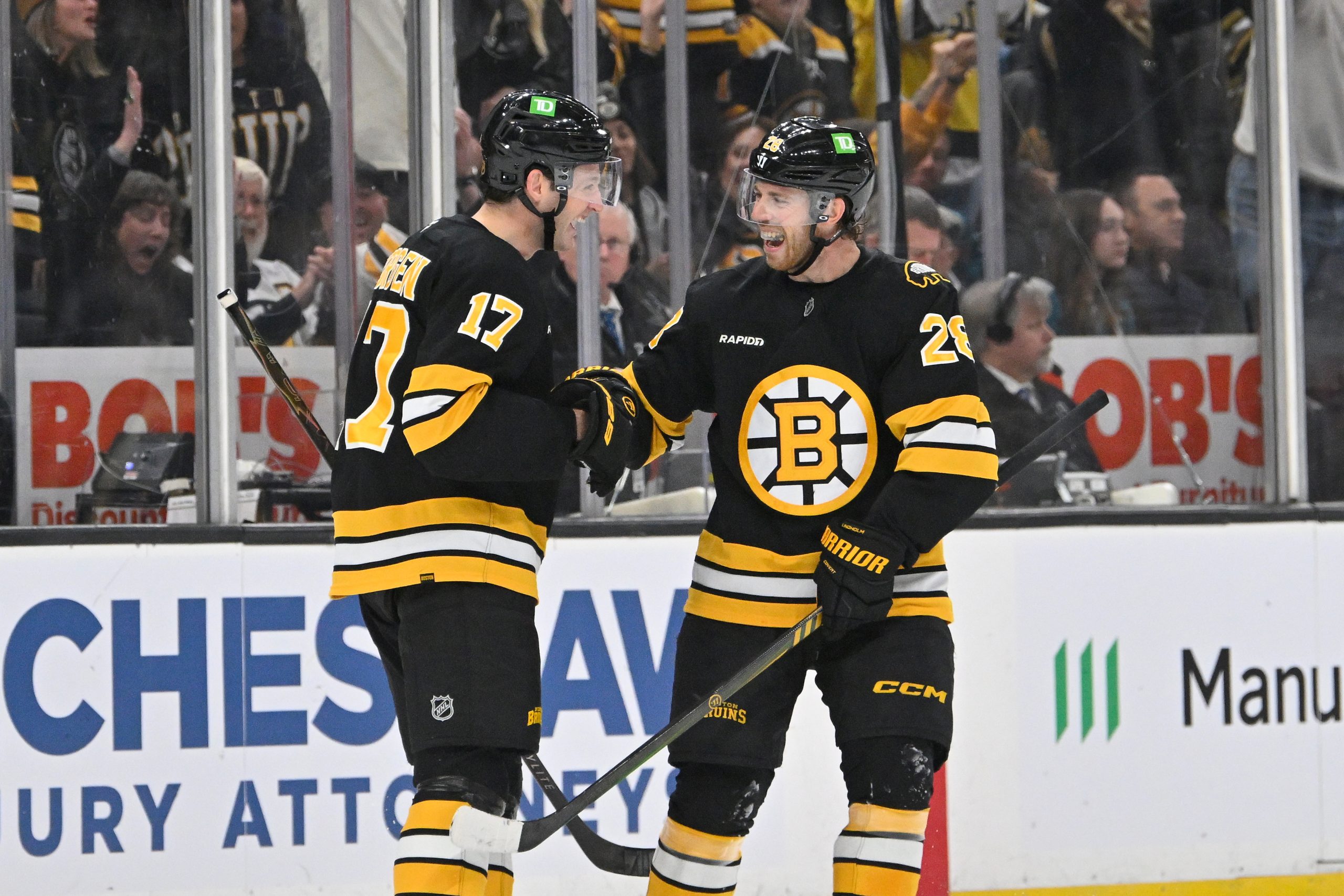
Oct 24, 2026; Boston, Massachusetts, USA; Boston Bruins defenseman Will Borgen (17) celebrates an empty net goal against the San Jose Sharks with center Elias Lindholm (28) during the third period at TD Garden. Mandatory Credit: Eric Canha-Imagn Images
The Boston Bruins are collecting points, getting contributions from different parts of the lineup and showing that a third-period deficit does not have to determine the outcome.
Those are encouraging traits. So is recognizing that the comeback should not become the game plan.
Boston extended its
point streak to eight games
with a
6–4 victory over San Jose on Saturday, improving to
9–2–1. The Bruins are
7–0–1 during that stretch, giving them a strong early foundation while leaving room to examine how they are winning.
Against the Sharks, Boston’s response was impressive. Its inability to maintain control earlier in the game was less reassuring.
Both belong in the assessment. The Bruins have earned confidence through their results, but making those results sustainable will require fewer stretches in which their offense must repair the damage.
Boston Responded Before the Game Got Away
San Jose took a
3–2 lead at 4:03 of the third period
on Dmitry Orlov’s goal. Boston answered with goals from David Pastrnak and James Hagens just
40 seconds apart, reversing the game’s direction before adding more separation.
The significance extends beyond scoring twice.
A team trailing late can become impatient. Players stretch their positioning, force passes and chase an immediate answer at the expense of the next defensive responsibility. Boston found its response quickly enough to avoid spending the rest of the evening in desperation.
That is evidence of a useful competitive quality: the ability to keep playing effectively after the scoreboard changes.
It does not prove that every comeback will arrive. It does show why this team has been difficult to put away.
The Scoring Came From More Than Pastrnak
Pastrnak remains central to Boston’s attack, but the most encouraging feature of the San Jose victory was the number of players who contributed.
Hagens, Fraser Minten and Casey Mittelstadt each recorded a goal and an assist. Marat Khusnutdinov and Will Borgen also scored, giving Boston six different goal scorers.
That distribution matters over a long season.
Opponents will devote significant attention to limiting Boston’s most dangerous scorer. There will also be nights when Pastrnak creates opportunities without finishing them himself, or when the matchup makes it difficult for his line to generate clean chances.
Secondary production
gives the Bruins more ways to remain competitive through those stretches.
It also changes the burden on the lineup. Boston does not have to wait for one player to supply the response. A timely contribution from another line can restore momentum and force the opponent to defend more than one source of danger.
One game cannot establish season-long depth. But getting meaningful production from several forwards and a defenseman is a better sign than repeatedly needing a single star to rescue the result.
Young Players Are Contributing to Winning Moments
Hagens and Minten were involved when the outcome was still unsettled.
Hagens supplied the go-ahead goal during Boston’s rapid third-period response, while Minten’s goal stood as the winner.
That gives their production practical value beyond the box score. Young players contributing in decisive situations can broaden a team’s options, particularly when opponents load their defensive attention toward established threats.
The next question is consistency.
Can those contributions continue when scoring chances become harder to find? Can they remain effective in games where Boston needs a disciplined defensive shift more than another goal?
Those are normal development questions. The positive is that the Bruins are already receiving contributions that directly affect results.
San Jose Exposed the Cost of Letting Games Reopen
The Sharks deserve credit for making Boston work.
San Jose responded to each of the Bruins’ first two one-goal advantages before taking the lead in the third. Boston eventually won, but it did not consistently turn a favorable position into control of the game.
That is the concern behind the excitement.
The ability to recover is valuable. The ability to prevent an opponent from repeatedly recovering may be more dependable.
Protecting a lead does not mean abandoning offense. It means managing possession, supporting the puck and avoiding decisions that unnecessarily expose the team when an attack breaks down.
A winning team must still press for another goal. It also must recognize when a difficult pass or poorly supported rush creates more risk than reward.
The final score alone cannot assign responsibility for every defensive breakdown. It does, however, justify reviewing how Boston allowed the Sharks to stay involved and eventually move ahead.
Special Teams Added to the Warning Signs
San Jose’s scoring included a
power-play goal from Michael Misa and a shorthanded goal from Kiefer Sherwood.
Those are different situations, but both affect a team’s margin for error.
A penalty kill can surrender a goal even while executing reasonably well. Allowing a shorthanded goal raises another set of questions about puck security, positioning and the response when possession changes.
Boston cannot expect every special-teams mistake to be offset by a productive third period.
The objective is not perfection. It is reducing avoidable chances and ensuring that an opportunity with the extra skater does not become an invitation for the opponent.
That kind of improvement would make the Bruins’ scoring depth more powerful. Instead of repairing a deficit, those additional goals could help establish control.
The Record Is Stronger Evidence Than Any One Comeback
Boston’s start should not be dismissed because Saturday became uncomfortable.
An eight-game point streak requires more than one productive period. The Bruins have repeatedly found enough offense, defensive execution or goaltending to leave games with something.
But resilience is easiest to sustain when it complements sound play rather than compensating for recurring problems.
The distinction will become clearer against stronger opposition. Boston visits Carolina on Tuesday, with both teams entering the matchup near the top of the early standings.
That provides another opportunity to evaluate whether the Bruins can dictate a game against a demanding opponent rather than depend on recovering within it.
Boston Has Reasons to Believe—and Details to Improve
The case for the Bruins
is credible: productive results, scoring contributions beyond their biggest star and players capable of answering adversity without losing their effectiveness.
The concern is equally clear. Giving opponents repeated openings makes winning harder than it needs to be.
Boston’s early success can last if the team carries its offensive depth forward while tightening the decisions that leave games open. The strongest version of these Bruins will retain the ability to come back while needing to use it less often.
Saturday showed why they are dangerous. The work ahead is making them more dependable.
New Users – Get $350 in Bonus Bets when you wager $5 for 7 days
T&Cs apply
4.6/5
Gambling Problem? Call 1-800-GAMBLER or 1-800-MY-RESET. Call 1-888-789-7777 or visit ccpgg.org/chat (CT). Hope is here. GamblingHelpLineMA.org or call (800) 327-5050 for 24/7 support (MA). Visit www.mdgamblinghelp.org (MD). Call 1-877-8HOPE-NY or text HOPENY (NY). 21+ (18+ DC, WY) and present in select states (for KS, in affiliation with Kansas Star Casino). Find online real money wagering only. Min $5 wager required for 7 consecutive days. $5 free play credit. Bonus issued as non-withdrawable bonus with cash withdrawable bonus with cash withdrawable. Bonus bets which expire 7 days after receipt. Restrictions apply. See terms at sportsbook.fanduel.com. Call 1-877-770-7867 (LA).
Get Up to $1,000 Back in Bonus Bets Over Your First 10 Days
T&Cs apply
4.5/5
Gambling problem? Call 1-800-GAMBLER or 1-800-MY-RESET (Available in the US) 877-8-HOPENY or text HOPENY (467369) (NY) 1-800-327-5050 (MA), 1-800-BETS-OFF (IA), 21+ only. Please Gamble Responsibly. Visit mdgamblinghelp.org (MD). See BetMGM.com for Terms. New Player Offer for new players only. Subject to eligibility requirements. Bonus bets are non-withdrawable. In partnership with Kansas Crossing Casino and Hotel. This promotional offer is not available in NJ, MA, MI, NV, NY, ON, PA, PR, and WV.
New DraftKings Customers: Bet $5, Get $200 + 3 Months of NBA League Pass!
T&Cs apply
4.5/5
GAMBLING PROBLEM? CALL 1-800-GAMBLER or 1-800-MY-RESET, (800) 327-5050 or visit gamblinghelplinema.org (MA). Please Gamble Responsibly. 888-789-7777/visit ccpg.org (CT), or visit www.mdgamblinghelp.org (MD), 1-800-981-0023 (PR). 21+ and present in most states. (18+ DC/NH/PR/WY). Void in CAN. Eligibility restrictions apply. On behalf of Boot Hill Casino (KS). Pass-thru of per wager tax may apply in IL. 1 per new Sportsbook customer. $5+ first-time bet req. Max. $200 issued as non-withdrawable Bonus Bets. Stake removed from payout. Reward issued as $50 in Bonus Bets every 7 days via click-to-claim for 21 days. Bonus Bets and click-to-claims expire 7 days (168hrs) after issuance. Terms: dkng.co/offer. Get 1 promo code to redeem a 3-month NBA League Pass subscription, complimentary of DraftKings. Subscription auto-renews monthly at then-current price (currently $16.99/mo); cancel anytime. Terms, restrictions, and eligibility requirements apply. Redeem League Pass by 12/19/26 at 11:59 PM ET. Addt’l terms: support.watch.nba.com/hc/en-us/articles/9165532876183-League-Pass-Terms-of-Use_. Ends 11/29/26 at 11:59 PM ET. Sponsored by DK.
Must be 21+. GAMBLING PROBLEM? CALL 1-800-GAMBLER OR CALL 1-800-MY-RESET, www.mdgamblinghelp.org (MD), (800)-327-5050 or gamblinghelplinema.org (MA), Call (877)8-HOPENY or text HOPENY (467369) (NY), (888) 789-7777 or ccpg.org (CT), morethanagame.nc.gov (NC), 1800gambler.net (WV)
Bet $1 and get double the winnings up to $25 for your next 10 bets
T&Cs apply
4.4/5
21+ New users only. Must register using eligible promo code. First bet after registration must qualify. Max. Bonus Bet: $1,000. Bonus Bet expires 14 days after receipt. Void where prohibited. See Caesars.com/promos for full terms. Gambling Problem? 1-800-GAMBLER (1-800-426-2537)
21+ and present in OH. Gambling Problem? Call 1-800-GAMBLER.
This site is using
Cloudflare
and adheres to the
Google Safe Browsing Program. We adapted
Google's Privacy Guidelines
to keep your data safe at all times.
Close
Ready to Win Big? Join the Elite with Our Sports Betting Deals!
FanDuel Promo
New Users – Get $350 in Bonus Bets when you wager $5 for 7 days
Our Favorite
T&Cs and 21+ apply
Gambling Problem? Call 1-800-GAMBLER or 1-800-MY-RESET. Call 1-888-789-7777 or visit ccpgg.org/chat (CT). Hope is here. GamblingHelpLineMA.org or call (800) 327-5050 for 24/7 support (MA). Visit www.mdgamblinghelp.org (MD). Call 1-877-8HOPE-NY or text HOPENY (NY). 21+ (18+ DC, WY) and present in select states (for KS, in affiliation with Kansas Star Casino). Find online real money wagering only. Min $5 wager required for 7 consecutive days. $5 free play credit. Bonus issued as non-withdrawable bonus with cash withdrawable bonus with cash withdrawable. Bonus bets which expire 7 days after receipt. Restrictions apply. See terms at sportsbook.fanduel.com. Call 1-877-770-7867 (LA).
Code:
Open FanDuel
Get Bonus
BetMGM Promo
Get Up to $1,000 Back in Bonus Bets Over Your First 10 Days
Best Slots
T&Cs and 21+ apply
Gambling problem? Call 1-800-GAMBLER or 1-800-MY-RESET (Available in the US) 877-8-HOPENY or text HOPENY (467369) (NY) 1-800-327-5050 (MA), 1-800-BETS-OFF (IA), 21+ only. Please Gamble Responsibly. Visit mdgamblinghelp.org (MD). See BetMGM.com for Terms. New Player Offer for new players only. Subject to eligibility requirements. Bonus bets are non-withdrawable. In partnership with Kansas Crossing Casino and Hotel. This promotional offer is not available in NJ, MA, MI, NV, NY, ON, PA, PR, and WV.
Code:
Open BetMGM
Get Bonus
DraftKings Promo
New DraftKings Customers: Bet $5, Get $200 + 3 Months of NBA League Pass!
Newcomer
T&Cs and 21+ apply
GAMBLING PROBLEM? CALL 1-800-GAMBLER or 1-800-MY-RESET, (800) 327-5050 or visit gamblinghelplinema.org (MA). Please Gamble Responsibly. 888-789-7777/visit ccpg.org (CT), or visit www.mdgamblinghelp.org (MD), 1-800-981-0023 (PR). 21+ and present in most states. (18+ DC/NH/PR/WY). Void in CAN. Eligibility restrictions apply. On behalf of Boot Hill Casino (KS). Pass-thru of per wager tax may apply in IL. 1 per new Sportsbook customer. $5+ first-time bet req. Max. $200 issued as non-withdrawable Bonus Bets. Stake removed from payout. Reward issued as $50 in Bonus Bets every 7 days via click-to-claim for 21 days. Bonus Bets and click-to-claims expire 7 days (168hrs) after issuance. Terms: dkng.co/offer. Get 1 promo code to redeem a 3-month NBA League Pass subscription, complimentary of DraftKings. Subscription auto-renews monthly at then-current price (currently $16.99/mo); cancel anytime. Terms, restrictions, and eligibility requirements apply. Redeem League Pass by 12/19/26 at 11:59 PM ET. Addt’l terms: support.watch.nba.com/hc/en-us/articles/9165532876183-League-Pass-Terms-of-Use_. Ends 11/29/26 at 11:59 PM ET. Sponsored by DK.
Code:
Open DraftKings
Get Bonus
Find out what the legends have to say about sports this week....
New Users – Get $350 in Bonus Bets when you wager $5 for 7 days
Gambling Problem? Call 1-800-GAMBLER or 1-800-MY-RESET. Call 1-888-789-7777 or visit ccpgg.org/chat (CT). Hope is here. GamblingHelpLineMA.org or call (800) 327-5050 for 24/7 support (MA). Visit www.mdgamblinghelp.org (MD). Call 1-877-8HOPE-NY or text HOPENY (NY). 21+ (18+ DC, WY) and present in select states (for KS, in affiliation with Kansas Star Casino). Find online real money wagering only. Min $5 wager required for 7 consecutive days. $5 free play credit. Bonus issued as non-withdrawable bonus with cash withdrawable bonus with cash withdrawable. Bonus bets which expire 7 days after receipt. Restrictions apply. See terms at sportsbook.fanduel.com. Call 1-877-770-7867 (LA).