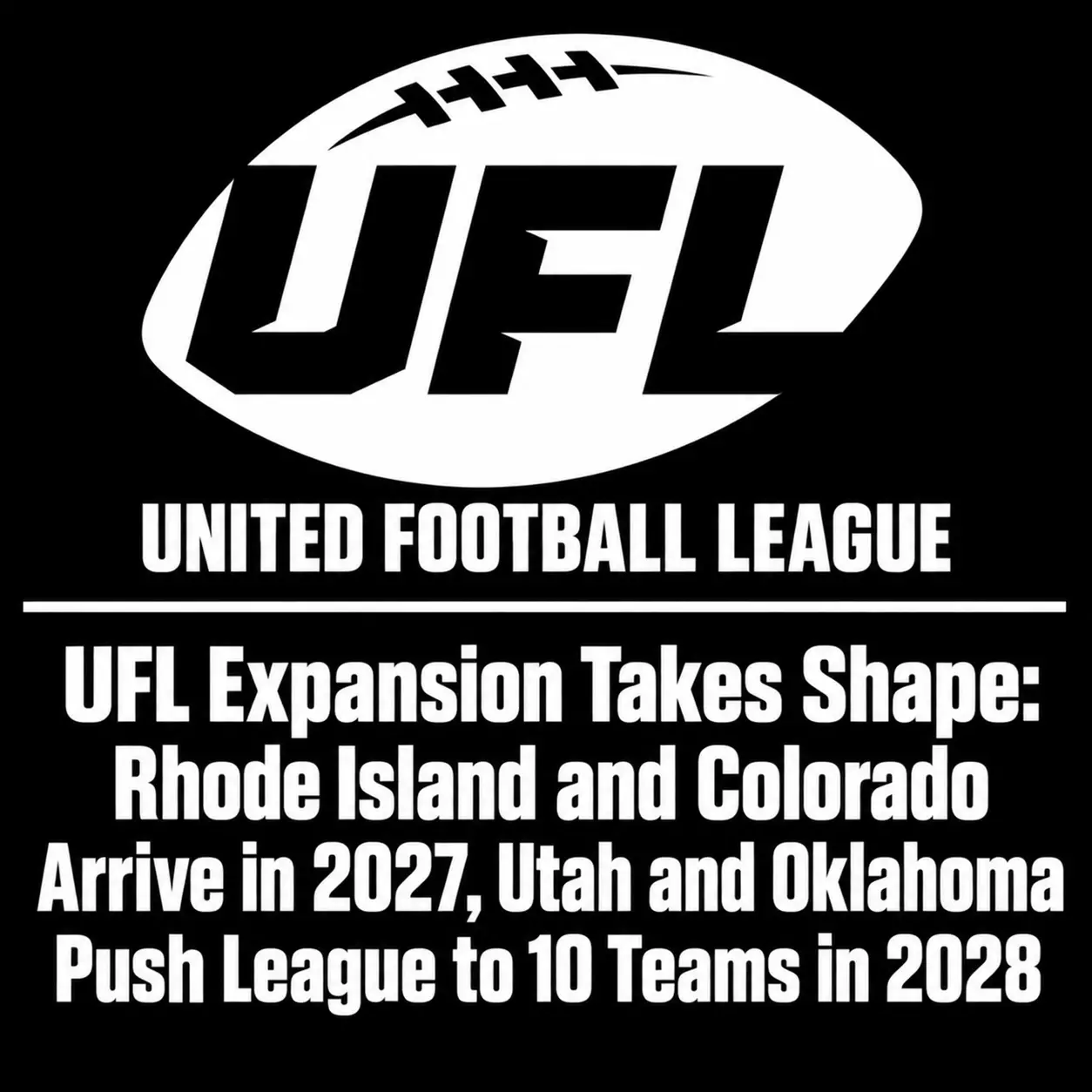
UFL Expansion Takes Shape: Rhode Island and Colorado Arrive in 2027, Utah and Oklahoma Push League to 10 Teams in 2028
The United Football League is making one of the biggest moves in modern spring football, adding four new markets over the next two seasons while reshaping its national footprint and setting the stage for further expansion.
The United Football League has officially revealed the next phase of its growth strategy.
On September 23, 2026, the UFL announced that
Rhode Island and Colorado will begin play in 2027, while
Utah and Oklahoma will join in 2028, when the league will grow from eight to 10 teams. The announcement provides considerably more clarity about where the league is headed after months of discussion about realignment, new markets and long-term expansion.
The moves also represent two different kinds of growth.
Rhode Island and Colorado will replace the departing Birmingham and Houston markets, meaning the UFL will remain an eight-team league in 2027. Utah and Oklahoma, however, will be true expansion franchises, increasing the league to 10 clubs beginning with the 2028 season.
And the league apparently isn’t planning to stop there.
The UFL has previously stated that its long-term goal is to reach
12 teams by 2030, with league officials acknowledging that strong interest from potential markets could accelerate that timetable to 2029.
Rhode Island Brings the UFL Into New England
One of the most interesting additions is Rhode Island.
The yet-to-be-named franchise will begin play in
Pawtucket in 2027, with home games at
Centreville Bank Stadium. The team is scheduled to play its first home game on
Friday, April 2, 2027, at 8 p.m. ET, as part of FOX UFL Friday.
Rhode Island’s complete identity won’t remain a mystery for long.
The UFL plans to unveil the team’s
name, colors, logos and overall brand identity on October 18
during a public event at Centreville Bank Stadium. Season-ticket information is also expected to be part of that launch.
The geographic significance may be just as important as the stadium itself.
The UFL currently has no franchise in the Northeast. A Pawtucket team gives the league an entry point into the broader New England sports market without attempting to compete directly inside Boston.
Centreville Bank Stadium also fits the venue philosophy the UFL has increasingly embraced. Rather than relying exclusively on massive NFL or major college stadiums that can look empty with spring-football crowds, the league has shown a preference for smaller venues capable of producing a more intimate game-day environment. The UFL specifically identified that strategy when it moved teams into soccer-oriented venues ahead of the 2026 season.
Centreville Bank Stadium opened in 2025 and is already home to Rhode Island FC. The venue has also hosted college football and other sporting events, giving the UFL a modern multipurpose facility rather than an oversized stadium designed for crowds several times larger than a typical spring-football attendance.
For the UFL, Rhode Island represents something it did not previously possess: a genuine foothold in New England.
Colorado Springs Gives the UFL a Unique Western Home
The second team arriving in 2027 will be located in
Colorado Springs, Colorado.
Colorado’s new UFL franchise will play at
Weidner Field, home of the Colorado Springs Switchbacks of the USL Championship. Its first home game is scheduled for
Sunday, April 11, 2027, at 1 p.m. Mountain Time — 3 p.m. ET — on ABC.
Like Rhode Island, Colorado will unveil its team name, colors, logos and branding during a public event, scheduled for
October 25 at Weidner Field.
There is also something unusual about the Colorado Springs venue.
According to the UFL, Weidner Field sits at approximately
6,035 feet above sea level, more than 750 feet higher than Denver’s Empower Field at Mile High. When UFL games begin there, the league says Weidner Field will become the highest-elevation home venue in professional football.
That could give the franchise an immediate identity.
Visiting teams will not simply be traveling to another stadium. They’ll be competing in an environment unlike anything else in the UFL, with altitude potentially becoming part of the home-field story.
Colorado Springs also gives the league a presence farther west while avoiding direct competition with an NFL franchise in Denver.
The market has an established sports culture that includes professional soccer, the United States Olympic and Paralympic Training Center and the nearby Air Force Academy. UFL officials are betting that spring football can become another part of that landscape.
Birmingham and Houston Are Out After 2026
Calling Rhode Island and Colorado “expansion” requires an important qualification.
They are new UFL markets, but they do
not
increase the number of teams in 2027.
The league announced on July 30 that it would leave
Birmingham and Houston
following the 2026 season as part of what it called a strategic market realignment. Rhode Island and Colorado take those two places, keeping the league at eight franchises.
That means the expected 2027 UFL lineup consists of:
Columbus Aviators
Dallas Renegades
DC Defenders
Louisville Kings
Orlando Storm
St. Louis Battlehawks
Colorado
Rhode Island
The UFL’s current team page already reflects the six returning established franchises following the departures of Birmingham and Houston.
Leaving Birmingham is particularly notable because the Stallions had been one of the most recognizable teams associated with the modern spring-football revival.
The UFL emphasized when announcing the departures that the decision was part of its long-term business strategy rather than a criticism of the players or supporters in either city. Co-owner Mike Repole said the objective was to build franchises in markets and venues capable of supporting the league over the long term.
It is another indication that this version of the UFL is willing to make aggressive changes rather than simply preserve markets because of their history.
Utah Becomes a True Expansion Franchise in 2028
The league’s numerical growth begins one year later.
In
2028, Utah will join the UFL, with the team playing at
America First Field in Sandy, part of the Salt Lake City metropolitan area.
America First Field is already the home of Major League Soccer’s Real Salt Lake and the NWSL’s Utah Royals.
The move puts the UFL into another major western market and continues the league’s trend toward using established soccer stadiums.
Utah already possesses a significant sports infrastructure. The region supports the NBA’s Utah Jazz, NHL’s Utah Mammoth, Real Salt Lake and the Utah Royals, while college football has a major presence through Utah, BYU and Utah State.
Salt Lake City will also host the
2034 Olympic and Paralympic Winter Games, further strengthening the region’s status as a major sports market.
Unlike Rhode Island and Colorado, however, Utah fans will have to wait longer for branding details.
The UFL says the Utah franchise’s
team name, logo, colors and launch plans will be announced closer to the 2028 season.
Oklahoma City Finally Gets Professional Spring Football
Utah will not enter alone.
Oklahoma City will also begin UFL play in 2028, giving the league 10 teams.
Oklahoma had actually been announced earlier. In April, the UFL revealed plans to put a franchise in Oklahoma City beginning in 2028, and Wednesday’s announcement officially placed that team alongside Utah as part of the league’s 10-team
expansion.
The Oklahoma franchise will play at the new
MAPS 4 Multipurpose Stadium, currently under construction in downtown Oklahoma City.
The facility is scheduled to open in early 2028 and is expected to have a capacity of just over
10,000 spectators.
That size is worth noting.
A roughly 10,000-seat football venue fits directly into the UFL’s developing stadium strategy: create demand inside a smaller building rather than attempt to fill 50,000 or 60,000 seats.
Oklahoma may also be one of the most intriguing football markets the league has entered.
The state has no NFL franchise but has an enormous football tradition centered around the University of Oklahoma, Oklahoma State and high school football. Oklahoma City has also demonstrated that it can support major professional sports through the NBA’s Oklahoma City Thunder.
UFL officials are clearly hoping some of that football enthusiasm transfers to the spring.
The Oklahoma team’s identity and branding will be announced later.
The UFL Is Changing Its Stadium Philosophy
Look closely at these four markets and a pattern emerges.
The UFL is not simply searching for the largest cities available.
It appears increasingly focused on the combination of
market, venue and fan experience.
Colorado will play in a soccer stadium.
Rhode Island will play in a soccer stadium.
Utah will play in a soccer stadium.
Oklahoma City will play in a new multipurpose venue with a capacity only slightly above 10,000.
This follows a strategy the league openly adopted before the 2026 season, when it moved franchises such as Dallas and Houston into soccer-oriented venues and added new franchises in Louisville, Columbus and Orlando.
For spring football, that approach has obvious advantages.
A crowd of 10,000 can look and sound impressive in a 10,000-to-20,000-seat stadium. The same crowd can appear sparse inside a massive NFL facility.
Smaller venues can also create greater ticket scarcity, stronger visual presentation for television and a louder atmosphere.
The UFL appears to be betting that building strong franchises does not necessarily begin with the biggest building. It begins with finding the right-sized building in a market that wants a team.
The 2026 Season Gave the UFL Reason to Grow
The expansion announcement comes after what the league describes as a successful 2026 season.
According to UFL figures, numerous games surpassed
one million television viewers, overall ticket sales increased, and the United Bowl sold out as the first-year
Louisville Kings defeated the DC Defenders 27-20 for the championship.
Louisville’s immediate success is particularly relevant to the
expansion
conversation.
The Kings did not simply enter the league as a new franchise. They won the championship in their first season, and Louisville will now host the opening game of the 2027 UFL season on
March 26 at Lynn Family Stadium.
The UFL has also continued to position itself as a developmental pathway to the NFL. The league reported that
118 former UFL players participated in NFL training camps following the 2026 season, with 46 eventually landing on NFL active rosters or practice squads.
That player-development component remains crucial.
Spring leagues have historically struggled when attempting to present themselves simply as competitors to the NFL. The UFL’s more sustainable opportunity may be as a complementary league — providing football during the NFL offseason while giving players another platform to earn their way back onto NFL rosters.
The UFL’s Map Is Starting to Look Very Different
The transformation of the league in only a couple of seasons is striking.
Before the 2026 season, the UFL added Louisville, Columbus and Orlando while repositioning and rebranding other franchises. Now Birmingham and Houston are leaving, Colorado Springs and Pawtucket are arriving, and Oklahoma City and Utah are waiting in the wings.
By 2028, the league’s geographic footprint is expected to stretch from the Northeast to the Rocky Mountain region and Utah, while maintaining teams in the Midwest, South and Mid-Atlantic.
The planned 10-team alignment will include six current franchises —
Columbus, Dallas, D.C., Louisville, Orlando and St. Louis
— plus
Rhode Island, Colorado, Utah and Oklahoma.
That is a significantly different league from the one that began play following the merger of the USFL and XFL.
Could the UFL Reach 12 Teams Even Sooner?
Ten teams apparently isn’t the final destination.
When the UFL announced the departure of Birmingham and Houston in July, the league said it was targeting a
12-team structure by 2030. It also left open the possibility that expansion could occur as early as
2029
if market interest and league momentum justified moving more quickly.
That creates an obvious next question:
Which cities come next?
The UFL has not announced the next two markets, and there is no reason to treat speculation as confirmation.
But the league’s recent choices provide clues about what officials appear to value: appropriate stadiums, strong football communities, local partnerships and markets where a spring team has an opportunity to establish its own identity.
Rather than simply chasing population numbers, the UFL seems to be looking for places capable of making the league feel important locally.
What Comes Next
The next major dates are already on the calendar.
Rhode Island will reveal its complete identity on
October 18.
Colorado follows with its branding announcement on
October 25.
The 2027 season then begins on
March 26, when defending champion Louisville opens the season at Lynn Family Stadium. Rhode Island’s first home game follows April 2, with Colorado’s home debut scheduled for April 11.
Utah and Oklahoma will spend another year preparing for their 2028 debuts.
There will still be major questions to answer — team names, coaches, player-allocation procedures, schedules, divisions or scheduling formats and how a 10-team league will handle the postseason.
But one question has now been answered.
The UFL intends to grow.
The Bottom Line
September 23,
2026
could eventually be remembered as an important date in the evolution of the United Football League.
Rhode Island and Colorado Springs are coming in 2027. Utah and Oklahoma City are coming in 2028. The league will grow to 10 teams, with 12 teams remaining the longer-term target.
The most important part of the announcement may not be any single city.
It is the strategy behind all four.
The UFL is trying to construct franchises around manageable stadiums, local partnerships and markets where professional spring football has room to establish itself. Rhode Island provides access to New England. Colorado Springs extends the western footprint. Utah enters one of America’s growing sports markets. Oklahoma City brings the league into one of the country’s most football-oriented states.
The UFL’s challenge now is turning expansion announcements into sustainable franchises.
If it can do that, the move from eight teams to 10 may ultimately be remembered not as the end of the
UFL’s expansion
story, but as the beginning of its next era.
New Users – Get $350 in Bonus Bets when you wager $5 for 7 days
T&Cs apply
4.6/5
Gambling Problem? Call 1-800-GAMBLER or 1-800-MY-RESET. Call 1-888-789-7777 or visit ccpgg.org/chat (CT). Hope is here. GamblingHelpLineMA.org or call (800) 327-5050 for 24/7 support (MA). Visit www.mdgamblinghelp.org (MD). Call 1-877-8HOPE-NY or text HOPENY (NY). 21+ (18+ DC, WY) and present in select states (for KS, in affiliation with Kansas Star Casino). Find online real money wagering only. Min $5 wager required for 7 consecutive days. $5 free play credit. Bonus issued as non-withdrawable bonus with cash withdrawable bonus with cash withdrawable. Bonus bets which expire 7 days after receipt. Restrictions apply. See terms at sportsbook.fanduel.com. Call 1-877-770-7867 (LA).
Up To $1500 in Bonus Bets Paid Back if your First Bet Does Not Win
T&Cs apply
4.5/5
Gambling problem? Call 1-800-GAMBLER or 1-800-MY-RESET (Available in the US) 877-8-HOPENY or text HOPENY (467369) (NY) 1-800-327-5050 (MA), 1-800-BETS-OFF (IA), 1-800-981-0023 (PR). 21+ only. Please Gamble Responsibly. See BetMGM.com for Terms. First Bet Offer for new customers only (if applicable). Subject to eligibility requirements. Bonus bets are non-withdrawable. In partnership with Kansas Crossing Casino and Hotel. Promotional offers not available in Mississippi, Massachusetts, New York, Ontario, or Puerto Rico.
New DraftKings Customers: Bet $5, Get $200 + 3 Months of NBA League Pass!
T&Cs apply
4.5/5
GAMBLING PROBLEM? CALL 1-800-GAMBLER or 1-800-MY-RESET, (800) 327-5050 or visit gamblinghelplinema.org (MA). Please Gamble Responsibly. 888-789-7777/visit ccpg.org (CT), or visit www.mdgamblinghelp.org (MD), 1-800-981-0023 (PR). 21+ and present in most states. (18+ DC/NH/PR/WY). Void in CAN. Eligibility restrictions apply. On behalf of Boot Hill Casino (KS). Pass-thru of per wager tax may apply in IL. 1 per new Sportsbook customer. $5+ first-time bet req. Max. $200 issued as non-withdrawable Bonus Bets. Stake removed from payout. Reward issued as $50 in Bonus Bets every 7 days via click-to-claim for 21 days. Bonus Bets and click-to-claims expire 7 days (168hrs) after issuance. Terms: dkng.co/offer. Get 1 promo code to redeem a 3-month NBA League Pass subscription, complimentary of DraftKings. Subscription auto-renews monthly at then-current price (currently $16.99/mo); cancel anytime. Terms, restrictions, and eligibility requirements apply. Redeem League Pass by 12/19/26 at 11:59 PM ET. Addt’l terms: support.watch.nba.com/hc/en-us/articles/9165532876183-League-Pass-Terms-of-Use_. Ends 11/29/26 at 11:59 PM ET. Sponsored by DK.
Must be 21+. GAMBLING PROBLEM? CALL 1-800-GAMBLER OR CALL 1-800-MY-RESET, www.mdgamblinghelp.org (MD), (800)-327-5050 or gamblinghelplinema.org (MA), Call (877)8-HOPENY or text HOPENY (467369) (NY), (888) 789-7777 or ccpg.org (CT), morethanagame.nc.gov (NC), 1800gambler.net (WV)
Bet $1 and get double the winnings up to $25 for your next 10 bets
T&Cs apply
4.4/5
21+ New users only. Must register using eligible promo code. First bet after registration must qualify. Max. Bonus Bet: $1,000. Bonus Bet expires 14 days after receipt. Void where prohibited. See Caesars.com/promos for full terms. Gambling Problem? 1-800-GAMBLER (1-800-426-2537)
21+ and present in OH. Gambling Problem? Call 1-800-GAMBLER.
This site is using
Cloudflare
and adheres to the
Google Safe Browsing Program. We adapted
Google's Privacy Guidelines
to keep your data safe at all times.
Close
Ready to Win Big? Join the Elite with Our Sports Betting Deals!
FanDuel Promo
New Users – Get $350 in Bonus Bets when you wager $5 for 7 days
Our Favorite
T&Cs and 21+ apply
Gambling Problem? Call 1-800-GAMBLER or 1-800-MY-RESET. Call 1-888-789-7777 or visit ccpgg.org/chat (CT). Hope is here. GamblingHelpLineMA.org or call (800) 327-5050 for 24/7 support (MA). Visit www.mdgamblinghelp.org (MD). Call 1-877-8HOPE-NY or text HOPENY (NY). 21+ (18+ DC, WY) and present in select states (for KS, in affiliation with Kansas Star Casino). Find online real money wagering only. Min $5 wager required for 7 consecutive days. $5 free play credit. Bonus issued as non-withdrawable bonus with cash withdrawable bonus with cash withdrawable. Bonus bets which expire 7 days after receipt. Restrictions apply. See terms at sportsbook.fanduel.com. Call 1-877-770-7867 (LA).
Code:
Open FanDuel
Get Bonus
BetMGM Promo
Up To $1500 in Bonus Bets Paid Back if your First Bet Does Not Win
Best Slots
T&Cs and 21+ apply
Gambling problem? Call 1-800-GAMBLER or 1-800-MY-RESET (Available in the US) 877-8-HOPENY or text HOPENY (467369) (NY) 1-800-327-5050 (MA), 1-800-BETS-OFF (IA), 1-800-981-0023 (PR). 21+ only. Please Gamble Responsibly. See BetMGM.com for Terms. First Bet Offer for new customers only (if applicable). Subject to eligibility requirements. Bonus bets are non-withdrawable. In partnership with Kansas Crossing Casino and Hotel. Promotional offers not available in Mississippi, Massachusetts, New York, Ontario, or Puerto Rico.
Code:
Open BetMGM
Get Bonus
DraftKings Promo
New DraftKings Customers: Bet $5, Get $200 + 3 Months of NBA League Pass!
Newcomer
T&Cs and 21+ apply
GAMBLING PROBLEM? CALL 1-800-GAMBLER or 1-800-MY-RESET, (800) 327-5050 or visit gamblinghelplinema.org (MA). Please Gamble Responsibly. 888-789-7777/visit ccpg.org (CT), or visit www.mdgamblinghelp.org (MD), 1-800-981-0023 (PR). 21+ and present in most states. (18+ DC/NH/PR/WY). Void in CAN. Eligibility restrictions apply. On behalf of Boot Hill Casino (KS). Pass-thru of per wager tax may apply in IL. 1 per new Sportsbook customer. $5+ first-time bet req. Max. $200 issued as non-withdrawable Bonus Bets. Stake removed from payout. Reward issued as $50 in Bonus Bets every 7 days via click-to-claim for 21 days. Bonus Bets and click-to-claims expire 7 days (168hrs) after issuance. Terms: dkng.co/offer. Get 1 promo code to redeem a 3-month NBA League Pass subscription, complimentary of DraftKings. Subscription auto-renews monthly at then-current price (currently $16.99/mo); cancel anytime. Terms, restrictions, and eligibility requirements apply. Redeem League Pass by 12/19/26 at 11:59 PM ET. Addt’l terms: support.watch.nba.com/hc/en-us/articles/9165532876183-League-Pass-Terms-of-Use_. Ends 11/29/26 at 11:59 PM ET. Sponsored by DK.
Code:
Open DraftKings
Get Bonus
Find out what the legends have to say about sports this week....
New Users – Get $350 in Bonus Bets when you wager $5 for 7 days
Gambling Problem? Call 1-800-GAMBLER or 1-800-MY-RESET. Call 1-888-789-7777 or visit ccpgg.org/chat (CT). Hope is here. GamblingHelpLineMA.org or call (800) 327-5050 for 24/7 support (MA). Visit www.mdgamblinghelp.org (MD). Call 1-877-8HOPE-NY or text HOPENY (NY). 21+ (18+ DC, WY) and present in select states (for KS, in affiliation with Kansas Star Casino). Find online real money wagering only. Min $5 wager required for 7 consecutive days. $5 free play credit. Bonus issued as non-withdrawable bonus with cash withdrawable bonus with cash withdrawable. Bonus bets which expire 7 days after receipt. Restrictions apply. See terms at sportsbook.fanduel.com. Call 1-877-770-7867 (LA).