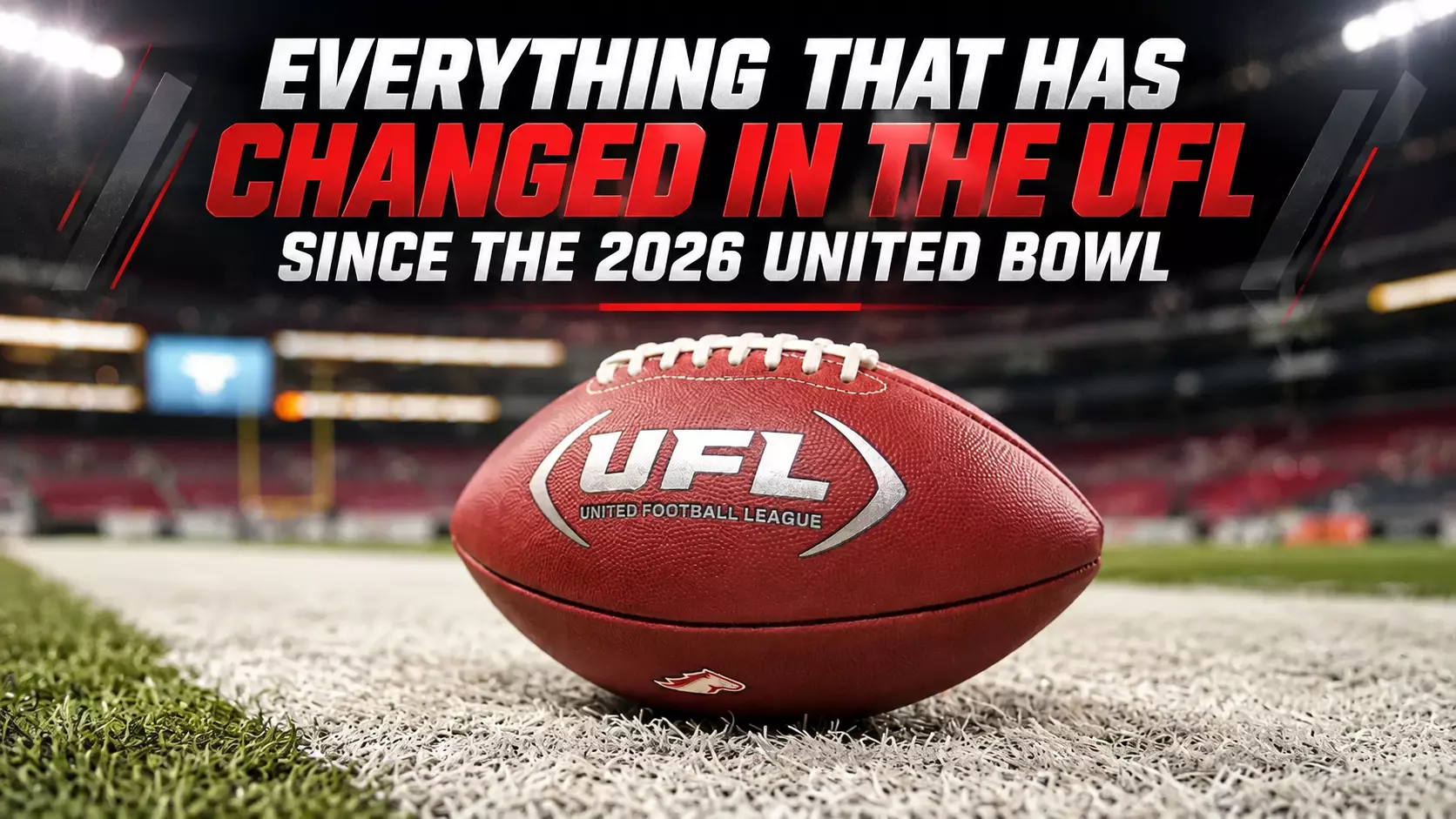
Everything That Has Changed in the UFL Since the 2026 United Bowl
Team relocations, expansion, coaching developments, innovative rules and a growing NFL pipeline are reshaping spring football heading into 2027
The confetti had barely settled after the Louisville Kings completed their remarkable inaugural season by defeating the D.C. Defenders
27-20 in the United Bowl on June 13
before the United Football League began moving toward its next era.
Louisville’s championship at Audi Field was only the end of the 2026 season. It was the beginning of an offseason that has included significant changes to the UFL’s geographical footprint, questions surrounding two coaching staffs, continued expansion plans and an extraordinary number of players receiving NFL opportunities.
As the UFL prepares for the 2027 season, here is everything that has happened since the United Bowl—and what football fans should be watching next.
Louisville Goes From Expansion Team to Defending Champion
Any discussion of the UFL’s offseason has to start with Louisville.
The Kings entered their first season in 2026 and endured a rough beginning before becoming the league’s best story.
Under first-year head coach
Chris Redman, Louisville recovered from an 0-3 start, won six of its final seven games and eventually captured the United Bowl.
The Kings went on the road in the playoffs and defeated the St. Louis Battlehawks before traveling to Washington and overcoming the Defenders in the championship game.
United Bowl MVP
Ian Wheeler
scored the go-ahead touchdown as Louisville erased a halftime deficit with 20 second-half points.
Now Louisville has been rewarded with one of the league’s showcase dates.
The UFL announced September 16 that the
2027 season will begin Friday, March 26, at 8 p.m. ET, when Louisville hosts the league opener at Lynn Family Stadium on FOX.
It will mark the second consecutive season that Louisville hosts the opening game of the UFL schedule.
For a franchise that didn’t exist before 2026, Louisville has quickly become one of the central markets in the UFL’s future.
Birmingham and Houston Are Out
The biggest UFL news since the championship came on July 30.
The league announced that it will
leave Birmingham and Houston following the 2026 season.
That means the Birmingham Stallions and Houston Gamblers will no longer operate in those markets in 2027.
Rather than reducing the size of the league, however, the UFL announced that
two new markets will replace Birmingham and Houston, keeping the league at eight teams next season.
The six markets currently confirmed to return are:
Columbus Aviators
Dallas Renegades
D.C. Defenders
Louisville Kings
Orlando Storm
St. Louis Battlehawks
The identity of the other two 2027 markets has not yet been officially announced.
It represents the second consecutive offseason in which the UFL has substantially altered its geographical footprint.
Before the
2026 season, the league moved on from Detroit, Memphis and San Antonio while introducing Columbus, Louisville and Orlando.
Now two more markets are changing.
Why Birmingham Lost the Stallions
Birmingham’s departure might be the most surprising because of the Stallions’ importance to modern spring-football history.
The Birmingham Stallions were one of the most successful franchises of the USFL/UFL era.
According to UFL co-owner
Mike Repole, however, the primary problem wasn’t Birmingham’s football tradition—it was the stadium.
Repole said the decision was entirely related to having what the league believed was the wrong-sized venue.
Even when approximately 16,000 fans attended opening day, Repole said the size of the stadium prevented the crowd from producing the atmosphere the league wants from its home markets.
That philosophy appears increasingly central to UFL expansion.
The league wants markets with passionate fan bases, but it also wants venues that look and feel full on television.
Smaller soccer-specific stadiums and modern venues in roughly the 10,000-to-25,000-seat range appear to fit that philosophy better than oversized football stadiums.
Importantly, Repole also indicated that the UFL would consider returning to Birmingham if an appropriate stadium solution develops.
So Birmingham may not necessarily be gone forever.
Houston’s Problem Was Different
Houston’s departure has a different explanation.
The league acknowledged that its own decisions made it difficult for the market to establish continuity.
Houston has experienced changes involving team identity, venues and organizational direction during the modern spring-football era.
Repole said Houston remains a strong sports city and praised Shell Energy Stadium, but admitted the league had not given the market the consistency necessary to build lasting momentum.
In other words, Birmingham’s issue was primarily the stadium.
Houston’s issue was stability.
Both franchises are leaving, but for very different reasons.
Where Will the UFL Go Next?
This is currently the biggest unanswered question surrounding the league.
The UFL has confirmed that two replacement markets will join in 2027, but it has not officially announced them.
Repole has publicly mentioned several markets during discussions about the league’s future.
Those possibilities have included
Austin, New England, Raleigh, Queens/New York, New Mexico, Greenville, Charleston, Utah and Boise.
Those cities should not be confused with confirmed franchises.
At this point they are markets the league has discussed or evaluated—not official 2027 teams.
The ultimate decisions will likely come down to the three factors Repole has repeatedly emphasized:
The right market. The right-sized stadium.A passionate fan base.
That formula may tell us more about the future of the UFL than population size alone.
The league appears willing to choose a smaller market with an enthusiastic audience and suitable stadium over a larger city where the UFL could become lost in an oversized venue.
Expansion Isn’t Stopping at Eight Teams
The Birmingham and Houston moves aren’t simply a contraction story.
The UFL plans to grow.
The league says it intends to expand to
10 teams by 2028
and eventually reach
12 teams by 2030, with officials saying that the 12-team timetable could potentially be accelerated to 2029.
One of those future markets is already known.
Oklahoma City Is Coming in 2028
Although the announcement came before the
United Bowl, it is an important piece of the league’s future structure.
The UFL announced in April that
Oklahoma City will receive a team beginning with the 2028 season.
The franchise is expected to play at the new MAPS 4 Multipurpose Stadium in downtown Oklahoma City.
The stadium is scheduled to open in early 2028 with a capacity of slightly more than 10,000 spectators—almost exactly the type of modern, intimate venue the UFL says it wants.
If everything proceeds according to plan, the league’s growth could look something like this:
2027: Eight teams
2028: Ten teams, including Oklahoma City
2029 or 2030: Potential expansion to 12 teams
That’s a significant difference from simply moving teams around.
The UFL appears to be attempting to establish a sustainable eight-team foundation before expanding from it.
What About the Rules?
One area that has been relatively quiet since the United Bowl is the rulebook.
As of September 18, the UFL has
not announced another major package of playing-rule changes for 2027.
That means the most recent significant changes remain the innovations introduced before the 2026 season.
Those included:
Four-point field goals:
Successful kicks from 60 yards or longer were worth four points.
One foot inbounds:
A receiver needed only one foot inbounds for a legal catch.
Tush Push ban:
The league eliminated the quarterback-push play that has become famous in the NFL.
No punting inside the opponent’s 50:
Teams were prohibited from punting after crossing midfield.
Modified overtime procedures:
The UFL continued experimenting with alternative overtime rules.
The four-point field goal became particularly noteworthy.
The UFL later highlighted how the rule changed late-game strategy and generated some of the season’s most memorable moments.
Whether the league adds another round of experimental rules for 2027 remains something to watch.
Innovation has clearly become part of the UFL’s identity.
The League Alignment Could Also Change Again
The 2026 UFL operated without the old USFL and XFL conferences.
Instead, all eight teams competed in one league standings table, with the four best records advancing to the playoffs.
No new conference or divisional alignment for 2027 has been announced.
With eight teams remaining next season, maintaining the single-table format would be possible.
Expansion to 10 teams in 2028, however, could eventually give the league reason to reconsider conferences or divisions.
That is another decision that could become clearer when the two new 2027 franchises are revealed.
Coaching Changes Have Been Relatively Quiet
For all the movement involving markets, the coaching situation among the six confirmed returning franchises has been surprisingly stable.
Chris Redman
is clearly returning with Louisville. The league specifically identified him as the Kings’ head coach while announcing the 2027 season opener.
Shannon Harris
is already preparing for another season with the D.C. Defenders.
Harris spent part of his offseason visiting six NFL training camps, studying practices, talking with coaches and evaluating personnel as he prepares for his third season running the Defenders.
Anthony Becht
also remains heavily involved with Orlando.
The 2026 UFL Coach of the Year led the Storm to an 8-2 regular-season record and the No. 1 playoff seed after previously coaching St. Louis. During the offseason he has continued evaluating potential UFL talent while balancing his broadcasting responsibilities.
There has been no corresponding league announcement replacing
Ted Ginn Jr. in Columbus, Rick Neuheisel in Dallas or Ricky Proehl in St. Louis.
The biggest coaching questions involve the franchises leaving their markets.
What Happens to A.J. McCarron and Kevin Sumlin?
Birmingham and Houston’s departures create two potentially significant coaching decisions.
A.J. McCarron
coached Birmingham in 2026, while former Houston and Texas A&M coach
Kevin Sumlin
led the Houston Gamblers.
What has not yet been publicly established is whether those football operations will simply move with the franchises into their replacement markets or whether the new teams will receive entirely new identities and coaching staffs.
Until the UFL announces its two 2027 markets, those questions remain unresolved.
The UFL-to-NFL Pipeline May Be the League’s Biggest Success
While team movement has generated headlines, perhaps the most encouraging development for the UFL has been what happened to its players after the season.
NFL teams aggressively pursued UFL talent.
Just 10 days after the United Bowl, the league announced that
23 players had already signed NFL contracts, while 47 players had participated in workouts and/or
signed with NFL organizations.
The numbers continued climbing.
By August 18,
59 players from the 2026 UFL season had signed NFL contracts, while 94 overall UFL or spring-football alumni were participating in NFL training camps.
When NFL rosters were finalized, the league reported that
45 modern UFL/spring-football players had earned places on active rosters or practice squads, with eight more landing on injured reserve.
Sixteen of those players came directly from the 2026 UFL season.
That pipeline was still visible in Week 2 of the NFL season, when the UFL reported
44 alumni on active NFL rosters or practice squads.
For the UFL, that may be one of the strongest selling points imaginable.
Come to the UFL.
Play meaningful professional football.
Create new film.
Get another NFL opportunity.
The Pipeline Goes Beyond Players
Players aren’t the only people moving upward.
The UFL announced in September that
17 football and business personnel members
had earned opportunities with NFL organizations or college football programs following the 2026 season.
That development strengthens the league’s claim that it can serve as a developmental platform for the entire football industry.
Coaches can develop.
Scouts can develop.
Front-office personnel can develop.
Players can develop.
That gives the UFL a purpose beyond simply being football played during the NFL offseason.
The Search for the Next UFL Players Has Already Started
While former UFL players chase NFL careers, the league is already searching for their replacements.
The UFL announced a nationwide schedule of player showcases running through the second half of 2026.
Events are scheduled in locations including Washington, St. Louis, Houston, Columbus, Atlanta, Phoenix, Orlando, Louisville, Los Angeles and Arlington.
Those showcases provide overlooked players another entry point into professional football.
They also allow UFL teams to rebuild rosters after losing some of their best performers to the NFL.
That’s the unusual challenge of a successful developmental league.
When the UFL does its job well, it loses good players.
Then it has to find the next ones.
Where Does the UFL Stand Heading Toward 2027?
Three months after Louisville raised the United Bowl trophy, the UFL looks considerably different.
Birmingham is gone.
Houston is gone.
Two new markets are coming.
Oklahoma City is waiting for 2028.
Louisville has gone from expansion experiment to defending champion.
Dozens of UFL players have received NFL opportunities.
And the league continues searching for the stadium sizes, cities, rules and business model that can finally create long-term stability for spring professional football.
There are still major questions.
Which two cities will receive teams in 2027?
Will those franchises inherit the Stallions and Gamblers identities or receive entirely new branding?
What happens to the Birmingham and Houston coaching staffs?
Will the UFL introduce more experimental rules?
Will the single-table playoff system remain in place?
And which market will join Oklahoma City when the league grows to 10 teams in 2028?
Those answers will shape the next stage of the UFL.
What is already clear is that the league isn’t standing still.
The 2026 United Bowl didn’t mark the end of something.
For the UFL, it appears to have marked the beginning of another transformation.
And when the Louisville Kings take the field at Lynn Family Stadium on
March 26, 2027, the league surrounding the defending champions could look considerably different from the one they conquered less than a year earlier.
New Users – Get $350 in Bonus Bets when you wager $5 for 7 days
T&Cs apply
4.6/5
Gambling Problem? Call 1-800-GAMBLER or 1-800-MY-RESET. Call 1-888-789-7777 or visit ccpgg.org/chat (CT). Hope is here. GamblingHelpLineMA.org or call (800) 327-5050 for 24/7 support (MA). Visit www.mdgamblinghelp.org (MD). Call 1-877-8HOPE-NY or text HOPENY (NY). 21+ (18+ DC, WY) and present in select states (for KS, in affiliation with Kansas Star Casino). Find online real money wagering only. Min $5 wager required for 7 consecutive days. $5 free play credit. Bonus issued as non-withdrawable bonus with cash withdrawable bonus with cash withdrawable. Bonus bets which expire 7 days after receipt. Restrictions apply. See terms at sportsbook.fanduel.com. Call 1-877-770-7867 (LA).
Up To $1500 in Bonus Bets Paid Back if your First Bet Does Not Win
T&Cs apply
4.5/5
Gambling problem? Call 1-800-GAMBLER or 1-800-MY-RESET (Available in the US) 877-8-HOPENY or text HOPENY (467369) (NY) 1-800-327-5050 (MA), 1-800-BETS-OFF (IA), 1-800-981-0023 (PR). 21+ only. Please Gamble Responsibly. See BetMGM.com for Terms. First Bet Offer for new customers only (if applicable). Subject to eligibility requirements. Bonus bets are non-withdrawable. In partnership with Kansas Crossing Casino and Hotel. Promotional offers not available in Mississippi, Massachusetts, New York, Ontario, or Puerto Rico.
New DraftKings Customers: Bet $5, Get $200 + 3 Months of NBA League Pass!
T&Cs apply
4.5/5
GAMBLING PROBLEM? CALL 1-800-GAMBLER or 1-800-MY-RESET, (800) 327-5050 or visit gamblinghelplinema.org (MA). Please Gamble Responsibly. 888-789-7777/visit ccpg.org (CT), or visit www.mdgamblinghelp.org (MD), 1-800-981-0023 (PR). 21+ and present in most states. (18+ DC/NH/PR/WY). Void in CAN. Eligibility restrictions apply. On behalf of Boot Hill Casino (KS). Pass-thru of per wager tax may apply in IL. 1 per new Sportsbook customer. $5+ first-time bet req. Max. $200 issued as non-withdrawable Bonus Bets. Stake removed from payout. Reward issued as $50 in Bonus Bets every 7 days via click-to-claim for 21 days. Bonus Bets and click-to-claims expire 7 days (168hrs) after issuance. Terms: dkng.co/offer. Get 1 promo code to redeem a 3-month NBA League Pass subscription, complimentary of DraftKings. Subscription auto-renews monthly at then-current price (currently $16.99/mo); cancel anytime. Terms, restrictions, and eligibility requirements apply. Redeem League Pass by 12/19/26 at 11:59 PM ET. Addt’l terms: support.watch.nba.com/hc/en-us/articles/9165532876183-League-Pass-Terms-of-Use_. Ends 11/29/26 at 11:59 PM ET. Sponsored by DK.
Must be 21+. GAMBLING PROBLEM? CALL 1-800-GAMBLER OR CALL 1-800-MY-RESET, www.mdgamblinghelp.org (MD), (800)-327-5050 or gamblinghelplinema.org (MA), Call (877)8-HOPENY or text HOPENY (467369) (NY), (888) 789-7777 or ccpg.org (CT), morethanagame.nc.gov (NC), 1800gambler.net (WV)
Bet $1 and get double the winnings up to $25 for your next 10 bets
T&Cs apply
4.4/5
21+ New users only. Must register using eligible promo code. First bet after registration must qualify. Max. Bonus Bet: $1,000. Bonus Bet expires 14 days after receipt. Void where prohibited. See Caesars.com/promos for full terms. Gambling Problem? 1-800-GAMBLER (1-800-426-2537)
21+ and present in OH. Gambling Problem? Call 1-800-GAMBLER.
This site is using
Cloudflare
and adheres to the
Google Safe Browsing Program. We adapted
Google's Privacy Guidelines
to keep your data safe at all times.
Close
Ready to Win Big? Join the Elite with Our Sports Betting Deals!
FanDuel Promo
New Users – Get $350 in Bonus Bets when you wager $5 for 7 days
Our Favorite
T&Cs and 21+ apply
Gambling Problem? Call 1-800-GAMBLER or 1-800-MY-RESET. Call 1-888-789-7777 or visit ccpgg.org/chat (CT). Hope is here. GamblingHelpLineMA.org or call (800) 327-5050 for 24/7 support (MA). Visit www.mdgamblinghelp.org (MD). Call 1-877-8HOPE-NY or text HOPENY (NY). 21+ (18+ DC, WY) and present in select states (for KS, in affiliation with Kansas Star Casino). Find online real money wagering only. Min $5 wager required for 7 consecutive days. $5 free play credit. Bonus issued as non-withdrawable bonus with cash withdrawable bonus with cash withdrawable. Bonus bets which expire 7 days after receipt. Restrictions apply. See terms at sportsbook.fanduel.com. Call 1-877-770-7867 (LA).
Code:
Open FanDuel
Get Bonus
BetMGM Promo
Up To $1500 in Bonus Bets Paid Back if your First Bet Does Not Win
Best Slots
T&Cs and 21+ apply
Gambling problem? Call 1-800-GAMBLER or 1-800-MY-RESET (Available in the US) 877-8-HOPENY or text HOPENY (467369) (NY) 1-800-327-5050 (MA), 1-800-BETS-OFF (IA), 1-800-981-0023 (PR). 21+ only. Please Gamble Responsibly. See BetMGM.com for Terms. First Bet Offer for new customers only (if applicable). Subject to eligibility requirements. Bonus bets are non-withdrawable. In partnership with Kansas Crossing Casino and Hotel. Promotional offers not available in Mississippi, Massachusetts, New York, Ontario, or Puerto Rico.
Code:
Open BetMGM
Get Bonus
DraftKings Promo
New DraftKings Customers: Bet $5, Get $200 + 3 Months of NBA League Pass!
Newcomer
T&Cs and 21+ apply
GAMBLING PROBLEM? CALL 1-800-GAMBLER or 1-800-MY-RESET, (800) 327-5050 or visit gamblinghelplinema.org (MA). Please Gamble Responsibly. 888-789-7777/visit ccpg.org (CT), or visit www.mdgamblinghelp.org (MD), 1-800-981-0023 (PR). 21+ and present in most states. (18+ DC/NH/PR/WY). Void in CAN. Eligibility restrictions apply. On behalf of Boot Hill Casino (KS). Pass-thru of per wager tax may apply in IL. 1 per new Sportsbook customer. $5+ first-time bet req. Max. $200 issued as non-withdrawable Bonus Bets. Stake removed from payout. Reward issued as $50 in Bonus Bets every 7 days via click-to-claim for 21 days. Bonus Bets and click-to-claims expire 7 days (168hrs) after issuance. Terms: dkng.co/offer. Get 1 promo code to redeem a 3-month NBA League Pass subscription, complimentary of DraftKings. Subscription auto-renews monthly at then-current price (currently $16.99/mo); cancel anytime. Terms, restrictions, and eligibility requirements apply. Redeem League Pass by 12/19/26 at 11:59 PM ET. Addt’l terms: support.watch.nba.com/hc/en-us/articles/9165532876183-League-Pass-Terms-of-Use_. Ends 11/29/26 at 11:59 PM ET. Sponsored by DK.
Code:
Open DraftKings
Get Bonus
Find out what the legends have to say about sports this week....
New Users – Get $350 in Bonus Bets when you wager $5 for 7 days
Gambling Problem? Call 1-800-GAMBLER or 1-800-MY-RESET. Call 1-888-789-7777 or visit ccpgg.org/chat (CT). Hope is here. GamblingHelpLineMA.org or call (800) 327-5050 for 24/7 support (MA). Visit www.mdgamblinghelp.org (MD). Call 1-877-8HOPE-NY or text HOPENY (NY). 21+ (18+ DC, WY) and present in select states (for KS, in affiliation with Kansas Star Casino). Find online real money wagering only. Min $5 wager required for 7 consecutive days. $5 free play credit. Bonus issued as non-withdrawable bonus with cash withdrawable bonus with cash withdrawable. Bonus bets which expire 7 days after receipt. Restrictions apply. See terms at sportsbook.fanduel.com. Call 1-877-770-7867 (LA).