The Bengals did not lose Sunday because Joe Burrow could not move the ball. He completed 28 of 37 passes for 282 yards and three touchdowns.
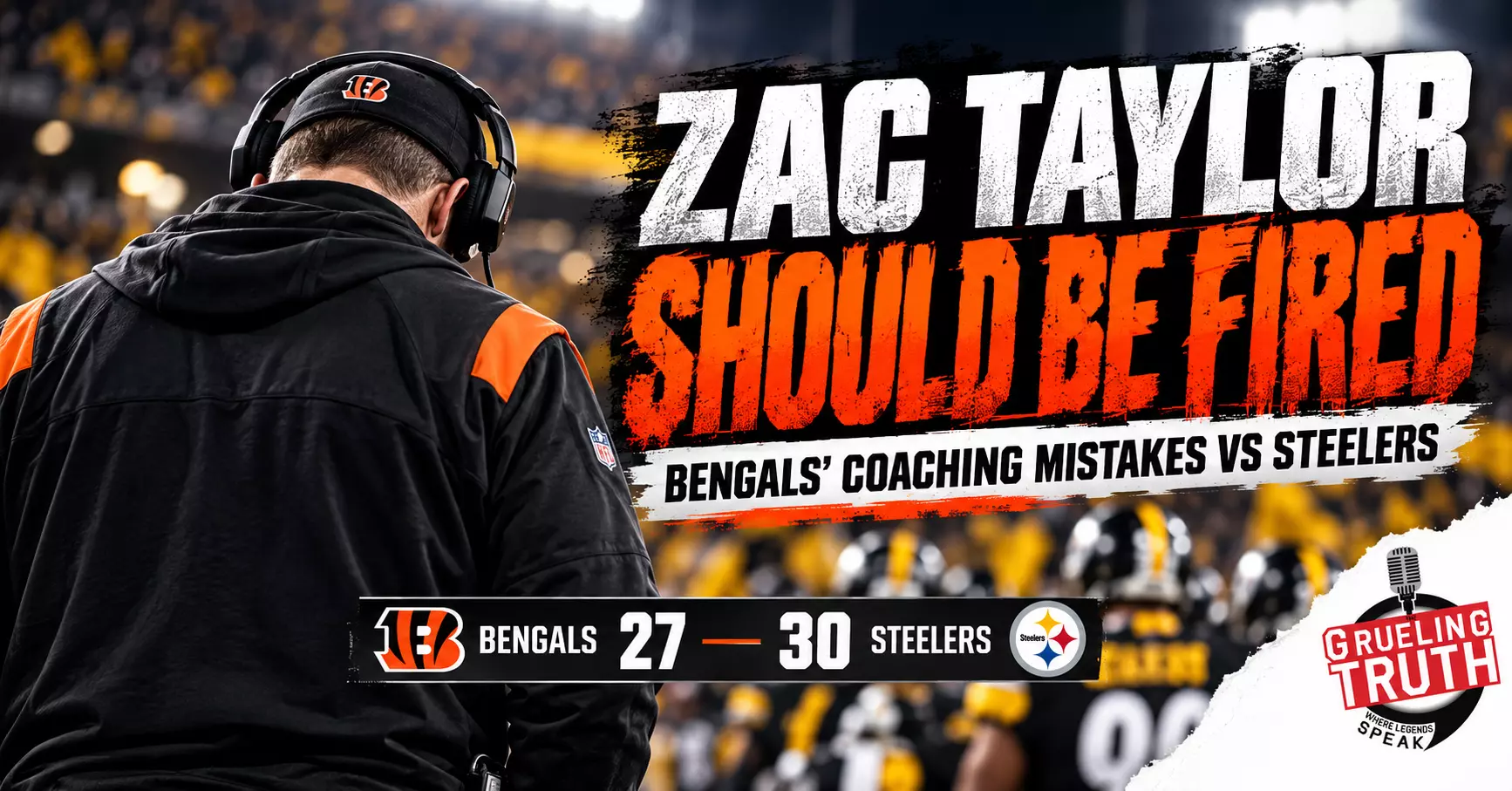
The Bengals did not lose Sunday because Joe Burrow could not move the ball. He completed 28 of 37 passes for 282 yards and three touchdowns. Cincinnati scored 27 points on the road against Pittsburgh and still lost, 30-27, on a strip-sack in the final minute.
Zac Taylor is right that players made mistakes in all three phases. But when a team repeatedly turns winnable games into lessons about discipline, communication and finishing, the head coach owns the pattern. Sunday gave the Bengals another painful example.
Taylor should be fired.
Two Stopped Drives Became 10 Steelers Points
Cincinnati led 20-17 in the third quarter when its defense forced a punt. Cedric Johnson roughed the punter, extending the possession, and Pittsburgh eventually scored a touchdown. Why in that field position at that point in the game are you even attempting to block a punt? Later, with the Bengals ahead 27-24, Ke’Shawn Williams muffed a punt, giving the Steelers the ball at Cincinnati’s 14. Pittsburgh kicked a field goal to tie the game. Taylor himself calculated the cost of those two special teams mistakes at
10 points.
Johnson and Williams are responsible for their individual errors. Taylor is responsible for a team that was unprepared to handle the moments that decide a divisional game. After the first punt disaster, Cincinnati had a clear warning about how costly a special teams mistake could be. It happened again with the fourth-quarter lead.
That is the coaching failure: not that Taylor personally touched either punt, but that the Bengals gave away possessions twice in the same game after their defense had done its job.
The Procedural Problems Reached the Final Drive
The offense was productive, yet it kept making its own work harder. Burrow acknowledged the penalties and procedural mistakes afterward. Those issues have carried from week to week, which makes them harder to dismiss as one bad afternoon.
Then came the final possession. Trailing 30-27 with 2:15 left, Cincinnati used a timeout before running its first play because it was not ready to snap the ball. The Bengals later reached the Pittsburgh 38, but a team trying to manage the clock, reach field-goal range and win the game had already spent a timeout fixing its own operation.
That is squarely within the head coach’s remit. Taylor has emphasized situational football. His team cannot afford a substitution and communication problem at the start of its most important drive of the day.
The Final Play Needed a Clearer Risk Calculation
Taylor said the Bengals wanted to score a touchdown rather than settle for a tying field goal. That was a defensible goal: Burrow had played well, and Cincinnati had time to attack. Taylor also acknowledged they would have kicked if necessary.
But once the Bengals reached the Pittsburgh 38, protecting the chance to tie became essential. On the next dropback, Derrick Harmon beat Dalton Risner, hit Burrow and forced the fumble that ended the game with 44 seconds left. Burrow bears responsibility for losing the ball. Taylor and his offensive staff bear responsibility for the plan, including how they protected the quarterback and balanced a touchdown attempt against the danger of a sack or turnover.
It would be unfair to claim that Taylor ordered Burrow to fumble. It is fair to ask why a drive that had reached a realistic tying position ended with the offense exposed to the one result it absolutely could not survive. Of you have the two wasted timeouts from earlier you could have afforded to run the ball against a light box to keep the defense off-balanced. Instead with only one timeout left your options are limited and you become a little more desperate.
The Defense Had No Answer for Pittsburgh’s Explosive Plays
The special teams errors did not account for all 30 Steelers points. Pittsburgh gained 411 yards, converted seven of 12 third downs, and got 176 total yards from Jaylen Warren. Aaron Rodgers threw three touchdowns.
The opening warning came almost immediately: Rodgers found Roman Wilson for a 38-yard touchdown less than two minutes into the game. Pittsburgh later caught Cincinnati unprepared for a designed play to Ben Skowronek, who scored from 23 yards. With the score tied late, Rodgers connected with Darnell Washington for 47 yards, and Warren followed with a 26-yard run to set up the winning field goal.
Defensive coordinator Al Golden and the players must answer for their assignments and tackling. Taylor must answer for the whole team. Pittsburgh kept finding big gains at the start of the game and on the drive when Cincinnati most needed a stop.
Burrow Played Well Enough to Win
The strongest argument for
firing Taylor
is that this was not a game in which his quarterback gave him nothing. Burrow completed his first 14 passes. Ja’Marr Chase caught nine balls for 98 yards, Tee Higgins added six catches for 90, and the Bengals scored touchdowns on two fourth-down plays. Taylor made aggressive calls that worked.
That makes the loss more frustrating, not less. Cincinnati got enough from its stars to win a road division game. Its defense forced two punts, only for special teams mistakes to hand both possessions back. Its offense reached the edge of tying range on the final drive, only to lose a timeout before the first snap and the ball on its last meaningful drive.
Taylor described the defeat as shared by all three phases. He was correct. He is also the person charged with getting all three phases ready.
The Bengals Need a Change
One loss does not automatically justify firing a coach, and Cincinnati is 2-1. Taylor deserves credit for the offense’s productive stretches and the successful fourth-down calls Sunday.
But this defeat fits a familiar and costly pattern: penalties, special teams breakdowns, explosive plays allowed and late-game operation that falls short of the talent on the roster. The Bengals have Joe Burrow. They have Ja’Marr Chase and Tee Higgins. They had enough opportunities in Pittsburgh to move to 3-0.
At some point, “we had our chances” stops being an explanation. For Zac Taylor, it has become the case against him. Cincinnati should make a coaching change before another season of Burrow’s prime disappears into games the Bengals could have won.
The numbers make the case against Zac Taylor harder to dismiss. Cincinnati is
6–51 when trailing entering the fourth quarter
under Taylor, winning just 10.5% of those games. His record without Joe Burrow starting is
9–30. That includes the 2019 season before Burrow arrived; even counting only games since Burrow was drafted, the Bengals are
7–16
with another starting quarterback. Over the last three completed seasons, Cincinnati is
24–27
and has missed the playoffs every year. Those records do not put every loss on Taylor, but they raise a fair question: after seven seasons, has he shown he can consistently win when Burrow cannot carry the team or the Bengals fall behind?
New Users – Get $350 in Bonus Bets when you wager $5 for 7 days
T&Cs apply
4.6/5
Gambling Problem? Call 1-800-GAMBLER or 1-800-MY-RESET. Call 1-888-789-7777 or visit ccpgg.org/chat (CT). Hope is here. GamblingHelpLineMA.org or call (800) 327-5050 for 24/7 support (MA). Visit www.mdgamblinghelp.org (MD). Call 1-877-8HOPE-NY or text HOPENY (NY). 21+ (18+ DC, WY) and present in select states (for KS, in affiliation with Kansas Star Casino). Find online real money wagering only. Min $5 wager required for 7 consecutive days. $5 free play credit. Bonus issued as non-withdrawable bonus with cash withdrawable bonus with cash withdrawable. Bonus bets which expire 7 days after receipt. Restrictions apply. See terms at sportsbook.fanduel.com. Call 1-877-770-7867 (LA).
Up To $1500 in Bonus Bets Paid Back if your First Bet Does Not Win
T&Cs apply
4.5/5
Gambling problem? Call 1-800-GAMBLER or 1-800-MY-RESET (Available in the US) 877-8-HOPENY or text HOPENY (467369) (NY) 1-800-327-5050 (MA), 1-800-BETS-OFF (IA), 1-800-981-0023 (PR). 21+ only. Please Gamble Responsibly. See BetMGM.com for Terms. First Bet Offer for new customers only (if applicable). Subject to eligibility requirements. Bonus bets are non-withdrawable. In partnership with Kansas Crossing Casino and Hotel. Promotional offers not available in Mississippi, Massachusetts, New York, Ontario, or Puerto Rico.
New DraftKings Customers: Bet $5, Get $200 + 3 Months of NBA League Pass!
T&Cs apply
4.5/5
GAMBLING PROBLEM? CALL 1-800-GAMBLER or 1-800-MY-RESET, (800) 327-5050 or visit gamblinghelplinema.org (MA). Please Gamble Responsibly. 888-789-7777/visit ccpg.org (CT), or visit www.mdgamblinghelp.org (MD), 1-800-981-0023 (PR). 21+ and present in most states. (18+ DC/NH/PR/WY). Void in CAN. Eligibility restrictions apply. On behalf of Boot Hill Casino (KS). Pass-thru of per wager tax may apply in IL. 1 per new Sportsbook customer. $5+ first-time bet req. Max. $200 issued as non-withdrawable Bonus Bets. Stake removed from payout. Reward issued as $50 in Bonus Bets every 7 days via click-to-claim for 21 days. Bonus Bets and click-to-claims expire 7 days (168hrs) after issuance. Terms: dkng.co/offer. Get 1 promo code to redeem a 3-month NBA League Pass subscription, complimentary of DraftKings. Subscription auto-renews monthly at then-current price (currently $16.99/mo); cancel anytime. Terms, restrictions, and eligibility requirements apply. Redeem League Pass by 12/19/26 at 11:59 PM ET. Addt’l terms: support.watch.nba.com/hc/en-us/articles/9165532876183-League-Pass-Terms-of-Use_. Ends 11/29/26 at 11:59 PM ET. Sponsored by DK.
Must be 21+. GAMBLING PROBLEM? CALL 1-800-GAMBLER OR CALL 1-800-MY-RESET, www.mdgamblinghelp.org (MD), (800)-327-5050 or gamblinghelplinema.org (MA), Call (877)8-HOPENY or text HOPENY (467369) (NY), (888) 789-7777 or ccpg.org (CT), morethanagame.nc.gov (NC), 1800gambler.net (WV)
Bet $1 and get double the winnings up to $25 for your next 10 bets
T&Cs apply
4.4/5
21+ New users only. Must register using eligible promo code. First bet after registration must qualify. Max. Bonus Bet: $1,000. Bonus Bet expires 14 days after receipt. Void where prohibited. See Caesars.com/promos for full terms. Gambling Problem? 1-800-GAMBLER (1-800-426-2537)
21+ and present in OH. Gambling Problem? Call 1-800-GAMBLER.
This site is using
Cloudflare
and adheres to the
Google Safe Browsing Program. We adapted
Google's Privacy Guidelines
to keep your data safe at all times.
Close
Ready to Win Big? Join the Elite with Our Sports Betting Deals!
FanDuel Promo
New Users – Get $350 in Bonus Bets when you wager $5 for 7 days
Our Favorite
T&Cs and 21+ apply
Gambling Problem? Call 1-800-GAMBLER or 1-800-MY-RESET. Call 1-888-789-7777 or visit ccpgg.org/chat (CT). Hope is here. GamblingHelpLineMA.org or call (800) 327-5050 for 24/7 support (MA). Visit www.mdgamblinghelp.org (MD). Call 1-877-8HOPE-NY or text HOPENY (NY). 21+ (18+ DC, WY) and present in select states (for KS, in affiliation with Kansas Star Casino). Find online real money wagering only. Min $5 wager required for 7 consecutive days. $5 free play credit. Bonus issued as non-withdrawable bonus with cash withdrawable bonus with cash withdrawable. Bonus bets which expire 7 days after receipt. Restrictions apply. See terms at sportsbook.fanduel.com. Call 1-877-770-7867 (LA).
Code:
Open FanDuel
Get Bonus
BetMGM Promo
Up To $1500 in Bonus Bets Paid Back if your First Bet Does Not Win
Best Slots
T&Cs and 21+ apply
Gambling problem? Call 1-800-GAMBLER or 1-800-MY-RESET (Available in the US) 877-8-HOPENY or text HOPENY (467369) (NY) 1-800-327-5050 (MA), 1-800-BETS-OFF (IA), 1-800-981-0023 (PR). 21+ only. Please Gamble Responsibly. See BetMGM.com for Terms. First Bet Offer for new customers only (if applicable). Subject to eligibility requirements. Bonus bets are non-withdrawable. In partnership with Kansas Crossing Casino and Hotel. Promotional offers not available in Mississippi, Massachusetts, New York, Ontario, or Puerto Rico.
Code:
Open BetMGM
Get Bonus
DraftKings Promo
New DraftKings Customers: Bet $5, Get $200 + 3 Months of NBA League Pass!
Newcomer
T&Cs and 21+ apply
GAMBLING PROBLEM? CALL 1-800-GAMBLER or 1-800-MY-RESET, (800) 327-5050 or visit gamblinghelplinema.org (MA). Please Gamble Responsibly. 888-789-7777/visit ccpg.org (CT), or visit www.mdgamblinghelp.org (MD), 1-800-981-0023 (PR). 21+ and present in most states. (18+ DC/NH/PR/WY). Void in CAN. Eligibility restrictions apply. On behalf of Boot Hill Casino (KS). Pass-thru of per wager tax may apply in IL. 1 per new Sportsbook customer. $5+ first-time bet req. Max. $200 issued as non-withdrawable Bonus Bets. Stake removed from payout. Reward issued as $50 in Bonus Bets every 7 days via click-to-claim for 21 days. Bonus Bets and click-to-claims expire 7 days (168hrs) after issuance. Terms: dkng.co/offer. Get 1 promo code to redeem a 3-month NBA League Pass subscription, complimentary of DraftKings. Subscription auto-renews monthly at then-current price (currently $16.99/mo); cancel anytime. Terms, restrictions, and eligibility requirements apply. Redeem League Pass by 12/19/26 at 11:59 PM ET. Addt’l terms: support.watch.nba.com/hc/en-us/articles/9165532876183-League-Pass-Terms-of-Use_. Ends 11/29/26 at 11:59 PM ET. Sponsored by DK.
Code:
Open DraftKings
Get Bonus
Find out what the legends have to say about sports this week....
New Users – Get $350 in Bonus Bets when you wager $5 for 7 days
Gambling Problem? Call 1-800-GAMBLER or 1-800-MY-RESET. Call 1-888-789-7777 or visit ccpgg.org/chat (CT). Hope is here. GamblingHelpLineMA.org or call (800) 327-5050 for 24/7 support (MA). Visit www.mdgamblinghelp.org (MD). Call 1-877-8HOPE-NY or text HOPENY (NY). 21+ (18+ DC, WY) and present in select states (for KS, in affiliation with Kansas Star Casino). Find online real money wagering only. Min $5 wager required for 7 consecutive days. $5 free play credit. Bonus issued as non-withdrawable bonus with cash withdrawable bonus with cash withdrawable. Bonus bets which expire 7 days after receipt. Restrictions apply. See terms at sportsbook.fanduel.com. Call 1-877-770-7867 (LA).