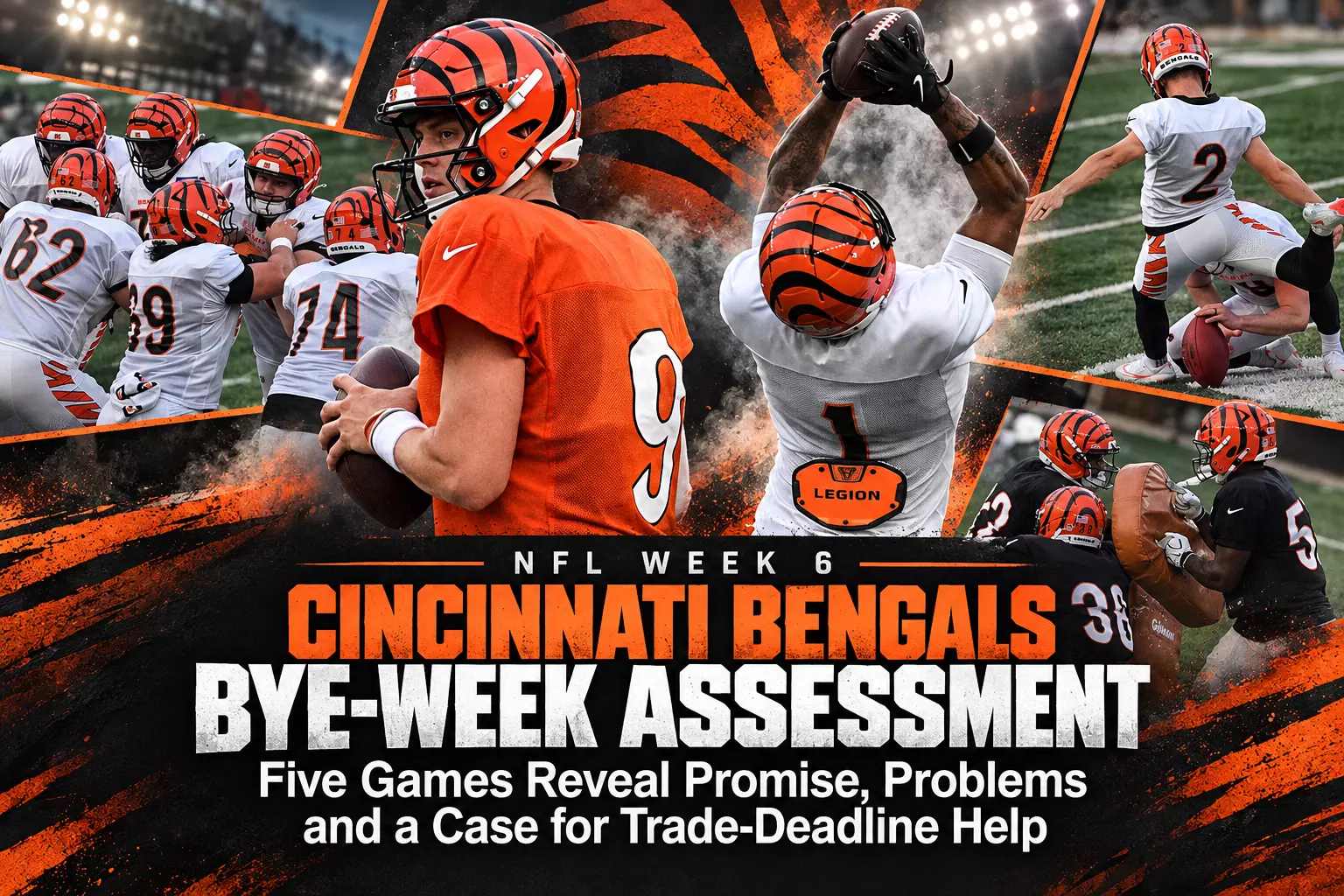
Cincinnati Bengals Bye-Week Assessment: Five Games Reveal Promise, Problems and a Case for Trade-Deadline Help
The Cincinnati Bengals enter their bye week with a winning record, a productive franchise quarterback and a legitimate opportunity to shape their season. They also arrive with several issues that demand attention before the schedule resumes.
At 3–2, Cincinnati has demonstrated both its potential and its vulnerability. Victories over Tampa Bay, Houston and Miami have provided encouraging moments, while narrow losses to Pittsburgh and Jacksonville exposed the consequences of missed opportunities. Through five games, the Bengals have outscored opponents 128–109, but their two defeats came by a combined eight points. Their next assignment is an October 25 trip to Baltimore, giving this early break considerable importance.
For head coach Zac Taylor and his staff, the objective should be clear: turn an uneven opening stretch into a more dependable brand of football. That begins with improving run defense, creating greater offensive balance and eliminating mistakes that have made winnable games unnecessarily difficult.
The season opener offered an encouraging example of Cincinnati receiving contributions throughout the roster. In a 33–27 victory over Tampa Bay, the defense recovered four fumbles, including one returned for a touchdown by linebacker Demetrius Knight Jr. Mike Gesicki contributed 78 receiving yards, Evan McPherson made four field goals, and the offense maintained possession for the final 3:19 to secure the win.
That final possession was particularly significant. Cincinnati demonstrated that it could protect a lead through offensive execution. The bye-week challenge is to make that ability a consistent feature of the team.
The following week produced the Bengals’ strongest defensive performance. Cincinnati defeated Houston 20–6, limiting the Texans to 60 rushing yards and five conversions on 17 third-down attempts. Dexter Lawrence delivered a crucial fourth-and-inches stop, while Ja’Marr Chase caught two touchdown passes from Joe Burrow.
Houston should serve as a reference point for the defensive staff. The Bengals controlled the running game, created difficult situations and ended possessions. Their offense could operate patiently because the defense kept the game manageable.
The third week delivered a costly reminder that productive offense cannot always overcome avoidable mistakes.
Burrow threw for 282 yards and three touchdowns against Pittsburgh, but
Cincinnati lost
30–27. A roughing-the-punter penalty and a muffed punt helped produce 10 Steelers points. The Bengals held a fourth-quarter lead before Pittsburgh moved ahead, and a late Burrow fumble ended Cincinnati’s final opportunity.
In a divisional matchup decided by three points, those errors carried enormous weight. Cincinnati had enough offensive production to win, but possession security and special-teams discipline failed at critical moments.
The Jacksonville loss presented a different problem. Burrow passed for 428 yards, and Tee Higgins finished with 11 receptions for 157 yards, yet the Bengals scored only 17 points. Two interceptions damaged Cincinnati’s chances, and its final possession failed to produce the touchdown needed to overturn a 22–17 deficit. Injuries also removed Chase and Higgins from the game.
That afternoon deserves close examination during the bye. Passing yardage measures movement, but scoring determines outcomes. Cincinnati must understand why productive stretches failed to become finishing drives and prepare more dependable alternatives when its leading receivers are unavailable.
Sunday’s 31–24 victory over Miami restored a winning record. Burrow threw four touchdown passes, and Jordan Battle intercepted two passes. However, Miami rushed for 217 yards, and Cincinnati’s 28–10 lead ultimately became a seven-point victory.
The win was valuable. The defensive warning was equally clear.
Across the opening five games, Cincinnati has allowed 615 rushing yards at 5.0 yards per attempt. Its own rushing offense has generated 414 yards at 3.6 per carry. That imbalance deserves immediate attention on both sides of the ball.
Defensively, the Bengals must determine where responsibility breaks down. Interior penetration, edge containment, linebacker positioning and tackling all affect rushing results. A defender abandoning his assignment can undermine an otherwise well-executed play.
The staff should distinguish physical losses from recognition and communication mistakes before deciding whether personnel changes are necessary. Adding talent can help, but it cannot substitute for coordinated execution.
There are encouraging pieces to build around. Lawrence, Jonathan Allen and Boye Mafe combined for 12 pressures against Jacksonville, according to Cincy Jungle’s film analysis. Their ability to disrupt passing plays offers a foundation for the defense’s development.
The challenge is creating more situations in which that pressure can matter. Allowing productive early-down runs gives opposing offenses flexibility and reduces opportunities for the defensive front to attack obvious passing situations.
Offensively, Burrow remains the strongest reason for confidence. Cincinnati’s official statistics list a 71.4% completion rate, 11 touchdown passes and three interceptions through five games. The Bengals have also converted half of their third-down opportunities.
Those numbers support an offense capable of sustaining possessions. Improving the running game would make that offense more difficult to defend and provide additional options when Cincinnati needs to protect a lead.
The solution should emphasize efficiency. The Bengals need to identify their most successful blocking combinations and rushing concepts, then build around them. An increased commitment to ineffective runs would simply create more difficult passing situations.
Special teams also require a balanced assessment. McPherson has been outstanding, making all 10 field-goal attempts, including five from at least 50 yards. His accuracy has provided dependable scoring, but the Pittsburgh game demonstrated why kicking success cannot excuse mistakes in other special-teams responsibilities.
Punt decisions, ball security and disciplined rush assignments should receive focused attention. These are correctable details with direct consequences in close games.
The bye also presents an opportunity for the front office to evaluate outside help before the November 10 trade deadline. Cincinnati should actively explore the market, particularly for defensive assistance, while maintaining a clear standard for what constitutes an upgrade.
Cornerback would be a sensible starting point. A dependable coverage addition could strengthen Cincinnati’s options and help the defensive front capitalize on its pressure. Linebacker should also receive consideration, especially if the internal review identifies second-level positioning or tackling as a recurring source of rushing breakdowns.
Two potential cornerback options are Brandon Stephens of the New York Jets and Zyon McCollum of Tampa Bay. PFF identified Cincinnati as a possible fit for both in its October 7 trade-candidate analysis, noting Stephens’ strong man-coverage performance and discussing McCollum’s potential fit despite uneven recent results. These are suggested possibilities, rather than confirmed Bengals trade discussions.
Stephens would merit an initial inquiry if the Jets become willing sellers. Any pursuit should depend on acquisition cost, contract obligations and Cincinnati’s evaluation of his ability to contribute immediately. The Bengals should also investigate interior offensive-line help if a clear improvement becomes available.
The purpose of a deadline move should be specific: address a weakness that threatens the team’s ability to win meaningful games. Cincinnati should resist paying a premium for name recognition or making a move simply to demonstrate urgency.
The first five weeks have left the Bengals with a credible opportunity and a clear list of responsibilities. They have shown they can generate turnovers, deliver efficient passing performances and win through multiple phases. They have also allowed mistakes and inconsistent execution to diminish those strengths.
Cincinnati’s bye week
will be successful if it produces healthier receiving options, clearer defensive assignments, more useful rushing production and greater discipline in decisive situations. A targeted trade could strengthen that progress, but the most immediate improvements must come from the players and coaches already in the building.
The Bengals have positioned themselves to compete. Their next step is proving they can play complete football consistently enough to turn that position into a postseason berth.
Up To $1500 in Bonus Bets Paid Back if your First Bet Does Not Win
T&Cs apply
4.5/5
Gambling problem? Call 1-800-GAMBLER or 1-800-MY-RESET (Available in the US) 877-8-HOPENY or text HOPENY (467369) (NY) 1-800-327-5050 (MA), 1-800-BETS-OFF (IA), 1-800-981-0023 (PR). 21+ only. Please Gamble Responsibly. See BetMGM.com for Terms. First Bet Offer for new customers only (if applicable). Subject to eligibility requirements. Bonus bets are non-withdrawable. In partnership with Kansas Crossing Casino and Hotel. Promotional offers not available in Mississippi, Massachusetts, New York, Ontario, or Puerto Rico.
New DraftKings Customers: Bet $5, Get $200 + 3 Months of NBA League Pass!
T&Cs apply
4.5/5
GAMBLING PROBLEM? CALL 1-800-GAMBLER or 1-800-MY-RESET, (800) 327-5050 or visit gamblinghelplinema.org (MA). Please Gamble Responsibly. 888-789-7777/visit ccpg.org (CT), or visit www.mdgamblinghelp.org (MD), 1-800-981-0023 (PR). 21+ and present in most states. (18+ DC/NH/PR/WY). Void in CAN. Eligibility restrictions apply. On behalf of Boot Hill Casino (KS). Pass-thru of per wager tax may apply in IL. 1 per new Sportsbook customer. $5+ first-time bet req. Max. $200 issued as non-withdrawable Bonus Bets. Stake removed from payout. Reward issued as $50 in Bonus Bets every 7 days via click-to-claim for 21 days. Bonus Bets and click-to-claims expire 7 days (168hrs) after issuance. Terms: dkng.co/offer. Get 1 promo code to redeem a 3-month NBA League Pass subscription, complimentary of DraftKings. Subscription auto-renews monthly at then-current price (currently $16.99/mo); cancel anytime. Terms, restrictions, and eligibility requirements apply. Redeem League Pass by 12/19/26 at 11:59 PM ET. Addt’l terms: support.watch.nba.com/hc/en-us/articles/9165532876183-League-Pass-Terms-of-Use_. Ends 11/29/26 at 11:59 PM ET. Sponsored by DK.
Must be 21+. GAMBLING PROBLEM? CALL 1-800-GAMBLER OR CALL 1-800-MY-RESET, www.mdgamblinghelp.org (MD), (800)-327-5050 or gamblinghelplinema.org (MA), Call (877)8-HOPENY or text HOPENY (467369) (NY), (888) 789-7777 or ccpg.org (CT), morethanagame.nc.gov (NC), 1800gambler.net (WV)
Bet $1 and get double the winnings up to $25 for your next 10 bets
T&Cs apply
4.4/5
21+ New users only. Must register using eligible promo code. First bet after registration must qualify. Max. Bonus Bet: $1,000. Bonus Bet expires 14 days after receipt. Void where prohibited. See Caesars.com/promos for full terms. Gambling Problem? 1-800-GAMBLER (1-800-426-2537)
21+ and present in OH. Gambling Problem? Call 1-800-GAMBLER.
This site is using
Cloudflare
and adheres to the
Google Safe Browsing Program. We adapted
Google's Privacy Guidelines
to keep your data safe at all times.
Close
Ready to Win Big? Join the Elite with Our Sports Betting Deals!
FanDuel Promo
New Users – Get $250 in Bonus Bets when you wager $5 for 5 days
Up To $1500 in Bonus Bets Paid Back if your First Bet Does Not Win
Best Slots
T&Cs and 21+ apply
Gambling problem? Call 1-800-GAMBLER or 1-800-MY-RESET (Available in the US) 877-8-HOPENY or text HOPENY (467369) (NY) 1-800-327-5050 (MA), 1-800-BETS-OFF (IA), 1-800-981-0023 (PR). 21+ only. Please Gamble Responsibly. See BetMGM.com for Terms. First Bet Offer for new customers only (if applicable). Subject to eligibility requirements. Bonus bets are non-withdrawable. In partnership with Kansas Crossing Casino and Hotel. Promotional offers not available in Mississippi, Massachusetts, New York, Ontario, or Puerto Rico.
Code:
Open BetMGM
Get Bonus
DraftKings Promo
New DraftKings Customers: Bet $5, Get $200 + 3 Months of NBA League Pass!
Newcomer
T&Cs and 21+ apply
GAMBLING PROBLEM? CALL 1-800-GAMBLER or 1-800-MY-RESET, (800) 327-5050 or visit gamblinghelplinema.org (MA). Please Gamble Responsibly. 888-789-7777/visit ccpg.org (CT), or visit www.mdgamblinghelp.org (MD), 1-800-981-0023 (PR). 21+ and present in most states. (18+ DC/NH/PR/WY). Void in CAN. Eligibility restrictions apply. On behalf of Boot Hill Casino (KS). Pass-thru of per wager tax may apply in IL. 1 per new Sportsbook customer. $5+ first-time bet req. Max. $200 issued as non-withdrawable Bonus Bets. Stake removed from payout. Reward issued as $50 in Bonus Bets every 7 days via click-to-claim for 21 days. Bonus Bets and click-to-claims expire 7 days (168hrs) after issuance. Terms: dkng.co/offer. Get 1 promo code to redeem a 3-month NBA League Pass subscription, complimentary of DraftKings. Subscription auto-renews monthly at then-current price (currently $16.99/mo); cancel anytime. Terms, restrictions, and eligibility requirements apply. Redeem League Pass by 12/19/26 at 11:59 PM ET. Addt’l terms: support.watch.nba.com/hc/en-us/articles/9165532876183-League-Pass-Terms-of-Use_. Ends 11/29/26 at 11:59 PM ET. Sponsored by DK.
Code:
Open DraftKings
Get Bonus
Find out what the legends have to say about sports this week....