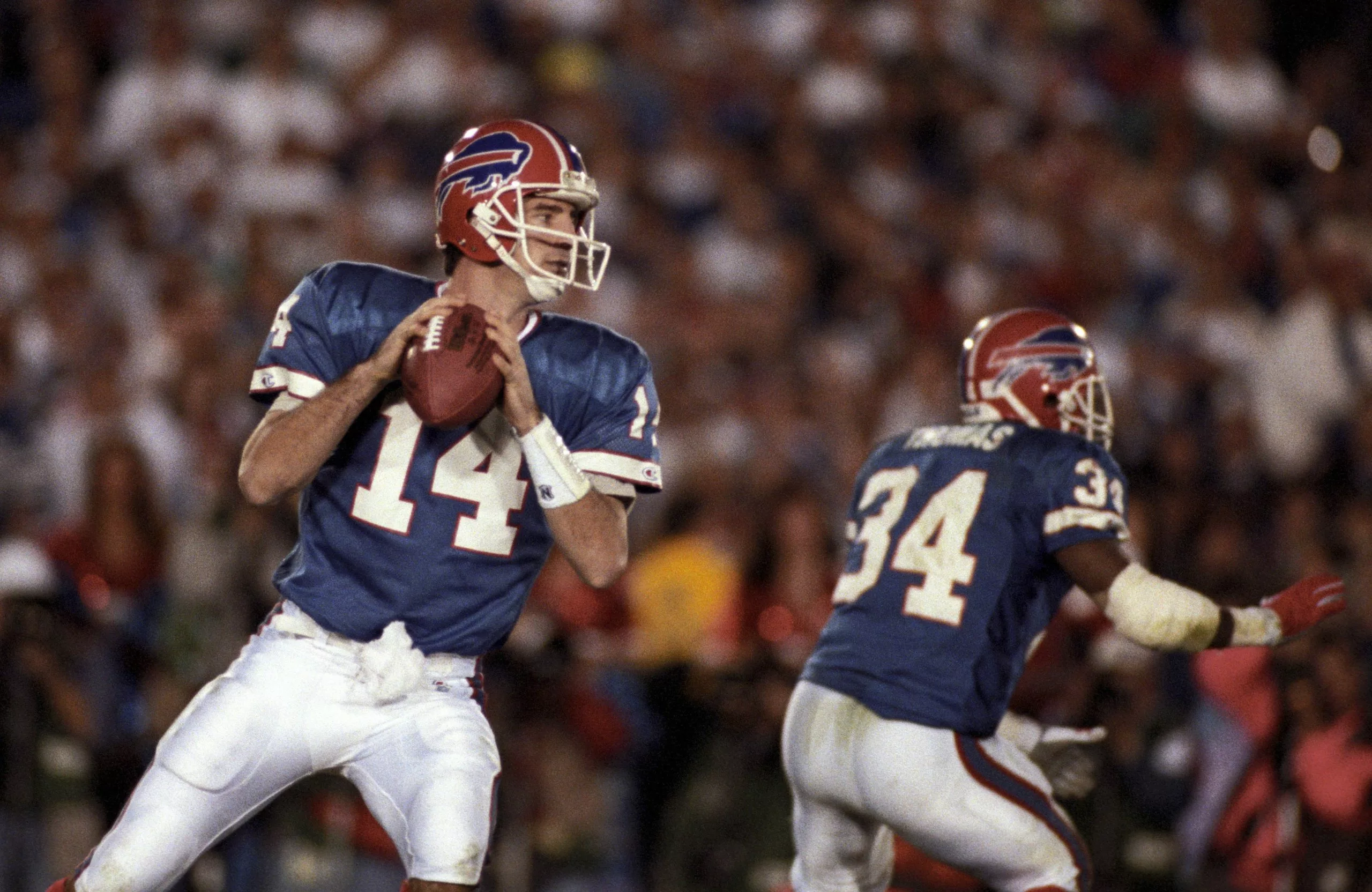
Jan 31, 1993; Pasadena, CA, USA; FILE PHOTO; Buffalo Bills quarterback Frank Reich (14) in action against the Dallas Cowboys during Super Bowl XXVII at the Rose Bowl. The Cowboys defeated the Bills 52-17. Mandatory Credit: Manny Rubio-USA TODAY Sports
It’s hard enough to be a starter in the NFL; this list of guys who, for the most part, were not starters, but when called upon, they could win you a game. Active players are not included in this list.
14) Cody Carlson, Houston Oilers
Carlson was Moon’s backup for seven seasons, keeping the Oilers’ high-powered run-and-shoot offense moving forward. Houston made the playoffs from 1987-1993, during which four seasons saw Carlson win in at least one spot start and go 10-4 under Carlson, who was selected out of Baylor in the third round of the 1988 NFL draft and made six relief starts including twice passing 300 yard games, four wins, leading three-game winning drives that season and twice leading game-winning drives; Carlson would fail as Moon’s successor but provided solid backup support during an otherwise successful stretch for the Houston Oilers.
Cody Carlson – Career Highlights
13) Damon Huard, Miami Dolphins and Kansas City Chiefs
While Dan Marino sat due to an injury during his final year, Huard went 4-1 in workman like fashion – helping Miami reach wild-card contention and an appearance in a wild-card playoff spot. Huard excelled further during an age-33 campaign for Kansas City after Trent Green suffered a concussion in Week 1. While often giving Larry Johnson some responsibility, Huard managed 11 touchdown passes against 1 INT while leading them into a playoff berth.
Damon Huard – Career Highlights
12) James Harris, LA Rams
Harris made history when he became the first Black quarterback to start regularly in an NFL season and playoff game, setting a historic example. Though not given many opportunities with the Bills during late 60s or early 70s, and briefly leaving football to attend Grambling University before rejoining football when Chuck Knox traded Pro Bowler John Hadl to the Rams midseason, soon thereafter, he led them to the NFC championship game before earning Pro Bowl honors before returning as a backup by 1976 before finishing up his career behind Dan Fouts at San Diego.
James Harris Highlights
11) Gary Danielson, Detroit Lions and Cleveland Browns
Danielson played 15 professional seasons, starting his career in the short-lived World Football League before catching on with the Detroit Lions for nine seasons despite playing during an era marked by high INT totals and finishing up his career with an 81-78 TD-INT ratio despite taking over midway through 1978 as starting QB, including dropping five touchdown passes against Minnesota before sharing time with Eric Hipple as Detroit won their NFC Central title year in 1983.
Gary Danielson – Career Highlights
10) Turk Schonert, Cincinnati Bengals
Schonert’s most significant moment came in his first game in 1981 against the Seattle Seahawks, as Schonert replaced a struggling Ken Anderson, down 21-0. What came next made Turk a legend in Cincinnati. Turk led the Bengals to 27 straight points, giving them an improbable win. That win would propel the Bengals to their first-ever Super Bowl. Schonert had some great games in the Bengals run for a divisional title in 1984 also, as he backed up Boomer Esiason and
all-time great Ken Anderson.
Turk Schonert – Career Highlights
9) Jeff Kemp Los Angeles Rams
Between Roman Gabriel and Jim Everett, the Rams struggled to find a reliable quarterback during a nearly 15-year span. Jeff Kemp provided invaluable help until replacing Vince Ferragamo in 1984 as an undrafted free agent, and led them directly to the playoffs thanks to Eric Dickerson breaking his single-season rushing record that year; later that season, they traded him to San Francisco, who used him,, six games of starting for the injured Joe Montana with impressive results including throwing 300+ yards twice during games with them before Montana returned.
Jeff Kemp
8) Bill Munson, Detroit Lions
Munson began his NFL career as a first-round Rams selection in 1964 but did not retire until 1980. A backup and part-time starter on five different teams, Utah State product Munson is perhaps best remembered for his eight years with the Detroit Lions under Greg Landry as both enjoyed success on offense and defense; Munson came off the bench during their playoff loss to the
Cowboys 5-0 in 1970
that same season to nearly pull an upset win and return as a starter during 1974 and ’75 despite their less-than-remarkable teams before ending his career.
1969-12-21 Detroit Lions @ Chicago Bears (Charlie Sanders 27-yard touchdown pass from Bill Munson)
7) Bob Lee, Minnesota Vikings
Between his reliable stints as a Vikings backup, Lee masterminded one of the most incredible runs by the Atlanta Falcons during their inaugural decade. A 17th-round pick out of Pacific in 1968, he was traded to Atlanta in 1973, where he oversaw an 8-2 streak from Week 5 – including this play- that beat a Vikings team headed for Super Bowl VIII! Lee returned home as Fran Tarkenton’s backup quarterback. In 1977’s regular-season finale, an ageing Viking squad defeated Atlanta 30-20, earning them another chance at the NFC championship!
Bob Lee – Career Highlights
6) Virgil Carter, Cincinnati Bengals
Greg Cook suffered an early and career-ending injury during his Bengals run, prompting a quick transition to former Bears sixth-rounder Carter as their quarterback in 1970. Following several injuries to other QBs, Cincinnati decided to test Bill Walsh’s West Coast Offense on Carter – who used a short pass system created by Walsh as an assistant coach to lead them from 1-6 to a playoff berth with his West Coast Offense; that year Carter led the NFL in completion percentage before giving way to first-rounder Ken Anderson in 1972 but continued as an NFL backup until 1976 when Anderson finally took over as starter.
Virgil Carter – Career Highlights
5) Doug Flutie, Buffalo Bills
Flutie may seem overqualified for this list, but not quite; his most notable NFL work came when he replaced Rob Johnson and helped Buffalo reach two more playoff berths. Flutie made his NFL debut as an undersized USFL alum and spent most of the ’90s as a Canada icon before reappearing as a Pro Bowler (inexplicably benched for the Music City Miracle game and came off the bench in 2000 to aid the Bills team). He finished his 21-year pro career playing, backing up Drew Brees and Tom Brady.
Doug Flutie Highlights
4) Zeke Bratkowski, Green Bay Packers
Bratkowski did not justify his second-round selection on either team in the 1950s and early ’60s due to interception-prone performances with the Bears and Rams in the 50s and early ’60s, however moving to Green Bay changed both his trajectory as well as providing essential backup protection for Bart Starr during their subsequent NFL three-peat between 1965-67 – going 8-1 when Bratkowski started or filled in for Starr during those years – and outdueled Roman Gabriel during one such game against Rams on December 26, 1966!
1968 Packers at Bears GOTW week 14
3) Don Strock, Miami Dolphins
Strock was among the greatest backup quarterbacks ever seen on an NFL field. Starting 22 games and leading eight game-winning drives during his 15 seasons as Dolphins backup quarterback, Strock played a critical role in helping lead two playoff wins for Miami in the late ’70s while his performance against the Chargers during their 38-35 Round 2 loss was unrivalled – throwing for 401 yards and four TDs. Even his final start became an upset victory when his final start became a comeback win over the Oilers that would clinch the Browns a playoff berth.
Don Strock – Career Highlights
2) Frank Reich, Buffalo Bills
Jim Kelly trusted Reich as his backup quarterback for eight of his 11 seasons. During those 14 years, Reich is best remembered for one of the greatest performances ever witnessed in NFL history: After struggling against the Oilers in Week 17 of the 1992 season, Reich delivered an NFL record 32-point comeback against the Houston in a Wild Card Rematch featuring 289 yards passing and four touchdown passes; one week later Reich the led Super Bowl bound Bills past Steelers 24-3 win that established his legacy and unassailability as QB2.
The Greatest Comeback in NFL History
1) Earl Morrall, Baltimore Colts, Miami Dolphins
Morrall must be included on any backup quarterback list because his legacy as a starter in 35% of games for 21-years cannot be denied. Morrall arguably delivered two memorable years as backup QB for the Colts after they traded Johnny Unitas in 1968 for Morrall (a former No. 2 overall pick who became NFL MVP with 26 TD passes thrown). Although Super Bowl III wasn’t kind, Morrall won two rings – first as Unitas’ backup/fill-in 1970 and later as Griese’s reliever — while finishing 11-0 as a starter in 1972 to protect the Dolphins 17-0 season! Morrall backed up some
all-time great quarterbacks.
Up To $1500 in Bonus Bets Paid Back if your First Bet Does Not Win
T&Cs apply
4.5/5
Gambling problem? Call 1-800-GAMBLER or 1-800-MY-RESET (Available in the US) 877-8-HOPENY or text HOPENY (467369) (NY) 1-800-327-5050 (MA), 1-800-BETS-OFF (IA), 1-800-981-0023 (PR). 21+ only. Please Gamble Responsibly. See BetMGM.com for Terms. First Bet Offer for new customers only (if applicable). Subject to eligibility requirements. Bonus bets are non-withdrawable. In partnership with Kansas Crossing Casino and Hotel. Promotional offers not available in Mississippi, Massachusetts, New York, Ontario, or Puerto Rico.
New DraftKings Customers: Spend $5+ Get $150 in Bonuses
T&Cs apply
4.5/5
GAMBLING PROBLEM? CALL 1-800-GAMBLER or 1-800-MY-RESET, (800) 327-5050 or visit gamblinghelplinema.org (MA). Please Gamble Responsibly. 888-789-7777/visit ccpg.org (CT), or visit www.mdgamblinghelp.org (MD), 1-800-981-0023 (PR). 21+ and present in most states. (18+ DC/NH/PR/WY). Void in CAN. Eligibility restrictions apply. On behalf of Boot Hill Casino (KS). Pass-thru of per wager tax may apply in IL. 1 per new DraftKings customer. $5+ first-time bet req. Max. $150 issued as non-withdrawable Bonus Bets. Stake removed from payout. Reward issued as $50 in Bonus Bets every 7 days via click-to-claim for 14 days. Bonus Bets and click-to-claims expire 7 days (168hrs) after issuance. Terms: sportsbook.draftkings.com/promos. Ends 10/11/26 at 11:59 PM ET. Sponsored by DK.
Must be 21+. GAMBLING PROBLEM? CALL 1-800-GAMBLER OR CALL 1-800-MY-RESET, www.mdgamblinghelp.org (MD), (800)-327-5050 or gamblinghelplinema.org (MA), Call (877)8-HOPENY or text HOPENY (467369) (NY), (888) 789-7777 or ccpg.org (CT), morethanagame.nc.gov (NC), 1800gambler.net (WV)
Bet $1 and get double the winnings up to $25 for your next 10 bets
T&Cs apply
4.4/5
21+ New users only. Must register using eligible promo code. First bet after registration must qualify. Max. Bonus Bet: $1,000. Bonus Bet expires 14 days after receipt. Void where prohibited. See Caesars.com/promos for full terms. Gambling Problem? 1-800-GAMBLER (1-800-426-2537)
21+ and present in OH. Gambling Problem? Call 1-800-GAMBLER.
This site is using
Cloudflare
and adheres to the
Google Safe Browsing Program. We adapted
Google's Privacy Guidelines
to keep your data safe at all times.
Close
Ready to Win Big? Join the Elite with Our Sports Betting Deals!
FanDuel Promo
New Users – Get $250 in Bonus Bets when you wager $5 for 5 days
Up To $1500 in Bonus Bets Paid Back if your First Bet Does Not Win
Best Slots
T&Cs and 21+ apply
Gambling problem? Call 1-800-GAMBLER or 1-800-MY-RESET (Available in the US) 877-8-HOPENY or text HOPENY (467369) (NY) 1-800-327-5050 (MA), 1-800-BETS-OFF (IA), 1-800-981-0023 (PR). 21+ only. Please Gamble Responsibly. See BetMGM.com for Terms. First Bet Offer for new customers only (if applicable). Subject to eligibility requirements. Bonus bets are non-withdrawable. In partnership with Kansas Crossing Casino and Hotel. Promotional offers not available in Mississippi, Massachusetts, New York, Ontario, or Puerto Rico.
Code:
Open BetMGM
Get Bonus
DraftKings Promo
New DraftKings Customers: Spend $5+ Get $150 in Bonuses
Newcomer
T&Cs and 21+ apply
GAMBLING PROBLEM? CALL 1-800-GAMBLER or 1-800-MY-RESET, (800) 327-5050 or visit gamblinghelplinema.org (MA). Please Gamble Responsibly. 888-789-7777/visit ccpg.org (CT), or visit www.mdgamblinghelp.org (MD), 1-800-981-0023 (PR). 21+ and present in most states. (18+ DC/NH/PR/WY). Void in CAN. Eligibility restrictions apply. On behalf of Boot Hill Casino (KS). Pass-thru of per wager tax may apply in IL. 1 per new DraftKings customer. $5+ first-time bet req. Max. $150 issued as non-withdrawable Bonus Bets. Stake removed from payout. Reward issued as $50 in Bonus Bets every 7 days via click-to-claim for 14 days. Bonus Bets and click-to-claims expire 7 days (168hrs) after issuance. Terms: sportsbook.draftkings.com/promos. Ends 10/11/26 at 11:59 PM ET. Sponsored by DK.
Code:
Open DraftKings
Get Bonus
Find out what the legends have to say about sports this week....