The NFL’s relationship with sports gambling extends beyond commercials and sportsbook logos. Public announcements
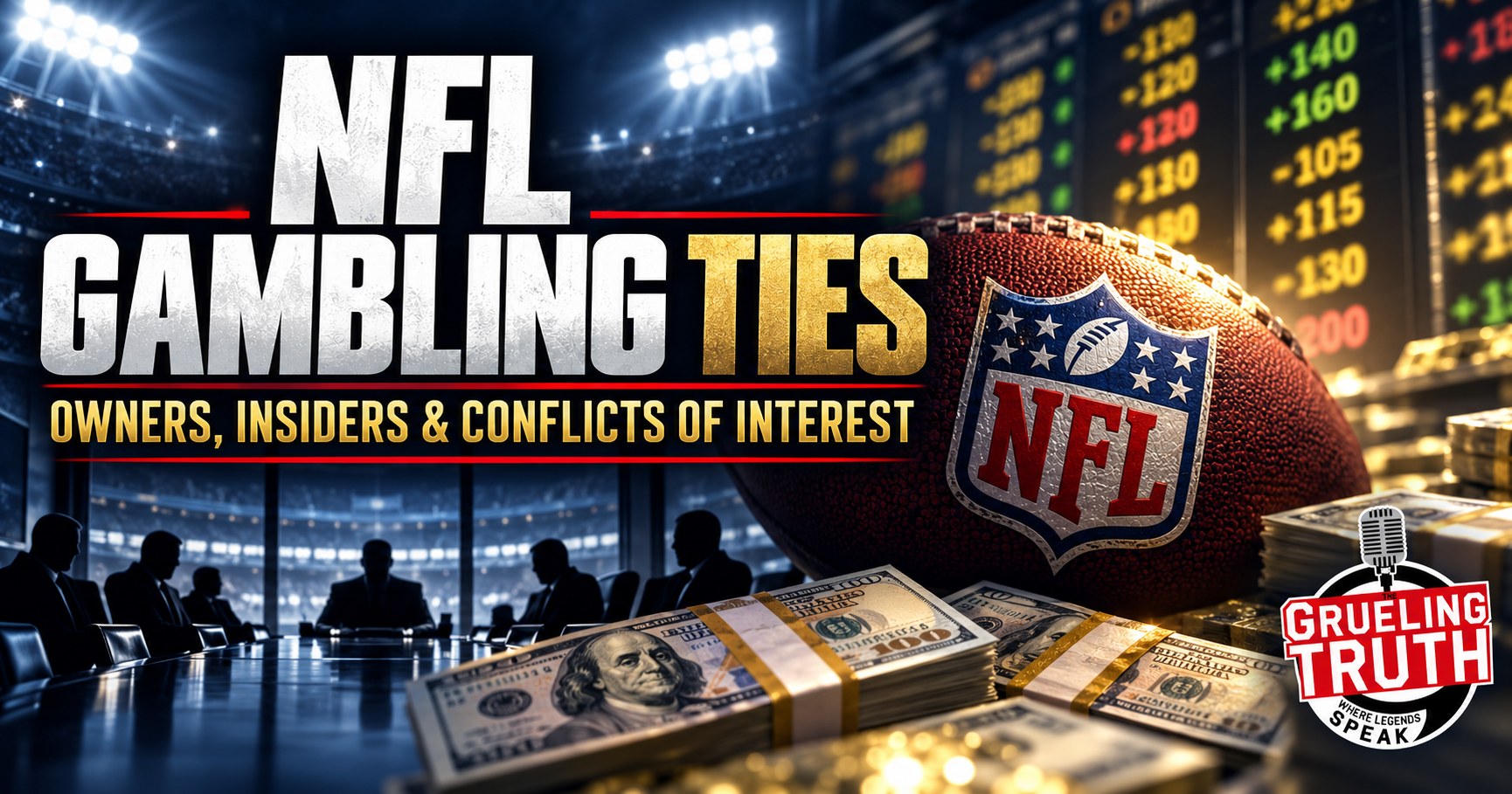
The NFL’s relationship with sports gambling extends beyond commercials and sportsbook logos.
Public announcements, financial filings, and established reporting document investments connecting football owners, a prominent NFL reporter, players, and the league itself to businesses involved in wagering, fantasy contests, gambling technology, and betting information.
Robert Kraft, Jerry Jones and
Adam Schefter
are part of that documented history. They are not the only names.
These relationships warrant scrutiny because professional football depends on confidence in two things: the competition on the field and the information surrounding it.
But scrutiny requires precision. Owning part of a gambling-related business does not establish that someone controls betting lines, shares confidential information or arranges game results.
The documented story is one of overlapping financial interests and legitimate transparency questions. Establishing corruption would require additional evidence.
Kraft and Jones: Documented DraftKings Investments
In August 2018, ESPN reporters David Purdum and Darren Rovell reported that Patriots owner Robert Kraft and Cowboys owner Jerry Jones had retained investments in DraftKings as the company expanded from daily fantasy contests into traditional sports betting.
Their stakes were described as less than 5% each. A Cowboys spokesperson said Jones’ investment was through the hospitality company Legends, rather than the Cowboys themselves.
That reporting establishes a historical investment. It does not establish either man’s exact holdings in October 2026.
The distinction matters. Investments can be sold, diluted, transferred or reorganized. An old disclosure cannot responsibly become a claim that someone still owns the same percentage today.
Nevertheless, the original arrangement illustrates the underlying concern: team owners could have economic interests in a business whose products depend on football outcomes and player performance.
That is a legitimate subject for disclosure and oversight, regardless of whether misconduct occurs.
Schefter and Kraft Were Named in the Same Gaming Investment
Boom Entertainment’s September 2021 funding announcement explicitly named both Kraft and ESPN NFL insider Adam Schefter among participants in its $15 million Series A round.
The company said the funding would support expansion into real-money gaming products. Its announcement described operations spanning free-to-play games, fantasy products, online casino games and sports betting technology.
This creates two distinct questions.
For Kraft, it concerns the relationship between franchise ownership and gambling-related investments.
For Schefter, it concerns journalistic independence. A reporter covering team owners shared an investment with one of those owners. Separately, his reporting concerns information that can affect wagering markets.
Neither circumstance establishes wrongdoing. Both justify asking what disclosures, editorial safeguards and restrictions applied.
Schefter Also Invested in Underdog
Underdog’s May 2021 fundraising announcement named Schefter, quarterback Jared Goff, broadcaster Adam Lefkoe and HBSE Ventures among its investors.
More recent reporting adds important context.
In July 2026, Front Office Sports reported that Underdog confirmed Schefter had been an early-stage investor. Sources described his investment as small and said he had made no further investments or had an operational role since then. ESPN declined to comment. The report also stated that whether Schefter still held his Boom stake was unknown.
Those qualifications belong alongside the investment disclosure.
It would be misleading to turn a documented passive investment into an unsupported assertion that Schefter operated a betting business or directed its decisions.
The Other Documented Connections
The following is a
publicly documented list, not an exhaustive ownership registry. It includes historical investments and distinguishes sportsbook ownership from fantasy, media and analytics businesses.
Person or organization
Documented relationship
Important qualification
Robert Kraft
DraftKings investment reported in 2018; named in Boom’s 2021 funding round.
Exact current holdings were not established by these sources.
Historical indirect investment; current percentage unconfirmed.
Adam Schefter
Named investor in Boom and Underdog in 2021.
Later reporting describes a small, nonoperational Underdog investment; current Boom ownership unknown.
Jared Goff
Named in Underdog’s 2021 investor announcement.
Establishes an investment at that time, not his current stake or operational involvement.
Odell Beckham Jr.
Named as an existing Underdog investor in its July 2022 announcement.
Current individual holdings unconfirmed.
Adam Lefkoe
Named in Underdog’s 2021 investor announcement.
Sports-media investment; current stake unconfirmed.
Richard Sherman
Identified as a Daily Number co-founder and equity partner in a 2019 company announcement.
Daily fantasy business; not proof of current sportsbook ownership.
Glover Qui
Reported in 2015 as investing in DraftKings and FanDuel through an investment group.
Historical daily fantasy investments; current holdings unconfirmed.
Drew Brees
Received an equity component in his 2021 PointsBet spokesperson agreement.
PointsBet announced the relationship ended in December 2022; that announcement alone does not establish disposition of every share.
Stephen Ross, through RSE Ventures
RSE participated in Action Network’s 2019 financing.
Betting media investment, not direct ownership of a sportsbook; Action Network was subsequently acquired.
David Blitzer
Named investor in Action Network’s 2019 financing.
Historical investment predating his participation in Washington’s ownership group.
HBSE Ventures
Named investor in Underdog’s 2021 financing.
HBSE is associated with Josh Harris and David Blitzer; a firm’s investment should not be described as a separately verified personal holding of each founder.
Cris Collinsworth
Retained control of PFF’s consumer business following the 2026 enterprise-business sale.
PFF offers betting-related analysis and tools; it is a different business model from a sportsbook taking wagers.
Action Network’s ownership history deserves particular care. Better Collective completed its acquisition in May 2021. Its earlier investors should not automatically be described as current owners of the independent business that existed before that transaction.
The NFL Itself Has Financial Exposure
The league’s role is more substantial than individual investments alone suggest.
Genius Sports’ financial disclosures state that NFL Enterprises exercised warrants in 2025 and received
8,492,320 ordinary shares. The companies also extended their data partnership through the end of the 2029 NFL season.
Genius supplies technology and official data used in betting markets. That establishes an ownership connection between the NFL and part of the infrastructure supporting wagering.
The NFL also invested in Fanatics. Sports Business Journal reported a $320 million league investment in its 2022 funding round. Fanatics subsequently developed a sportsbook business and became an official NFL betting partner in 2026.
These are league-level interests. They should not be converted into invented personal shareholdings for every franchise owner.
The players’ association has participated, too. In October 2020, the NFLPA announced an ownership stake in fantasy operator Monkey Knife Fight through an arrangement involving OneTeam Partners. That platform later closed in February 2023.
The broader picture is clear: financial involvement has existed across ownership, media, players and football institutions.
How This Connects to Betting Lines
Information can change a wagering market without anyone manipulating a game.
An injury update, an unexpected starter or a change in expected playing time can alter how a matchup is assessed. Sportsbooks also respond to informed wagers, their financial exposure and competing market prices. Line movement is a normal feature of that process.
Consider a hypothetical example: a reporter announces that a starting quarterback will miss a game, and the point spread changes immediately.
That sequence could simply show the market responding to accurate public reporting.
A different situation would arise if someone secretly supplied material nonpublic information to selected bettors, deliberately published false information to influence prices or coordinated wagers before releasing a report.
Those would require evidence: communications, timestamps, account records, transaction histories or investigative findings.
A reporter’s ability to publish market-moving news creates a potential conflict worth managing. It does not prove the reporter improperly moved a line.
Fixed Games Require a Different Level of Proof
Game fixing involves intentional interference with competition. It is a separate allegation from ownership, sponsorship or ordinary price movement.
A questionable penalty, an unusual coaching decision or a late score affecting the spread does not establish a fix.
Evidence would need to connect conduct on the field to deliberate manipulation—for example, documented instructions, payments, coordinated wagering or corroborated communications.
Even a gambling suspension does not necessarily establish game fixing.
When the NFL suspended Calvin Ridley in 2022 for betting on NFL games, the league said its investigation found no evidence that he used inside information or that any game was compromised. That was the league’s stated finding, and it should accompany references to the case.
The NFL’s published policy also expressly prohibits manipulating games for gambling purposes and sharing confidential information. Those prohibitions establish the rules; they do not independently prove that enforcement is adequate.
The Conflict Is Real Enough to Demand Transparency
Fans should not have to establish a criminal conspiracy before asking who has a financial interest in the industry surrounding their sport.
A sensible disclosure system would identify relevant ownership interests, distinguish personal holdings from fund investments, explain any league-approved exceptions and state when relationships end.
Media organizations should disclose relevant financial interests when their reporters cover companies, owners or commercial arrangements connected to those investments.
Integrity monitoring also deserves independent scrutiny. The NFL says Genius Sports and IC360 monitor wagering activity for indications of manipulation or leaked information. Because the league has an equity relationship with Genius, it is reasonable to ask how independence, escalation and outside review are maintained. That structural question is not evidence that monitoring has been compromised.
The Money Trail Supports Scrutiny, Not an Invented Verdict
The documented investments are significant. They show that people and institutions surrounding professional football have held financial interests in businesses serving the wagering economy.
That overlap can create competing incentives and damage confidence when disclosure is incomplete.
What the evidence reviewed does
not
establish is that the named investors used those relationships to fix NFL games or improperly manipulate betting lines.
The strongest demand is therefore concrete:
disclose the interests, explain the safeguards and investigate specific evidence when it appears.
Football’s credibility depends on making those answers available before public suspicion becomes the only account fans believe.
New Users – Get $350 in Bonus Bets when you wager $5 for 7 days
T&Cs apply
4.6/5
Gambling Problem? Call 1-800-GAMBLER or 1-800-MY-RESET. Call 1-888-789-7777 or visit ccpgg.org/chat (CT). Hope is here. GamblingHelpLineMA.org or call (800) 327-5050 for 24/7 support (MA). Visit www.mdgamblinghelp.org (MD). Call 1-877-8HOPE-NY or text HOPENY (NY). 21+ (18+ DC, WY) and present in select states (for KS, in affiliation with Kansas Star Casino). Find online real money wagering only. Min $5 wager required for 7 consecutive days. $5 free play credit. Bonus issued as non-withdrawable bonus with cash withdrawable bonus with cash withdrawable. Bonus bets which expire 7 days after receipt. Restrictions apply. See terms at sportsbook.fanduel.com. Call 1-877-770-7867 (LA).
Up To $1500 in Bonus Bets Paid Back if your First Bet Does Not Win
T&Cs apply
4.5/5
Gambling problem? Call 1-800-GAMBLER or 1-800-MY-RESET (Available in the US) 877-8-HOPENY or text HOPENY (467369) (NY) 1-800-327-5050 (MA), 1-800-BETS-OFF (IA), 1-800-981-0023 (PR). 21+ only. Please Gamble Responsibly. See BetMGM.com for Terms. First Bet Offer for new customers only (if applicable). Subject to eligibility requirements. Bonus bets are non-withdrawable. In partnership with Kansas Crossing Casino and Hotel. Promotional offers not available in Mississippi, Massachusetts, New York, Ontario, or Puerto Rico.
New DraftKings Customers: Bet $5, Get $200 + 3 Months of NBA League Pass!
T&Cs apply
4.5/5
GAMBLING PROBLEM? CALL 1-800-GAMBLER or 1-800-MY-RESET, (800) 327-5050 or visit gamblinghelplinema.org (MA). Please Gamble Responsibly. 888-789-7777/visit ccpg.org (CT), or visit www.mdgamblinghelp.org (MD), 1-800-981-0023 (PR). 21+ and present in most states. (18+ DC/NH/PR/WY). Void in CAN. Eligibility restrictions apply. On behalf of Boot Hill Casino (KS). Pass-thru of per wager tax may apply in IL. 1 per new Sportsbook customer. $5+ first-time bet req. Max. $200 issued as non-withdrawable Bonus Bets. Stake removed from payout. Reward issued as $50 in Bonus Bets every 7 days via click-to-claim for 21 days. Bonus Bets and click-to-claims expire 7 days (168hrs) after issuance. Terms: dkng.co/offer. Get 1 promo code to redeem a 3-month NBA League Pass subscription, complimentary of DraftKings. Subscription auto-renews monthly at then-current price (currently $16.99/mo); cancel anytime. Terms, restrictions, and eligibility requirements apply. Redeem League Pass by 12/19/26 at 11:59 PM ET. Addt’l terms: support.watch.nba.com/hc/en-us/articles/9165532876183-League-Pass-Terms-of-Use_. Ends 11/29/26 at 11:59 PM ET. Sponsored by DK.
Must be 21+. GAMBLING PROBLEM? CALL 1-800-GAMBLER OR CALL 1-800-MY-RESET, www.mdgamblinghelp.org (MD), (800)-327-5050 or gamblinghelplinema.org (MA), Call (877)8-HOPENY or text HOPENY (467369) (NY), (888) 789-7777 or ccpg.org (CT), morethanagame.nc.gov (NC), 1800gambler.net (WV)
Bet $1 and get double the winnings up to $25 for your next 10 bets
T&Cs apply
4.4/5
21+ New users only. Must register using eligible promo code. First bet after registration must qualify. Max. Bonus Bet: $1,000. Bonus Bet expires 14 days after receipt. Void where prohibited. See Caesars.com/promos for full terms. Gambling Problem? 1-800-GAMBLER (1-800-426-2537)
21+ and present in OH. Gambling Problem? Call 1-800-GAMBLER.
This site is using
Cloudflare
and adheres to the
Google Safe Browsing Program. We adapted
Google's Privacy Guidelines
to keep your data safe at all times.
Close
Ready to Win Big? Join the Elite with Our Sports Betting Deals!
FanDuel Promo
New Users – Get $350 in Bonus Bets when you wager $5 for 7 days
Our Favorite
T&Cs and 21+ apply
Gambling Problem? Call 1-800-GAMBLER or 1-800-MY-RESET. Call 1-888-789-7777 or visit ccpgg.org/chat (CT). Hope is here. GamblingHelpLineMA.org or call (800) 327-5050 for 24/7 support (MA). Visit www.mdgamblinghelp.org (MD). Call 1-877-8HOPE-NY or text HOPENY (NY). 21+ (18+ DC, WY) and present in select states (for KS, in affiliation with Kansas Star Casino). Find online real money wagering only. Min $5 wager required for 7 consecutive days. $5 free play credit. Bonus issued as non-withdrawable bonus with cash withdrawable bonus with cash withdrawable. Bonus bets which expire 7 days after receipt. Restrictions apply. See terms at sportsbook.fanduel.com. Call 1-877-770-7867 (LA).
Code:
Open FanDuel
Get Bonus
BetMGM Promo
Up To $1500 in Bonus Bets Paid Back if your First Bet Does Not Win
Best Slots
T&Cs and 21+ apply
Gambling problem? Call 1-800-GAMBLER or 1-800-MY-RESET (Available in the US) 877-8-HOPENY or text HOPENY (467369) (NY) 1-800-327-5050 (MA), 1-800-BETS-OFF (IA), 1-800-981-0023 (PR). 21+ only. Please Gamble Responsibly. See BetMGM.com for Terms. First Bet Offer for new customers only (if applicable). Subject to eligibility requirements. Bonus bets are non-withdrawable. In partnership with Kansas Crossing Casino and Hotel. Promotional offers not available in Mississippi, Massachusetts, New York, Ontario, or Puerto Rico.
Code:
Open BetMGM
Get Bonus
DraftKings Promo
New DraftKings Customers: Bet $5, Get $200 + 3 Months of NBA League Pass!
Newcomer
T&Cs and 21+ apply
GAMBLING PROBLEM? CALL 1-800-GAMBLER or 1-800-MY-RESET, (800) 327-5050 or visit gamblinghelplinema.org (MA). Please Gamble Responsibly. 888-789-7777/visit ccpg.org (CT), or visit www.mdgamblinghelp.org (MD), 1-800-981-0023 (PR). 21+ and present in most states. (18+ DC/NH/PR/WY). Void in CAN. Eligibility restrictions apply. On behalf of Boot Hill Casino (KS). Pass-thru of per wager tax may apply in IL. 1 per new Sportsbook customer. $5+ first-time bet req. Max. $200 issued as non-withdrawable Bonus Bets. Stake removed from payout. Reward issued as $50 in Bonus Bets every 7 days via click-to-claim for 21 days. Bonus Bets and click-to-claims expire 7 days (168hrs) after issuance. Terms: dkng.co/offer. Get 1 promo code to redeem a 3-month NBA League Pass subscription, complimentary of DraftKings. Subscription auto-renews monthly at then-current price (currently $16.99/mo); cancel anytime. Terms, restrictions, and eligibility requirements apply. Redeem League Pass by 12/19/26 at 11:59 PM ET. Addt’l terms: support.watch.nba.com/hc/en-us/articles/9165532876183-League-Pass-Terms-of-Use_. Ends 11/29/26 at 11:59 PM ET. Sponsored by DK.
Code:
Open DraftKings
Get Bonus
Find out what the legends have to say about sports this week....
New Users – Get $350 in Bonus Bets when you wager $5 for 7 days
Gambling Problem? Call 1-800-GAMBLER or 1-800-MY-RESET. Call 1-888-789-7777 or visit ccpgg.org/chat (CT). Hope is here. GamblingHelpLineMA.org or call (800) 327-5050 for 24/7 support (MA). Visit www.mdgamblinghelp.org (MD). Call 1-877-8HOPE-NY or text HOPENY (NY). 21+ (18+ DC, WY) and present in select states (for KS, in affiliation with Kansas Star Casino). Find online real money wagering only. Min $5 wager required for 7 consecutive days. $5 free play credit. Bonus issued as non-withdrawable bonus with cash withdrawable bonus with cash withdrawable. Bonus bets which expire 7 days after receipt. Restrictions apply. See terms at sportsbook.fanduel.com. Call 1-877-770-7867 (LA).