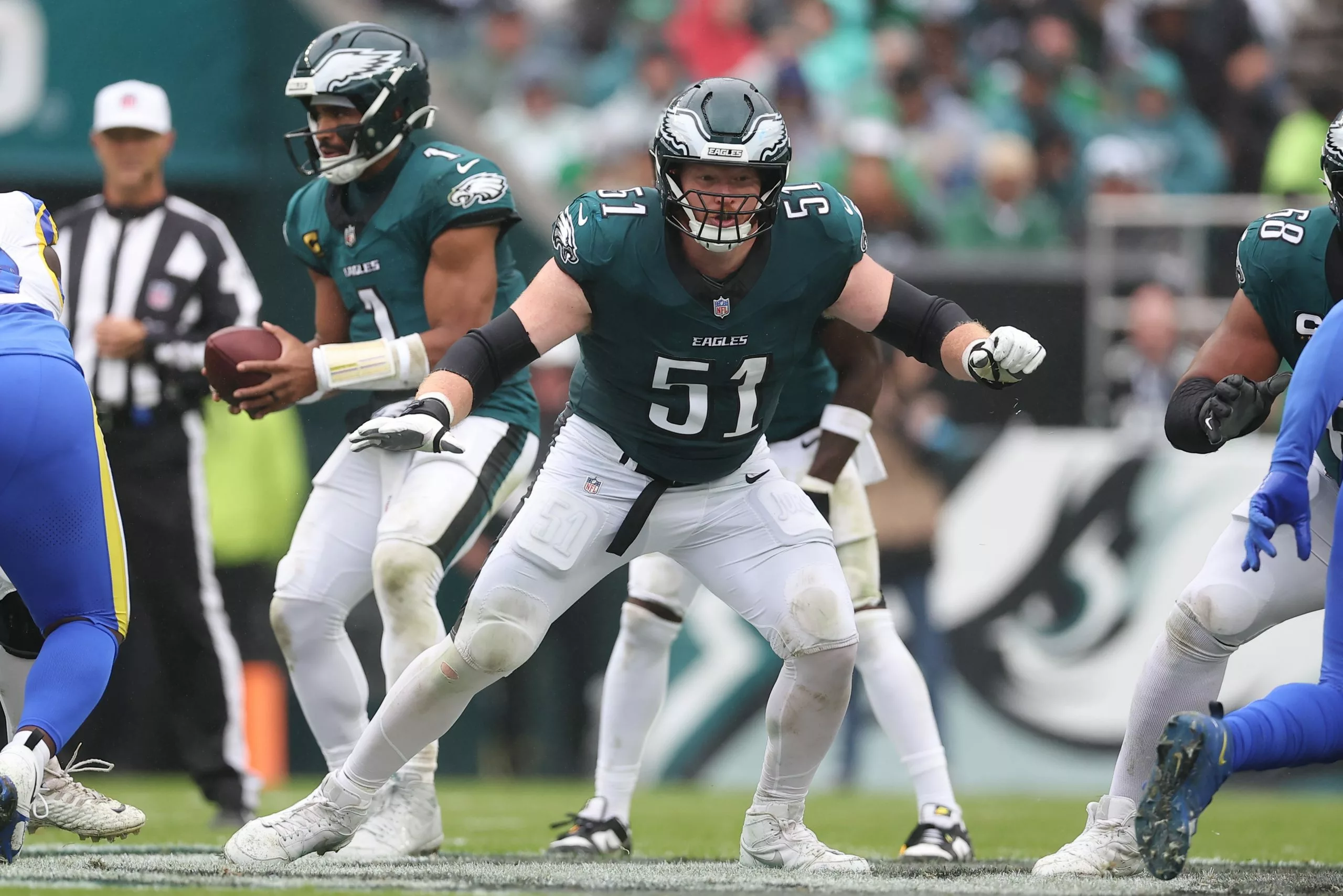
Oct 4, 2026; Philadelphia, Pennsylvania, USA; Philadelphia Eagles center Cam Jurgens (51) plays against the Los Angeles Rams at Lincoln Financial Field. Mandatory Credit: Bill Streicher-Imagn Images
Howie Roseman has a defensible explanation for trading Cam Jurgens. He also has an immediate problem that future draft picks cannot block.
Philadelphia agreed Wednesday to send the two-time Pro Bowl center and a 2027 seventh-round pick to Baltimore for a 2027 fifth-round selection and a 2028 second-rounder, pending a physical. The deal adds valuable resources to the Eagles’ future.
The timing makes it difficult to celebrate without asking questions.
Philadelphia is trying to stabilize an offense dealing with injuries, personnel changes and consecutive losses. Trading an experienced offensive lineman during that process puts additional responsibility on younger players—and on the executives and coaches who believe they are ready.
This move could eventually look shrewd.
For now, Roseman must explain why the Eagles can afford the immediate cost.
The Important Detail: Jurgens Was Already Playing Guard
The headline describes Jurgens as a
Pro Bowl center, which is accurate. But his recent assignment changes how the trade should be evaluated.
After Landon Dickerson went on injured reserve, Philadelphia moved Jurgens to left guard and installed Drew Kendall at center.
The Eagles therefore are not introducing a new center solely because of this deal. That transition was already underway.
Instead, they are removing a veteran who could play multiple interior positions while committing more heavily to their younger options.
That distinction strengthens Roseman’s argument in one respect. If Philadelphia believes Kendall is its long-term center, keeping Jurgens becomes a different calculation than retaining an unquestioned starter at his preferred position.
But versatility has value when a line is already short of healthy players.
The trade reduces Philadelphia’s flexibility at precisely the moment flexibility could become essential.
Roseman Is Buying Future Options
The strongest case for this decision begins with the return.
A second-round pick is a substantial asset. It can become a starter, provide flexibility to move around the draft or serve as part of another trade.
The Eagles say they are positioned to have 16 selections across the next two drafts before compensatory picks, including two first-rounders and two second-rounders in 2028.
That gives Roseman options.
His job requires considering more than the next Sunday. Holding every experienced player until a roster becomes older, more expensive and harder to replenish is its own form of risk.
If the front office believes a younger player can perform adequately, accepting strong compensation for a veteran can be sensible.
The complication is that acquiring an asset and using it successfully are separate accomplishments.
Philadelphia has received an opportunity to improve its future roster. It has not yet received the player who will justify the trade.
Financial Flexibility Is Part of the Argument
Roseman has also identified financial flexibility as a reason for the move, alongside the draft compensation and his confidence in Kendall.
That is a legitimate consideration.
A general manager must evaluate whether resources committed to one position could produce greater value elsewhere. Those decisions sometimes require moving a recognizable player before fans are ready to say goodbye.
Still, financial flexibility should be described carefully.
It does not automatically produce better football. The value depends on what Philadelphia does with it and whether the remaining players can handle their assignments.
Roseman’s case rests on several projections working together: the younger linemen develop, future selections become contributors and additional flexibility helps maintain a competitive roster.
That is a coherent strategy. It carries execution risk.
Lane Johnson’s Retirement Makes the Timing Harder
The Jurgens decision arrived immediately after Lane Johnson announced his retirement.
Philadelphia’s own analysis outlined a possible London lineup featuring Jordan Mailata, Willie Lampkin, Kendall, Tyler Steen and Markel Bell, while emphasizing that the coaching staff would determine the final configuration.
That is significant change across a unit that needs coordination.
Offensive linemen must recognize pressure together, pass defenders between assignments and understand how the player beside them handles a particular look.
A new combination can possess talent and still need time to function efficiently.
Opposing defenses will try to exploit that uncertainty. They can disguise pressure, move rushers before the snap and force unfamiliar combinations to communicate quickly.
Philadelphia is asking its line to develop while games with immediate consequences continue.
Roseman may believe the transition is necessary. Fans are entitled to ask why removing another experienced option helps that process.
Kendall’s Injury Adds Another Layer of Risk
The Wednesday injury report made the decision more uncomfortable.
Kendall did not practice because of a knee injury.
Saquon Barkley
and DeVonta Smith also missed practice with hamstring injuries, while Dallas Goedert returned in a limited capacity following his knee issue.
Those practice designations do not settle Sunday’s availability. They do establish uncertainty.
Confidence in Kendall is central to the trade’s logic. His health therefore matters considerably.
If he is available and performs well, Philadelphia can continue the transition it already started. If he cannot play, the Eagles will need another adjustment after trading away a player with experience at center.
That is the clearest immediate criticism of the move: Philadelphia has accepted reduced insurance while several important parts of its offense remain unsettled.
Jalen Hurts Cannot Solve Every Problem Himself
When an offense loses personnel, the quarterback inevitably absorbs more responsibility.
Hurts must communicate clearly, make sound decisions and avoid allowing difficult possessions to become disastrous ones.
The coaching staff must also help him.
Protection plans should reflect what the available line can execute. Passing concepts need answers when pressure arrives quickly. The running game must create manageable situations rather than leaving the offense repeatedly facing obvious passing downs.
There is a cost to constantly compensating for weaknesses.
Keeping extra players in protection reduces receiving options. Simplifying the offense can help execution, but it can also make the attack easier to anticipate.
The Eagles need their younger linemen to become productive enough that those compromises remain limited.
Otherwise, the consequences of this trade will extend beyond the player replacing Jurgens.
The Trade Should Be Judged Through Both Timelines
My assessment is that Roseman secured a meaningful return, but the timing places a substantial burden on his evaluation of the remaining roster.
The immediate test is whether Philadelphia can protect Hurts and sustain an effective offense through this transition. The longer-term test is whether the picks and financial flexibility produce enough value to justify surrendering Jurgens.
Both matter.
One difficult game would not settle the trade. Neither should the phrase “future second-round pick” excuse a prolonged decline up front.
Roseman is betting his judgment that Philadelphia can make this change and remain competitive. His reputation explains why that judgment deserves consideration. It does not remove the need for evidence.
The Eagles have improved their collection of future assets.
Now they must show that, while building the next version of the team, they have left this version enough protection to win.
Up To $1500 in Bonus Bets Paid Back if your First Bet Does Not Win
T&Cs apply
4.5/5
Gambling problem? Call 1-800-GAMBLER or 1-800-MY-RESET (Available in the US) 877-8-HOPENY or text HOPENY (467369) (NY) 1-800-327-5050 (MA), 1-800-BETS-OFF (IA), 1-800-981-0023 (PR). 21+ only. Please Gamble Responsibly. See BetMGM.com for Terms. First Bet Offer for new customers only (if applicable). Subject to eligibility requirements. Bonus bets are non-withdrawable. In partnership with Kansas Crossing Casino and Hotel. Promotional offers not available in Mississippi, Massachusetts, New York, Ontario, or Puerto Rico.
New DraftKings Customers: Spend $5+ Get $150 in Bonuses
T&Cs apply
4.5/5
GAMBLING PROBLEM? CALL 1-800-GAMBLER or 1-800-MY-RESET, (800) 327-5050 or visit gamblinghelplinema.org (MA). Please Gamble Responsibly. 888-789-7777/visit ccpg.org (CT), or visit www.mdgamblinghelp.org (MD), 1-800-981-0023 (PR). 21+ and present in most states. (18+ DC/NH/PR/WY). Void in CAN. Eligibility restrictions apply. On behalf of Boot Hill Casino (KS). Pass-thru of per wager tax may apply in IL. 1 per new DraftKings customer. $5+ first-time bet req. Max. $150 issued as non-withdrawable Bonus Bets. Stake removed from payout. Reward issued as $50 in Bonus Bets every 7 days via click-to-claim for 14 days. Bonus Bets and click-to-claims expire 7 days (168hrs) after issuance. Terms: sportsbook.draftkings.com/promos. Ends 10/11/26 at 11:59 PM ET. Sponsored by DK.
Must be 21+. GAMBLING PROBLEM? CALL 1-800-GAMBLER OR CALL 1-800-MY-RESET, www.mdgamblinghelp.org (MD), (800)-327-5050 or gamblinghelplinema.org (MA), Call (877)8-HOPENY or text HOPENY (467369) (NY), (888) 789-7777 or ccpg.org (CT), morethanagame.nc.gov (NC), 1800gambler.net (WV)
Bet $1 and get double the winnings up to $25 for your next 10 bets
T&Cs apply
4.4/5
21+ New users only. Must register using eligible promo code. First bet after registration must qualify. Max. Bonus Bet: $1,000. Bonus Bet expires 14 days after receipt. Void where prohibited. See Caesars.com/promos for full terms. Gambling Problem? 1-800-GAMBLER (1-800-426-2537)
21+ and present in OH. Gambling Problem? Call 1-800-GAMBLER.
This site is using
Cloudflare
and adheres to the
Google Safe Browsing Program. We adapted
Google's Privacy Guidelines
to keep your data safe at all times.
Close
Ready to Win Big? Join the Elite with Our Sports Betting Deals!
FanDuel Promo
New Users – Get $250 in Bonus Bets when you wager $5 for 5 days
Up To $1500 in Bonus Bets Paid Back if your First Bet Does Not Win
Best Slots
T&Cs and 21+ apply
Gambling problem? Call 1-800-GAMBLER or 1-800-MY-RESET (Available in the US) 877-8-HOPENY or text HOPENY (467369) (NY) 1-800-327-5050 (MA), 1-800-BETS-OFF (IA), 1-800-981-0023 (PR). 21+ only. Please Gamble Responsibly. See BetMGM.com for Terms. First Bet Offer for new customers only (if applicable). Subject to eligibility requirements. Bonus bets are non-withdrawable. In partnership with Kansas Crossing Casino and Hotel. Promotional offers not available in Mississippi, Massachusetts, New York, Ontario, or Puerto Rico.
Code:
Open BetMGM
Get Bonus
DraftKings Promo
New DraftKings Customers: Spend $5+ Get $150 in Bonuses
Newcomer
T&Cs and 21+ apply
GAMBLING PROBLEM? CALL 1-800-GAMBLER or 1-800-MY-RESET, (800) 327-5050 or visit gamblinghelplinema.org (MA). Please Gamble Responsibly. 888-789-7777/visit ccpg.org (CT), or visit www.mdgamblinghelp.org (MD), 1-800-981-0023 (PR). 21+ and present in most states. (18+ DC/NH/PR/WY). Void in CAN. Eligibility restrictions apply. On behalf of Boot Hill Casino (KS). Pass-thru of per wager tax may apply in IL. 1 per new DraftKings customer. $5+ first-time bet req. Max. $150 issued as non-withdrawable Bonus Bets. Stake removed from payout. Reward issued as $50 in Bonus Bets every 7 days via click-to-claim for 14 days. Bonus Bets and click-to-claims expire 7 days (168hrs) after issuance. Terms: sportsbook.draftkings.com/promos. Ends 10/11/26 at 11:59 PM ET. Sponsored by DK.
Code:
Open DraftKings
Get Bonus
Find out what the legends have to say about sports this week....