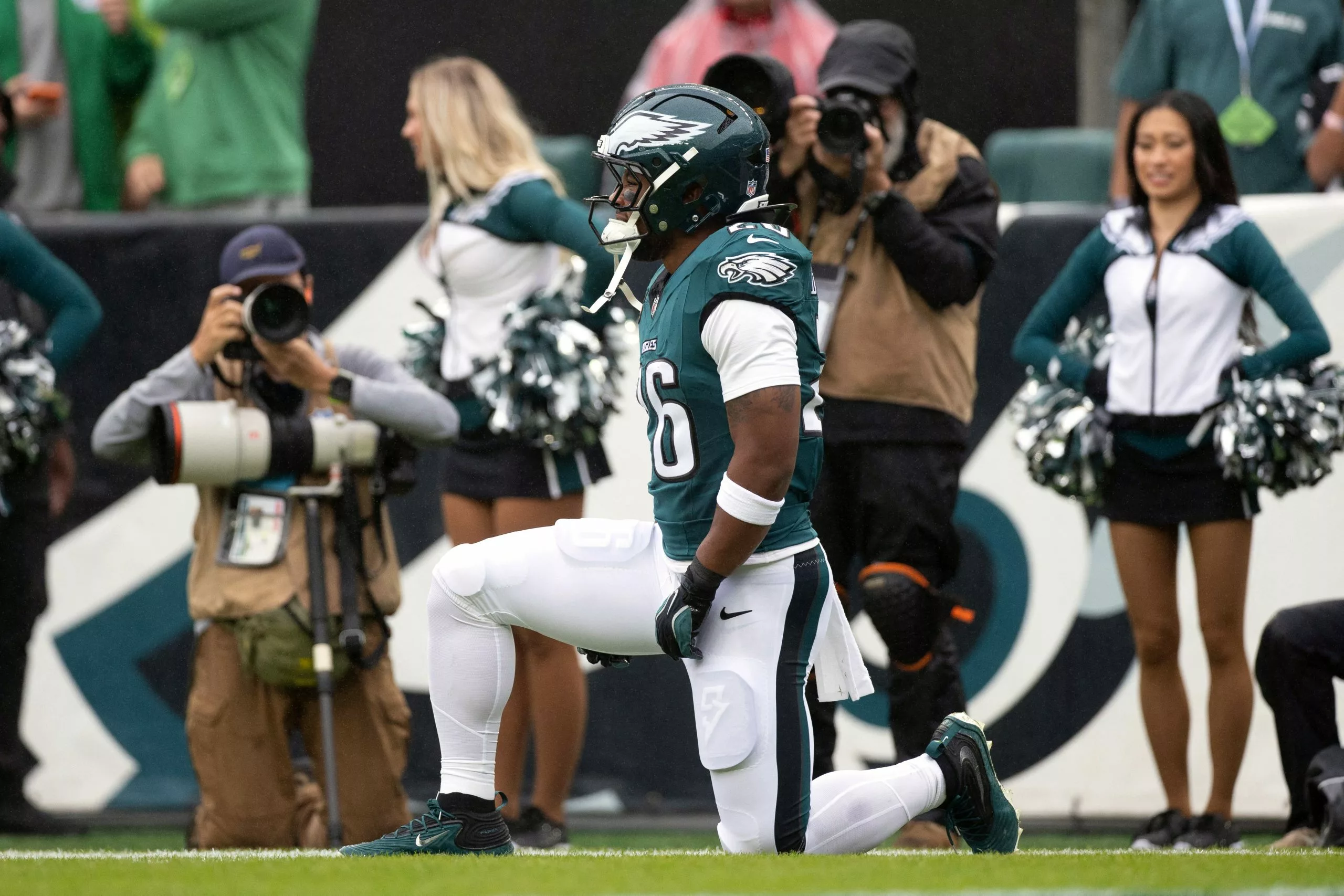
Oct 4, 2026; Philadelphia, Pennsylvania, USA; Philadelphia Eagles running back Saquon Barkley (26) kneels on the field with an apparent injury against the Los Angeles Rams during the first quarter at Lincoln Financial Field. Mandatory Credit: Bill Streicher-Imagn Images
The Eagles lost a game they had an opportunity to finish. Now they face a question that could shape considerably more than one Sunday.
What does Philadelphia’s offense look like without Saquon Barkley?
Barkley is considered week-to-week after suffering a hamstring injury in Sunday’s 24–20 loss to the Los Angeles Rams. His availability for the upcoming game against Jacksonville in London remains uncertain.
Philadelphia is 2–2, and its offense just delivered a performance that makes the prospect of playing without its most dangerous running back especially uncomfortable.
The Eagles finished with 172 yards of offense, failed to convert any of their 12 third-down opportunities and watched a 20–10 lead disappear.
Barkley’s injury makes the problem harder. It also exposes a responsibility Philadelphia cannot avoid: building an offense capable of functioning when its best running threat is unavailable.
Sunday Revealed an Offense With Too Few Answers
The Eagles’ third-down performance deserves more attention than the final score.
Philadelphia went 0-for-12 on third down and 1-for-4 on fourth down. The Rams repeatedly stopped the offense when a successful play could have extended a possession or helped secure the victory.
That is a failure of execution, preparation and offensive design.
An injury can change which plays are available. It cannot excuse an entire afternoon without a third-down conversion.
The Eagles
needed a dependable way to gain manageable yardage. They needed pass concepts that gave Jalen Hurts clear options. They needed blocking and ball placement that allowed those options to succeed.
Instead, too many possessions ended before Philadelphia could establish control.
Barkley’s absence matters enormously, but assigning the entire performance to his injury would let too many other people off the hook.
Barkley’s Value Extends Beyond His Carries
Barkley entered Sunday with 174 rushing yards over his first three games, averaging 5.1 yards per attempt. His early-season workload had been relatively modest, but he was producing efficiently when given the ball.
Replacing him involves more than finding someone to take those handoffs.
A back with Barkley’s ability can turn a small opening into a substantial gain. That possibility forces defenders to respect the run and makes a missed tackle particularly costly.
His presence also strengthens the logic of Philadelphia’s play-action and run-pass options. Those concepts depend partly on defenders believing the handoff deserves immediate attention.
Without him, the Eagles must earn that respect through execution.
They can still run effectively. They can still create favorable passing opportunities. But they cannot assume a replacement will generate the same explosive potential from the same blocking.
That distinction should shape the game plan.
The Backfield Problem Has Become More Serious
Philadelphia cannot simply turn to its usual second option.
Tank Bigsby reportedly needs core muscle surgery and is headed to injured reserve. With Barkley’s availability uncertain, Will Shipley is the remaining healthy running back on the active roster, while Dameon Pierce is among the practice-squad options.
That creates a substantial preparation challenge.
The Eagles must determine who can handle carries, who can contribute as a receiver and who can be trusted in pass protection. Those responsibilities do not automatically belong to the same player.
Shipley should be given opportunities that fit his strengths. Any additional back brought into the rotation needs a clearly defined role.
Expecting one replacement to reproduce everything Barkley provides would be an unreasonable starting point.
Philadelphia needs a workable combination of personnel and plays.
Jalen Hurts Must Give the Offense More
Hurts completed 12 of 27 passes for 93 yards against the Rams. His two touchdown passes were valuable, but the passing game did not produce enough consistent movement between those scoring plays.
The injuries around him matter. So does the pressure he faced.
Still, the quarterback must help the offense survive difficult circumstances. That means recognizing available throws, delivering the ball accurately and preventing manageable downs from becoming desperate situations.
If Barkley misses time, Philadelphia will need more dependable passing production from Hurts.
That does not mean asking him to throw constantly or rescue every possession with an improvised play. It means the offense needs its quarterback to execute the ordinary plays well enough that the extraordinary ones become a bonus.
A short completion on second down can change an entire possession. An accurate third-down throw can give the running game another opportunity.
Those are the contributions Philadelphia urgently needs.
Sean Mannion Needs a More Dependable Plan
Offensive coordinator Sean Mannion has to make that task achievable.
The Eagles cannot respond to Barkley’s absence by asking the remaining players to execute the same plan with less margin for error.
They should build around a smaller collection of concepts they can run consistently. Quick throws, defined reads and play-action that complements the available running game offer a practical starting point.
Motion can help Hurts gather information before the snap. Screens can punish an aggressive rush. Designed quarterback movement can change the launch point and create clearer throwing lanes.
These are possible adjustments, rather than guarantees. Their value depends on how well Philadelphia installs and executes them.
The objective should be straightforward: give the quarterback and replacement backs opportunities they can reliably handle.
An offense searching for its identity does not need greater complexity simply because it has lost an important player.
The Running Game Still Has to Matter
Abandoning the run would create another problem.
Philadelphia needs enough rushing production to avoid becoming predictable and keep Hurts from facing repeated obvious passing situations.
The standard for the replacement backs should be efficiency within their assignments. Make the correct read. Get through the available opening. Protect the football. Handle protection responsibilities.
The offensive line must help by creating gains that do not require a running back to beat multiple defenders on his own.
A successful replacement plan might feature fewer explosive runs than an offense with Barkley. It can still sustain drives if it produces manageable second and third downs.
Philadelphia’s identity can remain rooted in physical football. Its expectations must match the personnel available.
Sirianni Must Match His Decisions to the Offense
Nick Sirianni
also has to evaluate what his offense can realistically execute.
Against the Rams, Philadelphia went for a touchdown on fourth-and-goal from the 2 while leading 20–10. The attempt failed, leaving Los Angeles an opportunity to rally. Sirianni explained afterward that he wanted to build a three-score lead.
Aggressiveness can be sound. But a coach’s decisions need to account for the condition of his offense and its performance that day.
When an injury-depleted unit is struggling to convert short-yardage situations, confidence alone does not supply a reliable play.
Sirianni and Mannion need to identify those plays before the next critical moment arrives. They also need to recognize when the available points are especially valuable.
The Eagles Need an Identity That Survives an Injury
Philadelphia should hope Barkley returns quickly. It must prepare to play effectively if he does not.
The difference between those two positions is the difference between optimism and a useful plan.
The Eagles still have a quarterback capable of winning games. They still have coaches responsible for putting their remaining players in favorable situations. Their season remains recoverable.
But Sunday showed how fragile the offense can become when it loses an important piece.
Barkley’s absence would demand adjustments from the running backs, offensive line, quarterback and coaching staff. Nobody gets to wait for him to return before correcting their own part of the problem.
The Eagles do not need to recreate Saquon Barkley.
They need to prove they can run a functioning offense without him.
New Users – Get $350 in Bonus Bets when you wager $5 for 7 days
T&Cs apply
4.6/5
Gambling Problem? Call 1-800-GAMBLER or 1-800-MY-RESET. Call 1-888-789-7777 or visit ccpgg.org/chat (CT). Hope is here. GamblingHelpLineMA.org or call (800) 327-5050 for 24/7 support (MA). Visit www.mdgamblinghelp.org (MD). Call 1-877-8HOPE-NY or text HOPENY (NY). 21+ (18+ DC, WY) and present in select states (for KS, in affiliation with Kansas Star Casino). Find online real money wagering only. Min $5 wager required for 7 consecutive days. $5 free play credit. Bonus issued as non-withdrawable bonus with cash withdrawable bonus with cash withdrawable. Bonus bets which expire 7 days after receipt. Restrictions apply. See terms at sportsbook.fanduel.com. Call 1-877-770-7867 (LA).
Up To $1500 in Bonus Bets Paid Back if your First Bet Does Not Win
T&Cs apply
4.5/5
Gambling problem? Call 1-800-GAMBLER or 1-800-MY-RESET (Available in the US) 877-8-HOPENY or text HOPENY (467369) (NY) 1-800-327-5050 (MA), 1-800-BETS-OFF (IA), 1-800-981-0023 (PR). 21+ only. Please Gamble Responsibly. See BetMGM.com for Terms. First Bet Offer for new customers only (if applicable). Subject to eligibility requirements. Bonus bets are non-withdrawable. In partnership with Kansas Crossing Casino and Hotel. Promotional offers not available in Mississippi, Massachusetts, New York, Ontario, or Puerto Rico.
New DraftKings Customers: Bet $5, Get $200 + 3 Months of NBA League Pass!
T&Cs apply
4.5/5
GAMBLING PROBLEM? CALL 1-800-GAMBLER or 1-800-MY-RESET, (800) 327-5050 or visit gamblinghelplinema.org (MA). Please Gamble Responsibly. 888-789-7777/visit ccpg.org (CT), or visit www.mdgamblinghelp.org (MD), 1-800-981-0023 (PR). 21+ and present in most states. (18+ DC/NH/PR/WY). Void in CAN. Eligibility restrictions apply. On behalf of Boot Hill Casino (KS). Pass-thru of per wager tax may apply in IL. 1 per new Sportsbook customer. $5+ first-time bet req. Max. $200 issued as non-withdrawable Bonus Bets. Stake removed from payout. Reward issued as $50 in Bonus Bets every 7 days via click-to-claim for 21 days. Bonus Bets and click-to-claims expire 7 days (168hrs) after issuance. Terms: dkng.co/offer. Get 1 promo code to redeem a 3-month NBA League Pass subscription, complimentary of DraftKings. Subscription auto-renews monthly at then-current price (currently $16.99/mo); cancel anytime. Terms, restrictions, and eligibility requirements apply. Redeem League Pass by 12/19/26 at 11:59 PM ET. Addt’l terms: support.watch.nba.com/hc/en-us/articles/9165532876183-League-Pass-Terms-of-Use_. Ends 11/29/26 at 11:59 PM ET. Sponsored by DK.
Must be 21+. GAMBLING PROBLEM? CALL 1-800-GAMBLER OR CALL 1-800-MY-RESET, www.mdgamblinghelp.org (MD), (800)-327-5050 or gamblinghelplinema.org (MA), Call (877)8-HOPENY or text HOPENY (467369) (NY), (888) 789-7777 or ccpg.org (CT), morethanagame.nc.gov (NC), 1800gambler.net (WV)
Bet $1 and get double the winnings up to $25 for your next 10 bets
T&Cs apply
4.4/5
21+ New users only. Must register using eligible promo code. First bet after registration must qualify. Max. Bonus Bet: $1,000. Bonus Bet expires 14 days after receipt. Void where prohibited. See Caesars.com/promos for full terms. Gambling Problem? 1-800-GAMBLER (1-800-426-2537)
21+ and present in OH. Gambling Problem? Call 1-800-GAMBLER.
This site is using
Cloudflare
and adheres to the
Google Safe Browsing Program. We adapted
Google's Privacy Guidelines
to keep your data safe at all times.
Close
Ready to Win Big? Join the Elite with Our Sports Betting Deals!
FanDuel Promo
New Users – Get $350 in Bonus Bets when you wager $5 for 7 days
Our Favorite
T&Cs and 21+ apply
Gambling Problem? Call 1-800-GAMBLER or 1-800-MY-RESET. Call 1-888-789-7777 or visit ccpgg.org/chat (CT). Hope is here. GamblingHelpLineMA.org or call (800) 327-5050 for 24/7 support (MA). Visit www.mdgamblinghelp.org (MD). Call 1-877-8HOPE-NY or text HOPENY (NY). 21+ (18+ DC, WY) and present in select states (for KS, in affiliation with Kansas Star Casino). Find online real money wagering only. Min $5 wager required for 7 consecutive days. $5 free play credit. Bonus issued as non-withdrawable bonus with cash withdrawable bonus with cash withdrawable. Bonus bets which expire 7 days after receipt. Restrictions apply. See terms at sportsbook.fanduel.com. Call 1-877-770-7867 (LA).
Code:
Open FanDuel
Get Bonus
BetMGM Promo
Up To $1500 in Bonus Bets Paid Back if your First Bet Does Not Win
Best Slots
T&Cs and 21+ apply
Gambling problem? Call 1-800-GAMBLER or 1-800-MY-RESET (Available in the US) 877-8-HOPENY or text HOPENY (467369) (NY) 1-800-327-5050 (MA), 1-800-BETS-OFF (IA), 1-800-981-0023 (PR). 21+ only. Please Gamble Responsibly. See BetMGM.com for Terms. First Bet Offer for new customers only (if applicable). Subject to eligibility requirements. Bonus bets are non-withdrawable. In partnership with Kansas Crossing Casino and Hotel. Promotional offers not available in Mississippi, Massachusetts, New York, Ontario, or Puerto Rico.
Code:
Open BetMGM
Get Bonus
DraftKings Promo
New DraftKings Customers: Bet $5, Get $200 + 3 Months of NBA League Pass!
Newcomer
T&Cs and 21+ apply
GAMBLING PROBLEM? CALL 1-800-GAMBLER or 1-800-MY-RESET, (800) 327-5050 or visit gamblinghelplinema.org (MA). Please Gamble Responsibly. 888-789-7777/visit ccpg.org (CT), or visit www.mdgamblinghelp.org (MD), 1-800-981-0023 (PR). 21+ and present in most states. (18+ DC/NH/PR/WY). Void in CAN. Eligibility restrictions apply. On behalf of Boot Hill Casino (KS). Pass-thru of per wager tax may apply in IL. 1 per new Sportsbook customer. $5+ first-time bet req. Max. $200 issued as non-withdrawable Bonus Bets. Stake removed from payout. Reward issued as $50 in Bonus Bets every 7 days via click-to-claim for 21 days. Bonus Bets and click-to-claims expire 7 days (168hrs) after issuance. Terms: dkng.co/offer. Get 1 promo code to redeem a 3-month NBA League Pass subscription, complimentary of DraftKings. Subscription auto-renews monthly at then-current price (currently $16.99/mo); cancel anytime. Terms, restrictions, and eligibility requirements apply. Redeem League Pass by 12/19/26 at 11:59 PM ET. Addt’l terms: support.watch.nba.com/hc/en-us/articles/9165532876183-League-Pass-Terms-of-Use_. Ends 11/29/26 at 11:59 PM ET. Sponsored by DK.
Code:
Open DraftKings
Get Bonus
Find out what the legends have to say about sports this week....
New Users – Get $350 in Bonus Bets when you wager $5 for 7 days
Gambling Problem? Call 1-800-GAMBLER or 1-800-MY-RESET. Call 1-888-789-7777 or visit ccpgg.org/chat (CT). Hope is here. GamblingHelpLineMA.org or call (800) 327-5050 for 24/7 support (MA). Visit www.mdgamblinghelp.org (MD). Call 1-877-8HOPE-NY or text HOPENY (NY). 21+ (18+ DC, WY) and present in select states (for KS, in affiliation with Kansas Star Casino). Find online real money wagering only. Min $5 wager required for 7 consecutive days. $5 free play credit. Bonus issued as non-withdrawable bonus with cash withdrawable bonus with cash withdrawable. Bonus bets which expire 7 days after receipt. Restrictions apply. See terms at sportsbook.fanduel.com. Call 1-877-770-7867 (LA).