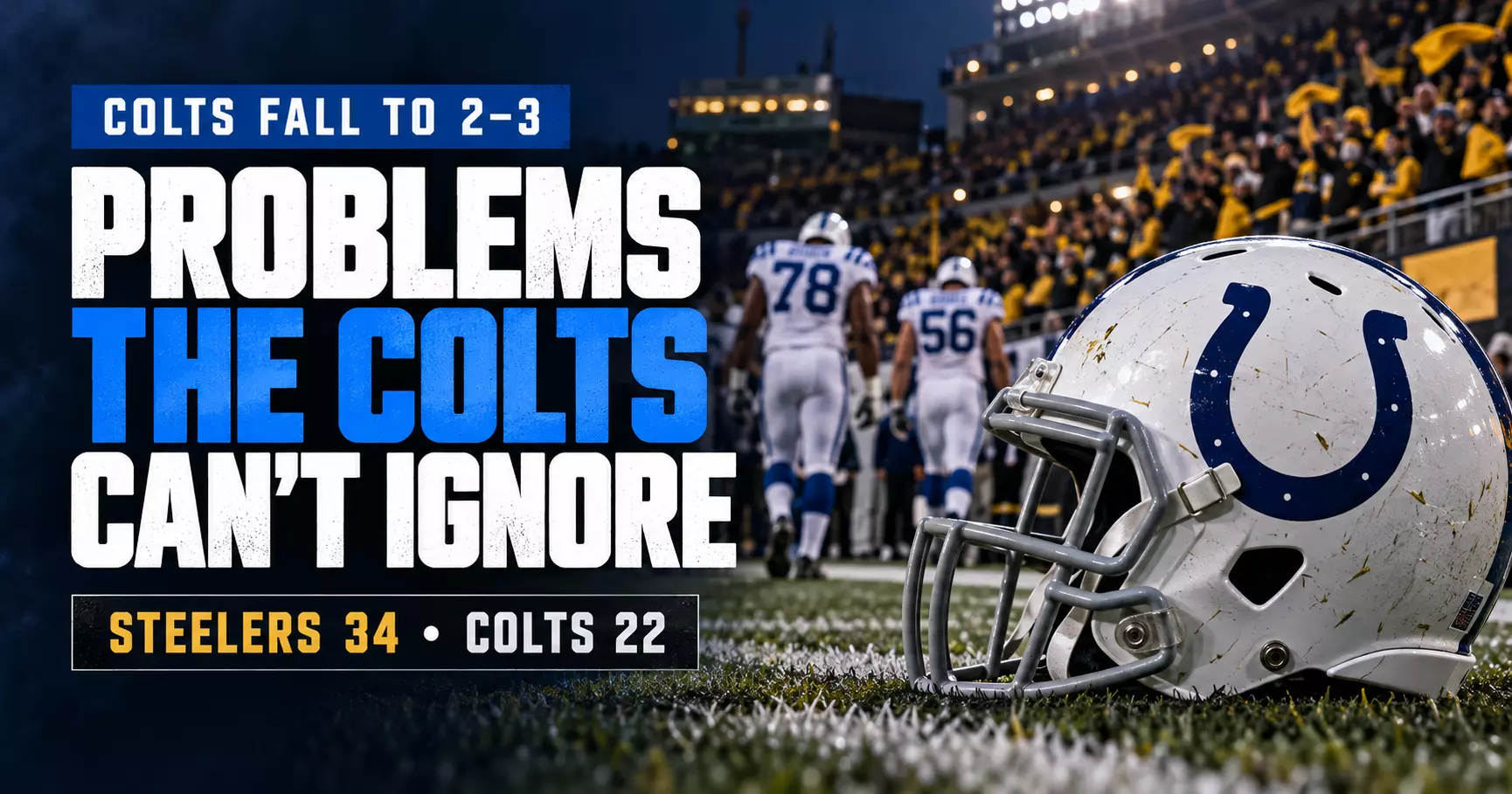
The Indianapolis Colts did enough Sunday to keep the game competitive. They did not do enough to win it. That distinction should concern everyone responsible for this team.
The Indianapolis Colts did enough Sunday to keep the game competitive. They did not do enough to win it.
That distinction should concern everyone responsible for this team.
Indianapolis lost 34–22 to Pittsburgh, falling to 2–3 after an afternoon defined by unfinished offensive possessions and defensive breakdowns that turned ordinary opportunities into enormous Steelers gains.
The Colts could move the ball. They could put points on the scoreboard. But when the game demanded touchdowns, tackles and a decisive stop, Pittsburgh delivered more often.
For Shane Steichen, Chris Ballard, and the rest of the organization, that is the problem that needs an answer.
Field Goals Kept Indianapolis Close—and Left Pittsburgh in Control
Spencer Shrader made five field goals. His work helped keep Indianapolis within reach, but the volume of field-goal attempts also exposed the offense’s inability to finish.
Daniel Jones completed 24 of 44 passes for 267 yards without a touchdown pass. Jonathan Taylor managed 45 rushing yards on 15 carries.
Those numbers describe an offense that could generate some movement without consistently imposing its preferred terms on the defense.
When Taylor is limited to three yards per carry, the passing game needs to provide more than enough completions to advance the ball between the 20s. It must create touchdowns and punish the opponent for containing the run.
Indianapolis did not produce enough of either.
There is a difference between a productive drive and a successful drive. Against an opponent creating
explosive touchdowns, repeatedly settling for three points leaves a team chasing the game even when the score remains close.
The Red-Zone Failure Needs Context—and Correction
The Colts scored one touchdown on three red-zone possessions Sunday.
That was a sharp departure from their earlier performance. Indianapolis entered Week 5 sixth in the NFL in red-zone touchdown rate at 75 percent and had scored touchdowns on all nine of its goal-to-go possessions.
It would be inaccurate to describe Sunday as proof that the Colts have been incapable of finishing drives all season.
It is fair to say their strength failed them in a game where they needed it most.
Steichen acknowledged responsibility for both the calls and the execution. That is appropriate. The head coach cannot separate himself from the offense’s performance when the field becomes condensed and each decision carries greater weight.
The next step must be specific. Indianapolis needs to identify why its options failed near the goal line, whether the calls matched what Pittsburgh presented, and how effectively players carried out their assignments.
Acknowledging the problem is useful. Correcting it determines whether that acknowledgment means anything.
Pittsburgh’s Biggest Plays Exposed the Defense
Jaylen Warren scored on an 80-yard reception and a 50-yard run. He finished with 188 yards from scrimmage.
Those plays gave Pittsburgh an advantage Indianapolis could not afford to surrender. While the Colts were working through drives that ended in field goals, Warren changed the scoreboard in a single snap.
Explosive touchdowns have consequences beyond the points themselves. They erase the value of earlier defensive work, alter the offense’s choices and reduce the margin for every subsequent mistake.
A defense cannot expect to win consistently when an opponent can turn a manageable play into a trip to the end zone.
My assessment is that Sunday’s defensive failure deserves more concern than the red-zone slump. The offense had demonstrated an ability to finish earlier in the season. Tackling had already emerged as an issue and returned at a damaging moment.
That makes it harder to dismiss Pittsburgh as an isolated bad afternoon.
Tackling Cannot Remain a Weekly Uncertainty
The Colts’ own postgame assessment cited eight missed tackles, based on Pro Football Focus’s evaluation, including misses on Warren’s two long touchdowns.
This was not merely a case of Aaron Rodgers making impossible throws against excellent coverage. Indianapolis failed to finish plays it had opportunities to contain.
Defensive coordinator Lou Anarumo and his staff must be judged on whether those mistakes become less frequent.
Players bear responsibility for their execution. Coaches bear responsibility for technique, preparation, assignments and deciding who can perform reliably. If a defender repeatedly struggles to finish, the response cannot end with another reminder about fundamentals.
The staff needs to determine whether the problem involves positioning, pursuit angles, tackling technique or personnel—and respond accordingly.
No scheme can fully compensate for a defense that reaches the ball and fails to bring the runner down.
Steichen Must Produce an Offense That Can Answer
Steichen’s challenge extends beyond one disappointing red-zone performance.
Indianapolis needs enough offensive flexibility to respond when Taylor is contained. That requires effective adjustments, dependable passing options and a plan that can create scoring opportunities without leaning entirely on one player.
The head coach should be evaluated on how the offense responds during difficult games. Does it find a workable counter? Does it improve after the opponent reveals its approach? Can it convert an opportunity when the score demands a touchdown?
Sunday supplied too many unsatisfactory answers.
That does not mean a 2–3 record ends the season. It means the Colts have reached a point where explanations must be accompanied by visible improvement.
Chris Ballard Cannot Be Separated From the Product
Ballard remains the
general manager
responsible for assembling this roster. Steichen remains the coach responsible for preparing it.
Both were retained for the 2026 season. The organization chose continuity, and that decision must be evaluated through results.
One loss does not prove that every personnel decision was wrong. But recurring weaknesses make roster construction a legitimate part of the discussion.
If the defense cannot tackle consistently, the questions reach beyond the coordinator. If the offense struggles when its featured runner is contained, the supporting personnel deserve examination alongside the calls.
Ballard should be judged on whether the team he assembled can withstand those challenges.
Fans do not need another explanation of what the roster might become. They need evidence of what it can accomplish.
The Colts Need a Response That Lasts
Indianapolis returns home to face the winless Tennessee Titans next week.
That offers a chance to get back to .500. It also creates a temptation to mistake one favorable result for a complete repair.
A victory would matter. The performance would matter too.
The Colts need to finish scoring opportunities, reduce defensive breakdowns and demonstrate that their corrections hold beyond one opponent. They need an offense capable of answering touchdowns and a defense that stops making the game harder than necessary.
Pittsburgh exposed problems Indianapolis can still address.
What the Colts cannot afford is another week in which those problems are acknowledged, explained and then repeated.
Up To $1500 in Bonus Bets Paid Back if your First Bet Does Not Win
T&Cs apply
4.5/5
Gambling problem? Call 1-800-GAMBLER or 1-800-MY-RESET (Available in the US) 877-8-HOPENY or text HOPENY (467369) (NY) 1-800-327-5050 (MA), 1-800-BETS-OFF (IA), 1-800-981-0023 (PR). 21+ only. Please Gamble Responsibly. See BetMGM.com for Terms. First Bet Offer for new customers only (if applicable). Subject to eligibility requirements. Bonus bets are non-withdrawable. In partnership with Kansas Crossing Casino and Hotel. Promotional offers not available in Mississippi, Massachusetts, New York, Ontario, or Puerto Rico.
New DraftKings Customers: Spend $5+ Get $150 in Bonuses
T&Cs apply
4.5/5
GAMBLING PROBLEM? CALL 1-800-GAMBLER or 1-800-MY-RESET, (800) 327-5050 or visit gamblinghelplinema.org (MA). Please Gamble Responsibly. 888-789-7777/visit ccpg.org (CT), or visit www.mdgamblinghelp.org (MD), 1-800-981-0023 (PR). 21+ and present in most states. (18+ DC/NH/PR/WY). Void in CAN. Eligibility restrictions apply. On behalf of Boot Hill Casino (KS). Pass-thru of per wager tax may apply in IL. 1 per new DraftKings customer. $5+ first-time bet req. Max. $150 issued as non-withdrawable Bonus Bets. Stake removed from payout. Reward issued as $50 in Bonus Bets every 7 days via click-to-claim for 14 days. Bonus Bets and click-to-claims expire 7 days (168hrs) after issuance. Terms: sportsbook.draftkings.com/promos. Ends 10/11/26 at 11:59 PM ET. Sponsored by DK.
Must be 21+. GAMBLING PROBLEM? CALL 1-800-GAMBLER OR CALL 1-800-MY-RESET, www.mdgamblinghelp.org (MD), (800)-327-5050 or gamblinghelplinema.org (MA), Call (877)8-HOPENY or text HOPENY (467369) (NY), (888) 789-7777 or ccpg.org (CT), morethanagame.nc.gov (NC), 1800gambler.net (WV)
Bet $1 and get double the winnings up to $25 for your next 10 bets
T&Cs apply
4.4/5
21+ New users only. Must register using eligible promo code. First bet after registration must qualify. Max. Bonus Bet: $1,000. Bonus Bet expires 14 days after receipt. Void where prohibited. See Caesars.com/promos for full terms. Gambling Problem? 1-800-GAMBLER (1-800-426-2537)
21+ and present in OH. Gambling Problem? Call 1-800-GAMBLER.
This site is using
Cloudflare
and adheres to the
Google Safe Browsing Program. We adapted
Google's Privacy Guidelines
to keep your data safe at all times.
Close
Ready to Win Big? Join the Elite with Our Sports Betting Deals!
FanDuel Promo
New Users – Get $250 in Bonus Bets when you wager $5 for 5 days
Up To $1500 in Bonus Bets Paid Back if your First Bet Does Not Win
Best Slots
T&Cs and 21+ apply
Gambling problem? Call 1-800-GAMBLER or 1-800-MY-RESET (Available in the US) 877-8-HOPENY or text HOPENY (467369) (NY) 1-800-327-5050 (MA), 1-800-BETS-OFF (IA), 1-800-981-0023 (PR). 21+ only. Please Gamble Responsibly. See BetMGM.com for Terms. First Bet Offer for new customers only (if applicable). Subject to eligibility requirements. Bonus bets are non-withdrawable. In partnership with Kansas Crossing Casino and Hotel. Promotional offers not available in Mississippi, Massachusetts, New York, Ontario, or Puerto Rico.
Code:
Open BetMGM
Get Bonus
DraftKings Promo
New DraftKings Customers: Spend $5+ Get $150 in Bonuses
Newcomer
T&Cs and 21+ apply
GAMBLING PROBLEM? CALL 1-800-GAMBLER or 1-800-MY-RESET, (800) 327-5050 or visit gamblinghelplinema.org (MA). Please Gamble Responsibly. 888-789-7777/visit ccpg.org (CT), or visit www.mdgamblinghelp.org (MD), 1-800-981-0023 (PR). 21+ and present in most states. (18+ DC/NH/PR/WY). Void in CAN. Eligibility restrictions apply. On behalf of Boot Hill Casino (KS). Pass-thru of per wager tax may apply in IL. 1 per new DraftKings customer. $5+ first-time bet req. Max. $150 issued as non-withdrawable Bonus Bets. Stake removed from payout. Reward issued as $50 in Bonus Bets every 7 days via click-to-claim for 14 days. Bonus Bets and click-to-claims expire 7 days (168hrs) after issuance. Terms: sportsbook.draftkings.com/promos. Ends 10/11/26 at 11:59 PM ET. Sponsored by DK.
Code:
Open DraftKings
Get Bonus
Find out what the legends have to say about sports this week....