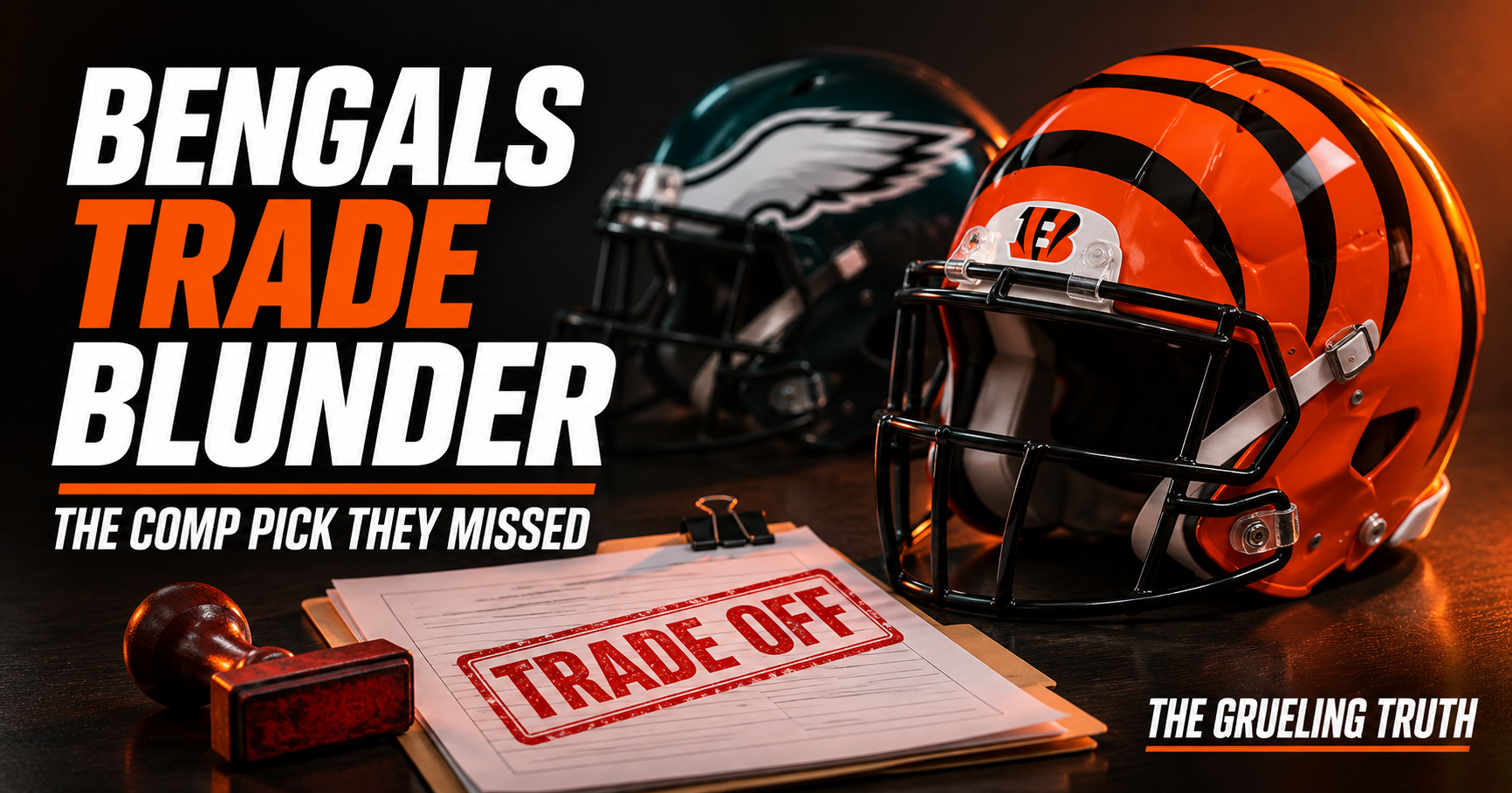
The Cincinnati Bengals should have known exactly what acquiring Arnold Ebiketie would cost before agreeing to send Philadelphia a draft pick.
The Cincinnati Bengals should have known exactly what acquiring Arnold Ebiketie would cost before agreeing to send Philadelphia a draft pick. That is the front office’s job. Tuesday’s reported reversal leaves an uncomfortable question for an organization trying to win with Joe Burrow. How did a trade get far enough to be reported as agreed upon before Cincinnati accounted for a significant part of its price?
The proposed deal would have sent a 2027 sixth-round pick to the Eagles for the pass rusher. NFL Network reported that Cincinnati called it off because acquiring Ebiketie would jeopardize a projected third-round compensatory pick connected to Trey Hendrickson’s departure. Over the Cap’s Nick Korte publicly identified the issue before the reversal.
Backing out preserved the opportunity to receive that compensation. It also exposed a failure that should have been caught before Cincinnati reached an agreement.
The full cost belonged in the first conversation
A trade’s price includes more than the selection written on the transaction sheet. Salary obligations, contract provisions and effects on future draft compensation all belong in the evaluation. A football operations department has to put those pieces together before the personnel staff decides whether the player is worth acquiring.
Compensatory selections
are projected until the league awards them. That uncertainty makes careful analysis more necessary. Cincinnati should have had a current projection showing what the proposed acquisition would do to its expected picks, including any assumptions that might change the result.
The published reporting does not establish every conversation inside the building. It does establish that the agreement was reported, the compensatory issue became public and the Bengals then backed away. On that sequence, the front office deserves criticism. The organization should be able to explain why a foreseeable contract consequence had not already been resolved when it committed to the deal.
Fans should expect the Bengals to understand their own roster
The rule at issue involves acquiring a player whose contract counts in the compensatory free-agent calculation. Ebiketie’s status meant the incoming contract had consequences for Cincinnati’s projected compensation. That was information attached to the player and the league’s rules before deadline day.
This is exactly the kind of detail fans pay professional decision-makers to understand. Supporters should not have to follow a public analyst’s posts to discover whether their team has properly calculated a transaction. Korte deserves credit for explaining the issue. Cincinnati should have reached its decision with the same issue already accounted for.
There are legitimate disagreements about how much to pay for a rotational pass rusher. Reasonable evaluators can watch the same player and arrive at different conclusions. Knowing the complete acquisition cost is a prerequisite to having that debate. A staff cannot make a sound personnel judgment while using an incomplete price.
The pass-rush need survives the canceled agreement
The reversal also matters because Cincinnati had identified a player it believed could help. Reaching an agreement suggests the Bengals saw a role for Ebiketie. Calling off the deal did nothing to fill that role. In truth it was a bad deal to begin with and should have never been pursued Ebiketie would have done nothing here in my opinion, but the fact the Bengals Front Office looks clueless once again is more than concerning.
That puts the burden back on the front office’s preparation. If a projected compensatory selection made Ebiketie too expensive, Cincinnati needed to know early enough to evaluate alternatives. Deadline hours are valuable. Spending them on an agreement that unravels over a discoverable contractual consequence can leave fewer opportunities to improve the team elsewhere.
Burrow’s presence should raise the standard for how the organization uses those opportunities. A roster capable of contending deserves a front office that can move decisively because its research is complete. That preparation includes identifying acceptable prices, checking contractual consequences and having other targets ready when negotiations stall.
Correcting the mistake does not erase the process failure
Cincinnati made the sensible choice once it decided the real price was too high. The criticism is that it should have made that calculation before agreeing to the trade.
The Bengals owe their players and supporters a better process. Every proposed deal should reach the final decision-makers with its full draft and financial consequences attached. If different departments are using different assumptions, those differences need to be settled before an agreement.
Tuesday gave fans another reason to question whether that standard is being met. The front office avoided one expensive outcome, but it still failed to handle a basic responsibility at the proper time. Protecting Burrow’s championship opportunity requires better than discovering the price after saying yes.
New Users - Get $200 in Bonus Bets when you wager $5 for 4 days
T&Cs apply
4.6/5
Gambling Problem? Call 1-800-GAMBLER or 1-800-MY-RESET. Visit www.mdgamblinghelp.org (MD). 1-888-789-7777 or ccpg.org/chat (CT). Hope is here. GamblingHelpLineMA.org or (800) 327-5050 for 24/7 support (MA). 1-877-8-HOPENY or text HOPENY (467369) (NY). 21+ (18+ D.C., WY) and present in select states (for KS, in affiliation with Kansas Star Casino). First online real money wager only. Min $5 wager required for 4 consecutive days. $5 first deposit required. Bonus issued as nonwithdrawable bonus bets which expire 5 days after receipt. Restrictions apply. See terms at sportsbook.fanduel.com. Call 1-877-770-7867 (LA).
Get Up to $1,000 Back in Bonus Bets Over Your First 10 Days
T&Cs apply
4.5/5
Gambling problem? Call 1-800-GAMBLER or 1-800-MY-RESET (Available in the US) 877-8-HOPENY or text HOPENY (467369) (NY) 1-800-327-5050 (MA), 1-800-BETS-OFF (IA), 21+ only. Please Gamble Responsibly. Visit mdgamblinghelp.org (MD). See BetMGM.com for Terms. New Player Offer for new players only. Subject to eligibility requirements. Bonus bets are non-withdrawable. In partnership with Kansas Crossing Casino and Hotel. This promotional offer is not available in NJ, MA, MI, NV, NY, ON, PA, PR, and WV.
New DraftKings Customers: Bet $5, Get $200 + 3 Months of NBA League Pass
T&Cs apply
4.5/5
GAMBLING PROBLEM? CALL 1-800-GAMBLER or 1-800-MY-RESET, (800) 327-5050 or visit gamblinghelplinema.org (MA). Please Gamble Responsibly. 888-789-7777/visit ccpg.org (CT), or visit www.mdgamblinghelp.org (MD), 1-800-981-0023 (PR). 21+ and present in most states. (18+ DC/NH/PR/WY). Void in CAN. Eligibility restrictions apply. On behalf of Boot Hill Casino (KS). Pass-thru of per wager tax may apply in IL. 1 per new Sportsbook customer. $5+ first-time bet req. Max. $200 issued as non-withdrawable Bonus Bets. Stake removed from payout. Reward issued as $50 in Bonus Bets every 7 days via click-to-claim for 21 days. Bonus Bets and click-to-claims expire 7 days (168hrs) after issuance. Terms: dkng.co/offer. Get 1 promo code to redeem a 3-month NBA League Pass subscription, complimentary of DraftKings. Subscription auto-renews monthly at then-current price (currently $16.99/mo); cancel anytime. Terms, restrictions, and eligibility requirements apply. Redeem League Pass by 12/19/26 at 11:59 PM ET. Addt’l terms: support.watch.nba.com/hc/en-us/articles/9165532876183-League-Pass-Terms-of-Use_. Ends 11/29/26 at 11:59 PM ET. Sponsored by DK.
Must be 21+. GAMBLING PROBLEM? CALL 1-800-GAMBLER OR CALL 1-800-MY-RESET, www.mdgamblinghelp.org (MD), (800)-327-5050 or gamblinghelplinema.org (MA), Call (877)8-HOPENY or text HOPENY (467369) (NY), (888) 789-7777 or ccpg.org (CT), morethanagame.nc.gov (NC), 1800gambler.net (WV)
Bet $1 and get double the winnings up to $25 for your next 10 bets
T&Cs apply
4.4/5
21+ New users only. Must register using eligible promo code. First bet after registration must qualify. Max. Bonus Bet: $1,000. Bonus Bet expires 14 days after receipt. Void where prohibited. See Caesars.com/promos for full terms. Gambling Problem? 1-800-GAMBLER (1-800-426-2537)
21+ and present in OH. Gambling Problem? Call 1-800-GAMBLER.
This site is using
Cloudflare
and adheres to the
Google Safe Browsing Program. We adapted
Google's Privacy Guidelines
to keep your data safe at all times.
Close
Ready to Win Big? Join the Elite with Our Sports Betting Deals!
FanDuel Promo
New Users - Get $200 in Bonus Bets when you wager $5 for 4 days
Our Favorite
T&Cs and 21+ apply
Gambling Problem? Call 1-800-GAMBLER or 1-800-MY-RESET. Visit www.mdgamblinghelp.org (MD). 1-888-789-7777 or ccpg.org/chat (CT). Hope is here. GamblingHelpLineMA.org or (800) 327-5050 for 24/7 support (MA). 1-877-8-HOPENY or text HOPENY (467369) (NY). 21+ (18+ D.C., WY) and present in select states (for KS, in affiliation with Kansas Star Casino). First online real money wager only. Min $5 wager required for 4 consecutive days. $5 first deposit required. Bonus issued as nonwithdrawable bonus bets which expire 5 days after receipt. Restrictions apply. See terms at sportsbook.fanduel.com. Call 1-877-770-7867 (LA).
Code:
Open FanDuel
Get Bonus
BetMGM Promo
Get Up to $1,000 Back in Bonus Bets Over Your First 10 Days
Best Slots
T&Cs and 21+ apply
Gambling problem? Call 1-800-GAMBLER or 1-800-MY-RESET (Available in the US) 877-8-HOPENY or text HOPENY (467369) (NY) 1-800-327-5050 (MA), 1-800-BETS-OFF (IA), 21+ only. Please Gamble Responsibly. Visit mdgamblinghelp.org (MD). See BetMGM.com for Terms. New Player Offer for new players only. Subject to eligibility requirements. Bonus bets are non-withdrawable. In partnership with Kansas Crossing Casino and Hotel. This promotional offer is not available in NJ, MA, MI, NV, NY, ON, PA, PR, and WV.
Code:
Open BetMGM
Get Bonus
DraftKings Promo
New DraftKings Customers: Bet $5, Get $200 + 3 Months of NBA League Pass
Newcomer
T&Cs and 21+ apply
GAMBLING PROBLEM? CALL 1-800-GAMBLER or 1-800-MY-RESET, (800) 327-5050 or visit gamblinghelplinema.org (MA). Please Gamble Responsibly. 888-789-7777/visit ccpg.org (CT), or visit www.mdgamblinghelp.org (MD), 1-800-981-0023 (PR). 21+ and present in most states. (18+ DC/NH/PR/WY). Void in CAN. Eligibility restrictions apply. On behalf of Boot Hill Casino (KS). Pass-thru of per wager tax may apply in IL. 1 per new Sportsbook customer. $5+ first-time bet req. Max. $200 issued as non-withdrawable Bonus Bets. Stake removed from payout. Reward issued as $50 in Bonus Bets every 7 days via click-to-claim for 21 days. Bonus Bets and click-to-claims expire 7 days (168hrs) after issuance. Terms: dkng.co/offer. Get 1 promo code to redeem a 3-month NBA League Pass subscription, complimentary of DraftKings. Subscription auto-renews monthly at then-current price (currently $16.99/mo); cancel anytime. Terms, restrictions, and eligibility requirements apply. Redeem League Pass by 12/19/26 at 11:59 PM ET. Addt’l terms: support.watch.nba.com/hc/en-us/articles/9165532876183-League-Pass-Terms-of-Use_. Ends 11/29/26 at 11:59 PM ET. Sponsored by DK.
Code:
Open DraftKings
Get Bonus
Find out what the legends have to say about sports this week....
New Users - Get $200 in Bonus Bets when you wager $5 for 4 days
Gambling Problem? Call 1-800-GAMBLER or 1-800-MY-RESET. Visit www.mdgamblinghelp.org (MD). 1-888-789-7777 or ccpg.org/chat (CT). Hope is here. GamblingHelpLineMA.org or (800) 327-5050 for 24/7 support (MA). 1-877-8-HOPENY or text HOPENY (467369) (NY). 21+ (18+ D.C., WY) and present in select states (for KS, in affiliation with Kansas Star Casino). First online real money wager only. Min $5 wager required for 4 consecutive days. $5 first deposit required. Bonus issued as nonwithdrawable bonus bets which expire 5 days after receipt. Restrictions apply. See terms at sportsbook.fanduel.com. Call 1-877-770-7867 (LA).