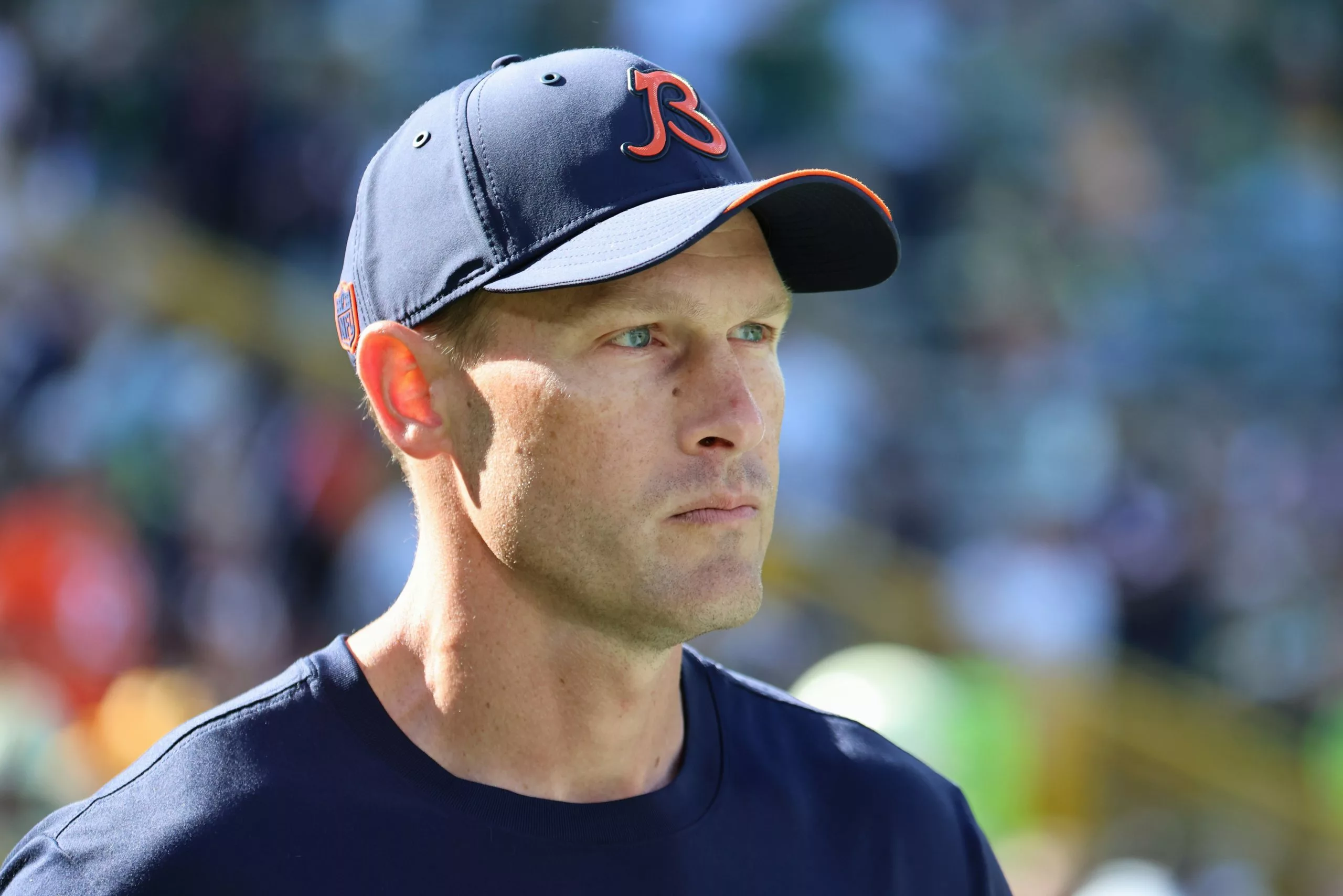
Oct 11, 2026; Green Bay, Wisconsin, USA; Chicago Bears head coach Ben Johnson looks on during warmups before the game against the Green Bay Packers at Lambeau Field. Mandatory Credit: Mike Dinovo-Imagn Images
Chicago’s 31–7 loss at Green Bay did more than interrupt a promising start. It exposed how quickly the Bears can unravel when their backup quarterbacks struggle and the rest of the team fails to compensate.
Tyson Bagent started. Case Keenum finished. Neither produced a touchdown pass.
Now Ben Johnson must prepare for Atlanta while Caleb Williams continues recovering from a hamstring injury. As of Monday’s update, Johnson had not determined which backup would lead the first-team offense in practice if Williams remained unavailable.
The Bears need an answer at quarterback. They also need to avoid treating that answer as a cure for everything that went wrong.
Williams’ Health Comes First
Williams has missed Chicago’s last three games. Johnson said Monday that he was progressing, but his availability for Atlanta remained unsettled.
That should govern the discussion.
If Williams is cleared and ready to perform, he is Chicago’s
starting quarterback. This is a question about how the Bears bridge his absence, not whether a poor game by the backups changes the long-term plan.
A return also needs to mean more than being able to take a snap. The offense needs its quarterback capable of moving, protecting himself and carrying out the game plan.
The Bears should prepare a credible alternative while Williams works toward returning. Waiting hopefully for their starter cannot replace a full week of preparation for whoever may have to play.
Bagent’s Green Bay Performance Demands Scrutiny
Bagent completed 12 of 21 passes for 87 yards and threw two interceptions before Johnson replaced him at the start of the fourth quarter.
That is not enough production to keep an offense competitive against a team making explosive plays.
But one bad afternoon should be evaluated alongside the evidence that preceded it. Bagent had helped Chicago beat the Jets the previous week. His performance in Green Bay does not erase that result.
The questions are specific: Why did he struggle to find a rhythm? Which decisions were avoidable? How effectively did the offense respond when Green Bay changed its coverage?
Johnson’s Monday assessment identified problems with Bagent’s interception decisions and credited the Packers for making the coverage picture difficult.
My view is that Bagent’s case for another start depends on whether the staff sees correctable mistakes within a plan it can trust. Familiarity is useful. It cannot substitute for protecting the football and moving the offense.
Keenum Has a Case—But No Automatic Claim
Keenum completed 11 of 19 passes for 108 yards in relief. He also threw an interception and lost a fumble.
That fourth-quarter appearance did not solve the problem.
Still, his case extends beyond the Green Bay box score. Keenum helped lead Chicago to a 27–7 victory over Philadelphia earlier this season. Johnson had previously praised his experience and understanding of the offense.
That gives the coach meaningful evidence to consider.
Keenum’s experience may help with identifying pressure, organizing protections and making quick decisions. Those are advantages a depleted offense can use.
Experience does not guarantee good execution, however. Against Green Bay, Keenum also contributed to the mistakes that prevented a comeback.
My assessment is that he deserves serious consideration if Williams cannot play. The decision should rest on the week’s preparation, the Atlanta matchup and the staff’s confidence in each quarterback’s ability to execute—not simply a reaction to Bagent’s benching.
Johnson Needs to Choose a Plan as Well as a Player
Selecting the starter is only part of the job.
Johnson must identify what that quarterback can execute reliably and build the game around it. A backup should receive a plan suited to his strengths, with manageable decisions and clear answers when the defense disrupts the first option.
That does not require abandoning the offense. It requires prioritizing its most dependable elements.
The Bears also need to assign practice work early enough for the chosen quarterback to develop timing with the players around him. An unsettled medical situation makes that difficult, but it does not make those repetitions less valuable.
Chicago’s goal should be a prepared starter with a coherent plan.
Changing names without improving the circumstances will accomplish little.
The Running Game Must Carry More Weight
The Bears managed 81 rushing yards against Green Bay after entering the game averaging 196.3.
That decline matters because a struggling passing game needs help staying out of predictable situations.
Kyle Monangai was unavailable with a toe injury. D’Andre Swift gained 43 yards on nine carries, while Chicago attempted to distribute the workload among other backs and receivers.
The injury explains part of the difficulty. It does not remove the need for an effective alternative.
My concern is that Chicago failed to establish enough consistency on the ground to support either quarterback. Johnson must determine which runs remain dependable with the available personnel and which additions complicated the attack without producing enough value.
The solution is not merely more rushing attempts. It is better execution and a plan that gives the offense manageable next downs.
The Defense Cannot Keep Giving Away Explosive Plays
Chicago’s quarterback problems did not cause every part of the defeat.
Jordan Love threw for 367 yards and two touchdowns.
The Packers
repeatedly attacked downfield, and the Bears allowed Green Bay to build an early lead.
A backup quarterback becomes easier to defend when he must chase the score. The opponent can anticipate passes and make each possession more demanding.
That places responsibility on defensive coordinator Dennis Allen and his players to limit the explosive gains that helped put Chicago in that position.
Rush and coverage must work together. A sound play on third-and-long should not become an opponent’s shortcut to the end zone.
The defense cannot ask the quarterback room to overcome problems it is creating.
A 3–2 Team Needs Corrections, Not Panic
Chicago remains 3–2. The season has not collapsed, and the backups have already contributed to wins.
But Green Bay exposed the limits of a team that lost the turnover battle 5–0, struggled to run and surrendered major gains through the air.
Johnson’s decision now requires more than choosing Bagent or Keenum. It requires an honest evaluation of what each can deliver, a plan that supports the chosen starter and corrections elsewhere that prevent the offense from carrying an impossible burden.
Williams’ return would strengthen Chicago’s outlook.
Until then, the Bears must prove they can function without him.
And when he comes back, they still need to fix the problems around him.
New Users – Get $350 in Bonus Bets when you wager $5 for 7 days
T&Cs apply
4.6/5
Gambling Problem? Call 1-800-GAMBLER or 1-800-MY-RESET. Call 1-888-789-7777 or visit ccpgg.org/chat (CT). Hope is here. GamblingHelpLineMA.org or call (800) 327-5050 for 24/7 support (MA). Visit www.mdgamblinghelp.org (MD). Call 1-877-8HOPE-NY or text HOPENY (NY). 21+ (18+ DC, WY) and present in select states (for KS, in affiliation with Kansas Star Casino). Find online real money wagering only. Min $5 wager required for 7 consecutive days. $5 free play credit. Bonus issued as non-withdrawable bonus with cash withdrawable bonus with cash withdrawable. Bonus bets which expire 7 days after receipt. Restrictions apply. See terms at sportsbook.fanduel.com. Call 1-877-770-7867 (LA).
Up To $1500 in Bonus Bets Paid Back if your First Bet Does Not Win
T&Cs apply
4.5/5
Gambling problem? Call 1-800-GAMBLER or 1-800-MY-RESET (Available in the US) 877-8-HOPENY or text HOPENY (467369) (NY) 1-800-327-5050 (MA), 1-800-BETS-OFF (IA), 1-800-981-0023 (PR). 21+ only. Please Gamble Responsibly. See BetMGM.com for Terms. First Bet Offer for new customers only (if applicable). Subject to eligibility requirements. Bonus bets are non-withdrawable. In partnership with Kansas Crossing Casino and Hotel. Promotional offers not available in Mississippi, Massachusetts, New York, Ontario, or Puerto Rico.
New DraftKings Customers: Bet $5, Get $200 + 3 Months of NBA League Pass!
T&Cs apply
4.5/5
GAMBLING PROBLEM? CALL 1-800-GAMBLER or 1-800-MY-RESET, (800) 327-5050 or visit gamblinghelplinema.org (MA). Please Gamble Responsibly. 888-789-7777/visit ccpg.org (CT), or visit www.mdgamblinghelp.org (MD), 1-800-981-0023 (PR). 21+ and present in most states. (18+ DC/NH/PR/WY). Void in CAN. Eligibility restrictions apply. On behalf of Boot Hill Casino (KS). Pass-thru of per wager tax may apply in IL. 1 per new Sportsbook customer. $5+ first-time bet req. Max. $200 issued as non-withdrawable Bonus Bets. Stake removed from payout. Reward issued as $50 in Bonus Bets every 7 days via click-to-claim for 21 days. Bonus Bets and click-to-claims expire 7 days (168hrs) after issuance. Terms: dkng.co/offer. Get 1 promo code to redeem a 3-month NBA League Pass subscription, complimentary of DraftKings. Subscription auto-renews monthly at then-current price (currently $16.99/mo); cancel anytime. Terms, restrictions, and eligibility requirements apply. Redeem League Pass by 12/19/26 at 11:59 PM ET. Addt’l terms: support.watch.nba.com/hc/en-us/articles/9165532876183-League-Pass-Terms-of-Use_. Ends 11/29/26 at 11:59 PM ET. Sponsored by DK.
Must be 21+. GAMBLING PROBLEM? CALL 1-800-GAMBLER OR CALL 1-800-MY-RESET, www.mdgamblinghelp.org (MD), (800)-327-5050 or gamblinghelplinema.org (MA), Call (877)8-HOPENY or text HOPENY (467369) (NY), (888) 789-7777 or ccpg.org (CT), morethanagame.nc.gov (NC), 1800gambler.net (WV)
Bet $1 and get double the winnings up to $25 for your next 10 bets
T&Cs apply
4.4/5
21+ New users only. Must register using eligible promo code. First bet after registration must qualify. Max. Bonus Bet: $1,000. Bonus Bet expires 14 days after receipt. Void where prohibited. See Caesars.com/promos for full terms. Gambling Problem? 1-800-GAMBLER (1-800-426-2537)
21+ and present in OH. Gambling Problem? Call 1-800-GAMBLER.
This site is using
Cloudflare
and adheres to the
Google Safe Browsing Program. We adapted
Google's Privacy Guidelines
to keep your data safe at all times.
Close
Ready to Win Big? Join the Elite with Our Sports Betting Deals!
FanDuel Promo
New Users – Get $350 in Bonus Bets when you wager $5 for 7 days
Our Favorite
T&Cs and 21+ apply
Gambling Problem? Call 1-800-GAMBLER or 1-800-MY-RESET. Call 1-888-789-7777 or visit ccpgg.org/chat (CT). Hope is here. GamblingHelpLineMA.org or call (800) 327-5050 for 24/7 support (MA). Visit www.mdgamblinghelp.org (MD). Call 1-877-8HOPE-NY or text HOPENY (NY). 21+ (18+ DC, WY) and present in select states (for KS, in affiliation with Kansas Star Casino). Find online real money wagering only. Min $5 wager required for 7 consecutive days. $5 free play credit. Bonus issued as non-withdrawable bonus with cash withdrawable bonus with cash withdrawable. Bonus bets which expire 7 days after receipt. Restrictions apply. See terms at sportsbook.fanduel.com. Call 1-877-770-7867 (LA).
Code:
Open FanDuel
Get Bonus
BetMGM Promo
Up To $1500 in Bonus Bets Paid Back if your First Bet Does Not Win
Best Slots
T&Cs and 21+ apply
Gambling problem? Call 1-800-GAMBLER or 1-800-MY-RESET (Available in the US) 877-8-HOPENY or text HOPENY (467369) (NY) 1-800-327-5050 (MA), 1-800-BETS-OFF (IA), 1-800-981-0023 (PR). 21+ only. Please Gamble Responsibly. See BetMGM.com for Terms. First Bet Offer for new customers only (if applicable). Subject to eligibility requirements. Bonus bets are non-withdrawable. In partnership with Kansas Crossing Casino and Hotel. Promotional offers not available in Mississippi, Massachusetts, New York, Ontario, or Puerto Rico.
Code:
Open BetMGM
Get Bonus
DraftKings Promo
New DraftKings Customers: Bet $5, Get $200 + 3 Months of NBA League Pass!
Newcomer
T&Cs and 21+ apply
GAMBLING PROBLEM? CALL 1-800-GAMBLER or 1-800-MY-RESET, (800) 327-5050 or visit gamblinghelplinema.org (MA). Please Gamble Responsibly. 888-789-7777/visit ccpg.org (CT), or visit www.mdgamblinghelp.org (MD), 1-800-981-0023 (PR). 21+ and present in most states. (18+ DC/NH/PR/WY). Void in CAN. Eligibility restrictions apply. On behalf of Boot Hill Casino (KS). Pass-thru of per wager tax may apply in IL. 1 per new Sportsbook customer. $5+ first-time bet req. Max. $200 issued as non-withdrawable Bonus Bets. Stake removed from payout. Reward issued as $50 in Bonus Bets every 7 days via click-to-claim for 21 days. Bonus Bets and click-to-claims expire 7 days (168hrs) after issuance. Terms: dkng.co/offer. Get 1 promo code to redeem a 3-month NBA League Pass subscription, complimentary of DraftKings. Subscription auto-renews monthly at then-current price (currently $16.99/mo); cancel anytime. Terms, restrictions, and eligibility requirements apply. Redeem League Pass by 12/19/26 at 11:59 PM ET. Addt’l terms: support.watch.nba.com/hc/en-us/articles/9165532876183-League-Pass-Terms-of-Use_. Ends 11/29/26 at 11:59 PM ET. Sponsored by DK.
Code:
Open DraftKings
Get Bonus
Find out what the legends have to say about sports this week....
New Users – Get $350 in Bonus Bets when you wager $5 for 7 days
Gambling Problem? Call 1-800-GAMBLER or 1-800-MY-RESET. Call 1-888-789-7777 or visit ccpgg.org/chat (CT). Hope is here. GamblingHelpLineMA.org or call (800) 327-5050 for 24/7 support (MA). Visit www.mdgamblinghelp.org (MD). Call 1-877-8HOPE-NY or text HOPENY (NY). 21+ (18+ DC, WY) and present in select states (for KS, in affiliation with Kansas Star Casino). Find online real money wagering only. Min $5 wager required for 7 consecutive days. $5 free play credit. Bonus issued as non-withdrawable bonus with cash withdrawable bonus with cash withdrawable. Bonus bets which expire 7 days after receipt. Restrictions apply. See terms at sportsbook.fanduel.com. Call 1-877-770-7867 (LA).