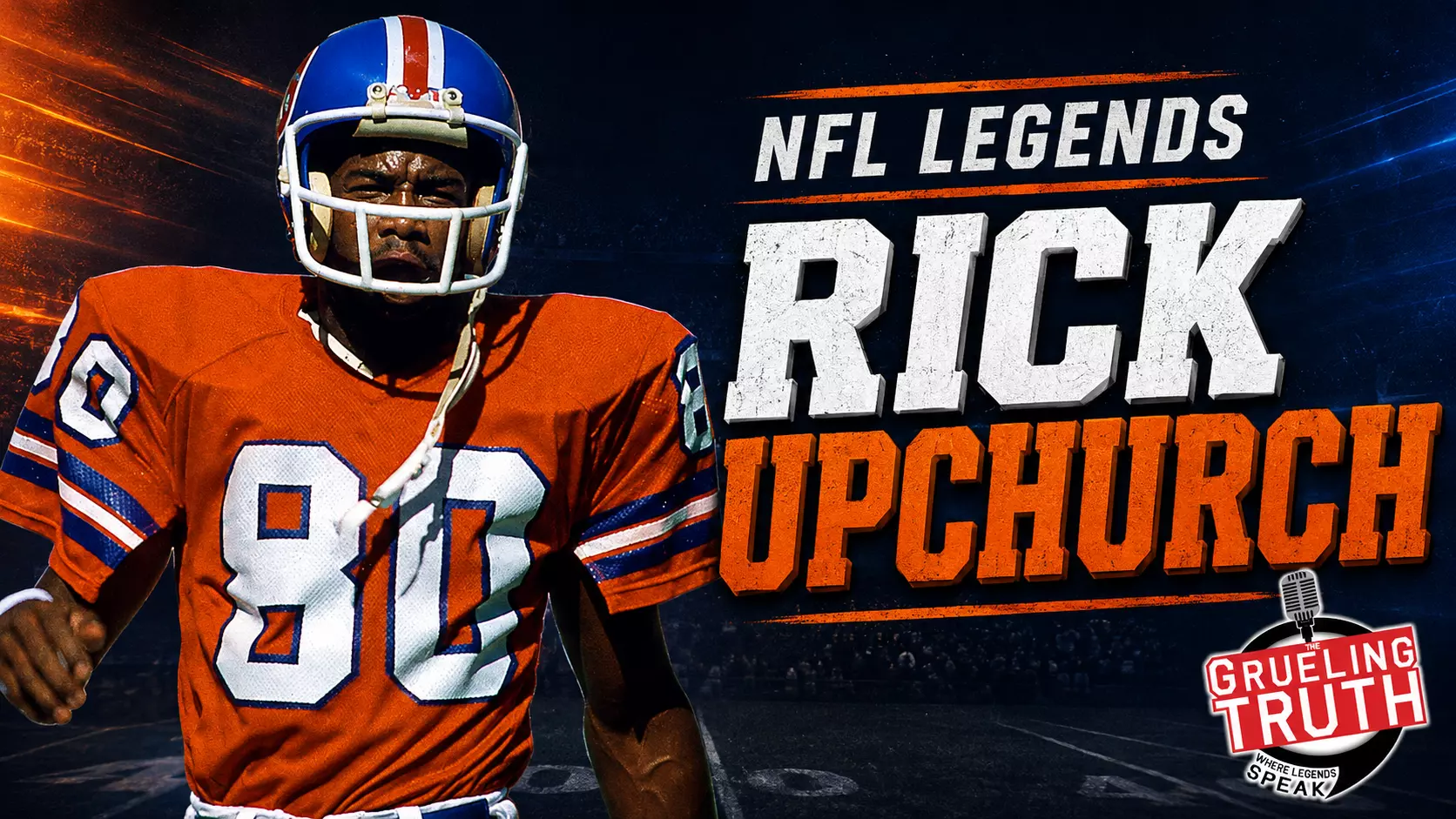
Rick Upchurch was never the biggest player on the football field, but few players in NFL history were more dangerous
Rick Upchurch was never the biggest player on the football field, but few players in
NFL history
were more dangerous with the ball in their hands. During nine seasons with the Denver Broncos, Upchurch developed into an electrifying return specialist, an underrated wide receiver and a central figure in the team’s emergence as an NFL contender.
Upchurch played his entire professional career in Denver from 1975 through 1983. He earned four Pro Bowl selections, received Associated Press All-Pro recognition five times and was selected to the NFL’s All-Decade teams for both the 1970s and 1980s. He also helped the Broncos reach the first Super Bowl in franchise history.
In this episode of NFL Legends, Upchurch discusses his remarkable football journey, the secrets behind his success as a returner, the 1977 Broncos, Super Bowl XII and his case for induction into the Pro Football Hall of Fame.
WATCH THE FULL INTERVIEW WITH RICK UPCHURCH BELOW
NFL Legends Show: Guest Broncos Legend Rick Upchurch
Inspired by Gale Sayers
Born in Toledo, Ohio, on May 20, 1952, Richard Upchurch grew up admiring Chicago Bears legend Gale Sayers. Upchurch wore No. 40 during his high school and college careers as a tribute to the Hall of Fame running back whose open-field ability helped influence his own playing style.
Upchurch played at Springfield High School in Holland, Ohio, before beginning his college career at Indian Hills Community College in Centerville, Iowa. His route to the NFL was hardly guaranteed, but junior college gave him an opportunity to develop and attract the attention of major college programs.
He eventually transferred to the University of Minnesota, where he played running back during the 1973 and 1974 seasons. Upchurch rushed for 1,783 yards in two years with the Golden Gophers, averaging 6.1 yards per carry. He also contributed as a receiver and returner while earning second-team All-Big Ten honors in both seasons.
Minnesota inducted Upchurch into its M Club Hall of Fame in 2001.
Finding a Home in Denver
The Broncos selected Upchurch with the 95th overall pick in the fourth round of the 1975 NFL Draft. At 5-foot-10 and approximately 175 pounds, he did not possess the size teams traditionally sought in an every-down running back. He did, however, have exceptional speed, vision and open-field instincts.
Denver found several ways to take advantage of those abilities.
As a rookie, Upchurch caught 18 passes for 436 yards, an extraordinary average of 24.2 yards per reception. He also rushed for 97 yards and handled both punt and kickoff returns. His ability to change field position immediately made him one of the most valuable and versatile players on the roster.
It didn’t take long for Upchurch to establish himself as one of the NFL’s most dangerous returners.
Redefining the Punt Return
Upchurch’s breakthrough came during his second season. In 1976, he returned four punts for touchdowns, tying the NFL’s single-season record at the time. He accumulated 536 yards on 39 punt returns and averaged 13.7 yards per return.
His success was not merely the result of straight-line speed. Upchurch possessed the vision to recognize developing lanes, the acceleration to reach them before they closed and the balance to survive contact. He understood pursuit angles and seemed to know where defenders would be before they arrived.
Returning punts also required extraordinary courage. Upchurch regularly fielded the ball while coverage players raced toward him at full speed under rules that provided returners considerably less protection than they receive today.
He remained an elite returner throughout his career. Upchurch led the NFL in punt-return average in 1978 and 1982. During that 1982 season, at 30 years old, he averaged 16.1 yards per return and scored two touchdowns.
He retired with 248 punt returns for 3,008 yards and eight touchdowns. His career average of 12.1 yards per punt return remains exceptional by any era’s standards. At the time of his retirement, he was the NFL’s career leader in punt-return yardage and tied for the league record in punt-return touchdowns.
Helping Transform the Broncos
Upchurch’s career coincided with one of the most important periods in Broncos history.
Before 1977, Denver had never qualified for the NFL playoffs. That changed under first-year head coach Red Miller, who led the Broncos to a 12–2 regular-season record and the AFC West championship.
The team became known nationally for its “Orange Crush” defense, led by players such as Randy Gradishar, Tom Jackson, Lyle Alzado and Louis Wright. The defense was outstanding, but Upchurch provided another dimension by consistently giving Denver an advantage in field position.
He led the NFL with a career-high 653 punt-return yards in 1977. His 87-yard punt-return touchdown against the Kansas City Chiefs was one of the defining plays of that historic season.
After defeating the Pittsburgh Steelers in the divisional round, Denver faced the defending Super Bowl champion Oakland Raiders in the AFC Championship Game. The Broncos won 20–17, sending the franchise to its first Super Bowl.
That season changed the way Denver viewed its football team. Mile High Stadium became one of the NFL’s most intimidating environments, and the Broncos established the passionate identity that continues to define the franchise.
A Memorable Moment in Super Bowl XII
The Broncos faced the Dallas Cowboys in Super Bowl XII at the Louisiana Superdome. Denver struggled offensively and committed eight turnovers in a 27–10 loss, but Upchurch provided one of the team’s few significant sparks.
In the third quarter, he returned a kickoff 67 yards to the Dallas 26-yard line. The return established a Super Bowl record at the time and helped set up Denver’s only touchdown.
Upchurch finished the game with 125 combined yards: 94 on kickoff returns, 22 on punt returns and nine as a receiver. Although the Broncos did not win the championship, their appearance represented the franchise’s arrival on the national stage.
An Underrated Wide Receiver
Upchurch is primarily remembered for his special-teams accomplishments, but describing him simply as a return specialist ignores a substantial part of his career.
He caught 267 passes for 4,369 yards and 24 touchdowns. His career average of 16.4 yards per reception demonstrates how explosive he could be within Denver’s offense.
His best receiving season came in 1979, when he recorded 64 receptions for 937 yards and seven touchdowns. He remained productive late in his career, catching 40 passes for 639 yards in 1983.
Upchurch also owns a special place in
Broncos history
because he caught John Elway’s first completed NFL pass. The nine-yard reception came against the Pittsburgh Steelers during the opening game of the 1983 season. It connected one of the greatest players of Denver’s early history with the quarterback who would eventually transform the franchise.
Upchurch retired after that season with 10,081 combined yards and 35 total touchdowns when his rushing, receiving and return production are included.
Life After the NFL
After leaving professional football, Upchurch remained involved in the sport through coaching. He worked at the college and high school levels, including a period as the head coach at Pueblo East High School in Colorado.
Coaching allowed him to share the lessons he learned during a career built on preparation, perseverance and understanding the smallest details of the game. For a player known for spectacular returns, Upchurch’s success was rooted in far more than natural talent. Film study, timing, blocking assignments and disciplined decision-making all contributed to his greatness.
Upchurch has remained connected to the Broncos and their fans. In 2014, he was inducted into the Broncos Ring of Fame alongside Gene Mingo and former head coach Dan Reeves. He was also named to the Broncos’ 50th Anniversary Team and is a member of the Colorado Sports Hall of Fame.
A Strong Pro Football Hall of Fame Case
Upchurch’s absence from the Pro Football Hall of Fame deserves serious examination.
He was selected to four Pro Bowls and received AP All-Pro recognition in five seasons. More importantly, he was named a first-team returner on the NFL’s 1970s All-Decade Team and a second-team selection on the 1980s All-Decade Team.
Being recognized among the best players of two different decades is an accomplishment few players can match.
For years, Hall of Fame voters appeared reluctant to recognize players whose greatest contributions came on special teams. Devin Hester’s election in 2024 established an important precedent by demonstrating that a historically great return specialist can deserve a place in Canton.
Upchurch’s candidacy should receive renewed attention. He did not merely compile impressive statistics. He helped define the position, set NFL records and influenced games every time an opponent punted him the ball. Unlike many return specialists, he was also a productive receiver who accumulated more than 4,300 yards from scrimmage through the air.
If the Hall of Fame intends to represent every important aspect of professional football, Rick Upchurch belongs in the conversation.
A Lasting Broncos Legacy
Rick Upchurch arrived in Denver when the Broncos were still searching for their first postseason appearance. By the time he retired, the franchise had won three
division championships, reached the playoffs four times and appeared in its first Super Bowl.
He helped make those accomplishments possible.
Upchurch gave Denver fans the feeling that something extraordinary could happen whenever an opponent punted. A routine change of possession could suddenly become a touchdown, a dramatic shift in field position or the play that changed an entire game.
His statistics establish him as one of the greatest returners in NFL history. His receiving production proves he was far more than a special-teams specialist. His role on the 1977 Broncos guarantees his permanent place in franchise history.
Rick Upchurch was one of the NFL’s most exciting players, one of the greatest Broncos of his generation and a football legend whose Hall of Fame case should no longer be overlooked.
New Users – Get $350 in Bonus Bets when you wager $5 for 7 days
T&Cs apply
4.6/5
Gambling Problem? Call 1-800-GAMBLER or 1-800-MY-RESET. Call 1-888-789-7777 or visit ccpgg.org/chat (CT). Hope is here. GamblingHelpLineMA.org or call (800) 327-5050 for 24/7 support (MA). Visit www.mdgamblinghelp.org (MD). Call 1-877-8HOPE-NY or text HOPENY (NY). 21+ (18+ DC, WY) and present in select states (for KS, in affiliation with Kansas Star Casino). Find online real money wagering only. Min $5 wager required for 7 consecutive days. $5 free play credit. Bonus issued as non-withdrawable bonus with cash withdrawable bonus with cash withdrawable. Bonus bets which expire 7 days after receipt. Restrictions apply. See terms at sportsbook.fanduel.com. Call 1-877-770-7867 (LA).
Up To $1500 in Bonus Bets Paid Back if your First Bet Does Not Win
T&Cs apply
4.5/5
Gambling problem? Call 1-800-GAMBLER or 1-800-MY-RESET (Available in the US) 877-8-HOPENY or text HOPENY (467369) (NY) 1-800-327-5050 (MA), 1-800-BETS-OFF (IA), 1-800-981-0023 (PR). 21+ only. Please Gamble Responsibly. See BetMGM.com for Terms. First Bet Offer for new customers only (if applicable). Subject to eligibility requirements. Bonus bets are non-withdrawable. In partnership with Kansas Crossing Casino and Hotel. Promotional offers not available in Mississippi, Massachusetts, New York, Ontario, or Puerto Rico.
New DraftKings Customers: Bet $5, Get $200 + 3 Months of NBA League Pass!
T&Cs apply
4.5/5
GAMBLING PROBLEM? CALL 1-800-GAMBLER or 1-800-MY-RESET, (800) 327-5050 or visit gamblinghelplinema.org (MA). Please Gamble Responsibly. 888-789-7777/visit ccpg.org (CT), or visit www.mdgamblinghelp.org (MD), 1-800-981-0023 (PR). 21+ and present in most states. (18+ DC/NH/PR/WY). Void in CAN. Eligibility restrictions apply. On behalf of Boot Hill Casino (KS). Pass-thru of per wager tax may apply in IL. 1 per new Sportsbook customer. $5+ first-time bet req. Max. $200 issued as non-withdrawable Bonus Bets. Stake removed from payout. Reward issued as $50 in Bonus Bets every 7 days via click-to-claim for 21 days. Bonus Bets and click-to-claims expire 7 days (168hrs) after issuance. Terms: dkng.co/offer. Get 1 promo code to redeem a 3-month NBA League Pass subscription, complimentary of DraftKings. Subscription auto-renews monthly at then-current price (currently $16.99/mo); cancel anytime. Terms, restrictions, and eligibility requirements apply. Redeem League Pass by 12/19/26 at 11:59 PM ET. Addt’l terms: support.watch.nba.com/hc/en-us/articles/9165532876183-League-Pass-Terms-of-Use_. Ends 11/29/26 at 11:59 PM ET. Sponsored by DK.
Must be 21+. GAMBLING PROBLEM? CALL 1-800-GAMBLER OR CALL 1-800-MY-RESET, www.mdgamblinghelp.org (MD), (800)-327-5050 or gamblinghelplinema.org (MA), Call (877)8-HOPENY or text HOPENY (467369) (NY), (888) 789-7777 or ccpg.org (CT), morethanagame.nc.gov (NC), 1800gambler.net (WV)
Bet $1 and get double the winnings up to $25 for your next 10 bets
T&Cs apply
4.4/5
21+ New users only. Must register using eligible promo code. First bet after registration must qualify. Max. Bonus Bet: $1,000. Bonus Bet expires 14 days after receipt. Void where prohibited. See Caesars.com/promos for full terms. Gambling Problem? 1-800-GAMBLER (1-800-426-2537)
21+ and present in OH. Gambling Problem? Call 1-800-GAMBLER.
This site is using
Cloudflare
and adheres to the
Google Safe Browsing Program. We adapted
Google's Privacy Guidelines
to keep your data safe at all times.
Close
Ready to Win Big? Join the Elite with Our Sports Betting Deals!
FanDuel Promo
New Users – Get $350 in Bonus Bets when you wager $5 for 7 days
Our Favorite
T&Cs and 21+ apply
Gambling Problem? Call 1-800-GAMBLER or 1-800-MY-RESET. Call 1-888-789-7777 or visit ccpgg.org/chat (CT). Hope is here. GamblingHelpLineMA.org or call (800) 327-5050 for 24/7 support (MA). Visit www.mdgamblinghelp.org (MD). Call 1-877-8HOPE-NY or text HOPENY (NY). 21+ (18+ DC, WY) and present in select states (for KS, in affiliation with Kansas Star Casino). Find online real money wagering only. Min $5 wager required for 7 consecutive days. $5 free play credit. Bonus issued as non-withdrawable bonus with cash withdrawable bonus with cash withdrawable. Bonus bets which expire 7 days after receipt. Restrictions apply. See terms at sportsbook.fanduel.com. Call 1-877-770-7867 (LA).
Code:
Open FanDuel
Get Bonus
BetMGM Promo
Up To $1500 in Bonus Bets Paid Back if your First Bet Does Not Win
Best Slots
T&Cs and 21+ apply
Gambling problem? Call 1-800-GAMBLER or 1-800-MY-RESET (Available in the US) 877-8-HOPENY or text HOPENY (467369) (NY) 1-800-327-5050 (MA), 1-800-BETS-OFF (IA), 1-800-981-0023 (PR). 21+ only. Please Gamble Responsibly. See BetMGM.com for Terms. First Bet Offer for new customers only (if applicable). Subject to eligibility requirements. Bonus bets are non-withdrawable. In partnership with Kansas Crossing Casino and Hotel. Promotional offers not available in Mississippi, Massachusetts, New York, Ontario, or Puerto Rico.
Code:
Open BetMGM
Get Bonus
DraftKings Promo
New DraftKings Customers: Bet $5, Get $200 + 3 Months of NBA League Pass!
Newcomer
T&Cs and 21+ apply
GAMBLING PROBLEM? CALL 1-800-GAMBLER or 1-800-MY-RESET, (800) 327-5050 or visit gamblinghelplinema.org (MA). Please Gamble Responsibly. 888-789-7777/visit ccpg.org (CT), or visit www.mdgamblinghelp.org (MD), 1-800-981-0023 (PR). 21+ and present in most states. (18+ DC/NH/PR/WY). Void in CAN. Eligibility restrictions apply. On behalf of Boot Hill Casino (KS). Pass-thru of per wager tax may apply in IL. 1 per new Sportsbook customer. $5+ first-time bet req. Max. $200 issued as non-withdrawable Bonus Bets. Stake removed from payout. Reward issued as $50 in Bonus Bets every 7 days via click-to-claim for 21 days. Bonus Bets and click-to-claims expire 7 days (168hrs) after issuance. Terms: dkng.co/offer. Get 1 promo code to redeem a 3-month NBA League Pass subscription, complimentary of DraftKings. Subscription auto-renews monthly at then-current price (currently $16.99/mo); cancel anytime. Terms, restrictions, and eligibility requirements apply. Redeem League Pass by 12/19/26 at 11:59 PM ET. Addt’l terms: support.watch.nba.com/hc/en-us/articles/9165532876183-League-Pass-Terms-of-Use_. Ends 11/29/26 at 11:59 PM ET. Sponsored by DK.
Code:
Open DraftKings
Get Bonus
Find out what the legends have to say about sports this week....
New Users – Get $350 in Bonus Bets when you wager $5 for 7 days
Gambling Problem? Call 1-800-GAMBLER or 1-800-MY-RESET. Call 1-888-789-7777 or visit ccpgg.org/chat (CT). Hope is here. GamblingHelpLineMA.org or call (800) 327-5050 for 24/7 support (MA). Visit www.mdgamblinghelp.org (MD). Call 1-877-8HOPE-NY or text HOPENY (NY). 21+ (18+ DC, WY) and present in select states (for KS, in affiliation with Kansas Star Casino). Find online real money wagering only. Min $5 wager required for 7 consecutive days. $5 free play credit. Bonus issued as non-withdrawable bonus with cash withdrawable bonus with cash withdrawable. Bonus bets which expire 7 days after receipt. Restrictions apply. See terms at sportsbook.fanduel.com. Call 1-877-770-7867 (LA).