James Brooks and Bob Trumpy are worthy members of the Cincinnati Bengals Ring of Honor. That point should be made immediately.
James Brooks and Bob Trumpy are worthy members of the Cincinnati Bengals Ring of Honor. That point should be made immediately.
Brooks was one of the most complete running backs in franchise history and a critical component of the 1988 AFC championship team. Trumpy was an original Bengal, a revolutionary receiving tight end and an important Cincinnati broadcaster after his playing career.
Neither selection should be diminished.
But a
Bengals Ring of Honor
that still does not include Reggie Williams cannot be considered a complete or accurate representation of the franchise’s history.
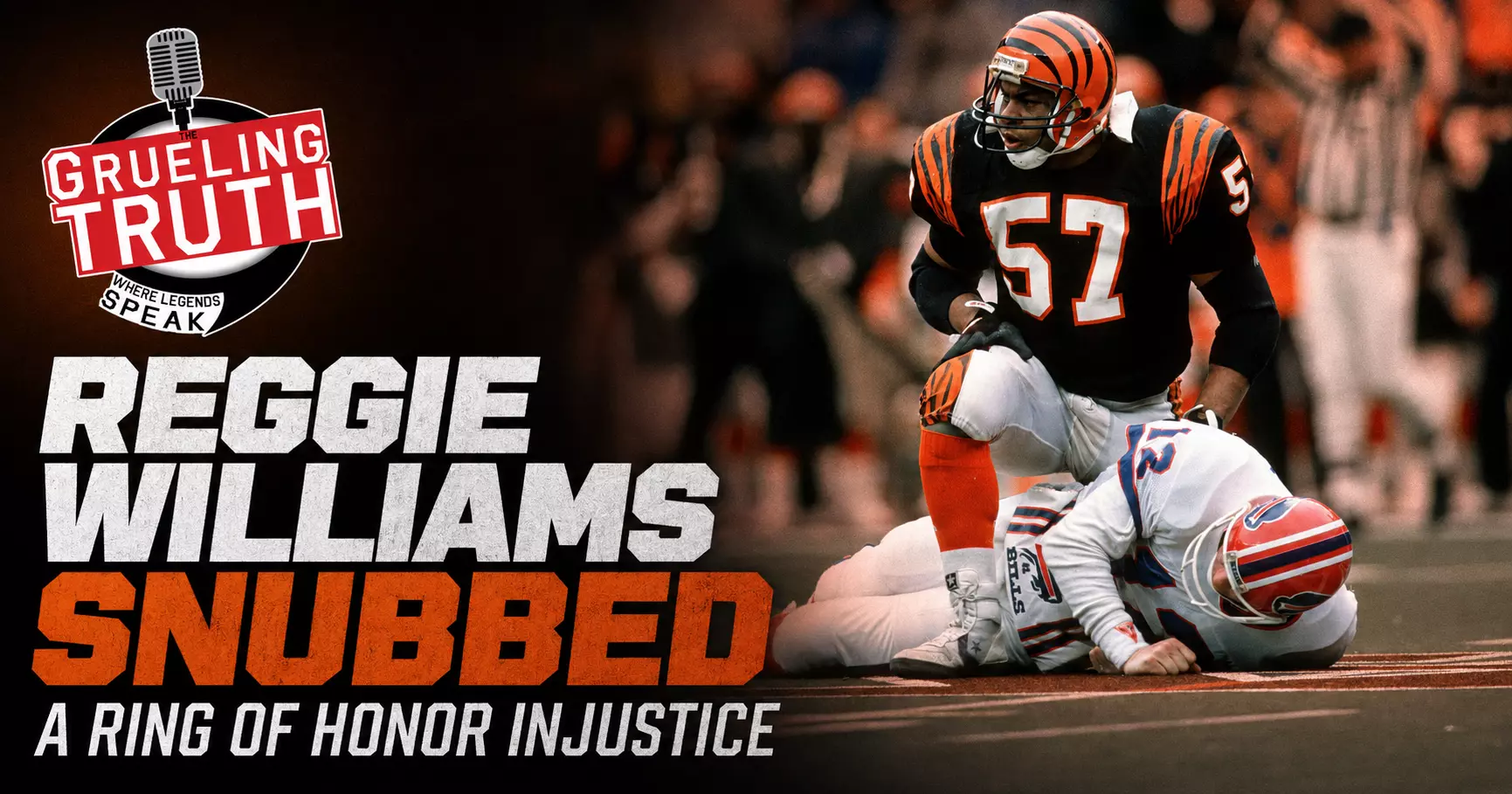
Williams spent 14 seasons in Cincinnati. He appeared in both of the franchise’s first two Super Bowls, produced in the biggest games, established linebacker records that have survived for decades and represented the city with distinction away from football.
He did practically everything a player could do to earn permanent recognition from an organization.
Yet when the Bengals announced Brooks and Trumpy as their two 2026 selections, Williams was left outside the Ring of Honor again.
It is not simply surprising. It is becoming indefensible.
The Most Productive Linebacker in Bengals History
Start with the football résumé.
The Bengals selected Williams in the third round of the 1976 NFL Draft out of Dartmouth. He remained with Cincinnati for his entire professional career, playing 206 games across 14 seasons.
According to the Bengals’ own historical summary, Williams is the most productive linebacker in franchise history. He holds the Bengals’ linebacker records for games played, sacks and interceptions.
The franchise credits him with 62.5 sacks and 16 interceptions. Williams also recovered 23 fumbles, which remains a Bengals record and is tied for 11th in NFL history.
That is an extraordinary combination of longevity, pass-rushing production and playmaking.
Williams was not a specialist who entered games only on passing downs. He was a complete linebacker who could pressure quarterbacks, defend the run, drop into coverage and create turnovers.
He played in an era when linebackers were expected to remain on the field in almost every situation. Williams took on pulling guards, chased running backs, covered receivers and rushed the passer without the benefit of modern defensive substitutions.
The statistics are even more impressive when placed in historical context. Sacks did not become an official NFL statistic until 1982, six seasons into Williams’ career. Much of his early pass-rushing production therefore required historical reconstruction rather than appearing in the official record book at the time.
This was not merely a good player who lasted a long time. Williams was a highly productive player whose longevity allowed him to become one of the defining defenders in franchise history.
He Delivered During Both Super Bowl Runs
Ring of Honor
discussions should place considerable weight on postseason performance. Williams’ case only becomes stronger when the stakes are raised.
During Cincinnati’s 1981 AFC championship season, Williams led the defense with 11 sacks and finished second on the team with 106 tackles. He was a central figure on the unit that helped the Bengals reach Super Bowl XVI.
Seven years later, Williams remained an important contributor as Cincinnati returned to the Super Bowl. In Super Bowl XXIII against the San Francisco 49ers, he recorded a team-high 10 tackles and one sack.
Think about the significance of that.
Williams was an essential player during the Bengals’ first Super Bowl season and was still leading their defense on the sport’s biggest stage seven years later. Few players in franchise history connect Cincinnati’s two great teams of the 1980s as directly as he does.
Ken Anderson, Anthony Muñoz, Ken Riley, Isaac Curtis and other stars of that era have rightly received permanent recognition. Williams belongs alongside them.
A franchise Ring of Honor is supposed to tell the organization’s story. It is difficult to accurately tell the story of the 1981 or 1988 Bengals without Reggie Williams.
He Was the Definition of an Iron Man
Williams’ 206 games should not be treated as an incidental statistic.
Playing linebacker in the NFL is physically punishing under modern rules. It was even more brutal during Williams’ era, when offensive linemen could use techniques that are now illegal and defensive players received far less protection.
Williams endured that punishment for 14 seasons.
He played through severe damage to his right knee and continued sacrificing his body for the franchise. The physical consequences followed him long after his career ended, requiring numerous surgeries and creating lifelong medical complications.
A Ring of Honor should recognize more than highlight plays and popularity. It should recognize sustained commitment to an organization.
Williams never left Cincinnati for a more lucrative opportunity. He never finished his career wearing another uniform. From his rookie season in 1976 through his final game in 1989, he was a Bengal.
The franchise asks fans to value loyalty, toughness and sacrifice. Williams embodied all three for nearly a decade and a half.
If that does not qualify someone for the Bengals Ring of Honor, what exactly does?
His Impact Extended Far Beyond Football
Williams’ candidacy would already be overwhelming if it were based exclusively on football. His contributions outside the sport elevate him into another category.
Williams received the Byron “Whizzer” White Award for humanitarian service in 1985. He was then named the NFL’s Walter Payton Man of the Year for 1986, one of the league’s most prestigious honors.
Sports Illustrated selected him as a co-Sportsman of the Year in 1987.
Those were not ceremonial lifetime-achievement awards presented decades after his retirement. Williams earned them while he was still playing at a high level for Cincinnati.
He also served on the Cincinnati City Council during the final portion of his playing career. When the Bengals reached Super Bowl XXIII, Williams was simultaneously an NFL linebacker and a public official representing the city.
That may be one of the most distinctive accomplishments in professional football history.
Williams later built a successful business career with Disney and was inducted into the College Football Hall of Fame. His personal website also lists membership in the Greater Flint Area Sports Hall of Fame and Greater Flint Afro-American Hall of Fame.
The Bengals Ring of Honor is supposed to recognize people who represent the franchise’s highest standards. Williams did that on the field, in the community and throughout his life after football.
Why Does Williams Keep Getting Overlooked?
The most likely explanation is the voting system.
Season-ticket members select the inductees, which makes the Ring of Honor interactive and gives fans a meaningful voice. However, fan voting naturally favors certain types of candidates.
Offensive stars are easier to remember. Their statistics appear prominently in record books, their highlights are replayed more frequently and fantasy football has made modern fans even more familiar with receivers and running backs.
Defensive players from earlier eras face a different challenge. Complete tackle statistics were not consistently recorded, and sacks did not become official until 1982. A linebacker such as Williams could dominate a game without producing a play that would appear in a modern highlight package.
Generational familiarity also matters. Fans who did not watch Williams play may be more inclined to support recent stars such as A.J. Green, Geno Atkins, Andrew Whitworth or Carlos Dunlap.
Those players will all have strong Ring of Honor cases. But their presence on an expanded ballot makes it even more difficult for an older defensive player to accumulate enough votes.
The Bengals added five modern-era candidates to the 2026 ballot, creating a 12-player field. The organization guaranteed that at least one of the two selections would come from the original ballot, but that safeguard was not enough to get Williams elected. Beginning in 2027, the Bengals plan to reduce annual induction classes to only one person.
That change could make Williams wait even longer.
The Bengals Should Not Leave Everything to a Popularity Contest
Fan participation is valuable, but the organization has a responsibility to protect its own history.
The Bengals waited until 2021 to establish a Ring of Honor. That late beginning created an enormous backlog of qualified candidates spanning more than five decades.
A fan vote alone cannot efficiently correct that backlog.
The organization should consider creating a veterans committee or historical selection panel with the authority to induct overlooked players. Such a group could include former players, team historians, longtime Cincinnati reporters and representatives of the organization.
That would not eliminate fan voting. It would supplement it.
The Pro Football Hall of Fame uses separate processes to ensure that senior candidates are not permanently buried beneath newer names. The Bengals need a similar mechanism for players whose accomplishments may not be fully understood by younger voters.
Williams is exactly the type of candidate such a committee should address.
His case does not require imagination, sentimentality or lowered standards. The franchise’s own records demonstrate his importance.
This Is Not an Argument Against Brooks or Trumpy
Brooks and Trumpy deserve congratulations.
Brooks ranks among the franchise’s most productive offensive players and helped transform Cincinnati’s offense during the 1980s. Trumpy was part of the Bengals’ inaugural season, became an early prototype for the modern receiving tight end and remained connected to Cincinnati through his broadcasting career.
The problem is not that either man was selected.
The problem is that the Bengals created a system in which one of the franchise’s greatest defenders continues to wait despite possessing a résumé that should have made him an automatic selection years ago.
There should be room to honor Brooks, Trumpy and Williams without forcing their legacies into competition.
A Ring of Honor is not supposed to be an artificially exclusive marketing exercise. It is supposed to preserve franchise history.
The
Bengals’ history
is richer when all three men are properly recognized.
Williams Should Have Been Among the Original Inductees
The strongest criticism is not that Williams failed to win the 2026 vote. It is that he ever needed to campaign for votes in the first place.
When the Bengals established the Ring of Honor, certain foundational figures should have entered automatically. Paul Brown, Anthony Muñoz, Ken Anderson and Ken Riley were obvious choices.
Williams belonged very close to that group.
He may not have received the national acclaim of Muñoz or accumulated Anderson’s passing records, but no linebacker has given more to the Cincinnati Bengals.
Fourteen seasons. Two Super Bowl teams. More games, sacks and interceptions than any linebacker in franchise history. Twenty-three fumble recoveries. A Walter Payton Man of the Year Award. A place on the Cincinnati City Council while still playing.
That is not the résumé of a borderline candidate.
That is the résumé of a franchise icon.
Put Reggie Williams in the Ring
The Bengals can correct this mistake.
Williams remains on the ballot, and fans can support him in future voting. But the organization should not simply wait and hope that he eventually survives an increasingly crowded field.
Cincinnati should find a direct path to honor him.
Create a senior category. Establish a historical committee. Add a legacy selection alongside the annual fan vote. If necessary, make Williams a special organizational inductee.
The precise mechanism matters less than the result.
The Bengals Ring of Honor currently includes many of the most important figures in franchise history. But as long as Reggie Williams remains absent, it is missing the player who defined linebacker excellence in Cincinnati.
Williams gave the Bengals 14 seasons, helped take them to two Super Bowls, set franchise records, served their city and represented the organization with uncommon distinction.
He has already done everything required to earn his place.
Now the Bengals need to do the right thing and put his name in the Ring of Honor.
Up To $1500 in Bonus Bets Paid Back if your First Bet Does Not Win
T&Cs apply
4.5/5
Gambling problem? Call 1-800-GAMBLER or 1-800-MY-RESET (Available in the US) 877-8-HOPENY or text HOPENY (467369) (NY) 1-800-327-5050 (MA), 1-800-BETS-OFF (IA), 1-800-981-0023 (PR). 21+ only. Please Gamble Responsibly. See BetMGM.com for Terms. First Bet Offer for new customers only (if applicable). Subject to eligibility requirements. Bonus bets are non-withdrawable. In partnership with Kansas Crossing Casino and Hotel. Promotional offers not available in Mississippi, Massachusetts, New York, Ontario, or Puerto Rico.
New DraftKings Customers: Spend $5+ Get $150 in Bonuses
T&Cs apply
4.5/5
GAMBLING PROBLEM? CALL 1-800-GAMBLER or 1-800-MY-RESET, (800) 327-5050 or visit gamblinghelplinema.org (MA). Please Gamble Responsibly. 888-789-7777/visit ccpg.org (CT), or visit www.mdgamblinghelp.org (MD), 1-800-981-0023 (PR). 21+ and present in most states. (18+ DC/NH/PR/WY). Void in CAN. Eligibility restrictions apply. On behalf of Boot Hill Casino (KS). Pass-thru of per wager tax may apply in IL. 1 per new DraftKings customer. $5+ first-time bet req. Max. $150 issued as non-withdrawable Bonus Bets. Stake removed from payout. Reward issued as $50 in Bonus Bets every 7 days via click-to-claim for 14 days. Bonus Bets and click-to-claims expire 7 days (168hrs) after issuance. Terms: sportsbook.draftkings.com/promos. Ends 10/11/26 at 11:59 PM ET. Sponsored by DK.
Must be 21+. GAMBLING PROBLEM? CALL 1-800-GAMBLER OR CALL 1-800-MY-RESET, www.mdgamblinghelp.org (MD), (800)-327-5050 or gamblinghelplinema.org (MA), Call (877)8-HOPENY or text HOPENY (467369) (NY), (888) 789-7777 or ccpg.org (CT), morethanagame.nc.gov (NC), 1800gambler.net (WV)
Bet $1 and get double the winnings up to $25 for your next 10 bets
T&Cs apply
4.4/5
21+ New users only. Must register using eligible promo code. First bet after registration must qualify. Max. Bonus Bet: $1,000. Bonus Bet expires 14 days after receipt. Void where prohibited. See Caesars.com/promos for full terms. Gambling Problem? 1-800-GAMBLER (1-800-426-2537)
21+ and present in OH. Gambling Problem? Call 1-800-GAMBLER.
This site is using
Cloudflare
and adheres to the
Google Safe Browsing Program. We adapted
Google's Privacy Guidelines
to keep your data safe at all times.
Close
Ready to Win Big? Join the Elite with Our Sports Betting Deals!
FanDuel Promo
New Users – Get $250 in Bonus Bets when you wager $5 for 5 days
Up To $1500 in Bonus Bets Paid Back if your First Bet Does Not Win
Best Slots
T&Cs and 21+ apply
Gambling problem? Call 1-800-GAMBLER or 1-800-MY-RESET (Available in the US) 877-8-HOPENY or text HOPENY (467369) (NY) 1-800-327-5050 (MA), 1-800-BETS-OFF (IA), 1-800-981-0023 (PR). 21+ only. Please Gamble Responsibly. See BetMGM.com for Terms. First Bet Offer for new customers only (if applicable). Subject to eligibility requirements. Bonus bets are non-withdrawable. In partnership with Kansas Crossing Casino and Hotel. Promotional offers not available in Mississippi, Massachusetts, New York, Ontario, or Puerto Rico.
Code:
Open BetMGM
Get Bonus
DraftKings Promo
New DraftKings Customers: Spend $5+ Get $150 in Bonuses
Newcomer
T&Cs and 21+ apply
GAMBLING PROBLEM? CALL 1-800-GAMBLER or 1-800-MY-RESET, (800) 327-5050 or visit gamblinghelplinema.org (MA). Please Gamble Responsibly. 888-789-7777/visit ccpg.org (CT), or visit www.mdgamblinghelp.org (MD), 1-800-981-0023 (PR). 21+ and present in most states. (18+ DC/NH/PR/WY). Void in CAN. Eligibility restrictions apply. On behalf of Boot Hill Casino (KS). Pass-thru of per wager tax may apply in IL. 1 per new DraftKings customer. $5+ first-time bet req. Max. $150 issued as non-withdrawable Bonus Bets. Stake removed from payout. Reward issued as $50 in Bonus Bets every 7 days via click-to-claim for 14 days. Bonus Bets and click-to-claims expire 7 days (168hrs) after issuance. Terms: sportsbook.draftkings.com/promos. Ends 10/11/26 at 11:59 PM ET. Sponsored by DK.
Code:
Open DraftKings
Get Bonus
Find out what the legends have to say about sports this week....