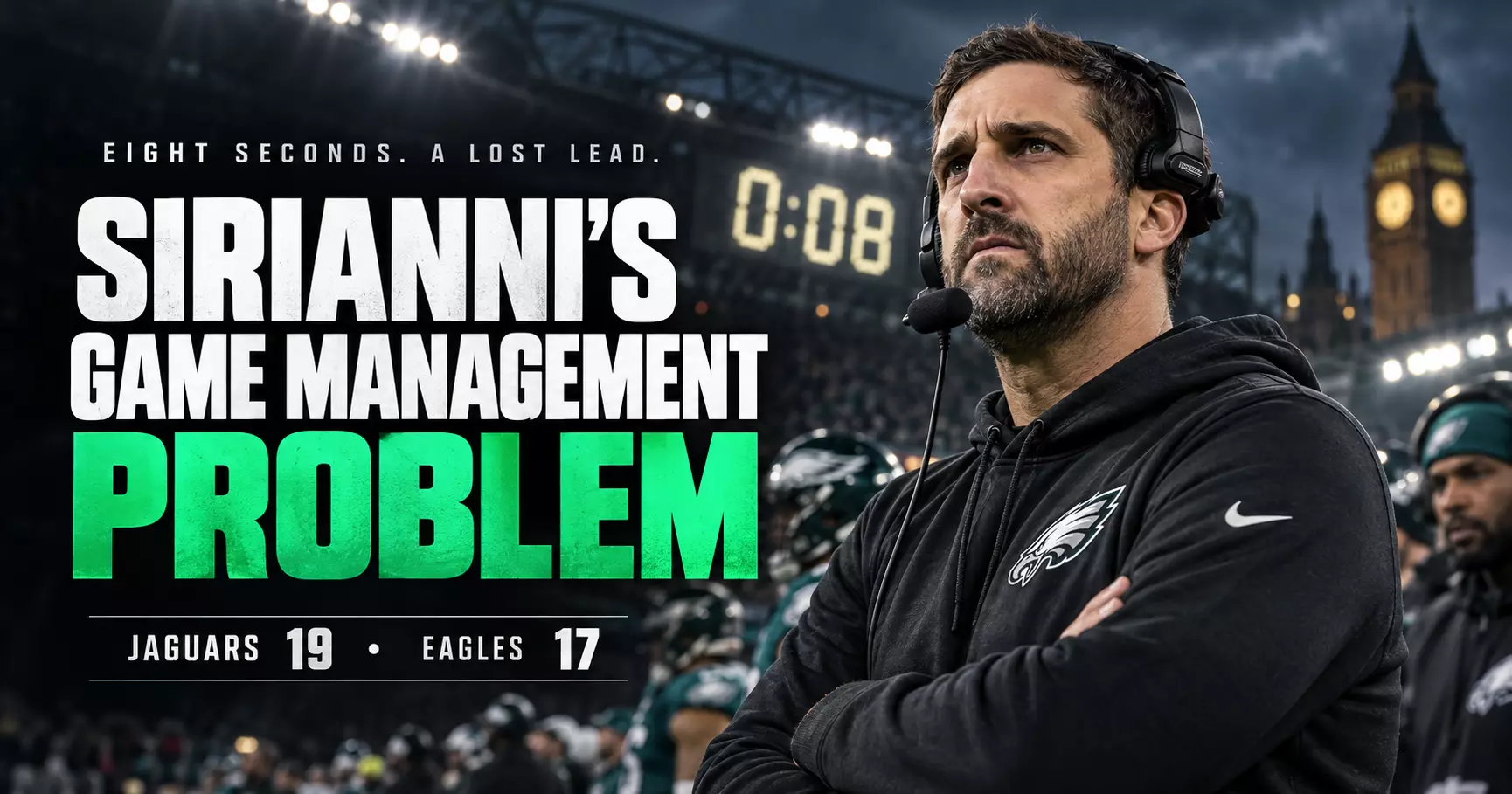
The Philadelphia Eagles took a 17–16 lead with eight seconds remaining in London. They left with a 19–17 defeat. That reversal deserves more than a shrug about football's unpredictability.
The Philadelphia Eagles took a 17–16 lead with eight seconds remaining in London. They left with a 19–17 defeat.
That reversal deserves more than a shrug about football’s unpredictability.
Jake Elliott made a 48-yard field goal to put Philadelphia ahead. Ameer Abdullah returned the ensuing kickoff 53 yards, leaving one second for Cam Little to make a 57-yard winner.
Jacksonville executed an extraordinary finish. Philadelphia helped make it possible.
Nick Sirianni accepted responsibility afterward. The harder task now is correcting the decisions and preparation that turned a nearly finished game into another Eagles loss.
The Clock Problem Started Before the Kickoff
The final kickoff has attracted most of the attention, but Philadelphia’s preceding offensive sequence deserves examination.
On second-and-10 from Jacksonville’s 34-yard line with 21 seconds remaining, Jalen Hurts completed a seven-yard pass to Makai Lemon. The play ended out of bounds, stopping the clock with 17 seconds left and leaving Jacksonville with its final timeout.
The Jaguars used that timeout after Philadelphia’s subsequent running play. Elliott then made the go-ahead field goal, with eight seconds still available.
The completion improved the kicking position. Its ending also preserved the timeout Jacksonville needed to stop the clock again.
That distinction matters. A successful offensive play can have an unsuccessful situational outcome.
My assessment is that
Philadelphia
needed to place a greater priority on an inbounds finish once it had reached a plausible field-goal position. Forcing Jacksonville to spend its final timeout earlier could have allowed the Eagles to control more of the remaining time before kicking.
That alternative still required sound execution. It was not an automatic victory. But it offered a way to reduce Jacksonville’s opportunity to respond.
A Rookie’s Execution Still Reflects the Preparation
It is fair to examine how Lemon finished the play. It is not fair to assume we know every instruction he received or that the outcome was entirely within his control.
Receivers operate against defenders who can influence where a play ends. A route near the sideline also creates different risks from one designed to finish in the middle of the field.
The coaching question is broader than whether a rookie should have understood the situation.
Was the preferred finish communicated clearly? Did the play design support it? Were the quarterback, receiver and sideline working toward the same objective?
Those questions belong to the staff responsible for preparing the offense. Players must execute, but the head coach must ensure that the assignment includes the game situation—not simply the route and coverage.
Late-game awareness should survive the pressure of the moment.
The Kickoff Added Another Risk
Once Philadelphia led by one with eight seconds remaining, Sirianni chose to leave the kickoff in play.
There is a recognizable rationale for that approach: a return consumes time. If coverage contains the returner, the receiving team can be left with poor field position and almost no time to advance.
The danger is equally clear. A long return can supply field position without requiring an offensive play.
Abdullah found the space, reached Philadelphia territory and went down with one second remaining. Jacksonville’s own account says he counted the time during the return to preserve a field-goal opportunity.
That was excellent situational execution by the returner.
It was also the precise combination Philadelphia needed to prevent: substantial yardage with enough time left for another snap.
My judgment is that attempting a touchback would have been the more defensible choice. It would have removed the conventional return and made Jacksonville advance the ball through its offense.
A touchback would not have guaranteed victory. It would have changed the route Jacksonville had to take to win.
Coverage Failed Too
The kickoff decision does not excuse the coverage unit.
Philadelphia still had a responsibility to contain Abdullah. Allowing 53 yards was a major execution failure, regardless of the strategy that put the return into play.
That produces shared accountability.
Sirianni owns the overall decision. Special-teams coordinator Michael Clay and the coverage players must account for how the unit carried it out.
Blaming only the coach ignores a return that should have been contained. Blaming only the players ignores the fact that the staff deliberately exposed the team to that possibility.
The useful review asks whether the decision was appropriate, whether the kick matched the plan and why the coverage failed.
Jacksonville Earned the Finish
The Jaguars deserve credit for more than accepting a gift.
Abdullah combined the return with awareness of the clock. Jacksonville then completed the field-goal operation despite having lost regular long snapper Ross Matiscik earlier in the game.
Backup snapper DaVon Hamilton delivered the ball, holder Logan Cooke handled a high snap, and Little converted from 57 yards.
Philadelphia made the opportunity available. Jacksonville still had to execute it.
Recognizing that distinction strengthens the criticism of Sirianni. The Eagles needed to plan for an opponent capable of making a difficult play, rather than rely on how unlikely the full sequence seemed.
The Eagles’ Larger Problems Made the Ending More Expensive
Philadelphia fell to 2–3 with its third consecutive loss.
The offense also continued a troubling second-half pattern. Elliott’s late field goal provided the Eagles’ first second-half points since their Week 2 game against Tennessee.
That does not mean every offensive failure belongs solely to Sirianni. Injuries and player execution affect what the team can accomplish.
It does mean Philadelphia has little room to waste the opportunities it creates.
When an offense struggles to extend a lead, managing the final possessions becomes even more important. The London ending magnified an existing problem: the Eagles are not doing enough after halftime to put games safely beyond reach.
Accountability Must Produce a Better Process
“I didn’t make the right decision, and I lost us that game,” Sirianni said afterward.
Owning the result is appropriate. It is only the beginning.
Philadelphia needs a clearer process for connecting play selection, clock management and
special-teams decisions. The staff should establish its priorities before the final seconds arrive and communicate them in terms players can act on immediately.
That means practicing situations in which staying inbounds is more valuable than gaining another yard. It means weighing field position against time when selecting a kickoff. It means reviewing execution without allowing either coaches or players to hide behind the other.
The Eagles can correct these problems. Their response must show up in the next difficult finish.
New Users – Get $350 in Bonus Bets when you wager $5 for 7 days
T&Cs apply
4.6/5
Gambling Problem? Call 1-800-GAMBLER or 1-800-MY-RESET. Call 1-888-789-7777 or visit ccpgg.org/chat (CT). Hope is here. GamblingHelpLineMA.org or call (800) 327-5050 for 24/7 support (MA). Visit www.mdgamblinghelp.org (MD). Call 1-877-8HOPE-NY or text HOPENY (NY). 21+ (18+ DC, WY) and present in select states (for KS, in affiliation with Kansas Star Casino). Find online real money wagering only. Min $5 wager required for 7 consecutive days. $5 free play credit. Bonus issued as non-withdrawable bonus with cash withdrawable bonus with cash withdrawable. Bonus bets which expire 7 days after receipt. Restrictions apply. See terms at sportsbook.fanduel.com. Call 1-877-770-7867 (LA).
Up To $1500 in Bonus Bets Paid Back if your First Bet Does Not Win
T&Cs apply
4.5/5
Gambling problem? Call 1-800-GAMBLER or 1-800-MY-RESET (Available in the US) 877-8-HOPENY or text HOPENY (467369) (NY) 1-800-327-5050 (MA), 1-800-BETS-OFF (IA), 1-800-981-0023 (PR). 21+ only. Please Gamble Responsibly. See BetMGM.com for Terms. First Bet Offer for new customers only (if applicable). Subject to eligibility requirements. Bonus bets are non-withdrawable. In partnership with Kansas Crossing Casino and Hotel. Promotional offers not available in Mississippi, Massachusetts, New York, Ontario, or Puerto Rico.
New DraftKings Customers: Bet $5, Get $200 + 3 Months of NBA League Pass!
T&Cs apply
4.5/5
GAMBLING PROBLEM? CALL 1-800-GAMBLER or 1-800-MY-RESET, (800) 327-5050 or visit gamblinghelplinema.org (MA). Please Gamble Responsibly. 888-789-7777/visit ccpg.org (CT), or visit www.mdgamblinghelp.org (MD), 1-800-981-0023 (PR). 21+ and present in most states. (18+ DC/NH/PR/WY). Void in CAN. Eligibility restrictions apply. On behalf of Boot Hill Casino (KS). Pass-thru of per wager tax may apply in IL. 1 per new Sportsbook customer. $5+ first-time bet req. Max. $200 issued as non-withdrawable Bonus Bets. Stake removed from payout. Reward issued as $50 in Bonus Bets every 7 days via click-to-claim for 21 days. Bonus Bets and click-to-claims expire 7 days (168hrs) after issuance. Terms: dkng.co/offer. Get 1 promo code to redeem a 3-month NBA League Pass subscription, complimentary of DraftKings. Subscription auto-renews monthly at then-current price (currently $16.99/mo); cancel anytime. Terms, restrictions, and eligibility requirements apply. Redeem League Pass by 12/19/26 at 11:59 PM ET. Addt’l terms: support.watch.nba.com/hc/en-us/articles/9165532876183-League-Pass-Terms-of-Use_. Ends 11/29/26 at 11:59 PM ET. Sponsored by DK.
Must be 21+. GAMBLING PROBLEM? CALL 1-800-GAMBLER OR CALL 1-800-MY-RESET, www.mdgamblinghelp.org (MD), (800)-327-5050 or gamblinghelplinema.org (MA), Call (877)8-HOPENY or text HOPENY (467369) (NY), (888) 789-7777 or ccpg.org (CT), morethanagame.nc.gov (NC), 1800gambler.net (WV)
Bet $1 and get double the winnings up to $25 for your next 10 bets
T&Cs apply
4.4/5
21+ New users only. Must register using eligible promo code. First bet after registration must qualify. Max. Bonus Bet: $1,000. Bonus Bet expires 14 days after receipt. Void where prohibited. See Caesars.com/promos for full terms. Gambling Problem? 1-800-GAMBLER (1-800-426-2537)
21+ and present in OH. Gambling Problem? Call 1-800-GAMBLER.
This site is using
Cloudflare
and adheres to the
Google Safe Browsing Program. We adapted
Google's Privacy Guidelines
to keep your data safe at all times.
Close
Ready to Win Big? Join the Elite with Our Sports Betting Deals!
FanDuel Promo
New Users – Get $350 in Bonus Bets when you wager $5 for 7 days
Our Favorite
T&Cs and 21+ apply
Gambling Problem? Call 1-800-GAMBLER or 1-800-MY-RESET. Call 1-888-789-7777 or visit ccpgg.org/chat (CT). Hope is here. GamblingHelpLineMA.org or call (800) 327-5050 for 24/7 support (MA). Visit www.mdgamblinghelp.org (MD). Call 1-877-8HOPE-NY or text HOPENY (NY). 21+ (18+ DC, WY) and present in select states (for KS, in affiliation with Kansas Star Casino). Find online real money wagering only. Min $5 wager required for 7 consecutive days. $5 free play credit. Bonus issued as non-withdrawable bonus with cash withdrawable bonus with cash withdrawable. Bonus bets which expire 7 days after receipt. Restrictions apply. See terms at sportsbook.fanduel.com. Call 1-877-770-7867 (LA).
Code:
Open FanDuel
Get Bonus
BetMGM Promo
Up To $1500 in Bonus Bets Paid Back if your First Bet Does Not Win
Best Slots
T&Cs and 21+ apply
Gambling problem? Call 1-800-GAMBLER or 1-800-MY-RESET (Available in the US) 877-8-HOPENY or text HOPENY (467369) (NY) 1-800-327-5050 (MA), 1-800-BETS-OFF (IA), 1-800-981-0023 (PR). 21+ only. Please Gamble Responsibly. See BetMGM.com for Terms. First Bet Offer for new customers only (if applicable). Subject to eligibility requirements. Bonus bets are non-withdrawable. In partnership with Kansas Crossing Casino and Hotel. Promotional offers not available in Mississippi, Massachusetts, New York, Ontario, or Puerto Rico.
Code:
Open BetMGM
Get Bonus
DraftKings Promo
New DraftKings Customers: Bet $5, Get $200 + 3 Months of NBA League Pass!
Newcomer
T&Cs and 21+ apply
GAMBLING PROBLEM? CALL 1-800-GAMBLER or 1-800-MY-RESET, (800) 327-5050 or visit gamblinghelplinema.org (MA). Please Gamble Responsibly. 888-789-7777/visit ccpg.org (CT), or visit www.mdgamblinghelp.org (MD), 1-800-981-0023 (PR). 21+ and present in most states. (18+ DC/NH/PR/WY). Void in CAN. Eligibility restrictions apply. On behalf of Boot Hill Casino (KS). Pass-thru of per wager tax may apply in IL. 1 per new Sportsbook customer. $5+ first-time bet req. Max. $200 issued as non-withdrawable Bonus Bets. Stake removed from payout. Reward issued as $50 in Bonus Bets every 7 days via click-to-claim for 21 days. Bonus Bets and click-to-claims expire 7 days (168hrs) after issuance. Terms: dkng.co/offer. Get 1 promo code to redeem a 3-month NBA League Pass subscription, complimentary of DraftKings. Subscription auto-renews monthly at then-current price (currently $16.99/mo); cancel anytime. Terms, restrictions, and eligibility requirements apply. Redeem League Pass by 12/19/26 at 11:59 PM ET. Addt’l terms: support.watch.nba.com/hc/en-us/articles/9165532876183-League-Pass-Terms-of-Use_. Ends 11/29/26 at 11:59 PM ET. Sponsored by DK.
Code:
Open DraftKings
Get Bonus
Find out what the legends have to say about sports this week....
New Users – Get $350 in Bonus Bets when you wager $5 for 7 days
Gambling Problem? Call 1-800-GAMBLER or 1-800-MY-RESET. Call 1-888-789-7777 or visit ccpgg.org/chat (CT). Hope is here. GamblingHelpLineMA.org or call (800) 327-5050 for 24/7 support (MA). Visit www.mdgamblinghelp.org (MD). Call 1-877-8HOPE-NY or text HOPENY (NY). 21+ (18+ DC, WY) and present in select states (for KS, in affiliation with Kansas Star Casino). Find online real money wagering only. Min $5 wager required for 7 consecutive days. $5 free play credit. Bonus issued as non-withdrawable bonus with cash withdrawable bonus with cash withdrawable. Bonus bets which expire 7 days after receipt. Restrictions apply. See terms at sportsbook.fanduel.com. Call 1-877-770-7867 (LA).