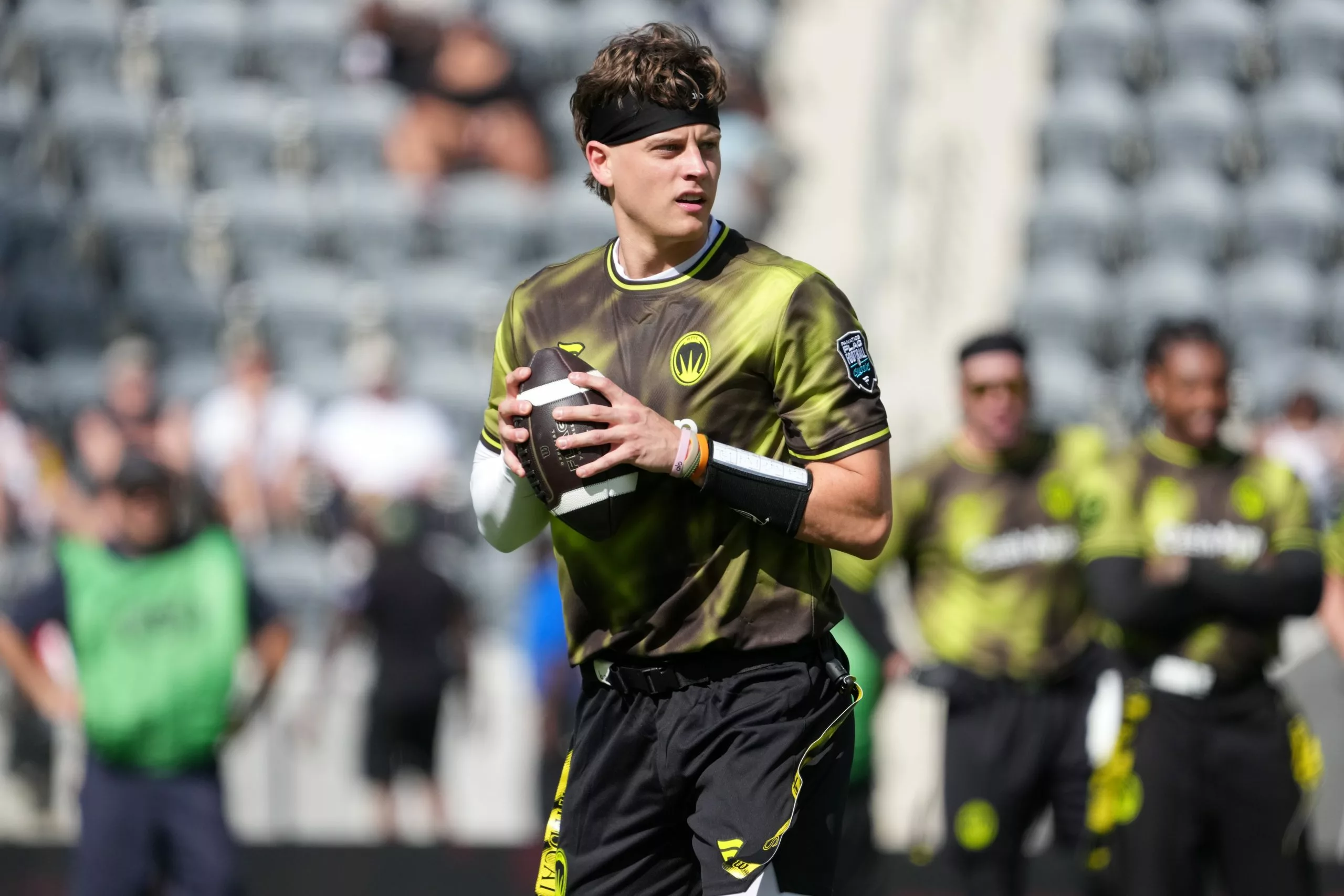
Mar 21, 2026; Los Angeles, CA, USA; Wildcats FFC quarterback Joe Burrow throws the ball during the Fanatics Flag Football Classic at BMO stadium. Mandatory Credit: Kirby Lee-Imagn Images
The NFL wanted the Fanatics Flag Football Classic to feel like a preview of the future. Instead, it felt like a reality check.
Because once the games actually started in Los Angeles, one thing became hard to ignore. The players most fans recognize weren’t close to the best players on the field.
Team USA didn’t just win, they exposed the gap
This wasn’t competitive. It wasn’t even close for long stretches.
Team USA went 3-0 and outscored the NFL-led teams 106-44 across the event. They scored on 14 of 15 possessions. Darrell “Housh” Doucette accounted for six touchdowns and walked away with MVP. The names on the other side didn’t matter.
Tom Brady threw touchdowns.
Joe Burrow, Jalen Hurts, and Jayden Daniels all had their moments. Odell Beckham Jr. made a one-handed catch that looked like it belonged in his prime. None of it changed the outcome.
The difference showed up immediately and stayed there.
Flag football isn’t a smaller version of the NFL game. The field is 50 yards long. There’s no blocking. Everything happens faster, tighter, and with less space to recover. Route timing, spacing, and instincts take over. Straight-line speed and size don’t carry the same weight.
Team USA lives in that environment. The NFL players did not know what they were doing.
Doucette said it after the game, and he didn’t sugarcoat it. The NFL group didn’t really know what they were walking into. That wasn’t trash talk. It was obvious.
Even Brady, who still looked sharp at 48, acknowledged what’s coming. He stressed that there will be a selection process for the Olympic team and that the best players should be the ones on the field.
Based on what played out in Los Angeles, that answer is uncomfortable for the NFL.
If the Olympics pick stars over specialists, it won’t land right
This is where the potential problem starts. The NFL wants its players involved. That part is obvious. The league has pushed flag football globally and sees the Olympics as a major stage to grow the game.
But what exactly are they trying to showcase?
If the Olympics are about winning, the professional flag players should be there. If it’s about attention, then the NFL names take over. Right now, those two paths don’t line up.
Team USA isn’t just a group of random players. They’ve won six IFAF World Championships. They understand the spacing, the angles, and the pace of a game that doesn’t look anything like what NFL players are used to.
That showed up on every possession in Los Angeles.
At the same time, it’s hard to picture an Olympic event built around players most casual fans don’t know. The league isn’t going to ignore that. Star power drives interest, and the NFL has more of it than anyone.
That’s where this gets tricky.
If the NFL leans too far into sending its own players, it risks putting a worse product on the field. The Fanatics event already hinted at that. Talent alone didn’t close the gap. It barely dented it.
If they go the other way and lean fully into
Team USA, the event might feel disconnected from the audience the NFL is trying to attract. There isn’t an easy middle ground.
The Fanatics event was supposed to build excitement. It did that. But it also made the decision before the NFL much more complicated. Because now there’s proof.
The best football players in the world aren’t automatically the best flag football players. And if the Olympics get that wrong, people will notice right away. Also, the 2028 Olympics take place very close to when NFL training camps open around the league. There has been no explanation on how the NFL would navigate that obvious schedule conflict.
The NFL wanted this to feel like an audition.
Instead, it turned into a reminder that they may not control the outcome as much as they thought.
Up To $1500 in Bonus Bets Paid Back if your First Bet Does Not Win
T&Cs apply
4.5/5
Gambling problem? Call 1-800-GAMBLER or 1-800-MY-RESET (Available in the US) 877-8-HOPENY or text HOPENY (467369) (NY) 1-800-327-5050 (MA), 1-800-BETS-OFF (IA), 1-800-981-0023 (PR). 21+ only. Please Gamble Responsibly. See BetMGM.com for Terms. First Bet Offer for new customers only (if applicable). Subject to eligibility requirements. Bonus bets are non-withdrawable. In partnership with Kansas Crossing Casino and Hotel. Promotional offers not available in Mississippi, Massachusetts, New York, Ontario, or Puerto Rico.
New DraftKings Customers: Spend $5+ Get $150 in Bonuses
T&Cs apply
4.5/5
GAMBLING PROBLEM? CALL 1-800-GAMBLER or 1-800-MY-RESET, (800) 327-5050 or visit gamblinghelplinema.org (MA). Please Gamble Responsibly. 888-789-7777/visit ccpg.org (CT), or visit www.mdgamblinghelp.org (MD), 1-800-981-0023 (PR). 21+ and present in most states. (18+ DC/NH/PR/WY). Void in CAN. Eligibility restrictions apply. On behalf of Boot Hill Casino (KS). Pass-thru of per wager tax may apply in IL. 1 per new DraftKings customer. $5+ first-time bet req. Max. $150 issued as non-withdrawable Bonus Bets. Stake removed from payout. Reward issued as $50 in Bonus Bets every 7 days via click-to-claim for 14 days. Bonus Bets and click-to-claims expire 7 days (168hrs) after issuance. Terms: sportsbook.draftkings.com/promos. Ends 10/11/26 at 11:59 PM ET. Sponsored by DK.
Must be 21+. GAMBLING PROBLEM? CALL 1-800-GAMBLER OR CALL 1-800-MY-RESET, www.mdgamblinghelp.org (MD), (800)-327-5050 or gamblinghelplinema.org (MA), Call (877)8-HOPENY or text HOPENY (467369) (NY), (888) 789-7777 or ccpg.org (CT), morethanagame.nc.gov (NC), 1800gambler.net (WV)
Bet $1 and get double the winnings up to $25 for your next 10 bets
T&Cs apply
4.4/5
21+ New users only. Must register using eligible promo code. First bet after registration must qualify. Max. Bonus Bet: $1,000. Bonus Bet expires 14 days after receipt. Void where prohibited. See Caesars.com/promos for full terms. Gambling Problem? 1-800-GAMBLER (1-800-426-2537)
21+ and present in OH. Gambling Problem? Call 1-800-GAMBLER.
This site is using
Cloudflare
and adheres to the
Google Safe Browsing Program. We adapted
Google's Privacy Guidelines
to keep your data safe at all times.
Close
Ready to Win Big? Join the Elite with Our Sports Betting Deals!
FanDuel Promo
New Users – Get $250 in Bonus Bets when you wager $5 for 5 days
Up To $1500 in Bonus Bets Paid Back if your First Bet Does Not Win
Best Slots
T&Cs and 21+ apply
Gambling problem? Call 1-800-GAMBLER or 1-800-MY-RESET (Available in the US) 877-8-HOPENY or text HOPENY (467369) (NY) 1-800-327-5050 (MA), 1-800-BETS-OFF (IA), 1-800-981-0023 (PR). 21+ only. Please Gamble Responsibly. See BetMGM.com for Terms. First Bet Offer for new customers only (if applicable). Subject to eligibility requirements. Bonus bets are non-withdrawable. In partnership with Kansas Crossing Casino and Hotel. Promotional offers not available in Mississippi, Massachusetts, New York, Ontario, or Puerto Rico.
Code:
Open BetMGM
Get Bonus
DraftKings Promo
New DraftKings Customers: Spend $5+ Get $150 in Bonuses
Newcomer
T&Cs and 21+ apply
GAMBLING PROBLEM? CALL 1-800-GAMBLER or 1-800-MY-RESET, (800) 327-5050 or visit gamblinghelplinema.org (MA). Please Gamble Responsibly. 888-789-7777/visit ccpg.org (CT), or visit www.mdgamblinghelp.org (MD), 1-800-981-0023 (PR). 21+ and present in most states. (18+ DC/NH/PR/WY). Void in CAN. Eligibility restrictions apply. On behalf of Boot Hill Casino (KS). Pass-thru of per wager tax may apply in IL. 1 per new DraftKings customer. $5+ first-time bet req. Max. $150 issued as non-withdrawable Bonus Bets. Stake removed from payout. Reward issued as $50 in Bonus Bets every 7 days via click-to-claim for 14 days. Bonus Bets and click-to-claims expire 7 days (168hrs) after issuance. Terms: sportsbook.draftkings.com/promos. Ends 10/11/26 at 11:59 PM ET. Sponsored by DK.
Code:
Open DraftKings
Get Bonus
Find out what the legends have to say about sports this week....