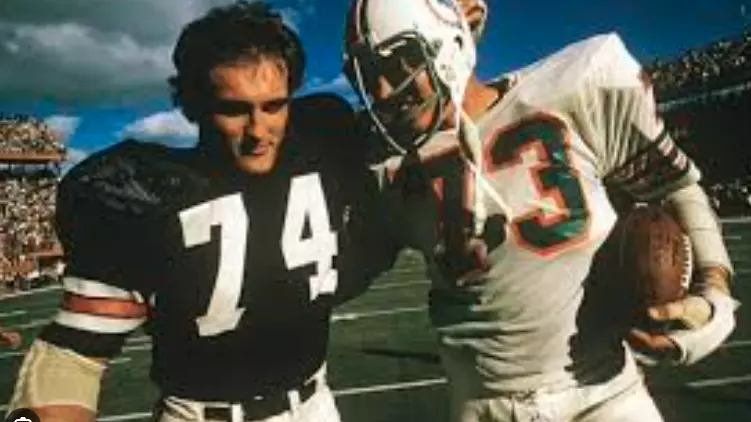
Michael Barry Reid was born on May 24, 1947, in Altoona, Pennsylvania, a region known for its steel mills, coal towns, and love of football. Like many young men growing up in western Pennsylvania, Reid was drawn to the gridiron, but he was equally drawn to academics and music. He was a disciplined student, an accomplished pianist, and a standout athlete — an unusual combination that foreshadowed his remarkable dual career.
At Altoona High School, Reid excelled in football, earning statewide attention for his dominance on the defensive line. His ability to combine raw strength with unusual quickness for a big man made him one of the top recruits in the country. That talent earned him a scholarship to
Penn State University, where he would make his first national mark.
Penn State Dominance and National Recognition
Reid became the backbone of Joe Paterno’s Nittany Lions defense in the late 1960s, a golden era for Penn State football. Playing defensive tackle, Reid was a disruptive force who routinely blew up plays before they developed. Coaches marveled at his intelligence, his conditioning, and his ability to play both the run and pass with equal effectiveness.
His career reached its peak in 1969:
Outland Trophy (1969):
Reid was named the nation’s top interior lineman, joining the ranks of legends who defined the line of scrimmage.
Consensus All-American:
Voted one of the best players in the nation, solidifying his reputation as an unstoppable force.
Heisman Trophy Candidate:
In an era when defensive linemen almost never received Heisman recognition, Reid finished fifth in the voting, ahead of several high-profile offensive stars.
Penn State finished the 1969 season undefeated, and Reid left as one of the greatest players in school history. His dominance made him a lock as a first-round NFL pick.
Cincinnati Bengals Career (1970–1974)
The
Cincinnati Bengals,
a young franchise under Paul Brown, drafted Reid with the 7th overall pick in the 1970 NFL Draft. He stepped immediately into a starting role on the defensive line, quickly proving he was NFL-ready.
Rookie Impact
In his rookie season, Reid helped the Bengals achieve their first-ever playoff berth. His presence on the defensive front gave Cincinnati legitimacy in only their third year in the NFL.
Prime Years
By his second season, Reid was considered one of the best defensive tackles in the league. He earned back-to-back Pro Bowl selections in 1972 and 1973, with First-Team All-Pro
honors in 1972.
Reid’s style of play was cerebral and technical. While many defensive linemen relied solely on brute force, Reid combined strength with anticipation, film study, and technique. He often beat double-teams, pressured quarterbacks into mistakes, and clogged running lanes.
Reputation Among Peers
Teammates and opponents alike respected Reid. Bengals linebacker Bill Bergey once noted that Reid’s quickness off the ball was “as good as any defensive lineman I’ve ever seen.” Coaches praised his discipline, his leadership, and his consistency — traits that made him a cornerstone of Cincinnati’s defense.
Sudden Retirement
Despite being at the height of his powers, Reid shocked the football world by retiring after the 1974 season. At just 26 years old, and with what many believed to be several Pro Bowl seasons still ahead, he walked away to pursue his other lifelong passion: music.
Transition to Music: A Second Life in Nashville
Even during his Bengals career, Reid was never far from a piano. He often spent evenings composing songs, and teammates sometimes joked that while they went out to celebrate after games, Reid went home to write music.
After retiring, he moved to Nashville, Tennessee, the heart of country music, and began working his way into the songwriting community. Though many athletes struggle to reinvent themselves after sports, Reid quickly proved he was just as gifted in music as he had been in football.
Songwriting Success
Reid wrote or co-wrote a string of hits through the 1980s and 1990s, becoming one of the most respected songwriters in country music. His credits include:
“Stranger in My House”
(Ronnie Milsap) – A Grammy-winning hit that showcased Reid’s gift for combining powerful lyrics with memorable melodies.
“Inside”
(Ronnie Milsap) – Another Milsap classic, reaching No. 1 on the charts.
“’Til You Love Me”
(Reba McEntire) – A top hit that cemented his place as a go-to songwriter for Nashville’s biggest stars.
“Forever’s As Far As I’ll Go”
(Alabama) – A romantic ballad that became one of the group’s most iconic songs.
Solo Career
Reid didn’t just write songs for others — he also performed his own. In 1990, he released
“Walk on Faith”, which hit No. 1 on the Billboard Hot Country Singles chart. The success proved Reid was more than just a behind-the-scenes talent.
Beyond Country Music
Reid’s musical curiosity didn’t stop with country. He ventured into classical and theatrical composition, even writing operas. His versatility demonstrated that his artistic mind was as broad as his athletic talent had once been.
Personal Life and Character
Reid has long been described as humble, thoughtful, and intelligent. Unlike many athletes, he didn’t crave the spotlight. Both in football and music, he let his work speak for itself.
Friends and colleagues often noted that Reid never defined himself by a single career. Football was a chapter, music another. Together, they told the story of a man who refused to be limited by labels.
Legacy: A Rare Dual Greatness
Mike Reid is part of a very rare fraternity: athletes who reached the highest level of professional sports and then reinvented themselves with equal success in another demanding field.
In Football:
He played only five seasons, but in that short time became a Pro Bowler, an All-Pro, and one of the Bengals’ foundational stars of the 1970s. Many believe that if he had played longer, he would be a strong candidate for the Pro Football Hall of Fame.
In Music:
Reid became a Grammy winner, a No. 1 hitmaker, and a respected figure in Nashville’s competitive music scene. His songs continue to be performed and recorded decades later.
Conclusion: A Life Beyond the Field
Mike Reid’s life story is a testament to following passion and having the courage to pivot, even when the world expects otherwise. At 26, he walked away from
NFL stardom
— not because he couldn’t play, but because he wanted something more. And he found it.
In the end, Reid’s legacy spans two worlds: the roar of the crowd in an NFL stadium and the quiet resonance of a country ballad. Few men have lived such a story, and fewer still have succeeded so completely in both.
Up To $1500 in Bonus Bets Paid Back if your First Bet Does Not Win
T&Cs apply
4.5/5
Gambling problem? Call 1-800-GAMBLER or 1-800-MY-RESET (Available in the US) 877-8-HOPENY or text HOPENY (467369) (NY) 1-800-327-5050 (MA), 1-800-BETS-OFF (IA), 1-800-981-0023 (PR). 21+ only. Please Gamble Responsibly. See BetMGM.com for Terms. First Bet Offer for new customers only (if applicable). Subject to eligibility requirements. Bonus bets are non-withdrawable. In partnership with Kansas Crossing Casino and Hotel. Promotional offers not available in Mississippi, Massachusetts, New York, Ontario, or Puerto Rico.
New DraftKings Customers: Spend $5+ Get $150 in Bonuses
T&Cs apply
4.5/5
GAMBLING PROBLEM? CALL 1-800-GAMBLER or 1-800-MY-RESET, (800) 327-5050 or visit gamblinghelplinema.org (MA). Please Gamble Responsibly. 888-789-7777/visit ccpg.org (CT), or visit www.mdgamblinghelp.org (MD), 1-800-981-0023 (PR). 21+ and present in most states. (18+ DC/NH/PR/WY). Void in CAN. Eligibility restrictions apply. On behalf of Boot Hill Casino (KS). Pass-thru of per wager tax may apply in IL. 1 per new DraftKings customer. $5+ first-time bet req. Max. $150 issued as non-withdrawable Bonus Bets. Stake removed from payout. Reward issued as $50 in Bonus Bets every 7 days via click-to-claim for 14 days. Bonus Bets and click-to-claims expire 7 days (168hrs) after issuance. Terms: sportsbook.draftkings.com/promos. Ends 10/11/26 at 11:59 PM ET. Sponsored by DK.
Must be 21+. GAMBLING PROBLEM? CALL 1-800-GAMBLER OR CALL 1-800-MY-RESET, www.mdgamblinghelp.org (MD), (800)-327-5050 or gamblinghelplinema.org (MA), Call (877)8-HOPENY or text HOPENY (467369) (NY), (888) 789-7777 or ccpg.org (CT), morethanagame.nc.gov (NC), 1800gambler.net (WV)
Bet $1 and get double the winnings up to $25 for your next 10 bets
T&Cs apply
4.4/5
21+ New users only. Must register using eligible promo code. First bet after registration must qualify. Max. Bonus Bet: $1,000. Bonus Bet expires 14 days after receipt. Void where prohibited. See Caesars.com/promos for full terms. Gambling Problem? 1-800-GAMBLER (1-800-426-2537)
21+ and present in OH. Gambling Problem? Call 1-800-GAMBLER.
This site is using
Cloudflare
and adheres to the
Google Safe Browsing Program. We adapted
Google's Privacy Guidelines
to keep your data safe at all times.
Close
Ready to Win Big? Join the Elite with Our Sports Betting Deals!
FanDuel Promo
New Users – Get $250 in Bonus Bets when you wager $5 for 5 days
Up To $1500 in Bonus Bets Paid Back if your First Bet Does Not Win
Best Slots
T&Cs and 21+ apply
Gambling problem? Call 1-800-GAMBLER or 1-800-MY-RESET (Available in the US) 877-8-HOPENY or text HOPENY (467369) (NY) 1-800-327-5050 (MA), 1-800-BETS-OFF (IA), 1-800-981-0023 (PR). 21+ only. Please Gamble Responsibly. See BetMGM.com for Terms. First Bet Offer for new customers only (if applicable). Subject to eligibility requirements. Bonus bets are non-withdrawable. In partnership with Kansas Crossing Casino and Hotel. Promotional offers not available in Mississippi, Massachusetts, New York, Ontario, or Puerto Rico.
Code:
Open BetMGM
Get Bonus
DraftKings Promo
New DraftKings Customers: Spend $5+ Get $150 in Bonuses
Newcomer
T&Cs and 21+ apply
GAMBLING PROBLEM? CALL 1-800-GAMBLER or 1-800-MY-RESET, (800) 327-5050 or visit gamblinghelplinema.org (MA). Please Gamble Responsibly. 888-789-7777/visit ccpg.org (CT), or visit www.mdgamblinghelp.org (MD), 1-800-981-0023 (PR). 21+ and present in most states. (18+ DC/NH/PR/WY). Void in CAN. Eligibility restrictions apply. On behalf of Boot Hill Casino (KS). Pass-thru of per wager tax may apply in IL. 1 per new DraftKings customer. $5+ first-time bet req. Max. $150 issued as non-withdrawable Bonus Bets. Stake removed from payout. Reward issued as $50 in Bonus Bets every 7 days via click-to-claim for 14 days. Bonus Bets and click-to-claims expire 7 days (168hrs) after issuance. Terms: sportsbook.draftkings.com/promos. Ends 10/11/26 at 11:59 PM ET. Sponsored by DK.
Code:
Open DraftKings
Get Bonus
Find out what the legends have to say about sports this week....